


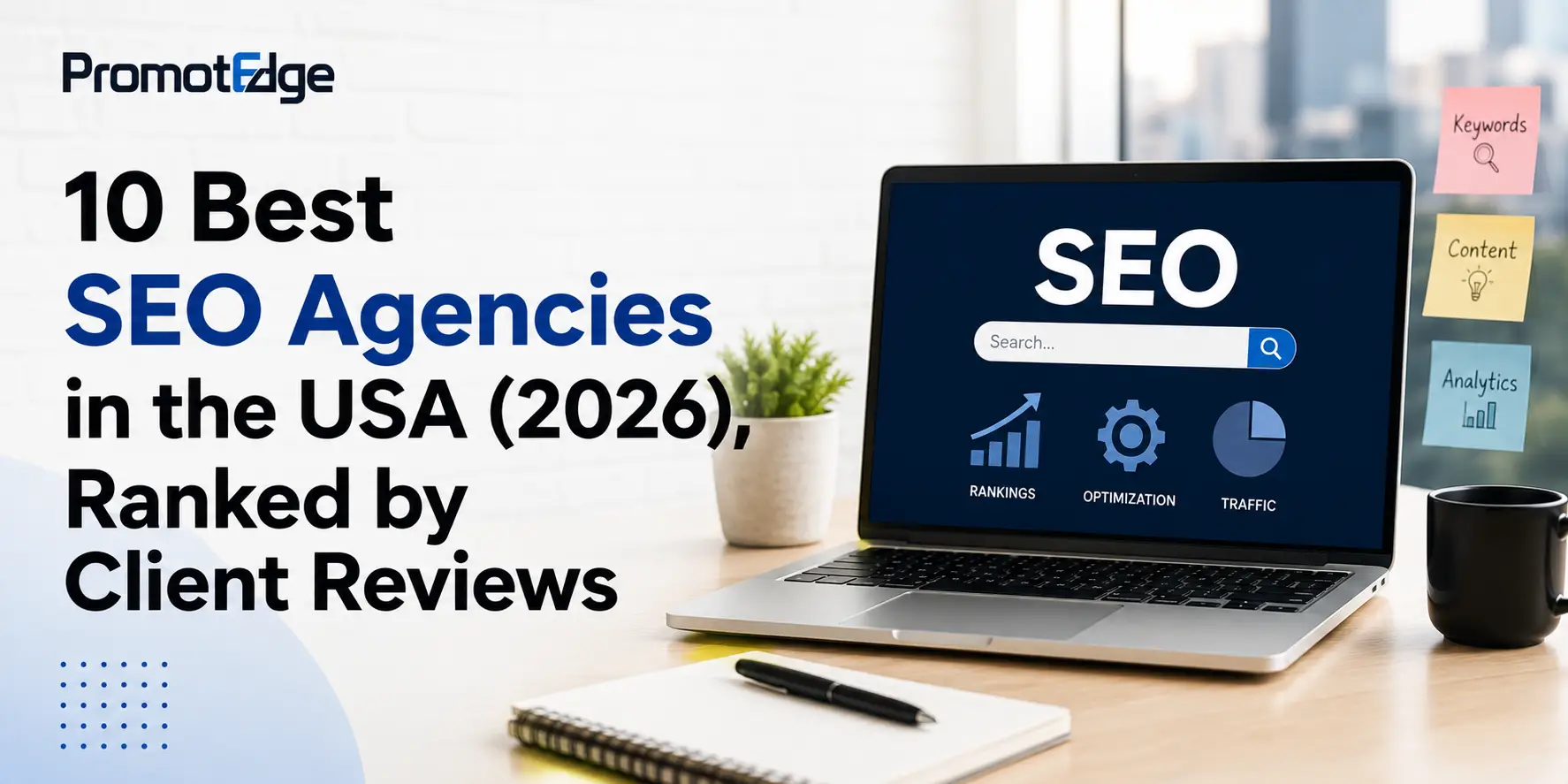
Top E-commerce SEO Agencies USA: Shopify & WooCommerce

-
Author
Anindita Barik
-
Updated Date
Oct-03-2026
-
Views
2 Min Read
-
Author: PromotEdge Digital
-
Updated Date: Oct-03-2026
-
Views: 2 Min Read
-
Author: Anindita Barik
Looking for the best e-commerce SEO agency in the USA? This guide compares top Shopify and WooCommerce SEO agencies based on platform expertise, technical SEO capabilities, reporting, and service models. Learn the differences between Shopify and WooCommerce SEO, discover how to evaluate agencies, identify red flags to avoid, and choose a partner that can improve organic rankings, traffic, conversions, and long-term revenue while preparing your store for AI-driven search.
Picking an e-commerce SEO agency is different from choosing a general SEO agency. Online stores have unique SEO challenges, including product pages, category pages, faceted navigation, inventory changes, and platform-specific technical requirements. Shopify and WooCommerce also work differently from an SEO perspective, which is why platform experience matters.
An e-commerce SEO agency helps online stores improve rankings, attract qualified traffic, and increase organic sales. Their work focuses on product pages, category pages, site structure, technical SEO, and overall store performance. The strongest agencies usually specialize in platforms such as Shopify and WooCommerce because each platform comes with its own SEO limitations and opportunities.
According to a study by Reboot Online , organic search drives 43% of all e-commerce traffic and contributes 23.6% of online orders. For many online stores, it remains the largest source of customer acquisition and revenue.
This guide covers the top e-commerce SEO agencies for Shopify and WooCommerce stores in the USA, explains why platform expertise matters, and outlines how to evaluate an agency before making a decision.
How We Evaluated the Best E-commerce SEO Agencies
Many “best agency” lists are based on client logos, awards, or review-site ratings. While those factors can be helpful, they do not reveal how well an agency can handle the SEO challenges of an e-commerce store. To make this list more practical, we focused on four key evaluation criteria:
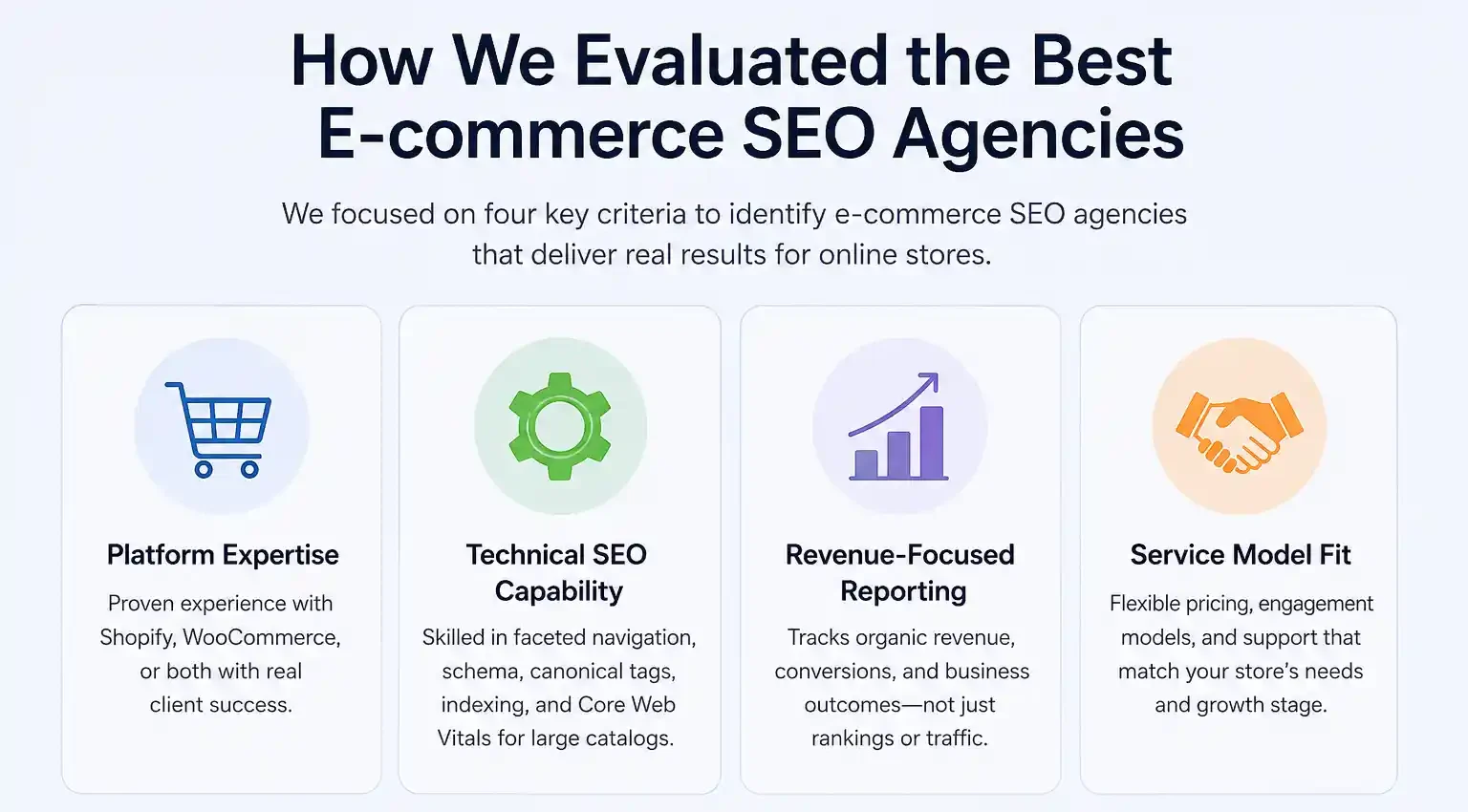
- Platform expertise — Demonstrated experience with Shopify, WooCommerce, or both, backed by real client work and platform-specific knowledge.
- Technical SEO capability — Ability to manage faceted navigation, canonical tags, product schema, indexing issues, and Core Web Vitals across large product catalogs.
- Revenue-focused reporting — Clear measurement of organic revenue, conversions, and business outcomes rather than rankings and traffic alone.
- Service model fit — A pricing structure, engagement model, and level of support that aligns with the needs and growth stage of the store.
If you’re evaluating SEO agencies more broadly before narrowing to e-commerce specialists, our complete guide to the best SEO agencies in the USA covers the full vetting process across every specialty.
Shopify SEO vs. WooCommerce SEO: Why Platform Fit Changes Your Shortlist
Shopify and WooCommerce may both power e-commerce stores, but they require different SEO approaches. Shopify is a hosted platform with predefined structures, platform limitations, and an app-based ecosystem. WooCommerce, on the other hand, runs on WordPress and offers greater flexibility, but store owners are responsible for hosting, site performance, security, and technical management.
According to data compiled by Mobiloud from BuiltWith and StoreLeads, Shopify and WooCommerce together power more than half of all identifiable online stores. Despite this, many agencies apply the same SEO strategy to both platforms. In practice, platform-specific SEO challenges differ considerably, which is why experience with the platform you use matters.
Here are some of the key areas where Shopify and WooCommerce SEO requirements diverge:
| Factor | Shopify | WooCommerce |
|---|---|---|
| Hosting & Speed Control | Fully managed; Core Web Vitals depend on theme code and app load. | Self-hosted via WordPress; speed depends entirely on your host and plugin stack. |
| URL Structure | Fixed /products/ and /collections/ paths, limited flexibility. |
Fully customizable permalinks and taxonomy structure. |
| Bloat Risk | App-driven — each app injects scripts that slow page load. | Plugin-driven — same risk, but more granular control to remove or replace. |
| Canonicalization | Handled natively but can duplicate via collection filtering. | Requires manual configuration via Yoast, Rank Math, or similar. |
| Content & Blogging | Native blog is functional but limited for content-led SEO. | Full WordPress CMS — stronger fit for content-heavy SEO strategies. |
| Migration Risk | Locked ecosystem makes platform switches harder to plan around. | Easier to migrate within WordPress, harder to migrate off it cleanly. |
This is a gap that most agency roundups skip entirely. An agency that is excellent at Shopify migration SEO may have little or no experience working within a WordPress development environment, and vice versa. Platform expertise matters because the technical requirements are not the same.
If your store runs on WooCommerce, hosting and page speed deserve specific attention. Our WordPress speed optimization checklist covers the Core Web Vitals fixes that matter most for WordPress-based stores.
The Top E-commerce SEO Agencies in the USA [2026]
The agencies featured below were selected based on proven Shopify and WooCommerce expertise, technical SEO capabilities, and a demonstrated track record of helping US-based e-commerce businesses grow organic traffic, visibility, and revenue.
| Best For | Brands that want website development, SEO, and digital marketing managed by a single team |
| Platforms | Shopify, WordPress / WooCommerce |
| Client Size | Startups, growth-stage businesses, and enterprise brands |
| Speciality | Custom Shopify B2C stores, headless storefronts, combined dev + SEO execution |
| Services | E-commerce web design, SEO, content marketing, performance marketing |
| Style | Full-service, in-house dev + SEO |
PromotEdge Digital handles both e-commerce website development and SEO under one roof, so there’s no back-and-forth between different teams. From site architecture and Core Web Vitals to search strategy, everything is planned together from the start.
The team works across Shopify B2C platform, headless commerce solutions, and the complete WordPress/WooCommerce ecosystem. Performance reporting is focused on business outcomes, connecting SEO efforts to traffic, conversions, and revenue growth.
This integrated approach helps identify and resolve SEO concerns during development itself, reducing the risk of costly technical issues that often require significant fixes after launch.
Watch-out: If your requirement is limited to a one-time technical SEO audit or a highly specialized project, a smaller specialist agency may offer a more focused engagement model.
2. OuterBox
| Best For | Mid-market and larger e-commerce brands with complex, high-volume product catalogs |
| Platforms | Shopify, Shopify Plus, WooCommerce, Magento, BigCommerce |
| Client Size | Mid-market to enterprise |
| Speciality | Catalog-scale SEO, faceted navigation, automotive, industrial, and home goods verticals |
| Services | Catalog SEO, technical implementation, conversion rate optimization, analytics |
| Style | Full-service, mid-market to enterprise |
OuterBox has more than two decades of experience managing SEO for large and complex e-commerce websites. Its work across industries such as automotive, industrial manufacturing, and home goods reflects deep sector expertise rather than a generalized approach to e-commerce marketing.
The agency combines SEO, conversion rate optimization (CRO), and analytics within a unified strategy. This allows performance insights, user behavior data, and search visibility efforts to work together instead of being managed as separate initiatives.
Its experience with Shopify Plus is particularly relevant for enterprise brands. Requirements such as custom scripts, multi-store management, and B2B e-commerce functionality require specialized platform knowledge that is typically gained through large-scale implementation experience.
Watch-out: Smaller e-commerce stores and some fashion or lifestyle brands may find OuterBox’s service model, team structure, and pricing more suitable for larger businesses with complex catalog and platform requirements.
3. Coalition Technologies
| Best For | Shopify and WooCommerce brands moving between platforms or scaling through organic + paid |
| Platforms | Shopify, WooCommerce |
| Client Size | Growth-stage to mid-market |
| Speciality | Platform migration SEO, redirect strategy, traffic retention during site changes |
| Services | SEO, PPC, migration strategy, indexing and technical audit |
| Style | SEO + PPC combined under a single growth strategy |
Coalition Technologies has extensive experience managing e-commerce platform migrations, where technical SEO mistakes can lead to ranking losses, traffic declines, and indexing issues. Its migration expertise is particularly valuable for brands moving between platforms while aiming to preserve existing search visibility.
The agency follows structured processes for URL mapping, redirect implementation, link equity preservation, and post-launch monitoring. This helps reduce common migration risks and supports a smoother transition from an SEO perspective.
Coalition Technologies also manages SEO and PPC as part of a coordinated strategy. This allows paid campaigns to help maintain traffic and visibility while organic performance stabilizes following a migration.
Watch-out: Businesses seeking only SEO services without paid media support may prefer an agency that focuses exclusively on organic search.
4. Inflow
| Best For | Online retailers that want an agency built specifically around e-commerce, not one where e-commerce is a vertical among many |
| Platforms | Shopify, WooCommerce, Magento, BigCommerce, Volusion |
| Client Size | Small to mid-market e-commerce brands |
| Speciality | Organic revenue growth, category and product page optimization, platform-specific technical SEO |
| Services | SEO strategy, technical SEO, content, conversion-focused page optimization |
| Style | SEO-focused specialist |
Inflow works exclusively with e-commerce brands, giving the agency deep experience in how online shoppers search, compare, and purchase products across different categories. Its strategies are built specifically for e-commerce growth rather than adapted from broader digital marketing campaigns.
The agency supports Shopify, WooCommerce, Magento, BigCommerce, and Volusion, allowing recommendations to be tailored to the technical requirements and opportunities of each platform.
Reporting is centered on organic revenue, conversions, and business performance rather than rankings alone. This helps brands evaluate SEO success based on sales impact rather than keyword positions in isolation.
Watch-out: Brands planning a complete platform rebuild or requiring extensive development support may find a larger agency with broader in-house development capabilities to be a better fit.
5. WebFX
| Best For | Businesses that want SEO, paid ads, CRO, and marketing automation managed from a single platform |
| Platforms | Shopify, WooCommerce, Magento, BigCommerce |
| Client Size | Mid-market to enterprise |
| Speciality | RevenueCloudFX proprietary reporting — connects all marketing channels to business outcomes |
| Services | SEO, PPC, CRO, content marketing, social media, marketing automation |
| Style | Full-service, large team, multi-channel |
WebFX provides SEO, PPC, CRO, content marketing, and marketing automation through a single team, helping businesses manage multiple growth channels without coordinating across several agencies.
Its RevenueCloudFX platform is designed to connect marketing performance with revenue outcomes, giving brands greater visibility into how organic search and other channels contribute to business growth.
The agency has the scale and resources to support large and complex accounts, making it a viable option for businesses that require broader execution capabilities. However, it is worth understanding who will manage the account day to day and the level of involvement senior strategists will have throughout the engagement.
Watch-out: Like many larger agencies, access to senior strategists may be less direct than with a boutique firm, so clarifying the account management structure upfront is recommended.
6. Thrive Internet Marketing Agency
| Best For | Mid-market e-commerce brands investing in both organic and paid acquisition channels simultaneously |
| Platforms | Shopify, WooCommerce, Magento, BigCommerce |
| Client Size | Mid-market, national brands |
| Speciality | Google Shopping and Performance Max alongside SEO — aligned organic and paid strategy |
| Services | SEO, Google Shopping, Performance Max, content marketing |
| Style | Full-service, mid-market |
Thrive works with mid-market and enterprise brands that run SEO and paid advertising together, helping ensure both channels support a unified growth strategy. Its client portfolio includes brands such as General Mills, Rocky Boots, and Atlas Oil, demonstrating experience with national-scale campaigns.
A key strength is the integration of SEO with Google Shopping and Performance Max. Areas such as product feed optimization, landing page relevance, and structured data influence both paid and organic performance, making coordination between channels particularly important for e-commerce businesses.
By aligning keyword research, audience insights, and campaign strategy across SEO and paid media, Thrive helps brands gain more value from both channels while reducing the inefficiencies that can occur when they are managed separately.
Watch-out: Businesses looking exclusively for organic SEO support may find a specialist SEO agency to be a more focused fit for their requirements.
7. SmartSites
| Best For | Shopify merchants who want technical SEO tied closely to measurable business growth |
| Platforms | Shopify |
| Client Size | Growth-stage e-commerce brands |
| Speciality | Technical SEO, content, link building — with visibility in AI-driven search experiences |
| Services | Technical SEO, content development, link building, performance marketing |
| Style | Performance marketing + SEO, fast-moving and execution-focused |
SmartSites has appeared on the Inc. 5000 list for multiple consecutive years, reflecting sustained business growth and a strong track record in digital marketing. Its performance marketing background shapes an SEO approach that prioritizes measurable business outcomes and long-term revenue growth.
The agency has also expanded its focus to include AI search optimization, helping brands adapt to evolving search experiences such as Google AI Overviews and other AI-driven search features. This can help businesses maintain visibility as search behavior continues to evolve.
With extensive Shopify experience, SmartSites understands many of the platform-specific factors that influence SEO performance. Areas such as Core Web Vitals, theme optimization, and app-related speed issues are addressed to help improve both search visibility and user experience.
Watch-out: Businesses that prefer a slower, highly consultative engagement style may find SmartSites’ growth-focused and execution-oriented approach more fast-paced than expected.
8. First Page Sage
| Best For | B2B and B2C e-commerce brands focused on durable organic growth and visibility in AI-driven search |
| Platforms | Multi-platform |
| Client Size | Mid-market to enterprise, brand-driven businesses |
| Speciality | Generative engine optimization (GEO) — earning citations in AI platforms like ChatGPT and Google AI Overviews |
| Services | SEO strategy, thought leadership content, GEO, long-form content programs |
| Style | Strategy-led, thought leadership focus |
First Page Sage has more than 15 years of experience in e-commerce SEO and has worked with brands such as Logitech, Wix, and Brooks Brothers. Its approach is centered on long-term authority building, helping businesses develop sustainable organic visibility rather than relying on short-term SEO tactics.
One of the agency’s key differentiators is its focus on Generative Engine Optimization (GEO). As AI-powered search experiences continue to expand, First Page Sage helps brands improve visibility across platforms such as ChatGPT and Google AI Overviews, where product research and discovery increasingly take place.
The agency follows a strategy-led model supported by research, content planning, and market analysis. Businesses with in-house development or marketing resources are generally well positioned to implement recommendations and maximize the impact of the engagement.
Watch-out: First Page Sage is best known for strategy, content planning, and long-term organic growth. Businesses that require extensive technical implementation or development support should discuss execution responsibilities before engagement.
At a Glance: How These Agencies Are Compared
| Agency | Best For | Platform Strength | Engagement Style |
|---|---|---|---|
| PromotEdge Digital | Combined web design + SEO under one team | Shopify, WordPress/WooCommerce | Full-service, SMB to enterprise |
| OuterBox | Large, technically complex catalogs | Shopify, Magento, WooCommerce, BigCommerce | Full-service, mid-market to enterprise |
| Coalition Technologies | Migration SEO + paid media | Shopify, WooCommerce | SEO + PPC combined |
| Inflow | E-commerce-only specialization | Shopify, WooCommerce, Magento, BigCommerce | SEO-focused specialist |
| WebFX | One vendor, full marketing stack | Shopify, WooCommerce, Magento, BigCommerce | Full-service, large team |
| Thrive | Organic + paid aligned for mid-market | Shopify, WooCommerce, Magento, BigCommerce | Full-service, mid-market |
| SmartSites | Fast-moving, ROI-driven growth | Shopify | Performance marketing + SEO |
| First Page Sage | Long-term organic growth + GEO | Multi-platform | Strategy-led, thought leadership |
How to Choose the Right E-commerce SEO Agency for Your Store
In our experience working with e-commerce clients on Shopify and WordPress builds, the stores that gain the most organic traction are the ones where SEO and platform decisions happen together from the start — not as two disconnected workstreams handed off between vendors.
Before signing with any agency, work through this checklist:
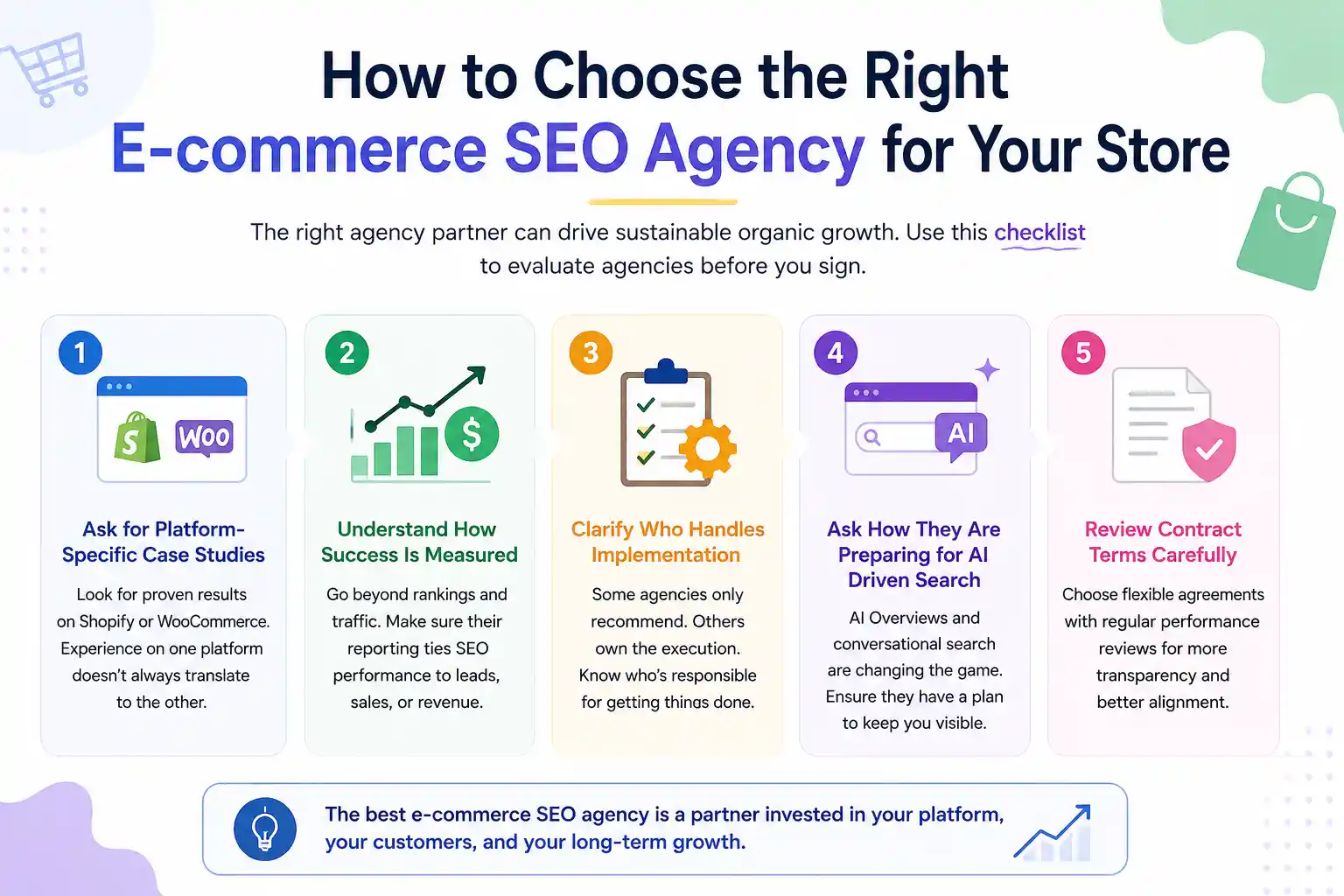
- Ask for platform-specific case studies, not just general e-commerce results. An agency that has delivered results for Shopify stores may not necessarily have the same experience with WooCommerce.
- Understand how success is measured. Look beyond rankings and traffic, and ask whether reporting connects SEO performance to leads, sales, or revenue.
- Clarify who handles implementation. Some agencies provide recommendations only, while others take responsibility for executing technical fixes and optimizations.
- Ask how they are preparing for AI-driven search. With AI Overviews and conversational search becoming more common, agencies should have a clear plan for maintaining visibility across new search experiences.
- Review contract terms carefully. Flexible agreements with regular performance reviews generally provide more transparency than long-term contracts with limited exit options.
Red Flags to Watch For
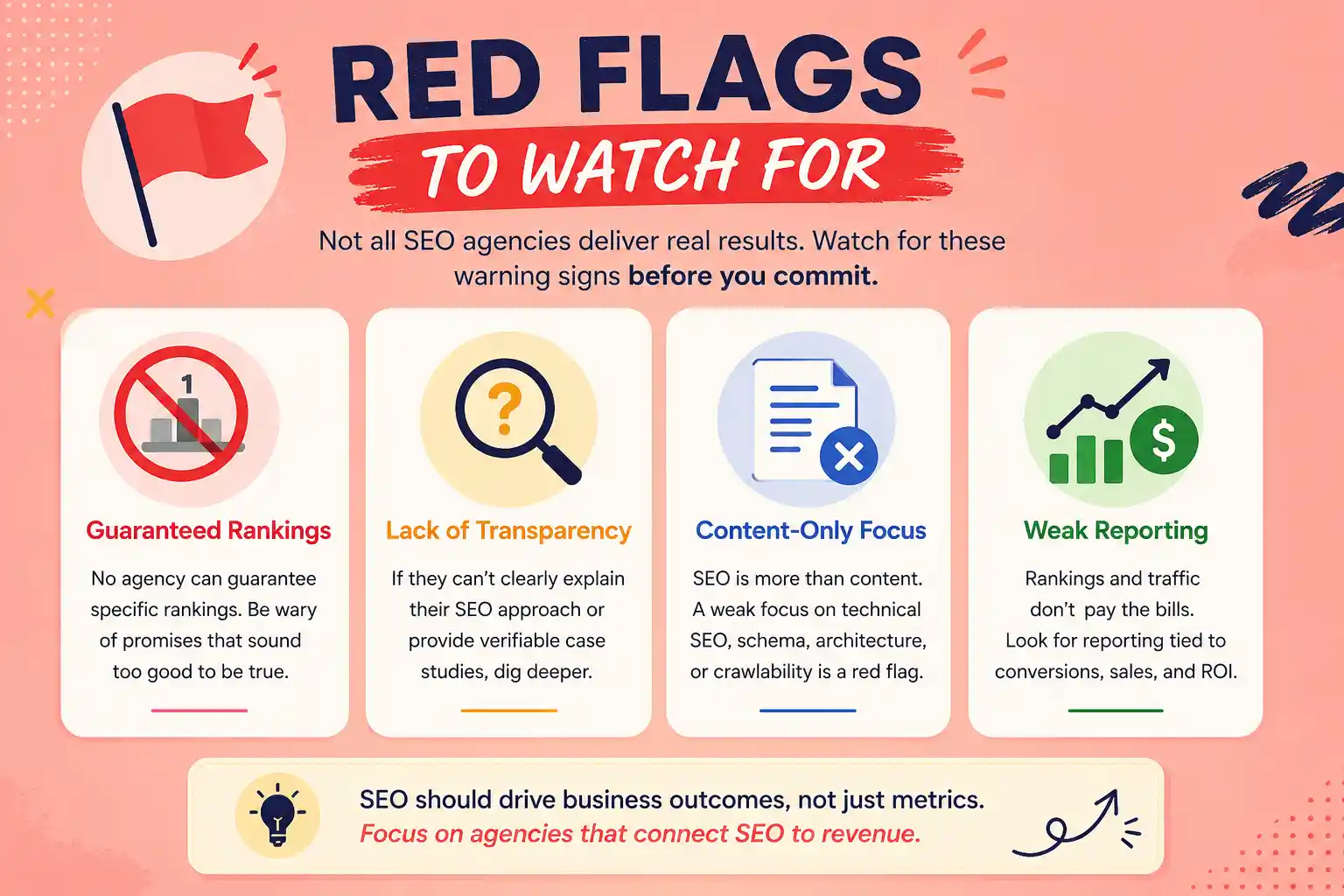
Be cautious of agencies that guarantee specific rankings, as no agency can control Google’s algorithm. Similarly, if an agency cannot clearly explain how it approaches SEO for your specific platform or relies on case studies that cannot be independently verified, it’s worth asking more questions before moving forward.
It’s also important to look beyond content promises. If a proposed SEO strategy focuses heavily on publishing content but says little about technical SEO, schema markup, site architecture, or crawlability, there is a good chance the agency has not fully evaluated the technical factors that influence e-commerce search performance.
Reporting deserves close attention as well. Rankings and traffic are useful metrics, but they don’t tell the full story. An experienced agency should be able to show how SEO efforts contribute to conversions, sales, and revenue.
Our guide on measuring digital marketing ROI is entirely based on the formula for tying organic SEO investment to actual business outcomes.
Final Thoughts
The right e-commerce SEO agency for your Shopify or WooCommerce store depends less on overall reputation and more on whether it understands your platform’s specific requirements and can connect SEO efforts to measurable business outcomes. Use the evaluation criteria and red flags outlined above to assess any agency on your shortlist and determine whether its approach aligns with your store’s growth goals.
If you’d like an expert second opinion on your store’s current SEO performance,request a free SEO audit from PromotEdge Digital to identify technical issues, growth opportunities, and areas that may be limiting your organic visibility and revenue potential.
FAQs
-
How much does e-commerce SEO cost for a Shopify or WooCommerce store?
Ans.Most US e-commerce SEO retainers range from $2,500 to $12,000+ per month, depending on catalog size, technical complexity, and the scope of services included. Smaller stores with under 500 SKUs usually sit at the lower end, while large catalogs with 10,000+ products and complex faceted navigation command higher fees due to the additional technical SEO work involved. -
Is Shopify or WooCommerce easier to rank in Google?
Ans.Neither platform has an inherent ranking advantage. Google evaluates content quality, technical performance, and authority—not the platform a store is built on. Shopify provides stronger SEO defaults out of the box, while WooCommerce offers greater flexibility for advanced customization. With the right SEO strategy, both platforms can achieve strong search visibility. -
How long does e-commerce SEO take to show results?
Ans.Most e-commerce SEO programs deliver measurable gains in rankings and organic traffic within 3 to 6 months, while substantial revenue impact usually develops over 6 to 12 months. The timeline can be longer for highly competitive niches or stores with extensive technical SEO issues that need to be resolved first.
Author Details

Latest Posts
-
 04 / Sep
-
 29 / Jul
Search Engine Optimization 6 Enterprise SEO Mistakes That Quietly Cost You Millions
29 / Jul
Search Engine Optimization 6 Enterprise SEO Mistakes That Quietly Cost You Millions -
 24 / Jul
-
 23 / Jul
Search Engine Optimization How to Improve Organic SEO: A Practical 2026 Guide
23 / Jul
Search Engine Optimization How to Improve Organic SEO: A Practical 2026 Guide -
21 / Jul
Search Engine Optimization Organic SEO vs Paid SEO: Which Is Better in 2026?

Blogs
Journey into Ideas Unveiling Tomorrow's Insights Today.



-
How much does e-commerce SEO cost for a Shopify or WooCommerce store?
Ans.Most US e-commerce SEO retainers range from $2,500 to $12,000+ per month, depending on catalog size, technical complexity, and the scope of services included. Smaller stores with under 500 SKUs usually sit at the lower end, while large catalogs with 10,000+ products and complex faceted navigation command higher fees due to the additional technical SEO work involved. -
Is Shopify or WooCommerce easier to rank in Google?
Ans.Neither platform has an inherent ranking advantage. Google evaluates content quality, technical performance, and authority—not the platform a store is built on. Shopify provides stronger SEO defaults out of the box, while WooCommerce offers greater flexibility for advanced customization. With the right SEO strategy, both platforms can achieve strong search visibility. -
How long does e-commerce SEO take to show results?
Ans.Most e-commerce SEO programs deliver measurable gains in rankings and organic traffic within 3 to 6 months, while substantial revenue impact usually develops over 6 to 12 months. The timeline can be longer for highly competitive niches or stores with extensive technical SEO issues that need to be resolved first.