


How to Get Your Business Cited in ChatGPT, Claude & AI Search

-
Author
Anindita Barik
-
Updated Date
Nov-02-2026
-
Views
2 Min Read
-
Author: PromotEdge Digital
-
Updated Date: Nov-02-2026
-
Views: 2 Min Read
-
Author: Anindita Barik
Learn how to get cited by ChatGPT, Claude, and other AI search platforms with effective Generative Engine Optimization (GEO) strategies. Discover how AI search engines find, evaluate, and cite business information, and explore practical ways to improve website accessibility, content quality, brand credibility, and online visibility. This guide covers crawler access, structured data, authoritative mentions, technical SEO, and AI visibility tracking. Follow a practical six-week action plan to strengthen your brand’s presence and improve its chances of appearing in AI-generated answers.
Nowadays, customers use ChatGPT, Claude and other AI search tools to find businesses, compare services and shortlist suppliers. Instead of opening ten websites, they can simply ask, “Which digital marketing agency should I hire?” or “Can you recommend a reliable industrial supplier?”
Now think about your own business. If someone asks AI tools for recommendations in your industry, will your brand appear in the answer?
If not, you could miss a potential customer before they even reach Google or visit your website.
This is where Generative Engine Optimization (GEO) helps make your website and business information easier for AI tools to find, understand and use when answering questions.
But how do these platforms decide which businesses to mention? Can you influence their recommendations? And what should you change on your website to improve your chances?
If you want to understand how to get cited by ChatGPT and other AI search tools, you first need to know how these platforms find, assess and select information.
Let’s break down the process and explore practical steps to improve your brand’s visibility across ChatGPT, Claude and other AI search platforms.
How to Get Cited by ChatGPT and Other AI Search Engines
If you want ChatGPT or Claude to mention your business, start by making your website easy to find, read and understand. These platforms need accurate information about your company, the services you offer and your industry experience before they can use it in their answers.
So, what can you do to improve your chances of getting cited?
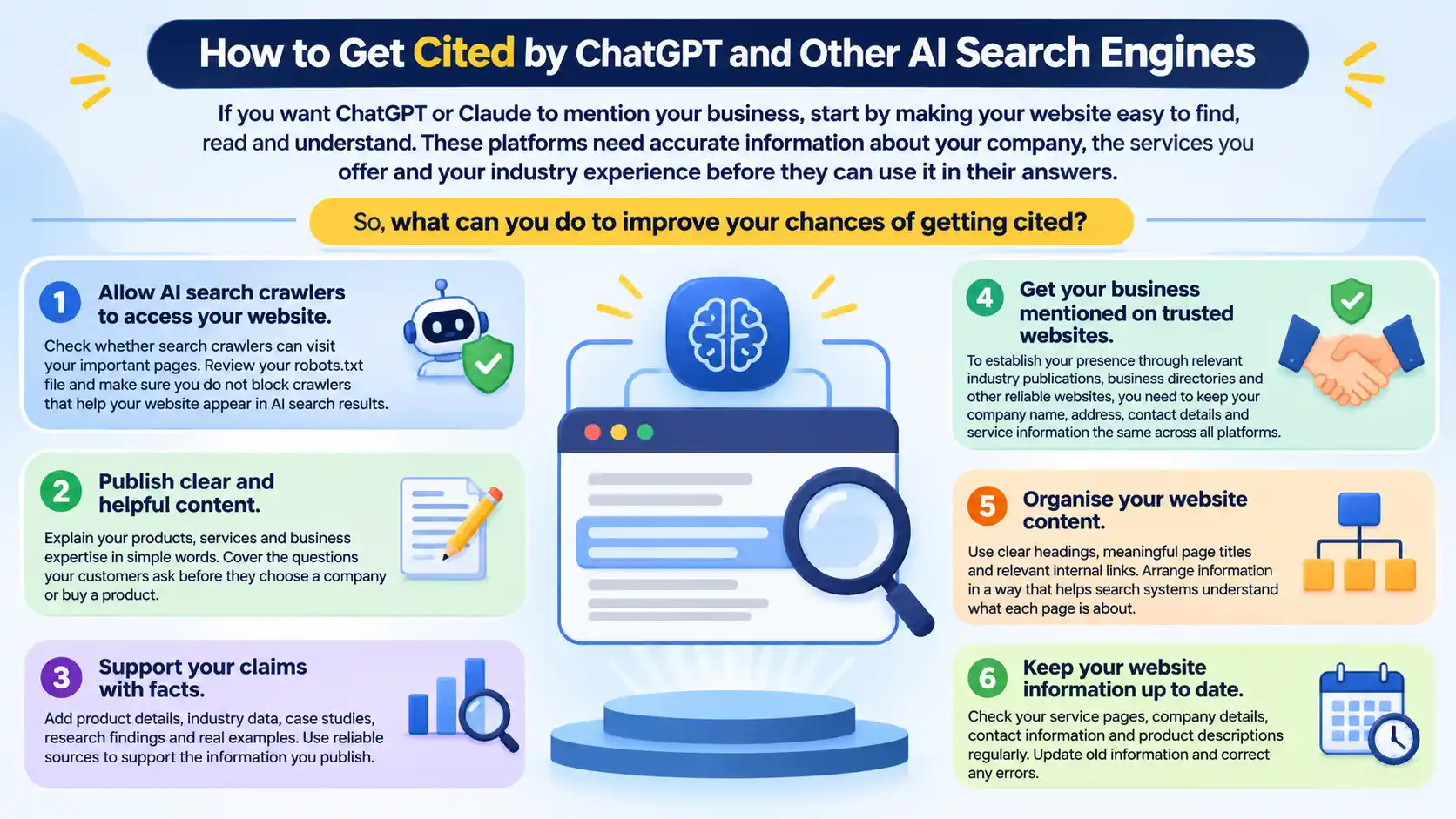
- Allow AI search crawlers to access your website. Check whether search crawlers can visit your important pages. Review your robots.txt file and make sure you do not block crawlers that help your website appear in AI search results.
- Publish clear and helpful content. Explain your products, services and business expertise in simple words. Cover the questions your customers ask before they choose a company or buy a product.
- Support your claims with facts. Add product details, industry data, case studies, research findings and real examples. Use reliable sources to support the information you publish.
- Get your business mentioned on trusted websites. To establish your presence through relevant industry publications, business directories and other reliable websites, you need to keep your company name, address, contact details and service information the same across all platforms.
- Organise your website content. Use clear headings, meaningful page titles and relevant internal links. Arrange information in a way that helps search systems understand what each page is about.
- Keep your website information up to date. Check your service pages, company details, contact information and product descriptions regularly. Update old information and correct any errors.
How AI Search Engines Find and Select Business Information
When someone asks ChatGPT or Claude to recommend a business, the platform needs to find relevant information before it can prepare an answer. It may search websites, retrieve information from relevant pages and compare different sources to decide which information best answers the user’s question.
Many AI search experiences use a method called Retrieval-Augmented Generation (RAG) to support this process. It allows an AI system to retrieve information from external sources and use it while generating an answer, rather than relying only on information learned during training.
The process generally involves four stages:
- Discovering sources: Finding websites, web pages and other sources that contain relevant information.
- Retrieving information: Collecting useful details from those sources.
- Assessing relevance: Checking how well the information matches the user’s question and whether it is useful.
- Generating an answer: Using the selected information to prepare a response, sometimes with links or citations to the original sources.
So, how does an AI search tool go from receiving a question to recommending a business or citing a website? Let’s look at each stage to understand how it works.
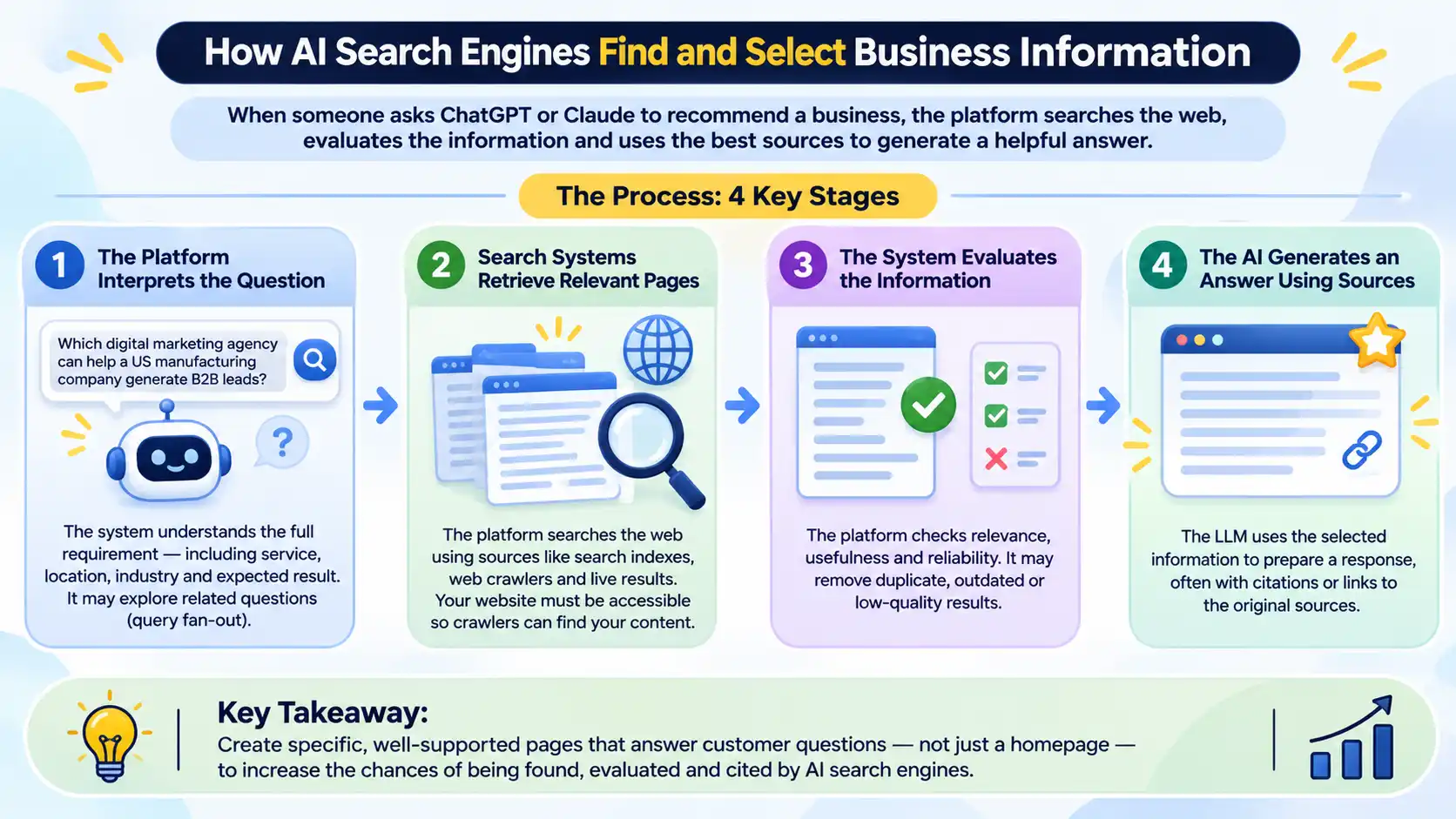
1. The platform interprets the user’s question
The process begins when a user enters a question or prompt. For example, someone might ask, “Which digital marketing agency can help a US manufacturing company generate qualified B2B leads?”
The platform needs to understand the full requirement, not just the words “digital marketing agency”. It looks at what service the user needs, the target location, the industry and the expected result.
To find a useful answer, the system may explore several related questions. It could look for agencies with B2B marketing experience, a track record with manufacturing clients, lead generation services and experience in the US market.
This process is known as query fan-out. In other words, the AI search tool breaks a broad question into smaller searches to gather information from different sources. It then uses the findings to prepare an answer..
2. Search systems retrieve relevant web pages
Once the platform understands the user’s question, it searches for web pages that may provide a useful answer. Depending on the query and the platform, it may use an existing search index, its own web crawlers, live search results or a mix of these sources.
This is where your website’s technical accessibility becomes important. Search systems must be able to discover and access your pages before they can use the information. If crawlers cannot reach your important service pages, product details or research articles, those pages may not appear in the information used to generate an AI answer.
OpenAI, for example, uses OAI-SearchBot to discover websites and surface their content in ChatGPT Search. GPTBot has a different purpose. It collects web content that may be used to train OpenAI’s foundation models. These two crawlers serve separate functions, so blocking GPTBot does not automatically prevent your website from appearing in ChatGPT Search. You need to manage access to each crawler separately.
Source: OpenAI’s official crawler documentation
3. The system evaluates the retrieved information
Finding a page does not mean the platform will cite it. The system must decide whether the information is relevant and useful for the question.
It may assess how closely a passage matches the user’s intent, whether the page provides enough context, how reliable the information appears and whether other sources support the same facts.
Search systems can also remove duplicate, outdated or low-quality results from the candidate set.
This is one reason a page that ranks well for a broad keyword may not appear in an AI-generated answer. A different page may provide a more precise answer to the specific question.
4. The AI generates an answer using selected sources
Once the system has shortlisted useful information, the LLM uses it to prepare a response. Depending on the platform, citations may appear beside individual claims or in a source list.
The model may use a focused passage from a service page, a technical guide, a comparison article or an independent review. It does not need to cite a website’s homepage simply because that page represents the business.
Just simply create pages that answer specific customer questions with accurate, well-supported information. Do not rely on your homepage or a single general company description to explain everything.
How ChatGPT, Claude and Google AI Search Differ
ChatGPT, Claude and Google AI Search use different methods to find information, select sources and present answers. Here is how they differ.
| Platform | How it finds information | What businesses should focus on |
|---|---|---|
| ChatGPT Search | Uses web search and OpenAI’s search crawlers to find relevant sources. | Allow OAI-SearchBot, publish accessible pages and support business claims with useful, credible information. |
| Claude | Uses web retrieval to find sources for answers and displays citations alongside its responses. |
Publish clear, current, well-sourced pages that answer specific questions and can be checked by readers. |
| Google AI Overviews | Uses Google’s Search systems and indexed web pages to generate AI summaries and links. |
Focus on SEO fundamentals, indexable pages, original content and accurate business information. |
Google does not require special AI files or a separate schema type for its AI search features. It uses its existing Search systems and eligibility requirements. ChatGPT Search, on the other hand, has a dedicated crawler setting. This means businesses need to follow the requirements of each platform rather than apply the same technical checklist everywhere.
Read Google’s guidance on AI features and your website and OpenAI’s crawler documentation.
What Makes a Website More Likely to Earn an AI Search Citation?
There is no guaranteed method to make ChatGPT or Claude cite a business. You can, however, improve the quality, accessibility and credibility of the information available to these systems. The following areas form a practical GEO strategy.
1. Make Sure AI Search Crawlers Can Access Your Website
Start with your robots.txt file. This file gives automated crawlers instructions about which parts of a website they may access. A rule that blocks a relevant search crawler can limit the platform’s ability to retrieve your content.
For ChatGPT Search, check whether OAI-SearchBot has access to the pages you want to appear in search results. OpenAI publishes its crawler documentation and IP information for site owners. If you use a content delivery network (CDN), web application firewall (WAF) or security plugin, check that it does not block verified crawler requests.
Keep training and search preferences separate. GPTBot relates to potential model training, while OAI-SearchBot relates to ChatGPT Search discovery. Review the purpose of each crawler before changing access rules.
Also check the basics: important pages should return a successful HTTP response, use a crawlable URL, avoid accidental noindex directives and appear in your XML sitemap where appropriate. Your technical SEO audit should cover these issues alongside normal search engine accessibility.
If your website has crawl, indexation or page-performance issues, review our technical SEO and site audit services before making content changes.
2. Write Pages That Answer One Clear Question
AI search systems need to identify what a page says and how that information relates to a user’s question. Clear page structure makes this easier for both search systems and human readers.
Begin each major section with a direct answer. Then explain the process, supporting details and any limitations. Avoid long introductions that delay the information a reader came to find.
For example, a page about industrial SEO services could open with a clear explanation of what the service covers, which businesses need it and what outcomes the strategy aims to improve. The rest of the section can explain keyword research, technical SEO, content planning and lead measurement.
Use descriptive H2 and H3 headings. Keep paragraphs focused, define technical terms and explain acronyms when they first appear. A comparison table can help when readers need to evaluate services, features or specifications. Use tables because they make comparisons easier to read, not because every AI system requires a particular table format.
3. Add Original Data, Evidence and Expert Insights
A page that repeats information available on dozens of other websites gives an AI search system little reason to select it over competing sources. Original information gives your content a stronger purpose.
Add data from your own projects, customer research, product testing, surveys or industry reports. Explain where the figures came from, when the research took place and what the numbers represent. If you quote an expert, identify the person and link to the original source where possible.
The Princeton-led study “GEO: Generative Engine Optimization”, published at ACM SIGKDD 2024, tested content changes across a benchmark of 10,000 queries. It found that adding statistics, quotations and source citations improved visibility in its experimental generative-engine setting. The reported gains varied by tactic and evaluation measure. These results are useful evidence, but they are not a promise of the same increase in live ChatGPT or Claude citations. Read the original Princeton-led GEO research paper for its methodology and reported results.
The takeaway is not to add numbers to every paragraph. It is to support important claims with evidence that readers can verify.
4. Build a Clear and Consistent Brand Identity Across the Web
AI systems need to understand which business a page describes. This becomes harder when a company uses different names, addresses, service descriptions or contact details across its website and external profiles.
Keep your business name, website, location, contact information and core service descriptions consistent. Use a clear About page to explain what the company does, which industries it serves and where it operates. Add author details to expert content so readers can understand who created it and why they are qualified to discuss the subject.
Your website is only one part of this picture. Review relevant business directories, industry associations, professional profiles, review platforms and media coverage. Correct outdated details and avoid creating duplicate or misleading profiles.
For a B2B company, this may include industry directories, supplier listings, trade publications and customer reviews. For a local service provider, accurate business listings, location details and genuine customer feedback may carry more practical value.
5. Earn Genuine Mentions and Third-Party References
A business can publish strong claims about its own services, but independent sources help customers verify those claims. Relevant third-party references can include trade publications, professional associations, customer case studies, industry reports and credible review platforms.
Focus on earning mentions that reflect real expertise or customer experience. Contribute useful commentary to industry publications, publish research that others can reference and encourage customers to leave honest reviews on platforms relevant to your sector.
Do not buy fake reviews, create artificial forum discussions or publish paid mentions that pretend to be independent recommendations. Such activity can damage trust and may violate platform policies. The aim is to build a credible online record, not to manufacture a pattern of mentions.
6. Use Structured Data to Clarify Important Details
Structured data is code that describes information on a web page in a format search engines can interpret. For example, Organization schema can identify a business, while Article schema can describe a published article and its author.
Use relevant Schema.org types where they accurately describe the visible page content. Check that the business name, author, dates and other marked-up details match what users can see. Validate the implementation and fix errors.
Structured data can help search engines interpret a page, but it does not guarantee an AI citation. Google has also stated that there is no special schema markup required for AI Overviews or AI Mode. Treat schema as part of a sound technical SEO setup, not as a shortcut to AI visibility. Google’s official AI search guidance explains the eligibility and structured-data requirements.
7. Keep Important Content Accurate and Up to Date
AI search tools may retrieve information from pages that have changed since they were first published. Outdated pricing, old service descriptions, incorrect product specifications or expired offers can create a poor experience and weaken trust.
Review high-value pages on a set schedule. Check facts, dates, links, product details, author information and contact details. Update a page when the information changes; do not change its publication date simply to make it look fresh.
For time-sensitive topics, state the date or period that the information covers. If a statistic comes from a 2024 report, identify it as a 2024 finding rather than presenting it as a current figure.
8. Build Topic Depth Instead of Publishing Isolated Articles
A single article rarely explains everything a buyer needs to know about a complex service. Build a connected set of pages around your main areas of expertise.
For example, a manufacturing company could publish a core page about its products, technical guides covering specifications and applications, comparison pages, maintenance resources and case studies. Each page should serve a distinct purpose and link to related information where it helps the reader.
This structure helps users move from a general question to a more specific one. It also gives search systems a clearer picture of the subjects your business covers.
If you need a real-time practical approach to planning and improving this content, refer to our guide to improving organic SEO.
How to Improve Your Visibility on Each Platform
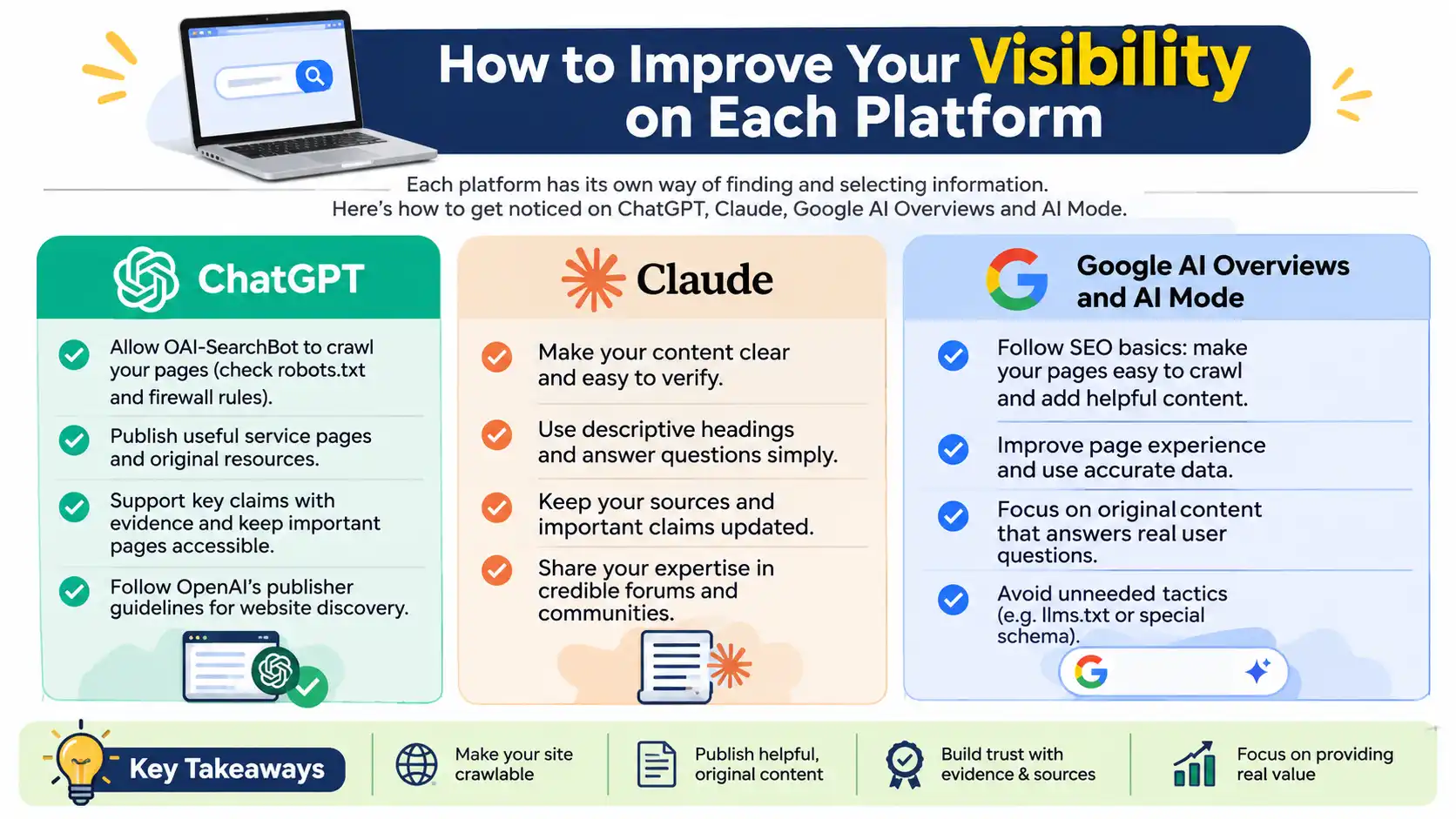
Each platform has its own way of finding and selecting information. Here’s how it’s done in ChatGPT, Claude, Google AI Overviews and AI Mode.
ChatGPT
Check that OAI-SearchBot can crawl the pages you want ChatGPT Search to discover. Review your robots.txt file and any CDN or firewall rules that may block the crawler. Publish useful service pages, original resources and clear business information. Support key claims with evidence and keep important pages accessible without requiring a login. Refer to OpenAI’s publisher and developer FAQ for website discovery and crawler access.
Remember that allowing the crawler makes your pages eligible for discovery; it does not guarantee that ChatGPT will cite them. OpenAI’s official crawler documentation explains the roles of OAI-SearchBot, GPTBot and ChatGPT-User.
You can also read our guide on how to rank a website on ChatGPT Search for more practical optimization steps.
Claude
Claude uses information from web sources to answer questions and displays citations alongside its responses. To improve your chances of being cited, make your website content clear and easy to verify. Use descriptive headings, answer questions in simple language and support important claims with reliable primary sources.
But good content alone is not enough. Claude’s crawlers must also be able to access your website. Check your robots.txt file and security settings against Claude’s published crawler guidelines. Keep your technical pages and supporting resources updated.
You can also share your industry knowledge through credible forums and professional communities where your potential customers look for advice.
Google AI Overviews and AI Mode
Google’s AI search features rely on its existing Search systems to find and display useful web content. This means your pages must meet Google’s technical requirements and qualify to appear in regular Search results with a snippet. So, where should you start? Focus on the SEO basics: make your pages easy to crawl, add useful internal links, publish helpful content, improve page experience and use accurate data. You can read Google Search Central’s AI features documentation for the full requirements.
At the same time, avoid spending time on tactics that Google does not recommend. You do not need an llms.txt file, unusually short content sections or special schema markup just to appear in AI Overviews. Instead, focus on publishing original information that answers real-time user questions and offers something useful.
If you want to explore this topic further, read our guide to optimizing content for Google AI Overviews.
How to Measure AI Search Visibility
Traditional SEO reports track rankings, impressions, clicks and organic conversions to measure website performance. However, these metrics do not show the full picture of your AI search visibility. A platform may mention your business in its answer without sending visitors to your website.
So, how do you measure this visibility?
Look beyond website traffic and combine regular citation checks, AI referral traffic and business results to understand whether your brand is gaining visibility through AI search.
Track AI referral traffic in analytics
Check your referral traffic in Google Analytics 4 (GA4) to see whether visitors come to your website from platforms such as ChatGPT and Claude. Look at the source and medium values in your reports, as referral names and tracking methods may change over time.
If you receive enough visits from these platforms, create a separate reporting view or channel group to track them. This will help you see how these visitors interact with your website. Track their engaged sessions, enquiry submissions, phone calls and conversions to understand whether AI referrals bring potential customers.
Keep in mind that GA4 may not record every AI-assisted visit as an AI referral. Someone might discover your business through a ChatGPT recommendation but visit your website later through Google or another channel.
Test the questions your customers actually ask
Create a list of buyer questions across informational, comparison and purchase intent. For example, a manufacturing buyer may ask which suppliers serve a particular region, how two product types differ or what specifications matter for a given application. This prompt-testing process is an important part of how to get cited by ChatGPT because it shows whether your pages appear for the questions your customers actually ask.
Run the same questions across ChatGPT Search, Claude and Google AI search at regular intervals. Record whether your business appears, which competitors appear, which pages receive citations and whether the information is accurate.
Use a consistent set of prompts and record the date, platform and wording. AI responses can change with the query, location, available sources and product updates. A single test is not enough to establish a trend.
Monitor crawler activity and technical health
Server access logs can show whether known search crawlers visit your website, which URLs they request and whether the server returns errors. Review relevant user-agent activity alongside HTTP status codes and response times.
Crawler visits do not prove that a page has been cited. They do help identify access problems and show whether important pages are being requested. Combine log checks with analytics and manual citation testing for a more complete view.
A Practical Six-Week GEO Action Plan
You do not need to change your entire website at once. A short, staged plan can help your team fix the main issues before expanding the work.
Week 1: Check access and indexation — Review robots.txt, noindex tags, XML sitemap coverage, CDN rules and important page responses. Confirm that the relevant search crawlers can access key content.
Weeks 2–3: Improve priority pages — Choose high-value service pages and resources. Rewrite unclear sections, answer buyer questions near the top, add supporting evidence and remove outdated claims.
Week 4: Strengthen brand information — Check business details across your website and important third-party profiles. Improve About pages, author information, case studies and relevant industry listings.
Week 5: Build useful supporting content — Publish or improve comparison pages, technical guides, FAQs and case studies that address real customer questions. Add internal links where they help readers explore the topic.
Week 6: Set up measurement — Create a baseline prompt list, review AI referral traffic, inspect crawler logs and record which pages and competitors appear in AI answers. Use the findings to plan the next round of improvements.
Common Mistakes That Can Limit AI Search Visibility
- Blocking search crawlers by mistake: A restrictive robots.txt or firewall rule can prevent a platform from retrieving important pages. Check the crawler access before assuming that there is a problem in content quality.
- Writing for algorithms instead of customers: Repeated keywords and awkward phrasing do not make a page more useful. Explain the subject clearly and use terms that customers understand.
- Publishing unsupported claims: Statements such as “the leading provider” or “the fastest solution” need evidence. Replace vague claims with verifiable details or do not make such claims at all.
- Treating schema as a shortcut: Structured data helps describe a page, but it cannot compensate for weak content, incorrect facts or blocked access.
- Creating artificial brand mentions: Fake reviews and manufactured discussions do not create genuine authority. Invest in real customer feedback, expert contributions and credible references.
- Measuring citations only once: AI answers vary. Check the same buyer questions regularly to see whether your business appears in ChatGPT, Claude or other AI platforms.
Final Thoughts
Getting your business cited in ChatGPT, Claude or other AI search tools is not about finding a hidden ranking trick. It is about making your business easy to discover, your information easy to understand and your claims easy to verify.
Start with the foundations: allow relevant crawlers, maintain technically sound pages, answer customer questions clearly and publish information that adds something useful to the subject.
Then build a credible brand presence across your website and trusted third-party sources. Track how your business appears in real buyer queries and improve the pages that are needed to.
AI search is still changing, and no agency or optimization method can promise a citation for every query. So, how to get cited by ChatGPT? The best way is to keep improving these above foundations as part of your long-term strategy.
Frequently Asked Questions
-
Can a business pay to appear in ChatGPT or Claude citations?
Ans.No. Paying for advertising does not guarantee an organic citation in ChatGPT or Claude answers. Paid Ads and organic citations are separate. -
Does blocking GPTBot remove a website from ChatGPT Search?
Ans.No. GPTBot and OAI-SearchBot serve different purposes. GPTBot is used for potential model training, while OAI-SearchBot helps discover websites for ChatGPT Search. -
How long does it take to get cited by ChatGPT or Claude?
Ans.There is no fixed timeline. It depends on whether crawlers can access your pages, how quickly they discover them, content quality and relevance to the user's query. Publishing new content does not guarantee a citation. -
What is the difference between SEO and GEO?
Ans.SEO improves a website's visibility in search engines. GEO focuses on making a business and its content easier for generative search systems to discover, understand and cite. GEO relies on many of the same SEO foundations. -
Why does my website rank first on Google but not appear in AI answers?
Ans.A high organic ranking does not guarantee an AI citation. The AI system may select another page that answers the exact question more clearly, provides stronger evidence or better matches the user's intent. -
Do I need an llms.txt file to appear in AI search?
Ans.No. Google does not require an llms.txt file for its AI search features. Check each platform's official guidelines before creating additional files. See Google's guide to generative AI features in Search. -
Does adding FAQ schema guarantee AI citations?
Ans.No. FAQ schema can describe question-and-answer content, but it does not guarantee that an AI platform will select or cite the page.
Author Details

Latest Posts
-
 30 / Oct
-
24 / Oct
-
 22 / Sep
Digital Marketing Digital Marketing for Ecommerce Brands: The 2027 Growth Playbook
-
 15 / Sep
-
 04 / Sep


-
Can a business pay to appear in ChatGPT or Claude citations?
Ans.No. Paying for advertising does not guarantee an organic citation in ChatGPT or Claude answers. Paid Ads and organic citations are separate. -
Does blocking GPTBot remove a website from ChatGPT Search?
Ans.No. GPTBot and OAI-SearchBot serve different purposes. GPTBot is used for potential model training, while OAI-SearchBot helps discover websites for ChatGPT Search. -
How long does it take to get cited by ChatGPT or Claude?
Ans.There is no fixed timeline. It depends on whether crawlers can access your pages, how quickly they discover them, content quality and relevance to the user's query. Publishing new content does not guarantee a citation. -
What is the difference between SEO and GEO?
Ans.SEO improves a website's visibility in search engines. GEO focuses on making a business and its content easier for generative search systems to discover, understand and cite. GEO relies on many of the same SEO foundations. -
Why does my website rank first on Google but not appear in AI answers?
Ans.A high organic ranking does not guarantee an AI citation. The AI system may select another page that answers the exact question more clearly, provides stronger evidence or better matches the user's intent. -
Do I need an llms.txt file to appear in AI search?
Ans.No. Google does not require an llms.txt file for its AI search features. Check each platform's official guidelines before creating additional files. See Google's guide to generative AI features in Search. -
Does adding FAQ schema guarantee AI citations?
Ans.No. FAQ schema can describe question-and-answer content, but it does not guarantee that an AI platform will select or cite the page.