


What Is Enterprise SEO? A Complete Guide for Large-Scale Websites
-
Author
Anindita Barik
-
Updated Date
Aug-20-2026
-
Views
2 Min Read
-
Author: PromotEdge Digital
-
Updated Date: Aug-20-2026
-
Views: 2 Min Read
-
Author: Milan Shyamal
Enterprise SEO is the process of optimizing large, complex websites with thousands or millions of pages to improve organic visibility, traffic, and revenue. This guide explains how enterprise SEO differs from traditional SEO, its core components, common challenges, AI search optimization, and the key metrics used to measure success. It also covers scalable technical SEO, content strategy, governance, internal linking, and choosing the right enterprise SEO platform or partner for long-term business growth.
Enterprise SEO is the practice of managing search visibility for very large websites, often with thousands or millions of pages and several teams involved. It is built for scale, coordination, and revenue, not for a single blog or a small service site. The stakes are high. Organic search still drives about 53% of all website traffic, according to BrightEdge research. For a large brand, a small ranking shift can move millions in revenue.
What Is Enterprise SEO?
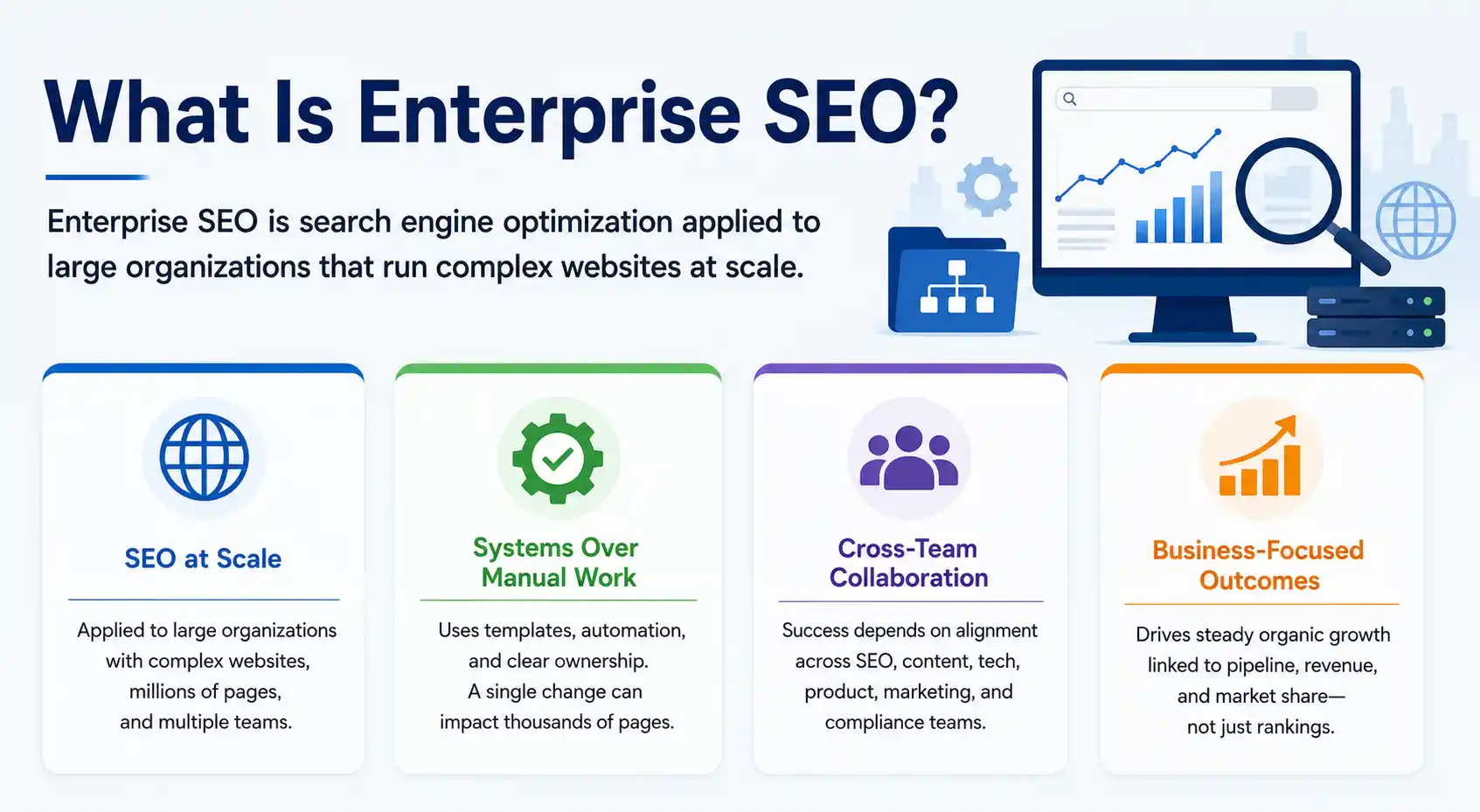
Enterprise SEO is search engine optimization applied to large organizations that run complex websites at scale. Think of retailers with millions of product pages, banks with strict compliance rules, or SaaS brands with content in many languages. The principle is the same, but the scale changes how the work is done.
At this level, you cannot fix pages one at a time. You need templates, automation, and clear ownership across teams. A single title tag change might touch 40,000 pages at once. That is why enterprise SEO depends on systems and governance far more than quick manual edits.
The goal is steady organic growth tied to business outcomes. Leadership wants pipeline, revenue, and market share, not just rankings. A strong program connects search performance to those numbers and proves its value to finance and product teams.
Enterprise SEO vs Traditional SEO: Key Differences
Traditional SEO usually covers a small site where one person handles keywords, content, and technical fixes. Enterprise SEO spans many domains, subdomains, and regions, with specialists working together. The gap is not effort. It is complexity, risk, and coordination.
| Category | Traditional SEO | Enterprise SEO |
|---|---|---|
| Site size | A few hundred pages | Thousands to millions of pages |
| Team | One person or a small team | Specialists across content, dev, product, and legal |
| Execution | Manual page-by-page edits | Templates, automation, and set workflows |
| Risk level | Low and contained | High, since one error can hit millions of pages |
| Reporting | Traffic and rankings | Revenue, pipeline, and market share |
| Search scope | Google rankings | Google plus AI search and answer engines |
For a plain-language primer on the fundamentals that apply at any size, see our guide on how to improve organic SEO. You can also compare channels in organic SEO vs paid SEO.
Signs Your Business Needs Enterprise SEO
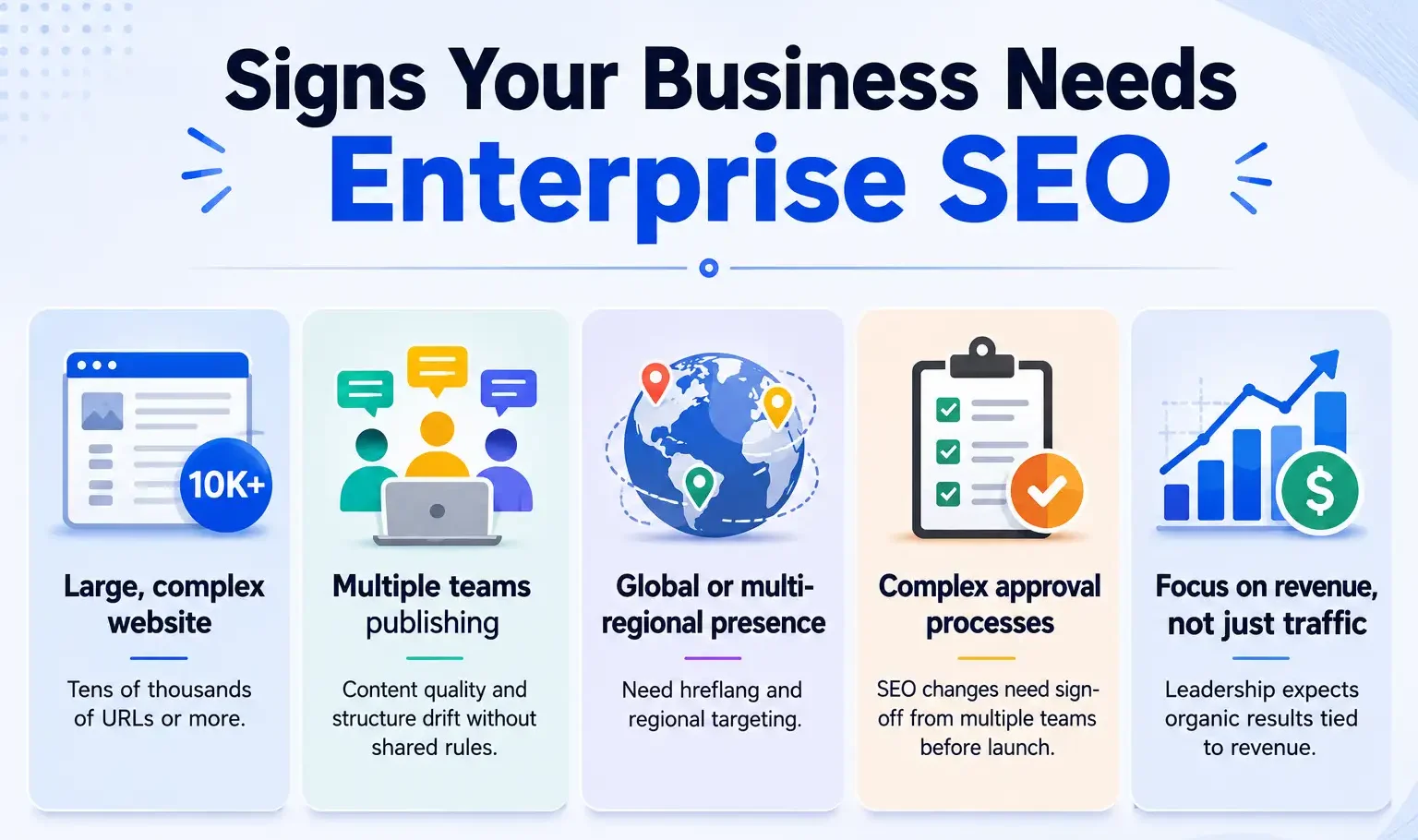
Not every large company needs an enterprise approach, and not every small one can avoid it. The trigger is complexity, not headcount alone. These signals point toward an enterprise SEO strategy:
- Your site has tens of thousands of URLs or more, and pages compete with each other for the same terms.
- Several teams publish to the site, so quality and structure drift without shared rules.
- You operate in multiple countries or languages and need hreflang and regional targeting.
- SEO changes require sign-off from developers, legal, or brand before they go live.
- Leadership asks you to tie organic results to revenue, not just traffic.
Core Components of an Enterprise SEO Strategy
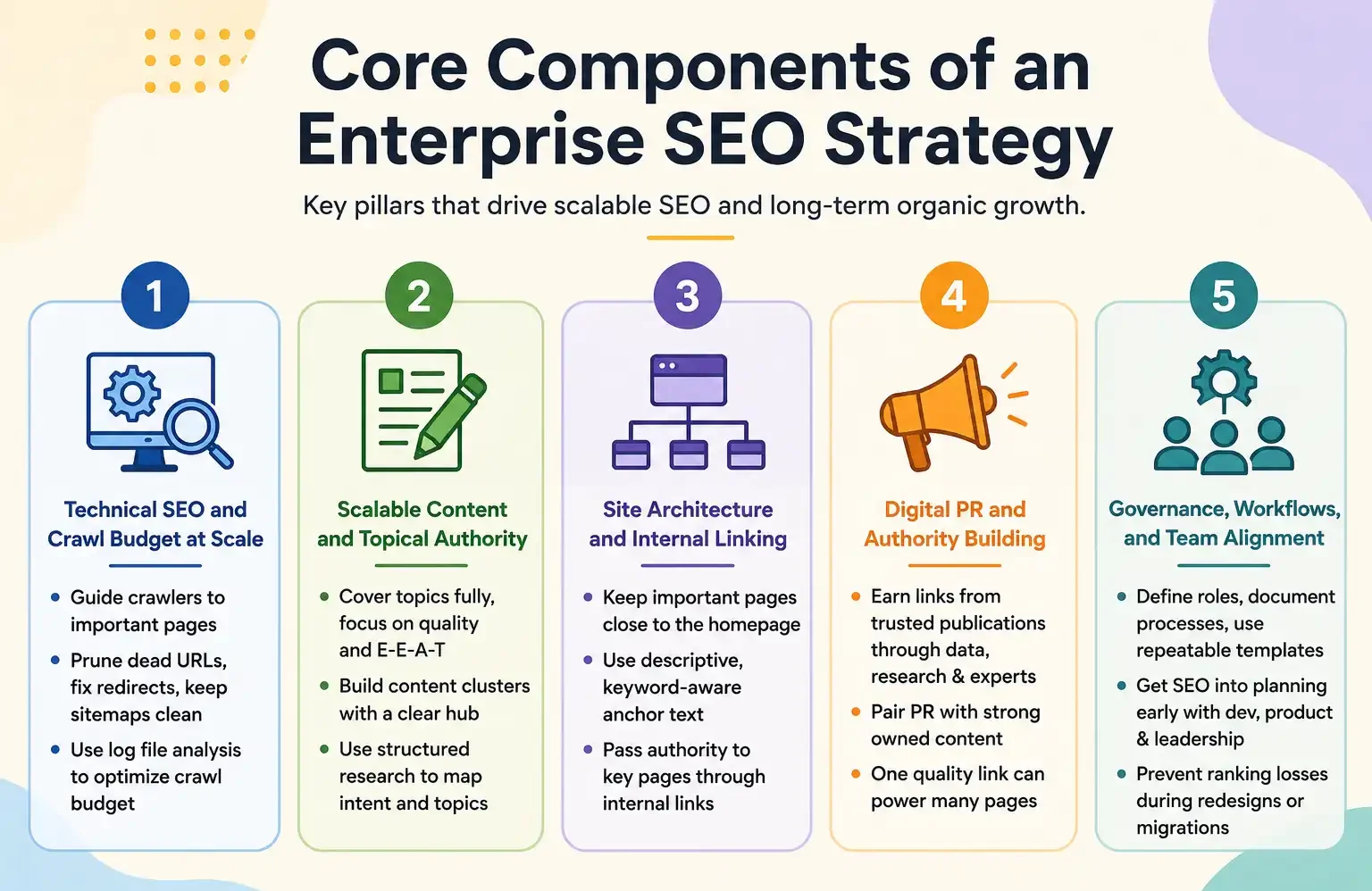
A working enterprise SEO strategy rests on a few pillars. Each one scales poorly if you treat it as a one-off task, so build repeatable processes around all of them.
1. Technical SEO and Crawl Budget at Scale
On a large site, search engines will not crawl every page as often as you would like. Google notes that crawl budget becomes a real concern once a site passes about one million pages, or ten thousand pages that change daily, per Google Search Central.
So the job is to guide crawlers toward pages that matter. Prune dead URLs, fix redirect chains, and keep XML sitemaps clean. Log file analysis shows where Googlebot actually spends time, which is often different from where you assume it goes.
2. Scalable Content and Topical Authority
Content at scale is not about publishing more for its own sake. It is about covering a topic fully so search engines treat you as a trusted source. Google rewards content that shows real experience and expertise, the E-E-A-T signals in its rater guidelines, as explained by Google Search Central.
Group related pages into clusters with a clear hub, then link them logically. Start with structured research. Our guide on how to do keyword research shows how to build clusters and map intent, so every team publishes to the same bar.
3. Site Architecture and Internal Linking
A clean structure helps users and search engines reach your best pages in a few clicks. Keep important pages close to the home page. Use descriptive, keyword-aware anchor text, and review internal links as products and categories change.
Internal links also pass authority to the pages you care about most. On a large site, this is one of the highest-return tasks, because you already own every link. Small, steady improvements add up over time.
4. Digital PR and Authority Building
Links from respected publications still carry weight, and big brands can earn them with data, research, and expert commentary. This is how authority is built at the enterprise level, well beyond basic outreach emails.
Pair earned coverage with strong owned content. When a journalist links to a useful resource on your site, that page ranks better and supports the pages it links to. PR and SEO work best as one motion, not two separate teams.
5. Governance, Workflows, and Team Alignment
Enterprise SEO stalls when teams work in silos. You need clear roles, shared documentation, and a process every campaign follows. Templates for briefs, audits, and reporting keep everyone speaking the same language.
Buy-in matters as much as tactics. Show product, dev, and leadership how search supports their goals, and bring SEO into planning early. A redesign or migration without SEO input can erase years of rankings overnight.
How Enterprise SEO Works With AI Search and Answer Engines
Search now includes AI Overviews, ChatGPT, and Perplexity, and your audience checks all of them. Gartner expected AI assistants to pull real volume away from classic search, which pushes brands to earn citations inside AI answers, not just blue links, per Gartner.
The path forward is content that is clear, sourced, and easy to quote. Answer questions directly, back claims with data, and structure pages so a machine can lift a clean passage. Our guides on optimizing content for Google AI Overviews and ranking on ChatGPT search go deeper.
This also changes how you read reports. More answers happen without a click, so track brand mentions and citations, not only sessions. Our primer on zero-click SEO explains how to measure visibility when the click never comes.
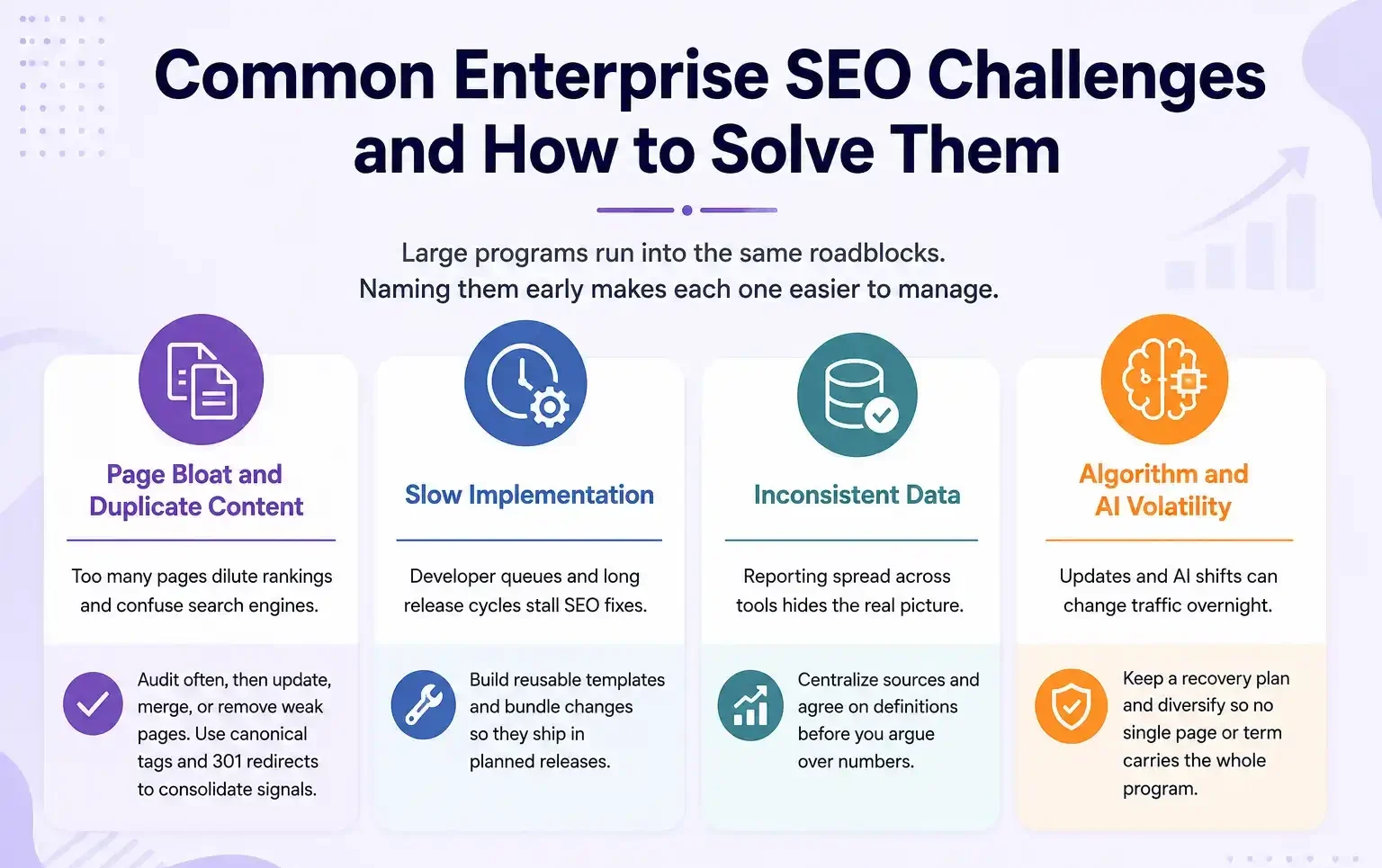
Common Enterprise SEO Challenges and How to Solve Them
Large programs run into the same roadblocks. Naming them early makes each one easier to manage.
- Page bloat and duplicate content: Audit often, then update, merge, or remove weak pages. Use canonical tags and 301 redirects to consolidate signals.
- Slow implementation: Developer queues stall SEO fixes. Build reusable templates and bundle changes so they ship in planned releases.
- Inconsistent data: Reporting spread across tools hides the real picture. Centralize sources and agree on definitions before you argue over numbers.
- Algorithm and AI volatility: Updates can shift traffic fast. Keep a recovery plan and diversify so no single page or term carries the whole program.
How to Measure Enterprise SEO ROI
Leadership funds outcomes, not activity. So tie organic performance to money, and report it in terms the C-suite understands. Organic search shows strong ROI because it compounds and does not stop the moment you pause.
Track a short set of KPIs that map to revenue: organic pipeline, assisted conversions, non-brand traffic, and share of voice on priority topics. Segment by region, product line, or business unit so each team sees its own impact.
Then translate results into a clear figure. Our guide on how to measure digital marketing ROI walks through attribution and the math, so you can defend the budget with confidence.
How to Choose an Enterprise SEO Partner or Platform
You have two levers: the platform and the people. Tools like BrightEdge, Conductor, and Semrush handle data and automation at scale. But software alone does not build strategy or earn authority for your brand.
Judge a platform on scalability, integrations, reporting, and how well it tracks AI visibility. Judge a partner on proven results, process, and clear communication. Our checklist on how to evaluate an SEO agency helps you ask the right questions.
If you run SaaS or B2B, the model shifts again. See how search fits those funnels in SEO for SaaS businesses and our B2B SEO strategy guide.
Build an Enterprise SEO Strategy That Scales
Enterprise SEO is less about tricks and more about systems, structure, and trust. Get the technical base right, cover your topics fully, and connect every result to revenue. Do that consistently, and organic search becomes one of your most reliable growth channels.
If you want a partner to plan and run this work, our SEO services team builds strategies for large sites that need scale and accountability. Reach out to map your next quarter.
Frequently Asked Questions About Enterprise SEO
-
What counts as an enterprise website?
Ans.There is no fixed number, but most enterprise sites run tens of thousands to millions of pages, serve several teams or regions, and require sign-off across departments before changing ships. -
How is enterprise SEO different from regular SEO?
Ans.The principles match, but the scale, risk, and coordination differ. Enterprise SEO relies on templates, automation, and governance rather than manual, page-by-page edits. -
How long does enterprise SEO take to show results?
Ans.Most programs see meaningful movement in six to twelve months. Technical fixes can help sooner, while content and authority gains build over several quarters. -
How much does enterprise SEO cost?
Ans.Costs vary with site size, tools, and scope. Enterprise platforms often run into five or six figures a year, and service costs depend on the depth of work and the size of the team. -
Does enterprise SEO include AI search optimization?
Ans.Yes. Modern programs optimize for AI Overviews and answer engines alongside classic rankings, since audiences now search across both.
Author Details

Latest Posts
-
 22 / Sep
Digital Marketing Digital Marketing for Ecommerce Brands: The 2027 Growth Playbook
22 / Sep
Digital Marketing Digital Marketing for Ecommerce Brands: The 2027 Growth Playbook -
 15 / Sep
-
 04 / Sep
-
 29 / Jul
Search Engine Optimization 6 Enterprise SEO Mistakes That Quietly Cost You Millions
29 / Jul
Search Engine Optimization 6 Enterprise SEO Mistakes That Quietly Cost You Millions -
24 / Jul
Blogs
Journey into Ideas Unveiling Tomorrow's Insights Today.

-
What counts as an enterprise website?
Ans.There is no fixed number, but most enterprise sites run tens of thousands to millions of pages, serve several teams or regions, and require sign-off across departments before changing ships. -
How is enterprise SEO different from regular SEO?
Ans.The principles match, but the scale, risk, and coordination differ. Enterprise SEO relies on templates, automation, and governance rather than manual, page-by-page edits. -
How long does enterprise SEO take to show results?
Ans.Most programs see meaningful movement in six to twelve months. Technical fixes can help sooner, while content and authority gains build over several quarters. -
How much does enterprise SEO cost?
Ans.Costs vary with site size, tools, and scope. Enterprise platforms often run into five or six figures a year, and service costs depend on the depth of work and the size of the team. -
Does enterprise SEO include AI search optimization?
Ans.Yes. Modern programs optimize for AI Overviews and answer engines alongside classic rankings, since audiences now search across both.