


6 Enterprise SEO Mistakes That Quietly Cost You Millions
-
Author
Anindita Barik
-
Updated Date
Sep-21-2026
-
Views
2 Min Read
-
Author: PromotEdge Digital
-
Updated Date: Sep-21-2026
-
Views: 2 Min Read
-
Author: Anindita Barik
Enterprise SEO mistakes often stem from broken processes rather than isolated technical issues. This guide explains the six most common enterprise SEO mistakes that quietly reduce crawl efficiency, rankings, AI search visibility, and revenue at scale. Learn how to identify crawl budget waste, keyword cannibalization, migration failures, blocked AI crawlers, weak reporting, and recurring deployment issues. It also includes a practical diagnostic checklist and measurable KPIs to help enterprise teams prioritize fixes that deliver long-term organic growth.
Most enterprise SEO mistakes never announce themselves. They look like an ordinary quarter where organic traffic slips four percent and someone blames seasonality. The room for error has also shrunk: Pew Research Center found users clicked a search result on 8% of visits to pages carrying an AI summary, against 15% without one.
I have watched a team spend six months on a content refresh when the real problem was a canonical tag a developer changed during a router upgrade. The pattern repeats across large sites. The errors that actually hurt are almost never tactical. They are process failures that a template, a deployment pipeline, or an org chart then multiplies across thousands of pages.
What counts as enterprise SEO mistakes
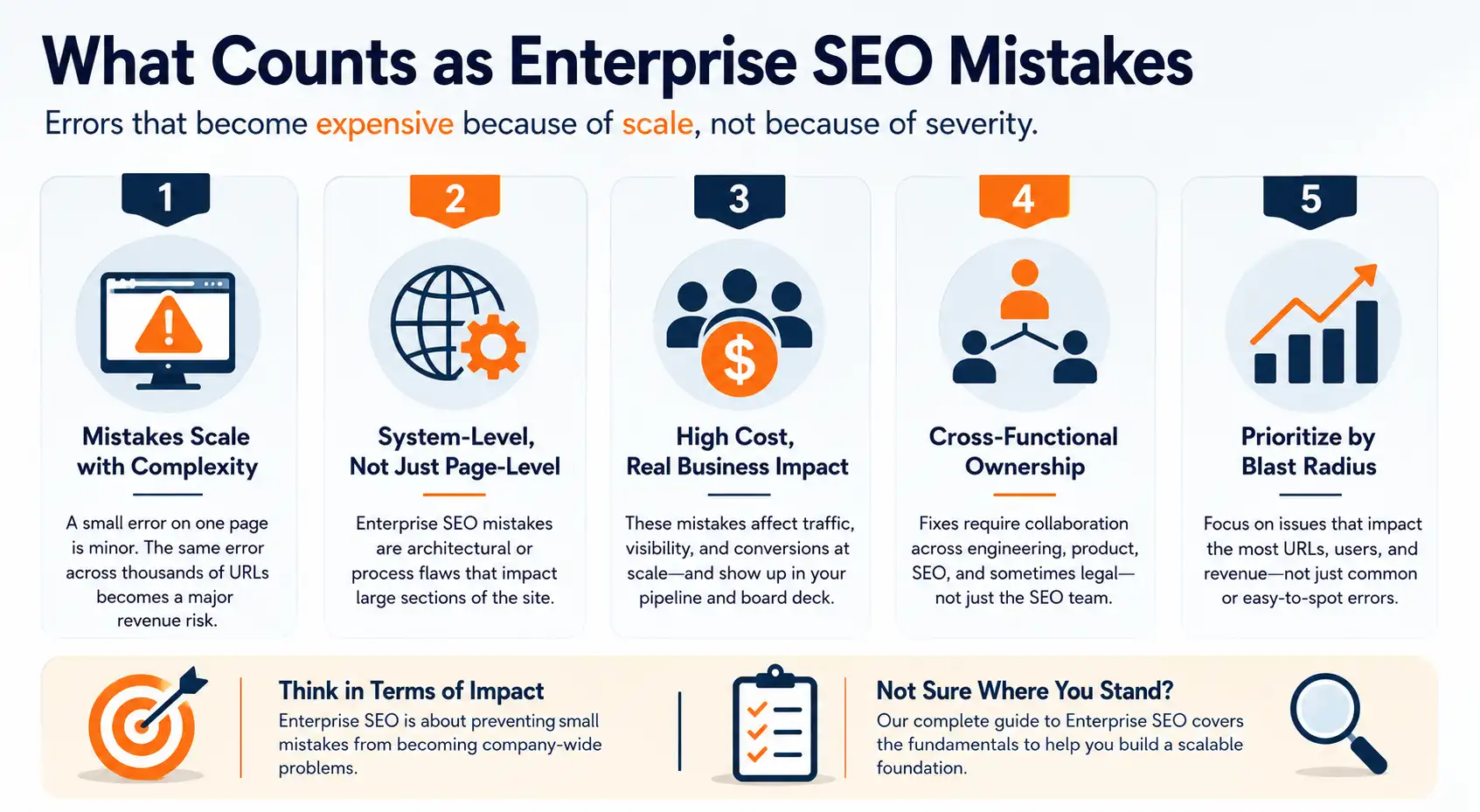
Enterprise SEO mistakes are errors whose cost scales with the complexity of the site rather than the severity of the individual error. A wrong title tag on a 40-page brochure site is a typo. The identical defect inside a product template rendering 40,000 URLs is a revenue event that shows up in a board deck.
That distinction changes who has to fix the problem. Page-level problems belong to an SEO specialist. System-level problems belong to engineering, product, and sometimes legal. They only get resolved once someone with budget authority understands what the defect costs in pipeline terms.
If you are still establishing the fundamentals before tackling scale problems, our complete guide to enterprise SEO covers the groundwork. The list below is ordered by blast radius, not by how often each mistake gets written about.
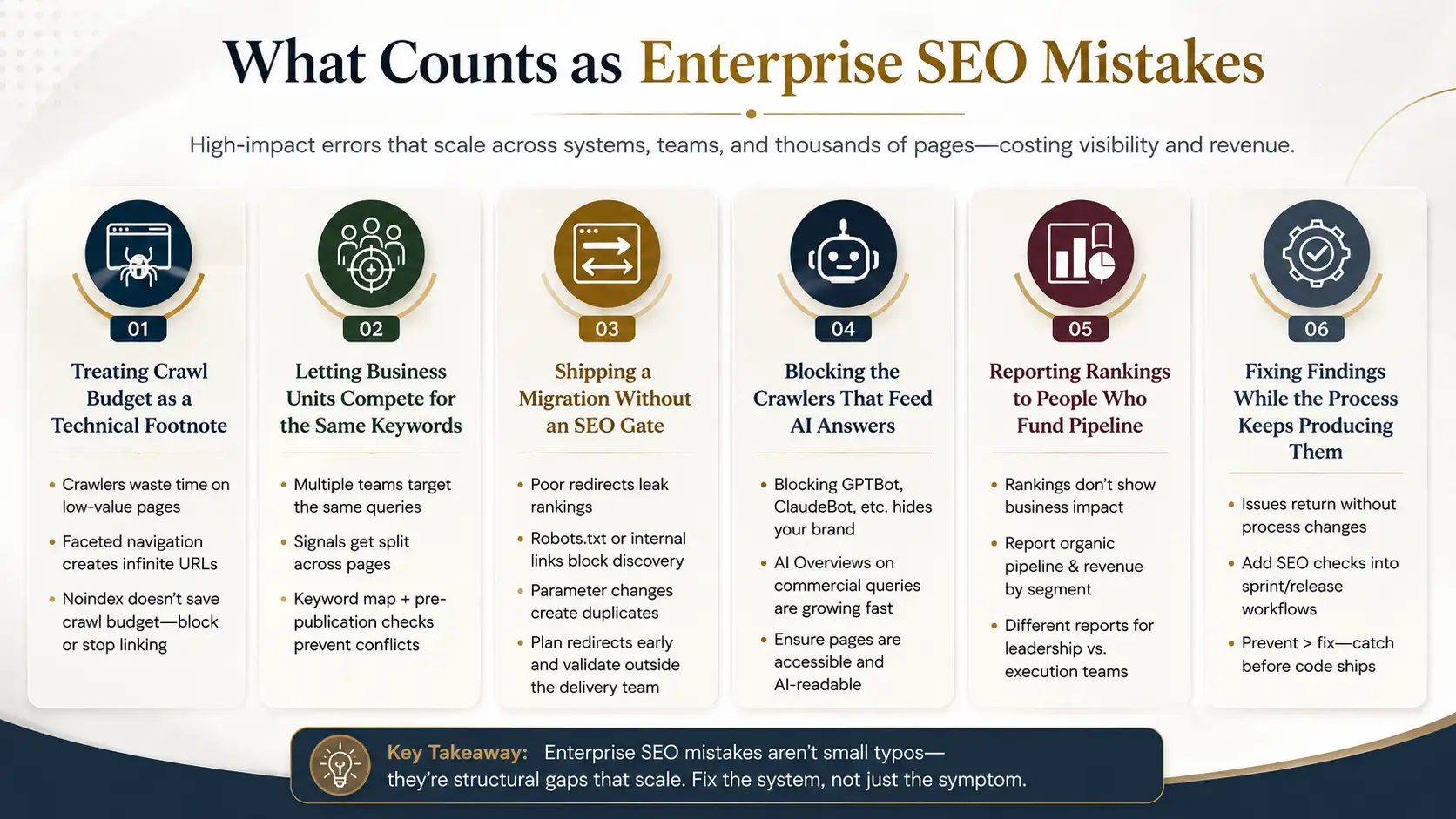
Mistake 1: Treating crawl budget as a technical footnote
Google’s crawl budget guidance is written for sites with a million or more pages changing weekly, or 10,000-plus pages changing daily. Most enterprise sites clear the second threshold on their blog alone and never realize the guidance applies to them.
This mechanism is where money leaks. Google defines a site as a unique hostname, so www.example.com and shop.example.com carry entirely separate crawl budgets. Move your catalogue to a subdomain and you have split your crawl allocation, which is why new SKUs sit undiscovered for weeks after launch.
Faceted navigation is the usual culprit. Google’s documentation on faceted URLs warns that parameter-based filters generate near-infinite URL spaces, and crawlers burn through them before working out the URLs are useless. Three filters with ten values each produce a thousand crawlable combinations from one category page.
One correction is worth making. as it comes up in nearly every audit conversation: noindex does not save crawl budget. Google still requests the page, then drops it after reading the tag. If you want that crawl back, disallow the pattern in robots.txt or stop linking to it.
Mistake 2: Letting business units compete for the same keywords
Cannibalization at a small scale is an accident you fix once. At an enterprise scale it is a governance defect that regenerates every publishing cycle. Corporate marketing writes a guide, the product team ships a feature page, a regional team builds a localized landing page. All three chase the same query.
Google then picks between three mediocre signals from one domain instead of receiving one strong signal. The site usually ranks none of them well, and the SEO team gets asked why a well-written page is stuck on page two.
Another audit will not solve this. A keyword map with named owners and a pre-publication check will, because it catches the conflict before the page goes live. Our guide to keyword research and mapping covers building the map. Enforcing it across teams who do not report to you is the harder half.
Mistake 3: Shipping a migration without an SEO gate
Nothing destroys enterprise organic revenue faster than a replatform. Google’s site move documentation is explicit about mapping every old URL to its new destination and keeping those redirects live for at least a year. Migrations still ship with redirect maps assembled the week before launch.
Four failure modes account for most of the damage. Redirect chains that leak signals across four hops. A staging robots.txt with a blanket disallow that goes live with the site. Internal links are still pointing at old URLs, so the redirect layer absorbs the entire crawl load. And parameter handling changes, spawning a duplicate set of the whole catalogue.
Build the redirect map before the design is signed off, not after QA. Then have someone outside the delivery team sign the pre-launch checklist, because the people shipping on a deadline are the worst possible reviewers of their own launch risk.
Mistake 4: Blocking the crawlers that feed AI answers
Plenty of enterprise robots.txt files still disallow GPTBot, ClaudeBot, PerplexityBot, or Google-Extended. Those lines were usually added by an infrastructure or legal team in 2023 without marketing sign-off. The brand then goes missing from AI answers, and nobody connects the two.
Semrush’s analysis of 600,000 US keywords found AI Overviews on commercial-intent SERPs grew 71% between November 2025 and April 2026, with finance up 231%. Commercial intent is where buyers build a shortlist. Being absent there costs pipeline, not sessions.
Read your robots.txt this week and ask who added each Disallow line. Then check whether answer engines can parse the page at all, since client-rendered body copy remains invisible to several AI crawlers that do not execute JavaScript. Our notes on optimizing content for Google AI Overviews and ranking inside ChatGPT Search go deeper into formatting for citation.
Falling clicks on retained rankings is the tell. If impressions hold while clicks drop, you are seeing the zero-click search effect rather than a ranking loss, and the response is different.
Mistake 5: Reporting rankings to people who fund pipeline
Enterprise SEO programs get defunded for reporting reasons more often than performance reasons. A CFO cannot act on an average position. What she can act on is organic contribution to qualified pipeline, segmented by business unit, with a trend line attached.
Run two reports for two audiences. Engineering and content need crawl efficiency, indexation coverage by template, open technical debt by age, and backlog throughput. Leadership needs revenue contribution by segment and an answer to one question: is this program compounding or flattening?
Sending the wrong layer to either audience is how good programs die in a planning meeting. Our breakdown of measuring digital marketing ROI covers the attribution mechanics behind the executive view.
Mistake 6: Fixing findings while the process keeps producing them
If the same class of issue appears in three consecutive audits, the fixes are not the problem. The missing gate is. Enterprise sites ship code weekly, and every deployment is a chance to reintroduce a canonical error or break server-side rendering for one section of the site.
Tie the SEO review to the sprint rather than the quarter. A ten-minute check on a release candidate is cheaper than a six-week recovery, and it places SEO inside the development workflow instead of arriving afterwards as criticism of work already shipped.
Why the same mistake costs more at enterprise scale
The table below is the argument I use with executives who think their SEO issues are the same ones they had at $20m revenue. The error types barely change. The multiplier does.
| The mistake | Mid-market impact | Enterprise impact |
|---|---|---|
| Duplicate or missing title tags | A handful of pages compete with each other | One template defect propagates across tens of thousands of URLs |
| Keyword overlap | Two blog posts, consolidated in an hour | Systemic conflict between business units that returns every publishing cycle |
| Broken redirects | A single page returns a 404 | Chains across a full URL migration, with months of lost equity |
| Slow server response | Weaker rankings on the affected pages | Reduced crawl capacity site-wide and slower discovery of every new page |
| Blocked AI crawler | Minor visibility loss | Brand absent from generated answers across an entire product category |
| Weak reporting | The client asks awkward questions | The program loses its budget at the next planning cycle |
A diagnostic you can run in one afternoon
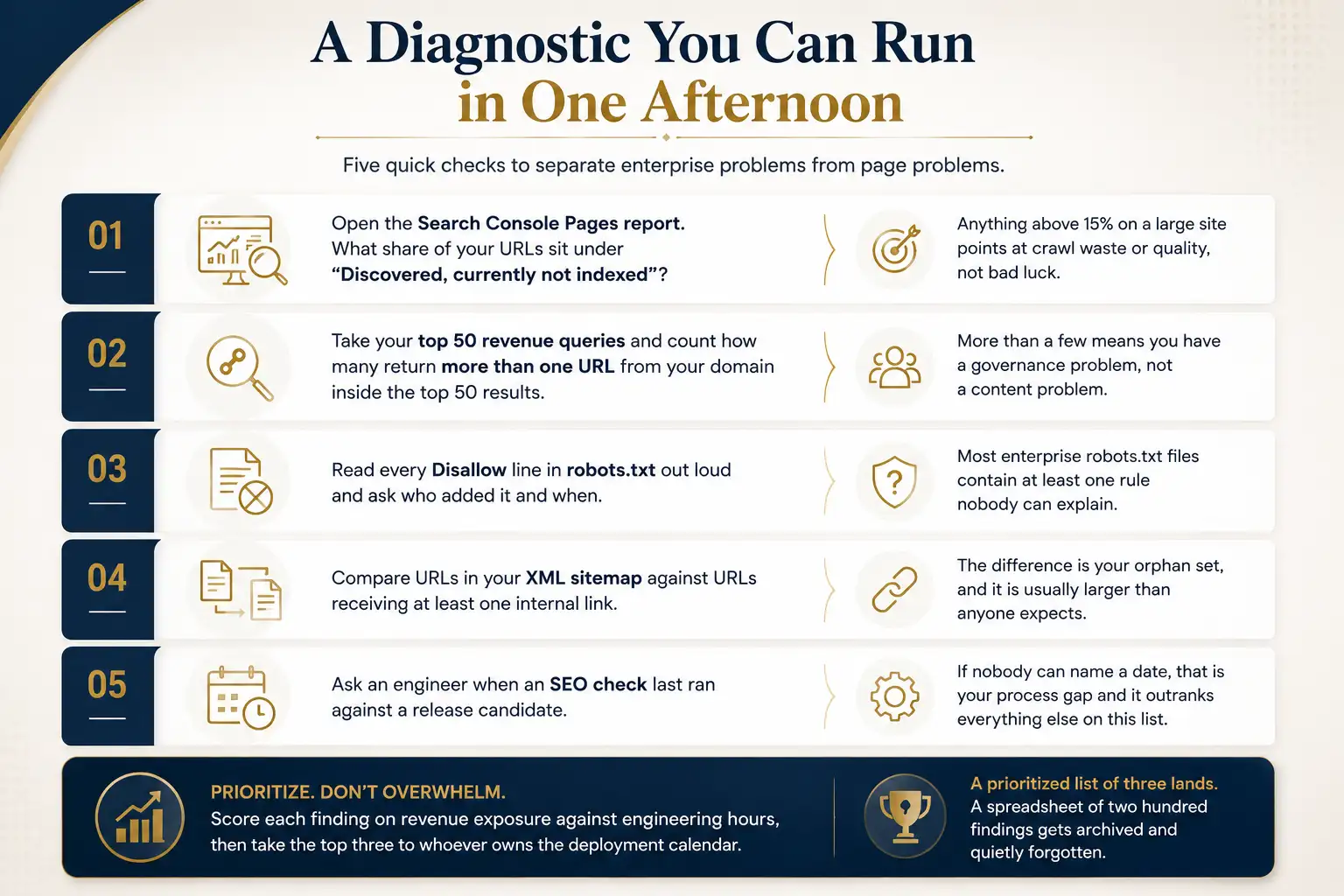
Before commissioning another audit, run these five checks yourself. Each takes minutes, and together they separate an enterprise problem from a page problem.
- Open the Search Console Pages report. What share of your URLs sit under “Discovered, currently not indexed”? Anything above 15% on a large site points at crawl waste or quality, not bad luck.
- Take your top 50 revenue queries and count how many return more than one URL from your domain inside the top 50 results. More than a few means you have a governance problem, not a content problem.
- Read every Disallow line in robots.txt out loud and ask who added it and when. Most enterprise robots.txt files contain at least one rule nobody can explain.
- Compare URLs in your XML sitemap against URLs receiving at least one internal link. The difference is your orphan set, and it is usually larger than anyone expects.
- Ask an engineer when an SEO check last ran against a release candidate. If nobody can name a date, that is your process gap and it outranks everything else on this list.
Score each finding on revenue exposure against engineering hours, then take the top three to whoever owns the deployment calendar. A prioritized list of three lands. A spreadsheet of two hundred findings gets archived and quietly forgotten.
How to measure whether the fixes worked
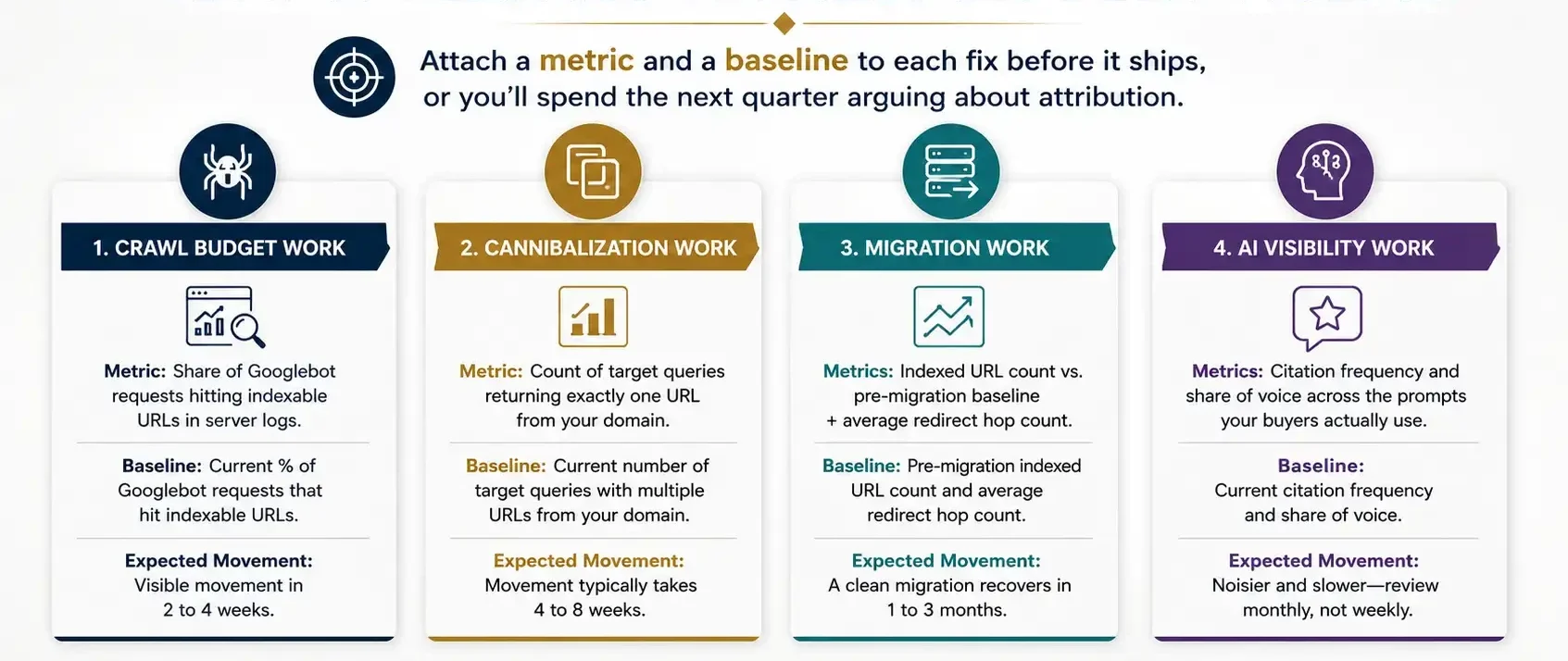
Attach a metric and a baseline to each fix before it ships, or you will spend the following quarter arguing about attribution with someone who suspects a core update did the work.
- Crawl budget work: the share of Googlebot requests hitting indexable URLs in your server logs. Expect visible movement in two to four weeks.
- Cannibalization work: the count of target queries returning exactly one URL from your domain. Movement typically takes four to eight weeks.
- Migration work: indexed URL count against the pre-migration baseline, plus average redirect hop count. A clean migration recovers in one to three months.
- AI visibility work: citation frequency and share of voice across the prompts your buyers actually use. Noisier and slower, so review monthly rather than weekly.
Set the baseline before the work starts. Retrofitting a baseline afterwards is how teams end up claiming credit for something Google did to the whole index. For the wider measurement frame, our guide on improving organic SEO performance covers which metrics belong in a monthly review.
Final Decision
None of this needs a bigger SEO team. It needs a shorter list, a named owner for each item, and a gate that stops the same defects from walking back in. Run the afternoon diagnostic, identify the three findings with the greatest revenue exposure, and put them on the engineering roadmap in business language.
If you want a second opinion on which of these mistakes is costing you the most, our enterprise SEO team runs diagnostics that end with a prioritized backlog rather than a 200-page PDF. B2B teams can also start with our B2B SEO campaign framework.
Frequently asked questions about enterprise SEO mistakes
-
What is the most common enterprise SEO mistake?
Ans.The most common enterprise SEO mistake is fixing symptoms without fixing the process that produces them. Teams close out findings from an audit, then watch the same class of issue return within two release cycles because no pre-publication or pre-deployment check exists. -
How is enterprise SEO different from regular SEO?
Ans.The principles match, but the scale, risk, and coordination differ. Enterprise SEO relies on templates, automation, and governance rather than manual, page-by-page edits. -
How much traffic can one enterprise SEO mistake cost?
Ans.It depends entirely on blast radius. A template defect touching 40,000 URLs, or a migration that loses a third of its redirect map, can remove double-digit percentages of organic revenue inside a single quarter. Page-level errors on the same site barely register in reporting. -
Do AI Overviews change which enterprise SEO mistakes matter?
Ans.Yes. Crawler access, entity consistency, and structured content that can be quoted cleanly now decide whether a brand appears in generated answers. Semrush recorded AI Overviews on commercial-intent SERPs growing 71% in six months, so the research stage of the buying cycle is where absence does the most damage. -
Who should own enterprise SEO inside the organization?
Ans.One accountable owner with a direct line to the deployment calendar, supported by named owners for keyword governance, content review, and technical review. Programmes fail when accountability sits in marketing while the decisions that actually move rankings get made in engineering and product. -
How often should an enterprise site be audited?
Ans.Continuously at the technical layer and quarterly at the strategic layer. Tie automated crawl monitoring to deployment cycles so regressions surface within days. Reserve the deep strategic review for quarterly planning, when architecture and content decisions are actually on the table. Our guide on evaluating an SEO agency covers what a useful audit deliverable should contain.
Author Details

Latest Posts
-
 04 / Sep
-
 29 / Jul
Search Engine Optimization 6 Enterprise SEO Mistakes That Quietly Cost You Millions
29 / Jul
Search Engine Optimization 6 Enterprise SEO Mistakes That Quietly Cost You Millions -
 24 / Jul
-
 23 / Jul
Search Engine Optimization How to Improve Organic SEO: A Practical 2026 Guide
23 / Jul
Search Engine Optimization How to Improve Organic SEO: A Practical 2026 Guide -
21 / Jul
Search Engine Optimization Organic SEO vs Paid SEO: Which Is Better in 2026?

Blogs
Journey into Ideas Unveiling Tomorrow's Insights Today.




-
What is the most common enterprise SEO mistake?
Ans.The most common enterprise SEO mistake is fixing symptoms without fixing the process that produces them. Teams close out findings from an audit, then watch the same class of issue return within two release cycles because no pre-publication or pre-deployment check exists. -
How is enterprise SEO different from regular SEO?
Ans.The principles match, but the scale, risk, and coordination differ. Enterprise SEO relies on templates, automation, and governance rather than manual, page-by-page edits. -
How much traffic can one enterprise SEO mistake cost?
Ans.It depends entirely on blast radius. A template defect touching 40,000 URLs, or a migration that loses a third of its redirect map, can remove double-digit percentages of organic revenue inside a single quarter. Page-level errors on the same site barely register in reporting. -
Do AI Overviews change which enterprise SEO mistakes matter?
Ans.Yes. Crawler access, entity consistency, and structured content that can be quoted cleanly now decide whether a brand appears in generated answers. Semrush recorded AI Overviews on commercial-intent SERPs growing 71% in six months, so the research stage of the buying cycle is where absence does the most damage. -
Who should own enterprise SEO inside the organization?
Ans.One accountable owner with a direct line to the deployment calendar, supported by named owners for keyword governance, content review, and technical review. Programmes fail when accountability sits in marketing while the decisions that actually move rankings get made in engineering and product. -
How often should an enterprise site be audited?
Ans.Continuously at the technical layer and quarterly at the strategic layer. Tie automated crawl monitoring to deployment cycles so regressions surface within days. Reserve the deep strategic review for quarterly planning, when architecture and content decisions are actually on the table. Our guide on evaluating an SEO agency covers what a useful audit deliverable should contain.