


What Is a Performance Marketing Agency? A 2026 Breakdown
-
Author
Anindita Barik
-
Updated Date
Oct-03-2026
-
Views
2 Min Read
-
Author: PromotEdge Digital
-
Updated Date: Oct-03-2026
-
Views: 2 Min Read
-
Author: Anindita Barik
A performance marketing agency is a digital marketing partner that plans, runs, and improves campaigns where you only pay for measurable results, such as clicks, leads, app installs, or sales, rather than paying for reach or impressions. It runs channels like paid search, paid social, programmatic, affiliate, and SEO, and it answers to hard numbers like ROAS, CPA, and CPL.
If you have ever looked at an advertising invoice and wondered where the money actually went, that is the exact problem a performance marketing agency was built to solve. A regular agency usually bills you for the work it does. A performance marketing agency ties its work to results you can count, so you always know what you paid for and what came back.
That kind of accountability carries more weight now than it did a few years ago. Gartner’s 2025 CMO Spend Survey found that marketing budgets have stalled at roughly 7.7 percent of company revenue, and many marketing leaders said they plan to walk away from agencies that cannot prove their contribution.
This guide walks through what these agencies do, the services and channels they run, what they charge, the numbers they track, how long it takes to see results, and how to pick the right one this year. We have spent more than eleven years running these campaigns as a USA-based performance marketing agency, and this guide is built straight from the questions our clients bring to us week after week.
What Is a Performance Marketing Agency?
A performance marketing agency is a results-first company that puts your budget only into tactics it can trace back to a specific action and a specific return. A brand-focused agency spends money to build awareness. A performance agency spends money to build revenue. Every campaign starts with a clear goal and a number attached to it, and the work is judged against that number, not against how many people happened to see the ad.
Day to day, the agency works like an extra part of your own marketing team. It agrees on targets with you, puts money into the channels that convert best, keeps testing to find what works, and reports back on the numbers that actually affect your profit. It is the same mindset you would expect from a full-service digital marketing agency, just pointed at the bottom of the funnel, where spending turns into sales.
How Does a Performance Marketing Agency Work?
Good performance marketing follows a loop that keeps repeating. Most solid agencies run some version of these five steps.
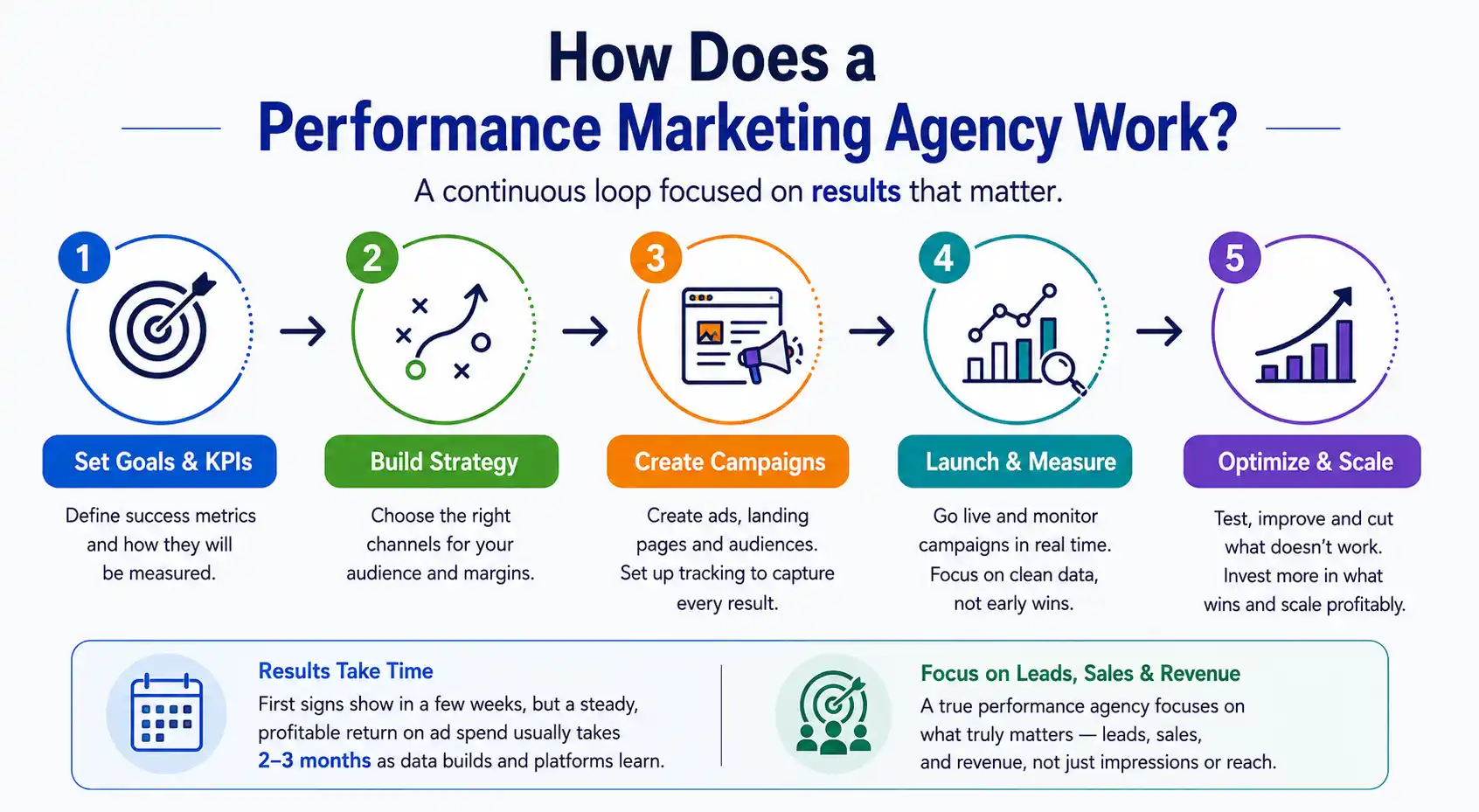
1. Setting goals and KPIs. You and the agency agree on the outcome that matters, whether that is cost per lead, return on ad spend, or a set number of sales, and on how it will be tracked.
2. Building the strategy and picking channels. The agency chooses the mix of channels most likely to hit that goal for your audience and your margins. A B2B software company and a direct-to-consumer skincare brand need very different plans.
3. Creating and building the campaign. The team writes the ads, builds the landing pages, and sets up the audiences. Before anything goes live, they wire in the tracking so no result slips through the cracks.
4. Launching and measuring. Campaigns go live and get watched against the goal almost in real time. The first stretch is about gathering clean data, not celebrating early wins.
5. Improving and scaling. Using controlled tests, the agency cuts what loses money, puts more behind what wins, and grows the budget without letting the cost per result creep up.
One thing worth setting straight early is that results take time. You will usually see the first signs within a few weeks, but a steady, profitable return on ad spend often takes two to three months, once enough conversion data has built up and the platforms have learned who to target. The clearest sign of a real performance agency is simple: it talks to you about leads, sales, and revenue, not just impressions and reach.
What Services Does a Performance Marketing Agency Offer?
Performance marketing is a broad label that covers a lot of ground. A strong agency offers most of the services below and runs them as one connected system, rather than as separate boxes that never talk to each other.
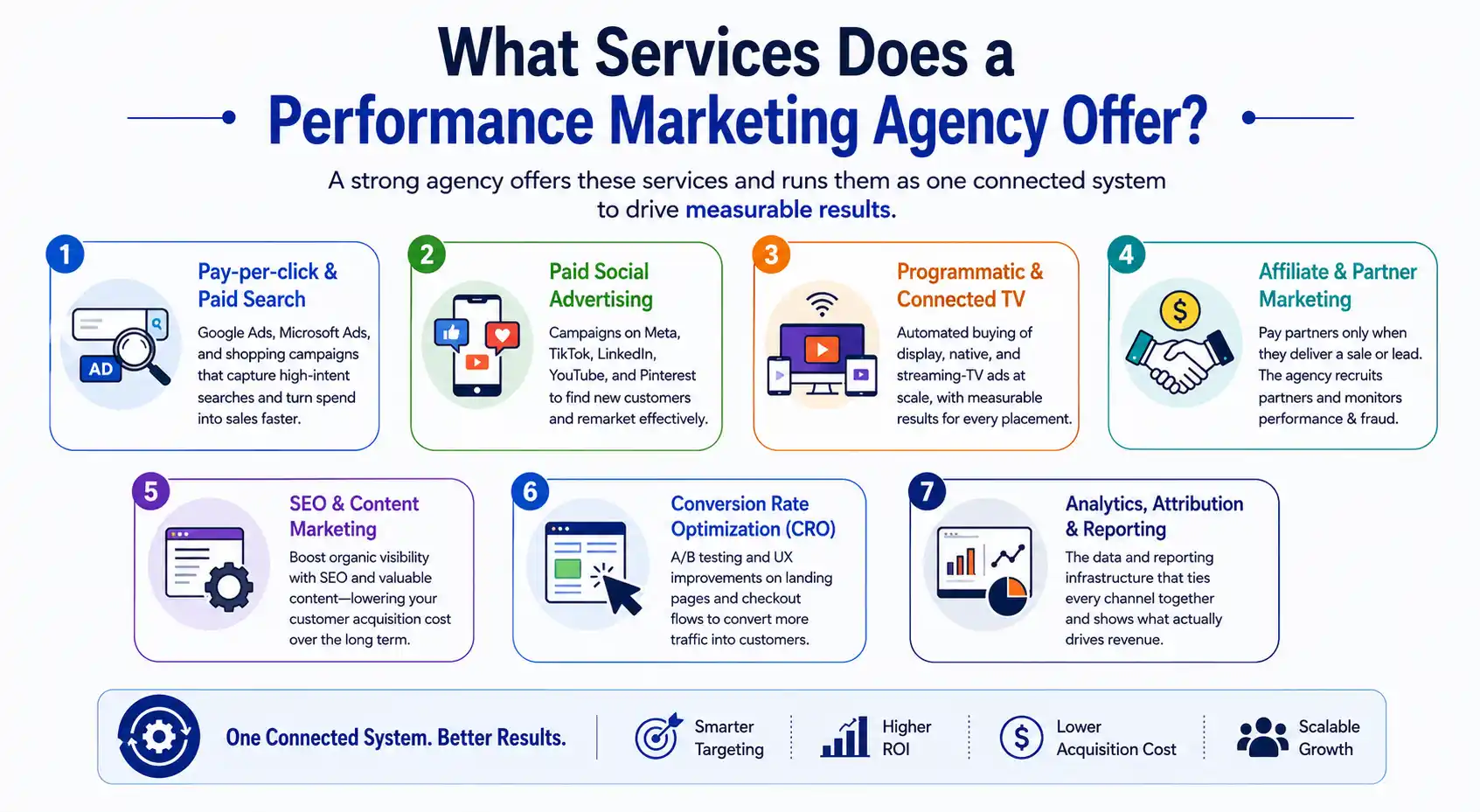
- Pay-per-click and paid search : Google Ads, Microsoft Ads, and shopping campaigns that catch people at the moment they are searching for what you sell. Because the intent is already there, it is often the fastest way to turn spend into sales.
- Paid social advertising : Campaigns on Meta, TikTok, LinkedIn, YouTube, and Pinterest, used both to find new customers and to win back people who did not buy the first time. You can see how PromotEdge handles this in our social media marketing services.
- Programmatic and connected TV : Automated buying of display, native, and streaming-TV ads at scale, so you can reach large audiences while still measuring what each placement did.
- Affiliate and partner marketing. You pay partners only when they deliver a sale or a lead, which makes it one of the lower-risk ways to grow. The agency recruits the partners and watches for fraud.
- SEO and content : Organic visibility lowers your blended cost of winning a customer over time. It is the slow-burn side of performance, and it keeps paying off long after the work is done.
- Conversion rate optimization : Testing on your landing pages and checkout flow so a bigger share of the traffic you already have turned into customers. Often it is cheaper to fix the leaks than to buy more traffic.
- Analytics, attribution, and reporting : The plumbing that ties everything together and shows which spend actually drove revenue. Without it, you are guessing.
Which Channels Do Performance Marketing Agencies Use?
Which channels an agency picks depends on where your buyers spend their time and how they make decisions. Paid search catches people who are already looking for you. Paid social media ads create demand and pull back people who drifted away. Most good agencies run both instead of betting everything on one, which is the same balancing act we cover in our guide to SEO vs PPC. A common mix looks like this.
| Channel | Best for | Main metric |
|---|---|---|
| Paid search (Google, Bing) | Catching existing high-intent demand | CPA or ROAS |
| Paid social (Meta, TikTok) | Creating demand and retargeting | CPA or ROAS |
| LinkedIn Ads | B2B lead generation | Cost per lead (CPL) |
| Programmatic and CTV | Reaching scale with measurement | CPM or view-through |
| Affiliate and partners | Low-risk, pay-per-result growth | Cost per sale |
| SEO and content | Compounding organic growth | Organic conversions |
Performance Marketing Agency vs. Digital Marketing Agency
This is usually the real question hiding behind the search. Both types of agency work in digital, but they are aiming at different things.
| Factor | Performance marketing agency | Traditional digital agency |
|---|---|---|
| Main goal | Measurable actions: sales, leads, installs | Brand, awareness, long-term presence |
| Success metric | ROAS, CPA, CPL, conversion rate | Reach, impressions, engagement |
| How they bill | Tied to results or managed spend | Fixed fee for the activity |
| Funnel focus | Mostly mid and bottom funnel | Top and mid funnel |
| Reporting | Revenue and pipeline dashboards | Visibility and engagement reports |
For most brands the smartest answer is not one or the other. Brand awareness fills the top of the funnel, performance media turns that interest into trackable sales, and the sales data then feeds back and makes the brand work sharper. A full-service digital marketing agency puts a performance team inside a wider brand and content plan, so the two support each other instead of fighting over the same budget.
What KPIs and Metrics Do Performance Marketing Agencies Track?
If an agency cannot explain these numbers in plain English, that tells you something. This is the shared language of performance, and a real reporting dashboard should track most of it.
| Metric | What it means |
|---|---|
| ROAS (Return on Ad Spend) | Revenue earned for every dollar spent on ads. |
| CPA (Cost per Acquisition) | What it costs to win one customer or conversion. |
| CPL (Cost per Lead) | What it costs to bring in one qualified lead. |
| CTR (Click-Through Rate) | The share of people who click after seeing an ad. |
| CVR (Conversion Rate) | The share of clicks that finish the action you want. |
| CAC and LTV | Acquisition cost against lifetime value, the real profit test. |
The number that separates healthy growth from slow bleeding is the ratio between lifetime value and acquisition cost, written as LTV to CAC. Most solid businesses aim for roughly three to one, meaning about three dollars of lifetime value for every dollar spent to win a customer. A good agency works toward that ratio, not just a cheap cost per click.
How Much Does a Performance Marketing Agency Cost?
Pricing is the part most competitors keep vague, so here it is out in the open. Agency fees are separate from your ad spend, which means you budget for both. In 2026 you will run into four common pricing models.
| Pricing model | How it works | Typical range in 2026 |
|---|---|---|
| Monthly retainer | A flat fee for an agreed scope, and the most common setup | $2,500 to $12,000+ per month |
| Percentage of ad spend | A management fee based on your media budget | 10 to 20 percent of spend |
| Performance-based | Pay tied to CPA, a revenue share, or bonuses | 5 to 25 percent of new revenue |
| Hybrid | A base retainer plus a performance bonus, and the fastest growing | Base plus bonus |
As a rough guide, entry-level packages tend to start around 1,000 to 3,000 dollars a month, boutique agencies sit closer to 3,000 to 8,000, and full-service teams working with mid-market and enterprise clients run from 10,000 into the tens of thousands. Whatever you pay should line up with the revenue the work is expected to bring back.
What Are the Benefits of Hiring a Performance Marketing Agency?
Hiring the right partner does more than take work off your plate. Here is what you actually get out of it.
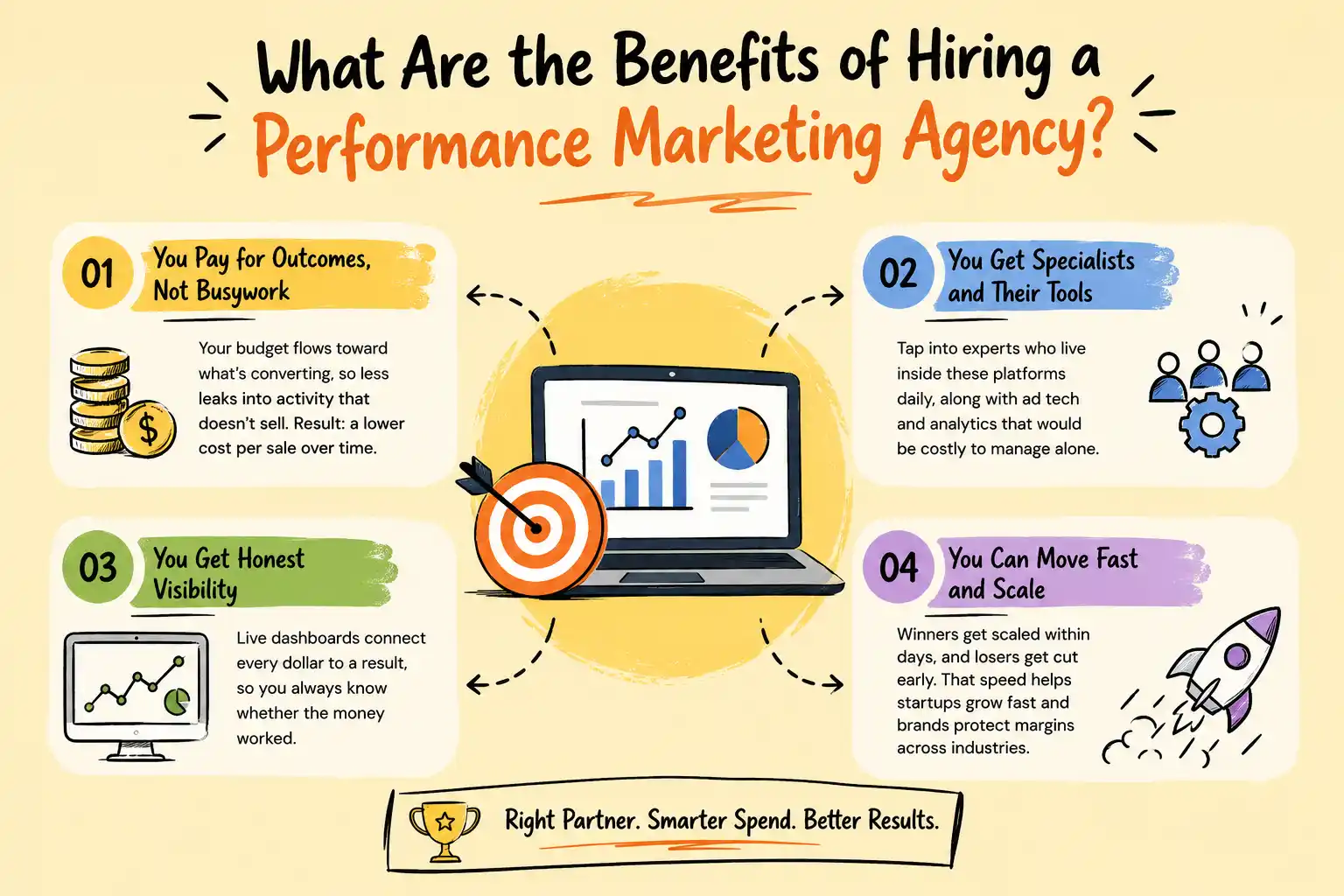
- You pay for outcomes, not busywork. Your budget flows toward whatever is converting, so less of it leaks into activity that looks busy but sells nothing. Over a few months, that usually shows up as a lower cost per sale.
- You get specialists and their tools on day one. Instead of hiring, training, and buying software yourself, you tap into people who live inside these platforms every day, plus the ad tech and analytics that would be expensive to carry alone.
- You get honest visibility. Live dashboards connect every dollar to a result, so you are never left guessing whether the money worked.
- You can move fast and scale. Campaigns that work can be pushed harder within days, and the ones that flop get cut before they drain the budget. That speed matters whether you are a startup growing quickly or an established brand protecting its margins across several industries.
Is a Performance Marketing Agency Right for You?
Performance marketing is not the fix for every problem, and an honest agency will say so before you sign anything. It works best when you already have a product that sells, margins that can carry both the ad spend and the fee, and a clear action worth paying for, whether that is a sale, a lead, an install, or a subscription.
The in-house versus agency question comes down to volume and complexity: a single channel and a modest budget can often stay in-house, but once you are running several platforms and want to scale without hiring a full department, an agency usually gets you there faster and for less.
It is a weaker fit in a few situations. If your real gap is that nobody has heard of you yet, that is a brand awareness problem, and no amount of bid tweaking will fix it. If your margins cannot absorb both the ad spend and the fee, the math will not work. And if you are expecting results overnight, you are going to be disappointed. In those cases, brand building or choosing the right agency partner for your stage comes first.
How to Choose the Right Performance Marketing Agency
Use this short checklist to tell a real performance partner from an agency that just swapped a few words on its homepage.
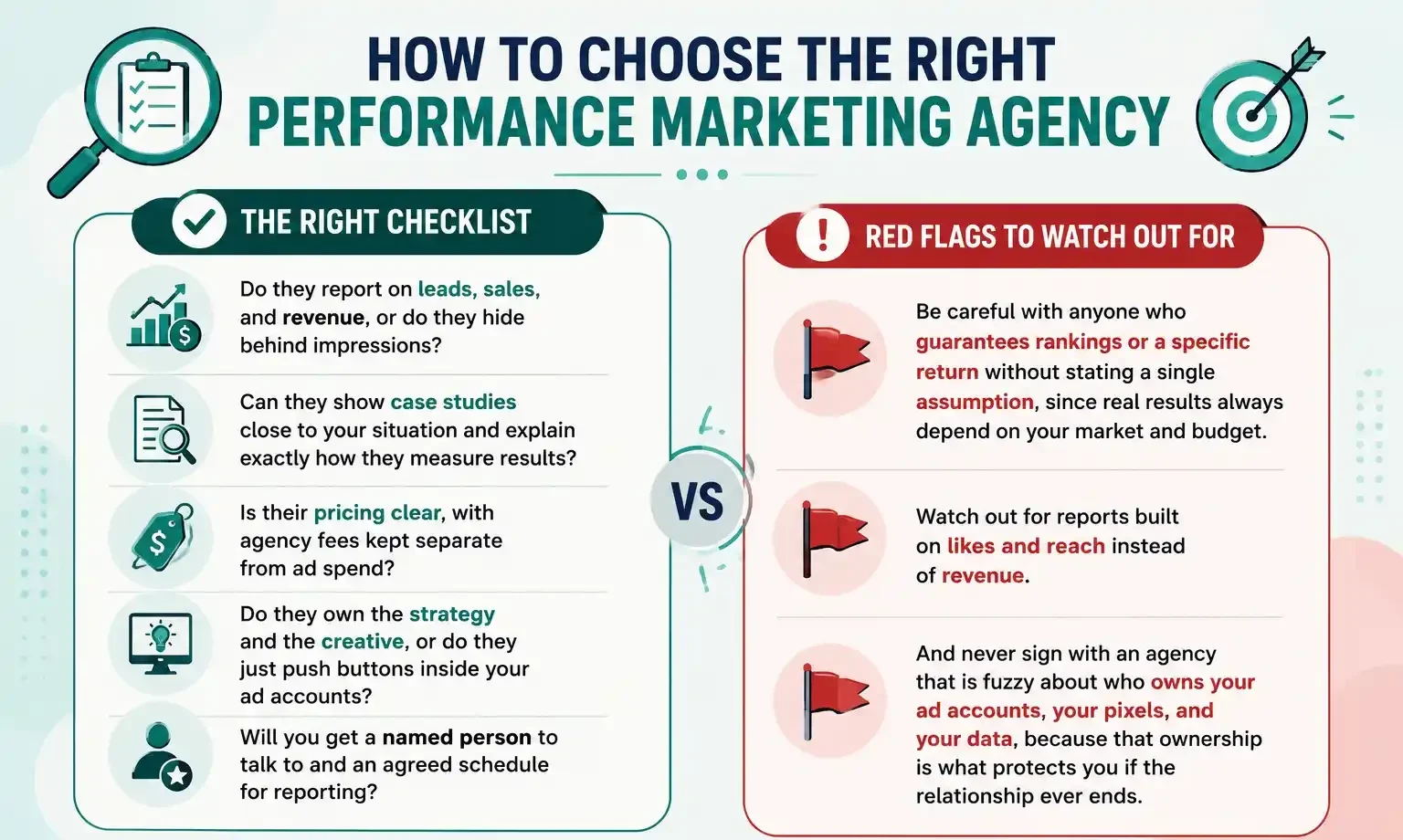
- Do they report on leads, sales, and revenue, or do they hide behind impressions?
- Can they show case studies close to your situation and explain exactly how they measure results?
- Is their pricing clear, with agency fees kept separate from ad spend?
- Do they own the strategy and the creative, or do they just push buttons inside your ad accounts?
- Will you get a named person to talk to and an agreed schedule for reporting?
A few red flags are worth walking away from:
- Be careful with anyone who guarantees rankings or a specific return without stating a single assumption, since real results always depend on your market and budget.
- Watch out for reports built on likes and reach instead of revenue.
- And never sign with an agency that is fuzzy about who owns your ad accounts, your pixels, and your data, because that ownership is what protects you if the relationship ever ends.
Performance Marketing Trends to Watch in 2026
A few shifts are worth keeping an eye on this year.
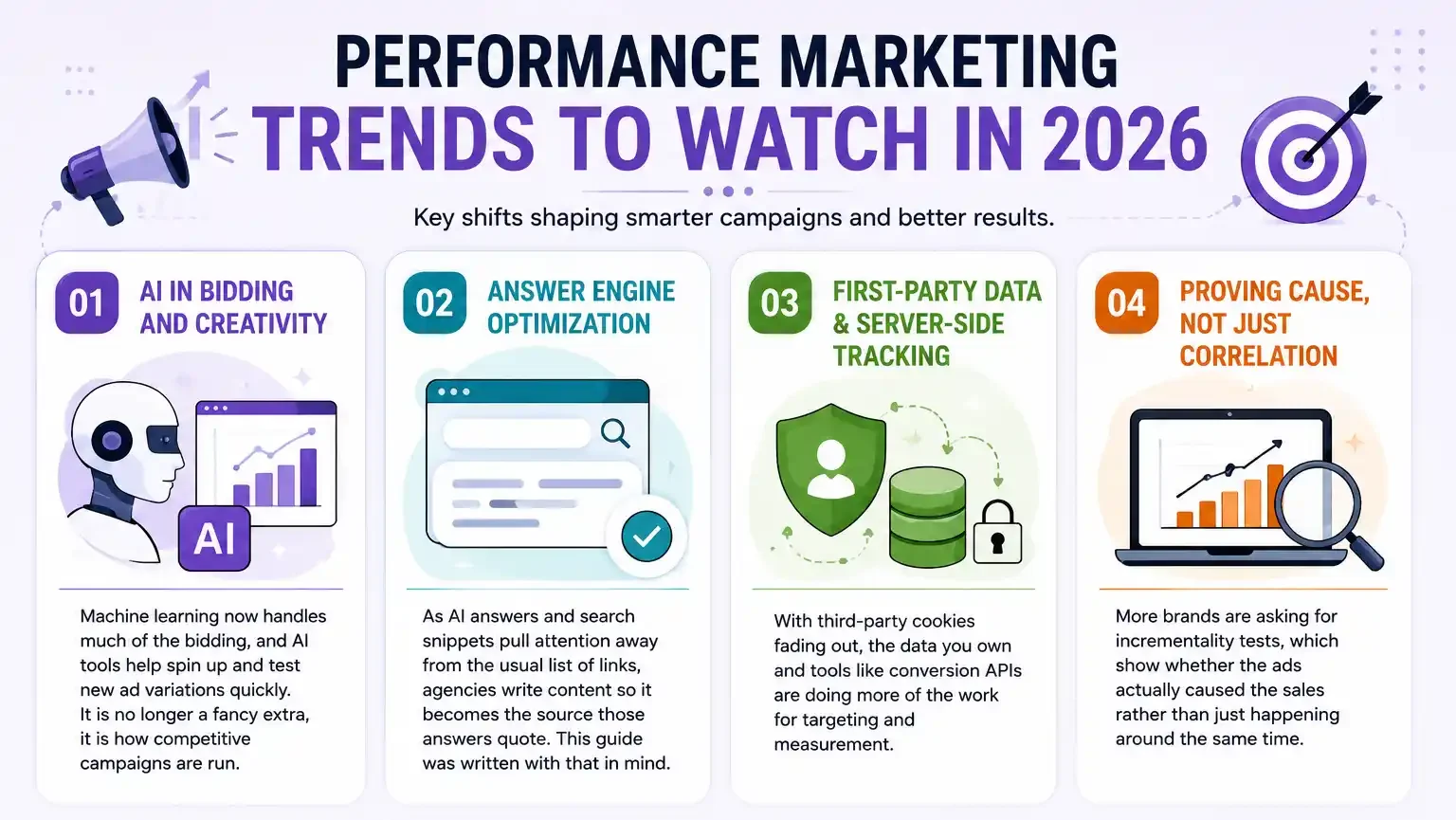
- AI in bidding and creativity : Machine learning now handles much of the bidding, and AI tools help spin up and test new ad variations quickly. It is no longer a fancy extra, it is how competitive campaigns are run.
- Answer engine optimization : As AI answers and search snippets pull attention away from the usual list of links, agencies write content so it becomes the source those answers quote. This guide was written with that in mind.
- First-party data and server-side tracking : With third-party cookies fading out, the data you own and tools like conversion APIs are doing more of the work for targeting and measurement.
- Proving cause, not just correlation : More brands are asking for incrementality tests, which show whether the ads actually caused the sales rather than just happening around the same time.
Conclusion
A performance marketing agency is only as valuable as its ability to connect marketing activity with business outcomes. Beyond managing campaigns, it should help you understand where your budget is creating value, where improvements are needed, and how performance changes over time. That level of visibility is what will help businesses like yours to make better marketing decisions, and not simply just better advertising campaigns.
Ready to scale? Consult us for a results-driven performance marketing strategy tailored to your business goals.
Frequently Asked Questions
-
What does a performance marketing agency do?
Ans.It plans, runs, and improves digital campaigns where you pay for measurable results, such as clicks, leads, installs, or sales, across channels like paid search, paid social, programmatic, affiliate, and SEO, and it reports on numbers like ROAS and CPA. -
What is the difference between performance marketing and digital marketing?
Ans.Digital marketing is the wide umbrella that covers brand, content, and awareness. Performance marketing is the results-focused slice of it, built for measurable actions and billed against outcomes rather than activity. -
How much does a performance marketing agency cost?
Ans.Most charge a monthly retainer of roughly 2,500 to 12,000 dollars or more, a fee of 10 to 20 percent of ad spend, a performance-based fee, or a mix. Whichever model you pick, the fee is separate from your ad budget. -
How long until a performance marketing agency delivers results?
Ans.Expect the first signs within a few weeks, and a steady, profitable return on ad spend in about two to three months, once there is enough conversion data to optimize with confidence. -
What channels do performance marketing agencies use?
Ans.Usually paid search on Google and Bing, paid social on Meta, TikTok, and LinkedIn, programmatic and connected TV, affiliate partnerships, and SEO. The right mix depends on where your buyers are and your target cost per result. -
Is a performance marketing agency worth it?
Ans.For businesses that want growth they can track and hold someone accountable for, yes. You get specialist skills, ad tech, and clear reporting, and your budget flows toward what actually converts. -
How do I choose a performance marketing agency?
Ans.Pick one that reports on revenue rather than vanity numbers, can show relevant case studies and a clear way of measuring results, keeps its pricing transparent, and lets you keep ownership of your ad accounts and data.
Author Details

Latest Posts
-
 22 / Sep
Digital Marketing Digital Marketing for Ecommerce Brands: The 2027 Growth Playbook
22 / Sep
Digital Marketing Digital Marketing for Ecommerce Brands: The 2027 Growth Playbook -
 15 / Sep
-
 04 / Sep
-
 29 / Jul
Search Engine Optimization 6 Enterprise SEO Mistakes That Quietly Cost You Millions
29 / Jul
Search Engine Optimization 6 Enterprise SEO Mistakes That Quietly Cost You Millions -
 24 / Jul
Blogs
Journey into Ideas Unveiling Tomorrow's Insights Today.

-
What does a performance marketing agency do?
Ans.It plans, runs, and improves digital campaigns where you pay for measurable results, such as clicks, leads, installs, or sales, across channels like paid search, paid social, programmatic, affiliate, and SEO, and it reports on numbers like ROAS and CPA. -
What is the difference between performance marketing and digital marketing?
Ans.Digital marketing is the wide umbrella that covers brand, content, and awareness. Performance marketing is the results-focused slice of it, built for measurable actions and billed against outcomes rather than activity. -
How much does a performance marketing agency cost?
Ans.Most charge a monthly retainer of roughly 2,500 to 12,000 dollars or more, a fee of 10 to 20 percent of ad spend, a performance-based fee, or a mix. Whichever model you pick, the fee is separate from your ad budget. -
How long until a performance marketing agency delivers results?
Ans.Expect the first signs within a few weeks, and a steady, profitable return on ad spend in about two to three months, once there is enough conversion data to optimize with confidence. -
What channels do performance marketing agencies use?
Ans.Usually paid search on Google and Bing, paid social on Meta, TikTok, and LinkedIn, programmatic and connected TV, affiliate partnerships, and SEO. The right mix depends on where your buyers are and your target cost per result. -
Is a performance marketing agency worth it?
Ans.For businesses that want growth they can track and hold someone accountable for, yes. You get specialist skills, ad tech, and clear reporting, and your budget flows toward what actually converts. -
How do I choose a performance marketing agency?
Ans.Pick one that reports on revenue rather than vanity numbers, can show relevant case studies and a clear way of measuring results, keeps its pricing transparent, and lets you keep ownership of your ad accounts and data.