


SEO vs PPC: Which Channel Will Work Better For Your Business?

-
Updated Date
Aug-20-2026
-
Views
2 Min Read
-
Author: PromotEdge Digital
-
Updated Date: Aug-20-2026
-
Views: 2 Min Read
-
Author: Anindita Barik
SEO vs PPC—discover which channel drives better results for your business. SEO builds long-term organic visibility, trust, and sustainable traffic, while PPC delivers instant exposure and quick leads through paid ads. The right choice depends on your goals, budget, competition, and timeline for measurable growth and smarter ROI decisions.
SEO and PPC are both search marketing channels with different strengths. SEO builds long-term organic visibility over 3–6 months without ongoing ad spend, while PPC delivers immediate paid traffic with full budget control. For most businesses, the best approach combines both: PPC for immediate leads and SEO for sustainable, compounding growth.
In today’s digital world, businesses need a strong online presence to grow. Customers often search online for products and services first, making digital marketing essential for success. In various available strategies, SEO (Search Engine Optimization) and PPC (Pay-Per-Click) stand out as two of the most effective methods for driving traffic and generating potential customers.
Both SEO and PPC provide unique benefits, but choosing the right approach depends on business goals, budget and timeline. The SEO content focuses on creating long -term organic visibility through adaptation, feedbacks and technical reforms.
This helps companies establish credibility and attract free traffic from the search engine. On the other hand, the PPC search engine provides quick results by placing ads paid on top of the results pages (SERP), making it ideal for fast leading and promotion.
Understanding the strength and weaknesses of SEO vs PPC is important for making an informed decision. Whether you are aiming for permanent development or requiring immediate traffic, choosing the right digital marketing channel can cause all differences. If you are looking for a long -term solution, consider our search engines adaptation services to operate permanently organic traffic.
How Do SEO and PPC Compare in Cost, Speed, and ROI?
When deciding between SEO and PPC, it is necessary to understand their major differences. SEO is a long -term strategy that focuses on adjusting websites for systematic ranking on search engines, making it a cost -effective solution over time.
Although the results take 3-6 months to see, organic Search Engine Optimization creates reliability, the brand increases visibility and generates durable, free traffic without ongoing advertising costs. The quality of organic traffic is often high because users rely on unjustified search results.
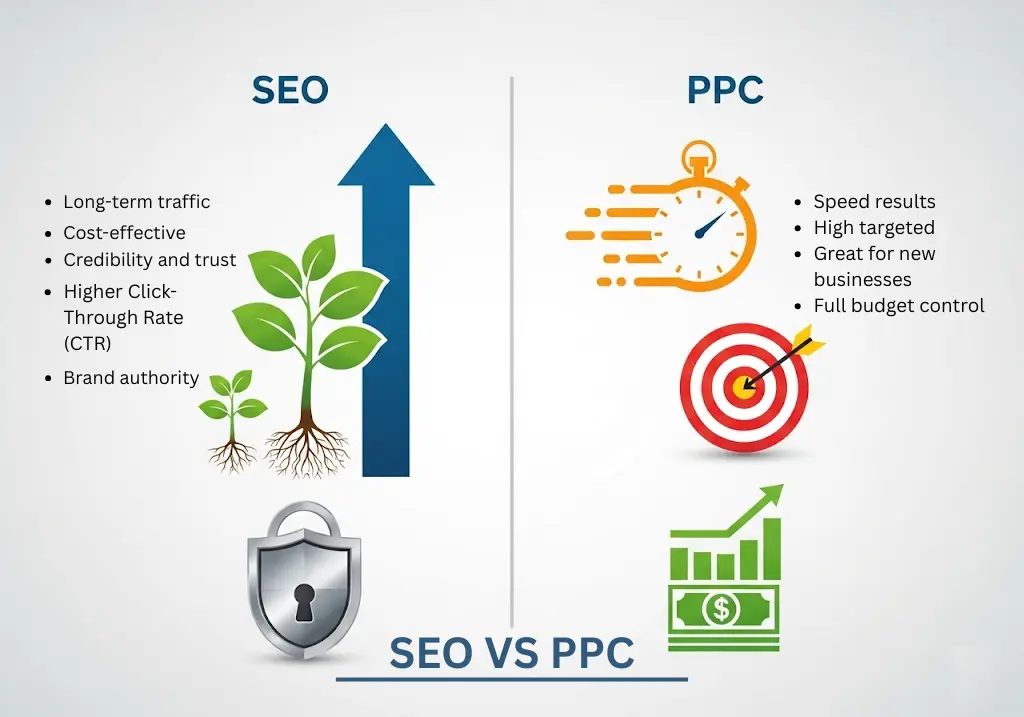
On the other hand, PPC (Pay-Per-Click) provides quick results by viewing ads paid on top of Google’s search results. The business pays per click, which means that traffic stops the moment when the budget expires.
While PPC provides highly targeted ads and lets companies now specific target groups, the costs are high and running. Traffic quality varies depending on factors such as ad copy, targeting and tender strategy.
Finally, SEO is a long -term investment, while PPC is a short -term solution for companies that require immediate traffic. The best approach often involves using both – taking PPC to rapid visibility for permanent visibility. Understanding the difference between SEO and PPC advertising helps companies to make informed marketing decisions based on the budget and goals.
| Factor | SEO (Organic) | PPC (Paid) |
|---|---|---|
| Cost | Time & content investment; no per-click fee | Pay per click — stops when budget stops |
| Speed to Results | 3–6 months typically | Immediate (same day) |
| Longevity | Compounding — traffic grows over time | Traffic stops when ads are paused |
| Trust & Credibility | Higher — users trust organic results | Lower — users aware it is an ad |
| Conversion Rate | ~2.4% average (SEO) | ~1.3% average (PPC) |
| Best For | Long-term brand building, content marketing | Product launches, promotions, fast leads |
| Measurability | Google Search Console, GA4 | Google Ads dashboard — precise attribution |
| ROI Timeline | 6–12+ months to peak ROI | ROI visible within days/weeks |
What Is SEO and How Does It Work for Businesses?
SEO helps companies rank systematically on search engines like Google. This involves optimizing the sites by focusing on keywords, feedbacks, quality of materials and technical SEOs. Unlike the paid ads, SEO generates free, organic traffic that continues to grow over time.
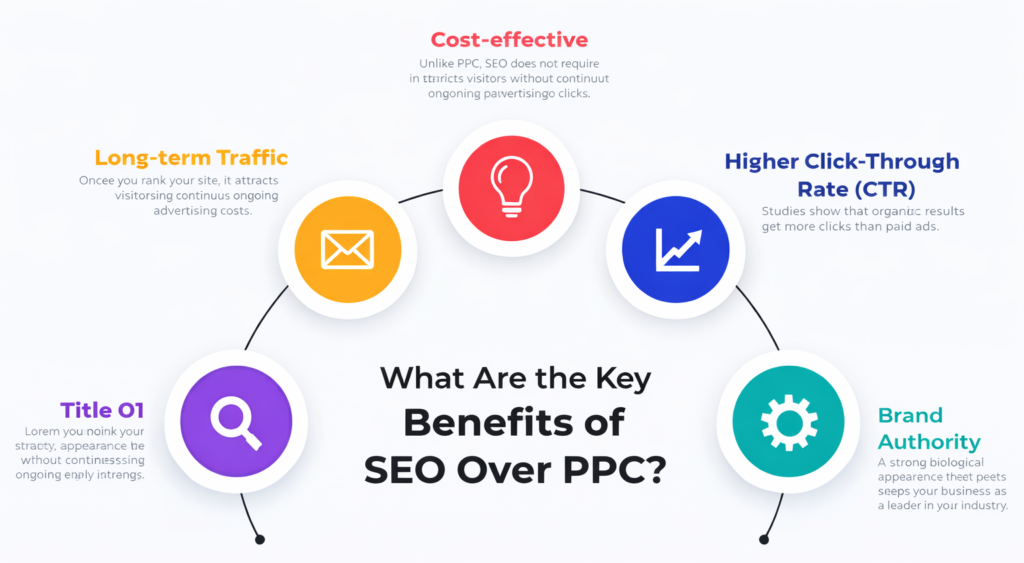
What Are the Key Benefits of SEO Over PPC?
- Long-term traffic: Once you rank your site, it attracts visitors without continuous ongoing advertising costs.
- Cost-effective: Unlike PPC, SEO does not require continuous payment for clicks.
- Credibility and trust: Users consider organic search results as more reliable than paid ads.
- Higher Click-Through Rate (CTR): Studies show that organic results get more clicks than paid ads.
- Brand authority: A strong biological appearance keeps your business as a leader in your industry.
SEO is a powerful tool for small businesses that want to set up online authority. This allows companies to compete with large brands by optimizing materials for their websites and relevant findings. Although SEO takes time to show the results, long-term return on investment (ROI) on investment make it a meaningful strategy for companies seeking permanent growth.
Staying updated with the latest trends and algorithm changes is important for SEO success. Learn about the latest SEO strategies to stay ahead in 2026.
What Is PPC Advertising and When Should You Use It?
PPC (Pay-Per-Click) advertising is a digital marketing strategy where businesses bid on keywords to display ads at the top of Google search results. Unlike SEO, which requires time to build rankings, PPC delivers immediate visibility. Each time someone clicks on an ad, the advertiser pays a fee, making it a fast but potentially costly method of driving traffic.
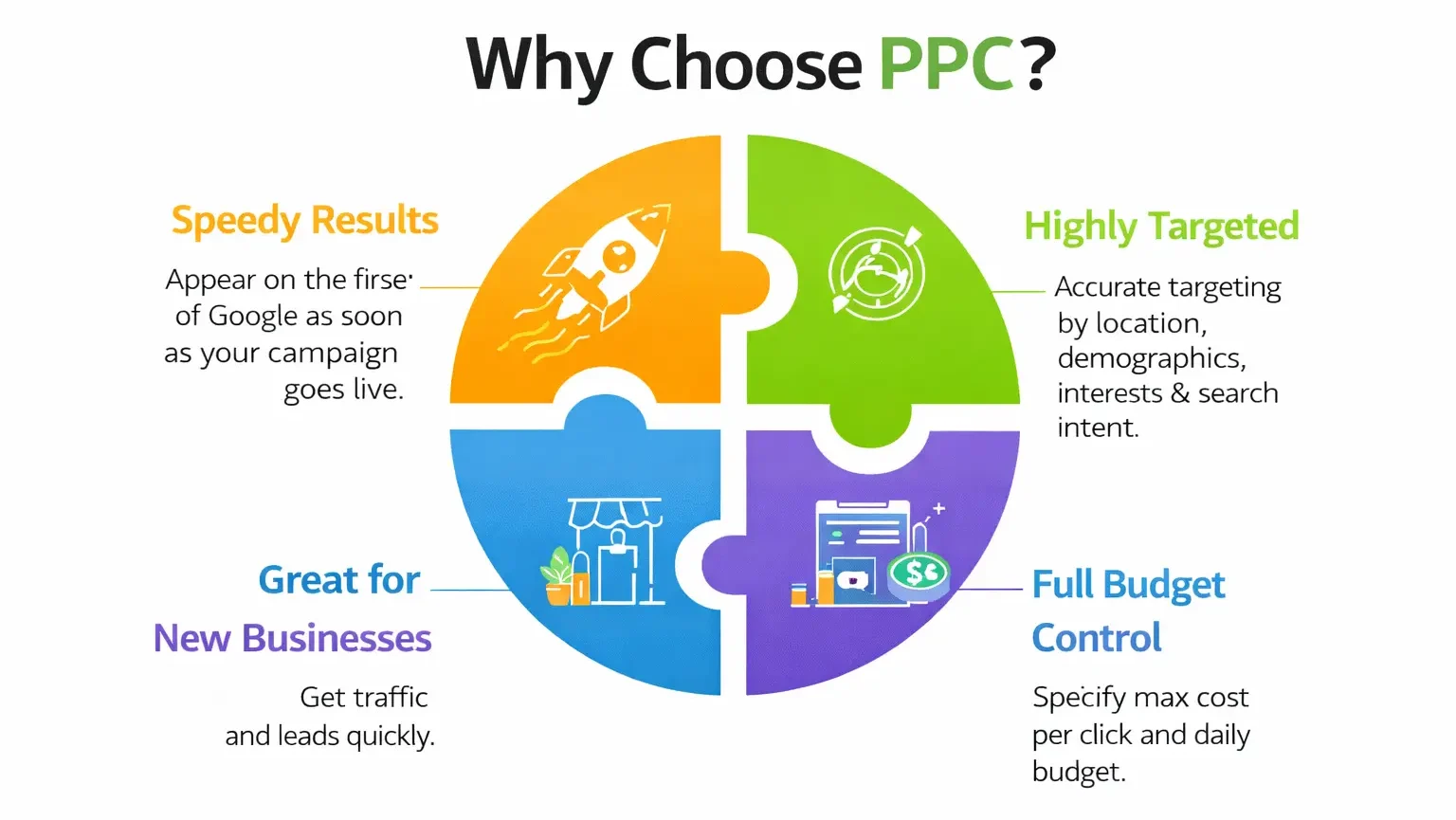
Why Choose PPC?
- Speed results: Your business can be displayed on the first page of Google as soon as your campaign becomes live.
- High targeted: PPC allows accurate targeting based on location, demographics, interests and exploration intentions.
- Great for new businesses: if you need traffic and lead quickly, PPC can promote immediately.
- Full budget control: to effectively score campaigns, specify maximum cost per click and daily budget.
However, PPC can be animals if not adapted to properly. Poor targeting or high competition can quickly empty the budget. In order to maximize the return, companies must implement strategic advertising campaigns with effective bids and targeting of the public. Explore our performance marketing services to run cost -effective PPC campaign that produces average results.
Pros and Cons of SEO for Businesses
SEO provides many benefits, making it a preferred strategy for sustainable growth companies. The main advantage is that it creates long -term reliability and trust with users. Unlike the PPC, SEO does not require pay per click, making it a cost-effective solution for a long time. Companies that invest in SEO are experiencing better returns over time, as organic traffic continues to flow even after initial adaptation.
However, SEO is not without the challenges. An important negative side is that it takes months to show concrete results. The ranking on the search engine requires continuous efforts in material construction, link production and technical adaptation. In addition, algorithm can affect update ranking and requires ongoing adjustment. For companies that want to maximize the SEO efforts, professional guidance can be invaluable. Check out our professional SEO services to ensure long-term success.
Pros and Cons of PPC for Businesses
PPC is an excellent choice for companies that require immediate visibility and quick results. Unlike SEO, which takes time to make, the PPC advertising campaign appears at the top of the search results as soon as it starts.
Another great advantage is that it has high -level control – the business can adjust dialects, can test different advertising copies and refine targeting to maximize conversions. In addition, PPC is perfect for testing new markets and campaign campaigns, so companies can see immediate commitment.
However, PPC comes with deficiencies. This can be expensive over time, as businesses should continuously pay for clicks. The moment a PPC budget comes out, traffic stops, unlike SEO, where ranking and organic traffic continue. In addition, PPC competition can increase costs, making it challenging for small companies with limited marketing budgets. If you need a specialist PPC management, you can find out our Google Advertising campaign services to customize your advertising expenses.
Which Channel is Better for Different Types of Businesses?
The determination of the best marketing channel depends on the nature of the business and its specific goals. Local companies benefit from a combination of local SEOs and Google ads, as SEO helps them rank them to local search results, while PPC ensures immediate visibility and fast lead generations.
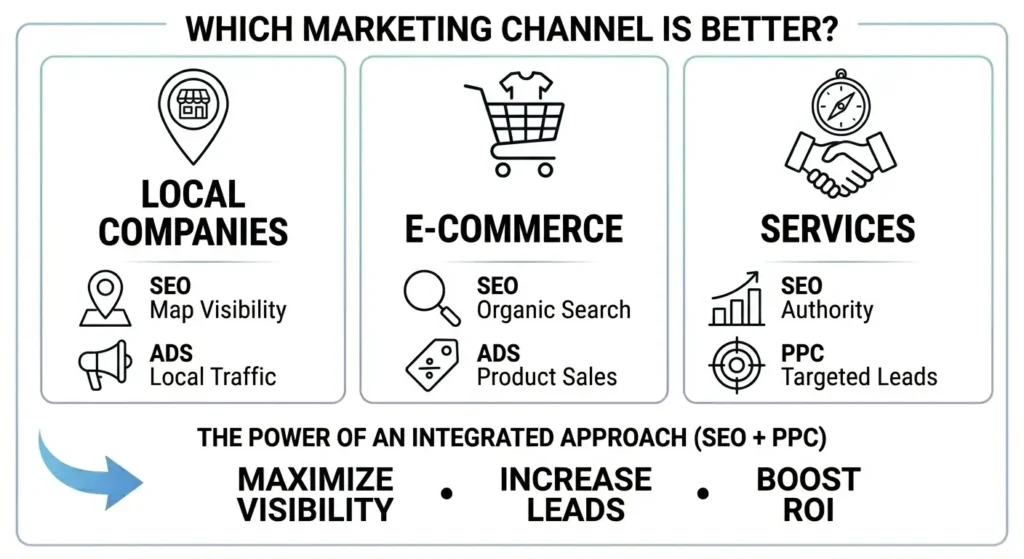
E-commerce companies must invest in SEOs for product pages to improve organic ranking, while Google Shopping ads are ready to buy customers by targeting and selling them immediately.
For service -based businesses, a balanced approach works best. The content SEO helps to create long -term reliability and confidence, so that companies can establish themselves as industry leaders. Meanwhile, PPC campaign users actively generate a quick lead by targeting users who detect specific services. Since different strategies meet different needs, companies should consider their priorities before deciding on the most effective approach.
Most companies show that an integrated SEO and PPC strategy gives the best results. SEO ensures permanent growth and increases the branding authority, while PPC provides fast traffic and conversion. With effective advantage of both strategies, companies can maximize visibility, increase the lead generation and optimize the marketing of ROI.
Whether your goal is long-term organic growth or short-term paid traffic, a well-planned digital marketing strategy can help your business achieve sustainable success in a competitive online market.
Should You Use SEO and PPC Together? (Best Strategy for 2026)
In 2026, the most effective digital marketing strategy is a combination of SEO and PPC, as both channels complement each other in unique ways. SEO focuses on long -term development by improving organic rankings, increasing reliability and driving permanent traffic over time.
However, it takes months to show the results of SEO, which is why PPC acts as an excellent short -term solution to attract visitors immediately to attract visitors and to achieve traction to SEO’s efforts. By using rapid visibility for long -term branding authority and PPC for SEO, the business can establish a strong digital appearance that provides continuous success.
When they are strategically integrated, SEO and PPC improve the total brand, adapt prices and return on investment (ROI). PPC ad can provide valuable keyword data that reports SEO strategies, while highly ranked SEO content can reduce the dependence on ads paid in the long term.
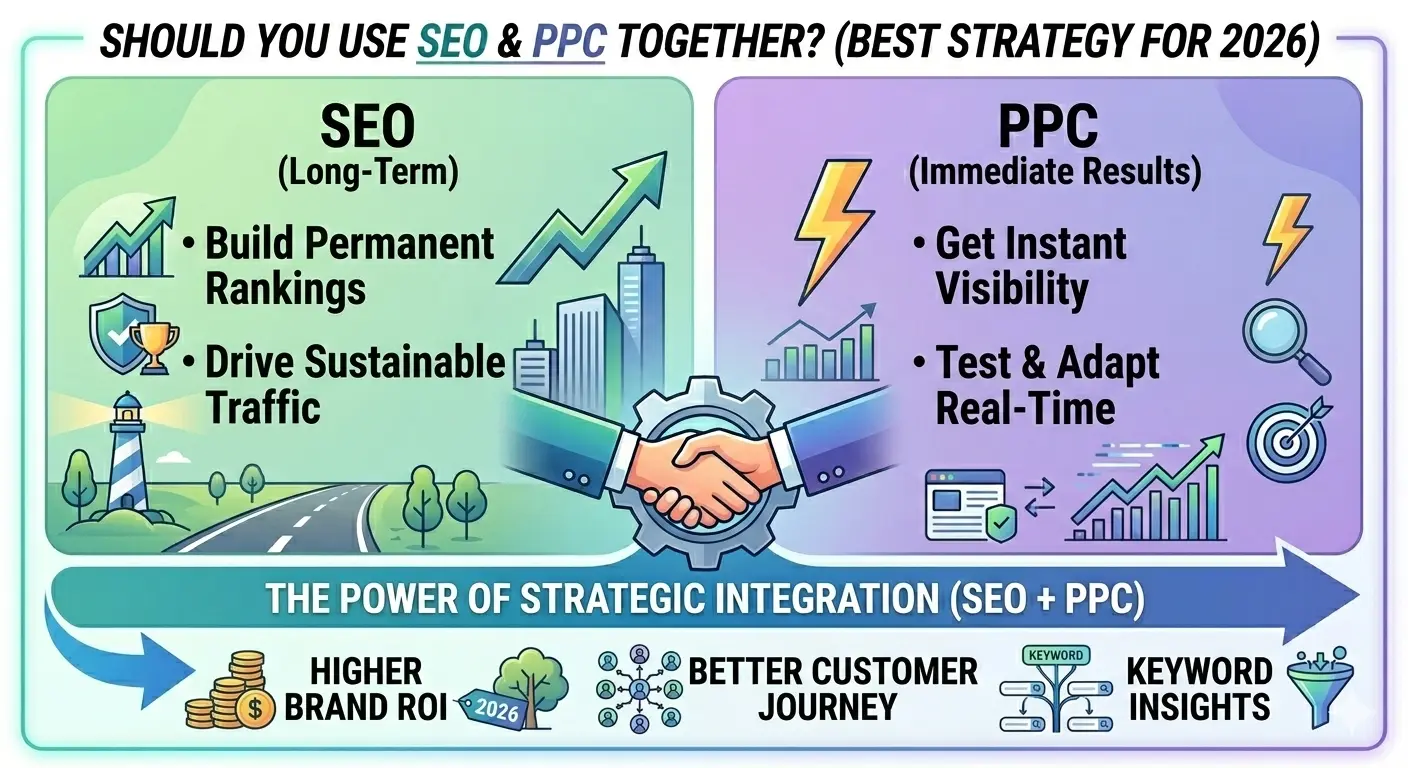
Companies that combine both methods experience higher engagement, better lead generation, and stronger long-term results than those that rely on a single channel. While PPC can drive quick traffic, SEO is what builds sustainable growth. If you’re looking to understand the key steps involved, explore this SEO guide for small business owners. Ultimately, balancing organic and paid traffic helps businesses achieve both immediate wins and long-term success.
A hybrid SEO and PPC get a competitive advantage by maximizing business access in strategy, advertising expenses and running regular revenues. Whether your goal is to market sales quickly or build a long -lasting brand appearance, integration of SEO and PPC is the best approach to 2026 and beyond.
SEO vs PPC: What Is the Cost Difference for Small Businesses?
The cost of SEO and PPC varies depending on several factors including industry competitions, target groups and business goals. SEO usually requires a pre -investment from $ 500 to $ 2000 per month, depending on the level of adaptation, material construction and coupling insert.
While the result takes time to see, SEO is usually more cost -effective in the long term, as it produces continuous organic traffic without ongoing advertising costs.
On the other hand, PPC gives immediate visibility, but comes with an anticipatory cost that can range from $1 to $10 depending on keyword competition and target parameters.
While PPC can run immediate traffic and conversion, businesses must distribute a budget continuously to maintain visibility. Finally, the choice between SEO and PPC should match the company’s financial capacity, marketing goals and development strategy.
Which One Should Your Business Choose?
The range between SEO and PPC depends on several important factors, including budget, timeline and business goals. SEO is a long -term investment that creates reliability and operates permanently organic traffic. Although it takes time often for months to see the most important results, the benefits are permanent, making it a cost -effective solution for a long time.
By continuously adjusting website content, earning feedbacks and improving technical SEOs, companies can achieve high rankings and reduce the dependence on paid advertising.
On the other hand, PPC provides immediate visibility, making it ideal for companies that require fast traffic and immediate lead generations. However, the cost of paid campaigns can be added, especially in competing industries, and when the budget ends, traffic stops.
For best results, companies should consider integrating both SEO and PPC to maximize marketing efforts. A well -structured PPC campaign can provide quick gain while the SEO effort forms long -term authority and organic traffic.
By taking advantage of both strategies, companies can increase brand awareness, attract high -quality potential customers and ensure a stable stream of traffic over time. Whether you are aiming for permanent growth or instant conversion, our full digital marketing services in the USA can help you achieve your goals.
If you are looking for expert results on SEO, explore our Search Engine Optimization Services in USA to enhance your organic reach. Additionally, check out Top SEO Companies in the USA and learn How to Rank Your Business on ChatGPT AI Tools to stay ahead in 2026. A well-balanced marketing strategy with a combination of SEO and PPC ensures long -term success in an ever -evolving digital landscape. Get your free digital marketing consultation today!
-
What is the main difference between SEO and PPC?
Ans.SEO (Search Engine Optimization) earns organic traffic by improving your site's relevance and authority over time, with no cost per click. PPC (Pay-Per-Click) buys immediate placement in search results through paid ads. SEO results compound over months; PPC delivers instant visibility but stops the moment you pause your budget. -
How long does SEO take to show results?
Ans.Most businesses begin seeing meaningful SEO results in 3 to 6 months, though competitive niches may take 9 to 12 months. Unlike PPC, SEO results compound — once you rank, traffic often continues growing without proportional increases in spend. -
Is PPC worth it for a small business with a limited budget?
Ans.Yes, PPC can be highly effective for small businesses, especially for time-sensitive promotions or local lead generation. Starting with a modest budget of ₹10,000–₹30,000 per month allows testing before scaling. The key is targeting high-intent, specific keywords to maximise ROI. -
Can SEO and PPC work together?
Ans.Absolutely. Running SEO and PPC simultaneously offers the best results. PPC provides instant visibility while your SEO strategy matures. PPC data (high-converting keywords, ad copy that resonates) also informs your SEO content strategy, reducing guesswork and accelerating organic growth. -
Which channel has a better ROI — SEO or PPC?
Ans.SEO typically delivers a higher long-term ROI. Studies show SEO converts at approximately 2.4% versus PPC's 1.3%, and organic traffic continues generating results without ongoing spend. However, PPC offers faster, more measurable short-term ROI and is easier to attribute directly to revenue. -
What is a good monthly budget for PPC advertising in India?
Ans.For small-to-medium Indian businesses, a starting PPC budget of ₹15,000–₹50,000 per month on Google Ads is reasonable. E-commerce and competitive sectors may require ₹1 lakh or more. The global average cost-per-click on Google Ads was $4.66 (approximately ₹388) in 2024, though India CPCs are significantly lower.
Author Details

Latest Posts
-
 04 / Sep
-
 29 / Jul
Search Engine Optimization 6 Enterprise SEO Mistakes That Quietly Cost You Millions
29 / Jul
Search Engine Optimization 6 Enterprise SEO Mistakes That Quietly Cost You Millions -
 24 / Jul
-
 23 / Jul
Search Engine Optimization How to Improve Organic SEO: A Practical 2026 Guide
23 / Jul
Search Engine Optimization How to Improve Organic SEO: A Practical 2026 Guide -
21 / Jul
Search Engine Optimization Organic SEO vs Paid SEO: Which Is Better in 2026?
Blogs
Journey into Ideas Unveiling Tomorrow's Insights Today.










-
What is the main difference between SEO and PPC?
Ans.SEO (Search Engine Optimization) earns organic traffic by improving your site's relevance and authority over time, with no cost per click. PPC (Pay-Per-Click) buys immediate placement in search results through paid ads. SEO results compound over months; PPC delivers instant visibility but stops the moment you pause your budget. -
How long does SEO take to show results?
Ans.Most businesses begin seeing meaningful SEO results in 3 to 6 months, though competitive niches may take 9 to 12 months. Unlike PPC, SEO results compound — once you rank, traffic often continues growing without proportional increases in spend. -
Is PPC worth it for a small business with a limited budget?
Ans.Yes, PPC can be highly effective for small businesses, especially for time-sensitive promotions or local lead generation. Starting with a modest budget of ₹10,000–₹30,000 per month allows testing before scaling. The key is targeting high-intent, specific keywords to maximise ROI. -
Can SEO and PPC work together?
Ans.Absolutely. Running SEO and PPC simultaneously offers the best results. PPC provides instant visibility while your SEO strategy matures. PPC data (high-converting keywords, ad copy that resonates) also informs your SEO content strategy, reducing guesswork and accelerating organic growth. -
Which channel has a better ROI — SEO or PPC?
Ans.SEO typically delivers a higher long-term ROI. Studies show SEO converts at approximately 2.4% versus PPC's 1.3%, and organic traffic continues generating results without ongoing spend. However, PPC offers faster, more measurable short-term ROI and is easier to attribute directly to revenue. -
What is a good monthly budget for PPC advertising in India?
Ans.For small-to-medium Indian businesses, a starting PPC budget of ₹15,000–₹50,000 per month on Google Ads is reasonable. E-commerce and competitive sectors may require ₹1 lakh or more. The global average cost-per-click on Google Ads was $4.66 (approximately ₹388) in 2024, though India CPCs are significantly lower.