


How to Measure Marketing Performance: A Practical 2026 Guide
-
Author
Anindita Barik
-
Updated Date
Jul-18-2026
-
Views
2 Min Read
-
Author: PromotEdge Digital
-
Updated Date: Jul-18-2026
-
Views: 2 Min Read
-
Author: Anindita Barik
Learn how to measure marketing performance with a practical framework that connects marketing activity to real business results. This guide explains the key marketing KPIs, including ROI, ROAS, CAC, CLV, and conversion rate, while covering attribution models, funnel-based metrics, data tracking, and common measurement mistakes. Discover how to evaluate campaign performance, optimize marketing spend, and make data-driven decisions that improve revenue, customer acquisition, and long-term marketing success in 2026.
Every quarter, the same question keeps coming up. Where did the marketing budget go, and what did it bring back? Campaigns may have generated clicks, leads, and traffic, but those numbers alone do not explain whether the investment delivered real business value. If you have ever been asked to justify marketing spend with clear financial results, you already know how difficult that conversation can become.
That challenge is becoming harder across the industry. In 2025, 64% of senior marketing leader named proving marketing’s impact on financial outcomes as their single biggest challenge. Expectations continue to rise, yet marketing teams are being asked to achieve more with the same, or even fewer, resources.
Gartner’s 2025 survey found that marketing budgets have flatlined at 7.7% of company revenue, with most marketing leaders saying that level of investment is not enough to support their plans. When budgets stop growing, every campaign, every channel, and every marketing decision comes under greater scrutiny.
That is exactly why measuring marketing ROI has become a business priority rather than just a marketing exercise. This guide explains how to calculate it, which metrics deserve your attention in 2026, and how to turn marketing data into insights that support better business decisions. No jargon, no fluff, just a practical framework you can start applying this week.
How do you measure marketing performance?
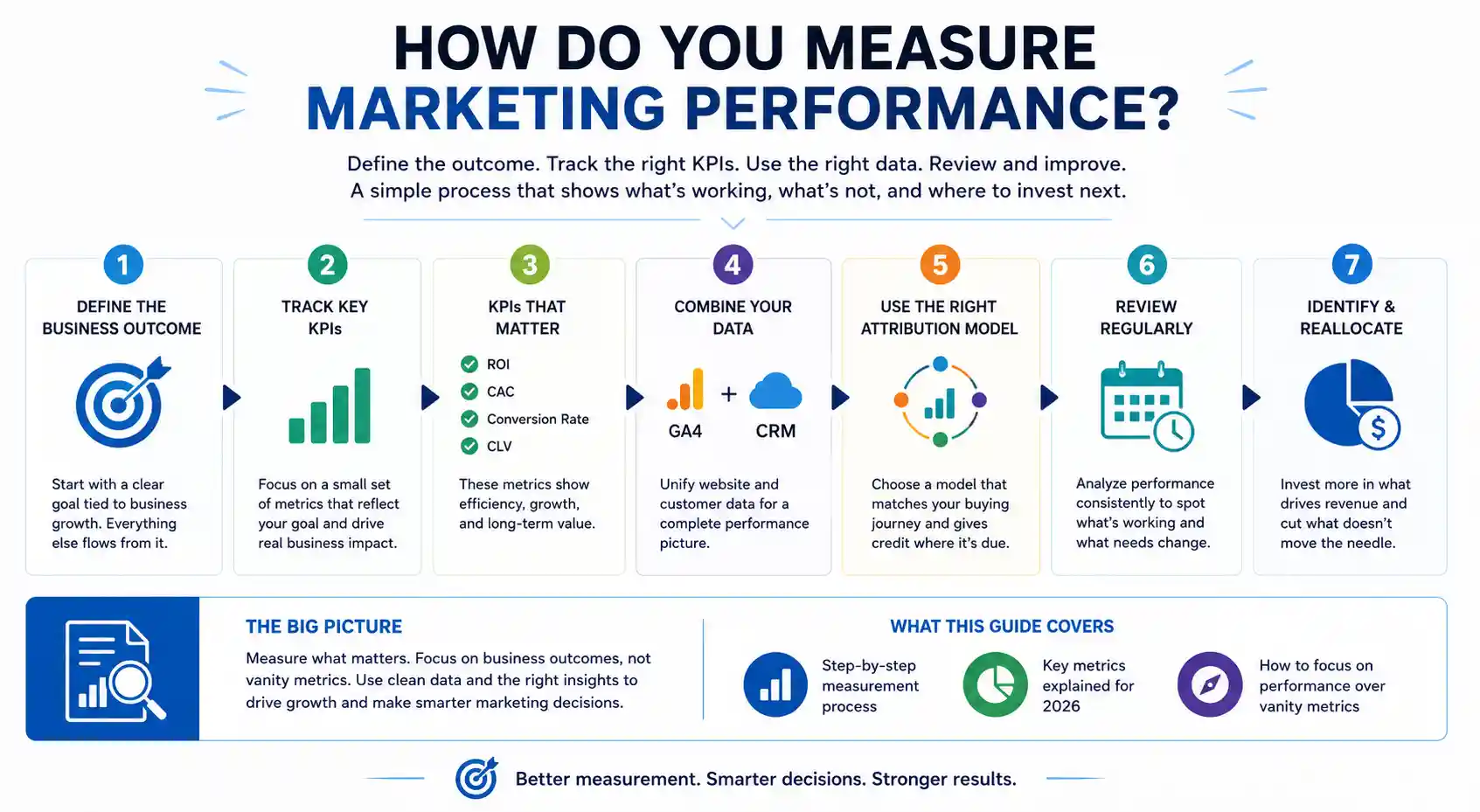
To measure marketing performance, start by defining the business outcome you want to achieve, then track a small set of KPIs that reflect that goal, including ROI, customer acquisition cost (CAC), conversion rate, and customer lifetime value (CLV). Combine data from GA4 and your CRM, use an attribution model that fits your buying journey, and review performance regularly so you can identify what is generating revenue and where your marketing budget should be reallocated.
That is the overview. The rest of this guide explains each step in detail, breaks down the metrics that matter most in 2026, and shows you how to focus on the numbers that reflect business performance instead of vanity metrics that add volume to reports without adding value.
What does measuring marketing performance actually mean?
Measuring marketing performance means tracking the right metrics and KPIs against your business goals, so you can understand what is working, improve what is not, and prove the value of your marketing investment.
Marketing performance acts as a reality check for every campaign. It shows which channels are generating business value, which campaigns are using budget without delivering enough in return, and where the next opportunity for growth lies. Done well, it replaces assumptions with evidence and gives you a clearer direction for every marketing decision.
If your bigger question is about the revenue your marketing generates rather than the metrics behind it, our detailed walkthrough on how to measure digital marketing ROI is the natural next read after this one.
How to measure marketing performance in 7 steps
The process below works across businesses of every size, from startups building their first campaigns to established brands managing multiple marketing channels. Follow each step in order, because every stage builds on the insights from the one before it.
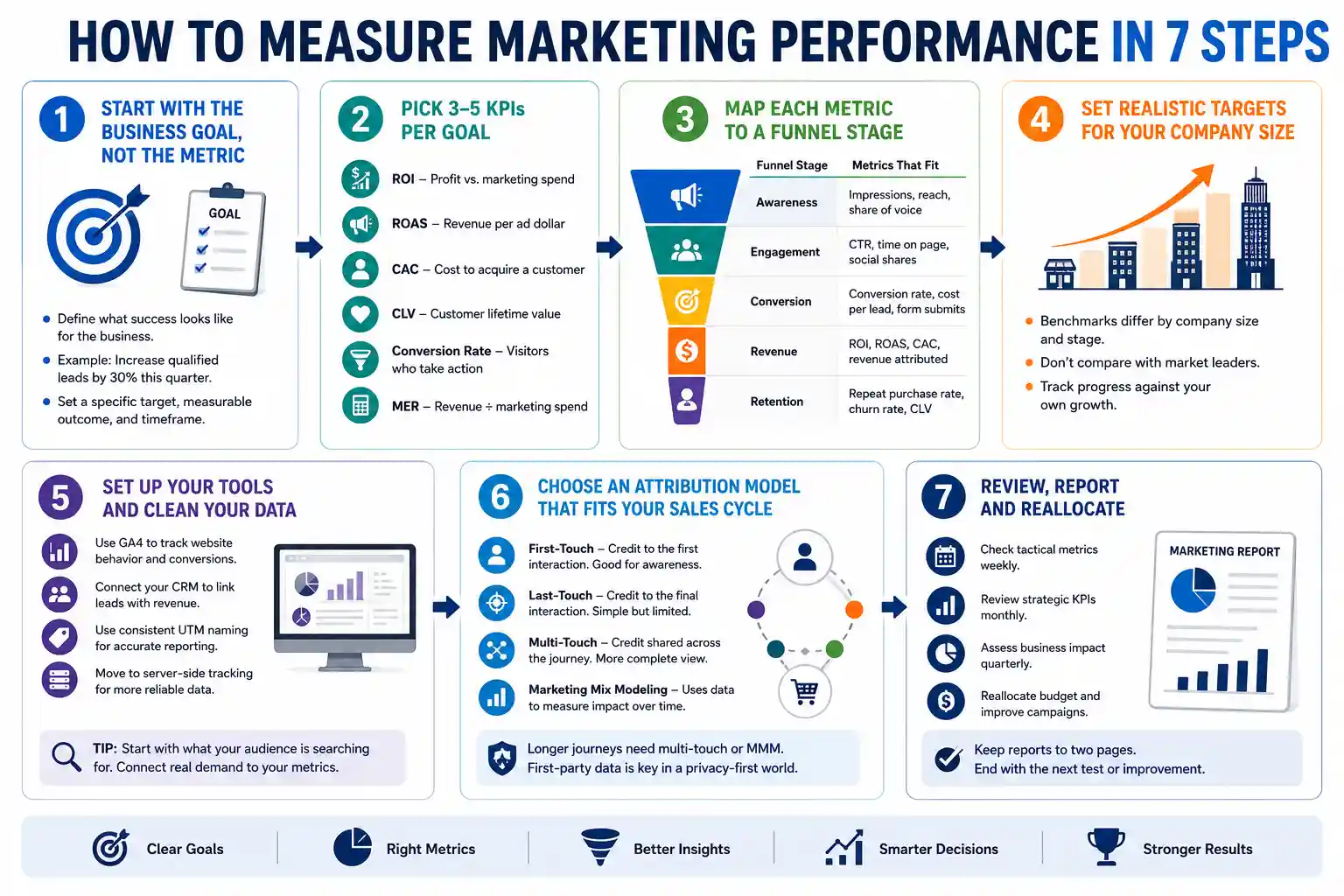
Step 1: Start with the business goal, not the metric
Before you look at reports or start tracking KPIs, decide what success looks like for the business. Are you trying to increase revenue, generate more qualified leads, reduce customer acquisition costs, or improve customer retention? Every metric you measure later should help answer whether that objective is being achieved.
A goal such as “increase qualified leads by 30% this quarter” gives your marketing efforts a clear direction and makes performance easier to evaluate. A vague objective like “increase website traffic” does not. Set a specific target, attach a measurable outcome, and define a timeframe before you begin measuring results.
Step 2: Pick three to five KPIs per goal
Once your business goal is clear, decide how you are going to measure it. Trying to track every available metric usually creates more confusion than clarity. A focused set of three to five KPIs gives you a much better understanding of whether your marketing is moving in the right direction.
Here are the KPIs that carry real weight:
- Return on investment (ROI): The profit you earned compared with what you spent on marketing. This is the number business leaders care about most.
- Return on ad spend (ROAS): Shows how much revenue your paid advertising brings in for every dollar spent on ads.
- Customer acquisition cost (CAC): Calculates the average amount you spend to acquire a new customer across your marketing activities.
- Customer lifetime value (CLV): Estimates the total value a customer contributes to your business over the course of the relationship.
- Conversion rate: Measures the percentage of visitors who complete the action you want them to take, whether that is making a purchase, submitting a form, or signing up.
- Marketing efficiency ratio (MER): Total revenue divided by total marketing spend. It gives you a quick reality check on how efficiently your marketing investment is performing.
Step 3: Map each metric to a funnel stage
Every KPI has a purpose, but not every KPI belongs everywhere. Measuring an awareness campaign with revenue or a retention campaign with impressions can lead to the wrong conclusions. Match your metrics to the right stage of the marketing funnel, and your reports will tell a much more accurate story.
| Funnel stage | Metrics that fit |
|---|---|
| Awareness | Impressions, reach, share of voice, branded search volume |
| Engagement | Click-through rate, time on page, social shares, bounce rate |
| Conversion | Conversion rate, cost per lead, form submissions, demo bookings |
| Revenue | ROI, ROAS, CAC, revenue attributed to marketing |
| Retention | Repeat purchase rate, churn rate, customer lifetime value |
Step 4: Set realistic targets for your company size
Once you know which metrics to track, the next step is deciding what good performance actually looks like. That is where many businesses go wrong. Research by Paul Dyson found an 18x advertising profit multiplier tied to market share, showing that larger brands can generate stronger returns simply because they are already established in the market.
The lesson is simple. A startup should not measure its marketing performance against a market leader. Set benchmarks that match your stage of growth, and your results will tell you how far you have come instead of how far you have left to go.
Step 5: Set up your tools and clean your data
You cannot measure marketing performance without reliable tracking. Set up your measurement tools before you start analysing campaigns, because every KPI depends on accurate data. Miss this step, and every conclusion you draw becomes harder to trust.
- Use GA4 to understand how visitors interact with your website and where conversions happen.
- Connect your CRM, such as HubSpot or Salesforce, so marketing leads can be matched with actual revenue.
- Enforce consistent UTM naming so every campaign, channel, and traffic source is reported accurately, making performance comparisons much easier.
- Move to server-side tracking where you can, because browser-based tracking continues to lose visibility and incomplete data leads to incomplete reporting.
Start with what your audience is searching for before deciding which metrics to track. Our guide on keyword research for SEO helps you connect real demand to the metrics you report.
Step 6: Choose an attribution model that fits your sales cycle
Attribution decides which marketing touchpoint gets credit for a conversion. Choose the wrong model and you risk rewarding the channel that closed the sale while overlooking the one that created the opportunity.
- First-touch: gives all credit to the channel that started the customer journey, making it a good choice for measuring brand awareness and demand generation.
- Last-touch: gives all credit to the final interaction before conversion. It is simple to implement but overlooks the channels that influenced the decision earlier.
- Multi-touch: distributes credit across the customer journey, giving you a more complete picture of how different marketing channels work together.
- Marketing mix modeling: uses statistical analysis to measure how each marketing channel contributes to sales over time, making it well suited for privacy-first measurement.
A simple marketing journey with one or two channels can rely on last-touch attribution. A longer buying journey across multiple channels needs multi-touch attribution or marketing mix modeling. As third-party cookies disappear, first-party data and modeled measurement become more important every year.
Step 7: Review, report and reallocate
Review your marketing performance regularly instead of measuring it once and moving on. Check tactical metrics every week, review strategic KPIs every month, and assess business impact each quarter. Then use those insights to improve campaigns, reallocate budget, and strengthen future results.
Keep your leadership report to two pages. If you cannot explain your marketing performance that briefly, simplify the story before you present it. End every report with the next test or improvement you plan to make, because every review should lead to a better decision.
Why do your marketing numbers sometimes lie?
Your marketing data becomes misleading when your measurement setup misses key parts of the customer journey. A short attribution window, offline conversions, or branded searches can all give credit to the wrong channel and hide what actually influenced the sale.
A common mistake looks like this. Your reports credit branded search with the conversion, so you increase its budget. In reality, another campaign generated the demand first, but your attribution model failed to recognise its role.
The fix is incrementality testing. Pause a marketing channel for a few weeks, track what happens to sales, and measure what that channel actually contributed instead of what it simply touched. It is one of the closest things marketing has to a controlled experiment.
What is changing in marketing measurement in 2026?
Marketing measurement is changing quickly. If your reporting framework has not kept pace, these four shifts deserve your immediate attention right now.
- First-party data takes the lead: third-party cookie loss and privacy controls make first-party data and modeled conversions the foundation of accurate measurement.
- AI changes the customer journey: buyers now interact with AI Overviews and chat tools before they visit your website, making click-based measurement less complete.
- Email open rates lose credibility: privacy protection inflates, so clicks, replies, and conversions now provide a more reliable measure of engagement.
- Incrementality becomes the benchmark: marketing teams now test what each channel actually contributes instead of relying only on attributed conversions.
AI visibility has become a discipline of its own, and if that is part of your strategy, start with our guide on optimizing content for Google AI Overviews.
What are the most common measurement mistakes?
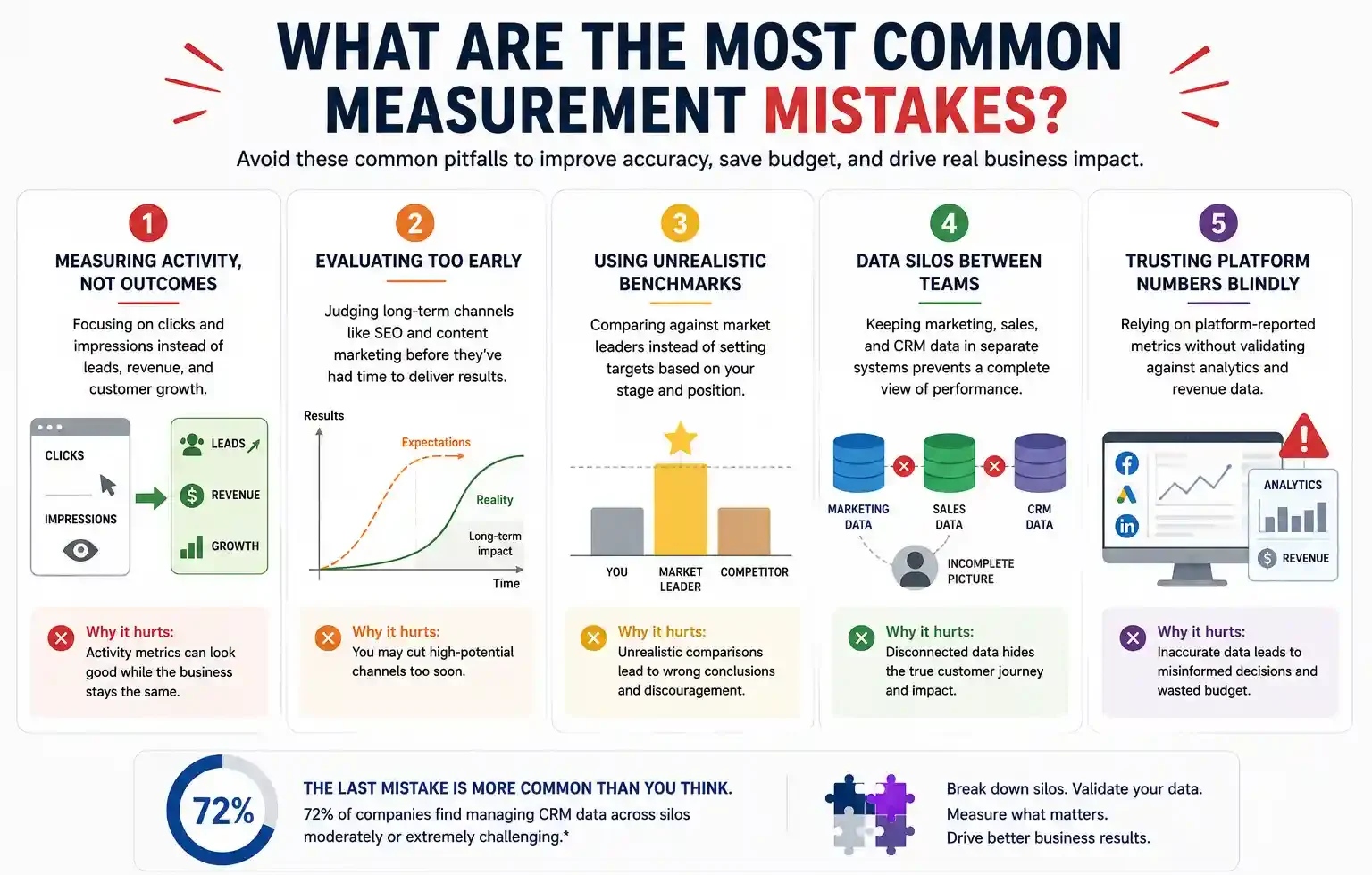
Most measurement problems come from the same few mistakes. Address them early, and you will save both budget and credibility.
- Measuring marketing activity, such as clicks and impressions, instead of business outcomes like leads, revenue, and customer growth.
- Evaluating long-term channels, such as SEO and content marketing, before they have enough time to produce measurable results.
- Comparing performance against unrealistic benchmarks instead of targets that reflect your business stage and market position.
- Keeping marketing, sales, and CRM data in separate systems that prevent a complete view of performance.
- Trusting platform-reported numbers without validating them against analytics and revenue data.
The last mistake deserves more attention because 72% of companies find managing CRM data across silos moderately or extremely challenging, and fragmented data quickly turns reliable measurement into unreliable reporting.
Conclusion
Marketing performance only creates value when it changes the decisions you make next. The businesses that improve year after year do not collect more data than everyone else. They measure the right metrics, act on what those metrics reveal, and invest where the evidence points.
Performance marketing works best when every campaign contributes to this process. Businesses that measure, optimize, and adapt this system are better positioned in terms of improving their marketing performance and maximizing their actual return on every marketing investment.
Ready to validate your marketing performance with reliable measurement? Talk to the PromotEdge Digital team and connect your marketing data to business results.
Frequently asked questions
-
What is the best way to measure marketing performance?
Ans.Start with a clear business goal, choose three to five KPIs that measure it, track performance in GA4 and your CRM, apply the right attribution model, and review the results regularly to improve future marketing decisions. -
What are the most important marketing KPIs to track?
Ans.Track ROI, ROAS, customer acquisition cost (CAC), customer lifetime value (CLV), and conversion rate. These metrics show how marketing contributes to revenue, customer growth, and business performance. -
How often should I measure marketing performance?
Ans.Review tactical metrics every week to identify issues early, evaluate strategic KPIs every month, and assess overall business impact every quarter. Give long-term channels like SEO and content marketing six to twelve months to deliver measurable results before you evaluate their performance. -
What is the difference between a vanity metric and a real metric?
Ans.Vanity metrics look impressive but rarely influence business decisions. Real metrics, such as customer acquisition cost (CAC), conversion rate, and ROI, help you evaluate performance and decide where to invest your marketing budget. -
How do I measure marketing performance without third-party cookies?
Ans.Use first-party data from your website and CRM, track consent-modeled conversions in GA4, and apply marketing mix modeling or incrementality testing to measure marketing performance more accurately. -
How is measuring marketing performance different from measuring ROI?
Ans.Marketing performance measures the effectiveness of your marketing across the entire customer journey. ROI measures one part of that performance by comparing the revenue or profit generated with the amount you invest in marketing.
Author Details

Latest Posts
-
 22 / Sep
Digital Marketing Digital Marketing for Ecommerce Brands: The 2027 Growth Playbook
22 / Sep
Digital Marketing Digital Marketing for Ecommerce Brands: The 2027 Growth Playbook -
 15 / Sep
-
 04 / Sep
-
 29 / Jul
Search Engine Optimization 6 Enterprise SEO Mistakes That Quietly Cost You Millions
29 / Jul
Search Engine Optimization 6 Enterprise SEO Mistakes That Quietly Cost You Millions -
 24 / Jul
Blogs
Journey into Ideas Unveiling Tomorrow's Insights Today.



-
What is the best way to measure marketing performance?
Ans.Start with a clear business goal, choose three to five KPIs that measure it, track performance in GA4 and your CRM, apply the right attribution model, and review the results regularly to improve future marketing decisions. -
What are the most important marketing KPIs to track?
Ans.Track ROI, ROAS, customer acquisition cost (CAC), customer lifetime value (CLV), and conversion rate. These metrics show how marketing contributes to revenue, customer growth, and business performance. -
How often should I measure marketing performance?
Ans.Review tactical metrics every week to identify issues early, evaluate strategic KPIs every month, and assess overall business impact every quarter. Give long-term channels like SEO and content marketing six to twelve months to deliver measurable results before you evaluate their performance. -
What is the difference between a vanity metric and a real metric?
Ans.Vanity metrics look impressive but rarely influence business decisions. Real metrics, such as customer acquisition cost (CAC), conversion rate, and ROI, help you evaluate performance and decide where to invest your marketing budget. -
How do I measure marketing performance without third-party cookies?
Ans.Use first-party data from your website and CRM, track consent-modeled conversions in GA4, and apply marketing mix modeling or incrementality testing to measure marketing performance more accurately. -
How is measuring marketing performance different from measuring ROI?
Ans.Marketing performance measures the effectiveness of your marketing across the entire customer journey. ROI measures one part of that performance by comparing the revenue or profit generated with the amount you invest in marketing.