


Digital Marketing Strategies for Financial Services in 2026

-
Updated Date
Jul-18-2026
-
Views
2 Min Read
-
Author: PromotEdge Digital
-
Updated Date: Jul-18-2026
-
Views: 2 Min Read
-
Author: Milan Shyamal
Picture this: a 42-year-old business owner just sold his company. He has serious money to invest, a retirement to plan, and zero idea where to start. He doesn’t walk into a bank. He opens Google.
At that moment, your firm either exists or it doesn’t.
This is the reality of financial services marketing in 2026. The client journey no longer starts with a referral or a branch visit — it starts with a search bar, a YouTube video, or a question typed into ChatGPT. Firms that have invested in the right digital marketing strategies for financial services are capturing those moments while others watch their pipeline quietly shrink.
The challenge is that financial services isn’t a forgiving vertical. Every marketing claim is under regulatory scrutiny, and trust — once lost — is nearly impossible to rebuild. This guide gives you a complete, compliance-aware digital marketing framework built for the way financial clients actually behave today.
What Is a Digital Marketing Strategy for Financial Services?
A digital marketing strategy for financial services is a structured plan that uses online channels — SEO, content marketing, paid advertising, email, and AI-powered personalization — to attract and convert clients while meeting compliance requirements like FINRA, SEC, FCA guidelines.
Unlike standard marketing, financial services strategy must account for:
- Longer buyer journeys and high-stakes decision making
- Significant trust deficits in the industry
- Strict regulatory oversight over advertising claims
Why Does Digital Marketing Matter for Financial Services in 2026?
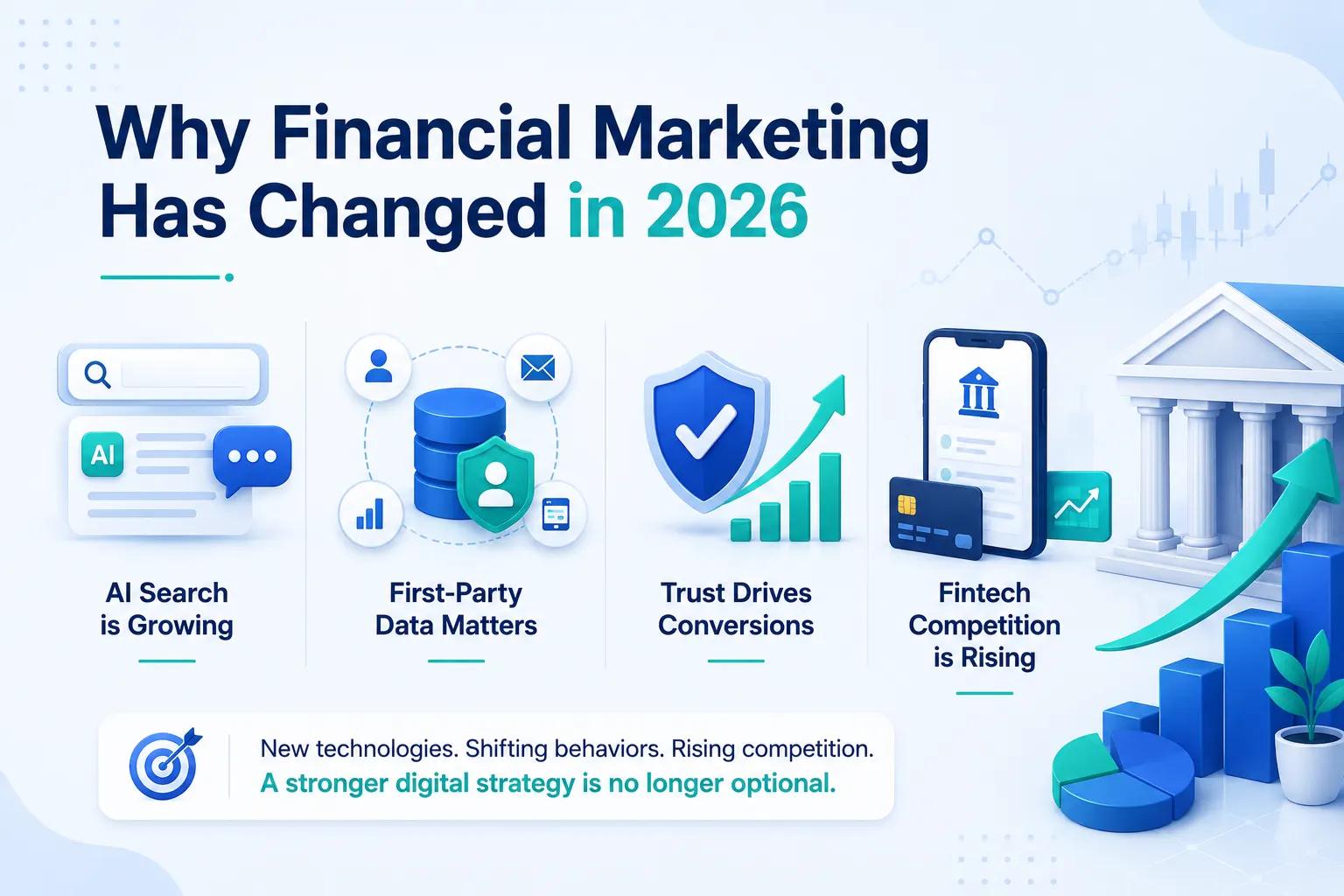
71% of financial product research now begins on search engines or social platforms. Your prospects are already searching — the question is whether they find you or a competitor.
Here’s what makes a structured digital strategy non-negotiable today:
- Generative AI & Answer Engines (ChatGPT, Perplexity, Google AI Overviews) now handle financial queries that once went to search results. Brands without AEO presence are invisible.
- Third-party cookie deprecation has forced financial marketers to shift to first-party data strategies.
- Trust is the primary conversion driver. Financial services remains one of the lowest-trusted industries globally — making content-led trust building a long-term competitive edge.
- Fintech competition has eroded traditional brand loyalty. Legacy banks and insurers now compete with neobanks and robo-advisors that spend heavily on digital.
The 8 Core Pillars of Digital Marketing Strategy for Financial Services
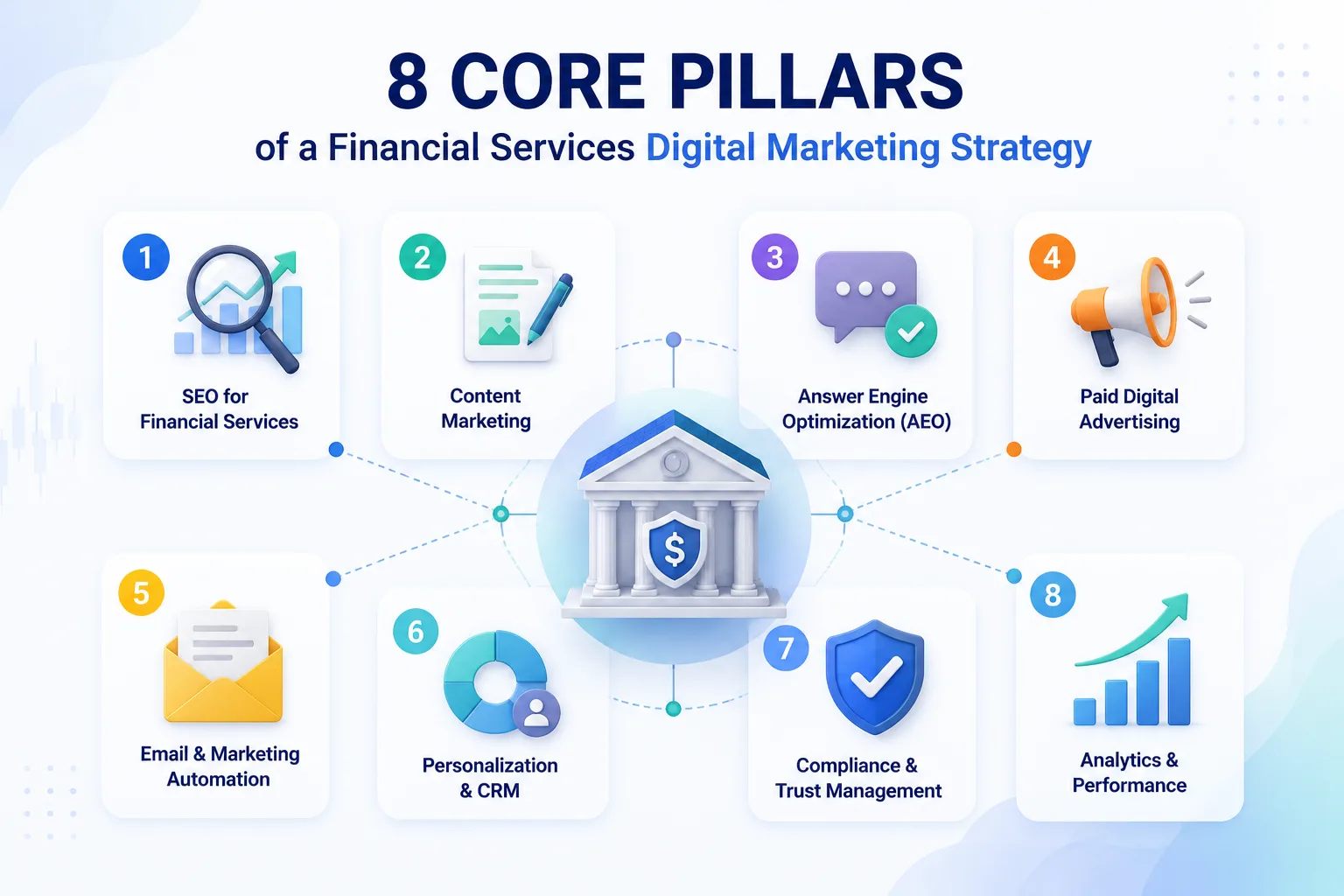
1. SEO for Financial Services: Ranking in the YMYL Era
Does SEO work for financial services? Yes — organic SEO is the highest-ROI long-term channel for financial brands. But Google classifies financial content as YMYL (Your Money or Your Life), applying stricter quality standards. Ranking requires genuine E-E-A-T: Experience, Expertise, Authoritativeness, and Trustworthiness.
Your SEO strategy must include:
- Author credentials and bylines — licensed CFPs, CPAs, or named subject matter experts
- Transparent sourcing — link to FINRA, SEC, FDIC, and peer-reviewed data
- Technical SEO — Core Web Vitals, FAQPage/FinancialProduct schema markup, fast mobile load times
- Local SEO — Google Business Profile optimization and service-area content pages
Keyword cluster framework by funnel stage:
| Funnel Stage | Sample Keywords |
|---|---|
| Awareness | “how does wealth management work” |
| Consideration | “best financial advisor near me” |
| Decision | “certified financial planner cost” |
| Retention | “how to rebalance investment portfolio” |
Because financial SEO involves technical optimisation, compliance-sensitive content, and strong trust signals, many firms rely on specialised SEO services to strengthen organic visibility and improve long-term lead acquisition.
2. Content Marketing: The Trust Engine
Content marketing serves three purposes: building brand trust, improving organic rankings, and nurturing prospects through long sales cycles.
What content formats perform best for financial services?
- Long-form educational guides — “How to Choose a Financial Advisor,” “Life Insurance vs Term Insurance.” These capture high-intent traffic and establish authority.
- Market commentary — Timely insights on interest rates or regulatory changes that signal thought leadership.
- Comparison content — “ETF vs Mutual Fund,” “Roth IRA vs Traditional IRA.” These rank well because they catch decision-stage searchers.
- Case studies — Anonymized or permission-granted client outcomes are among the strongest conversion tools.
- Video explainers — A severely underused channel. Educational YouTube content builds trust at scale and generates leads for years.
Every piece must pass compliance review before publication. Build this into your content calendar workflow — not as an afterthought.
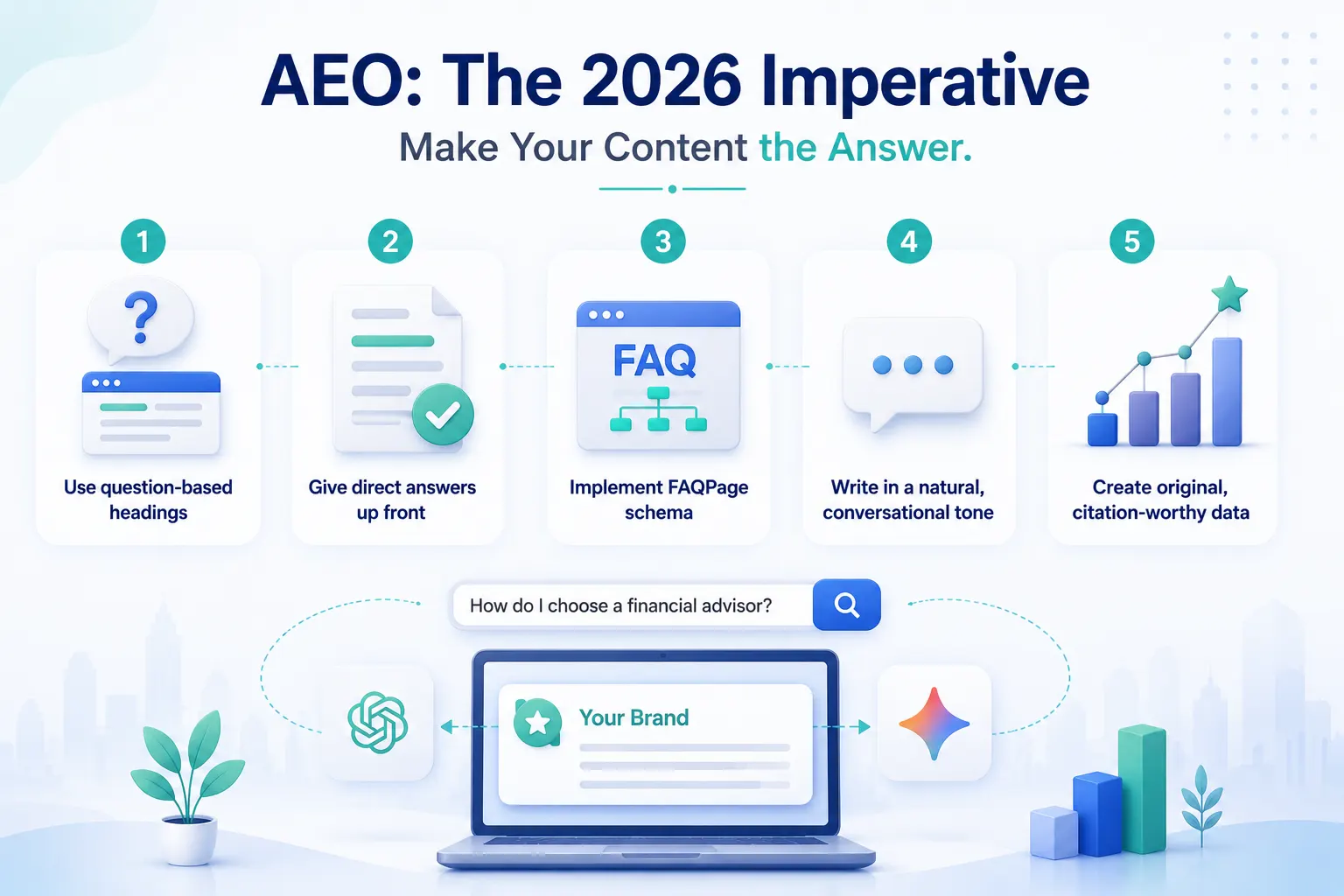
3. AEO (Answer Engine Optimization): The 2026 Imperative
What is AEO and why does it matter for financial brands?
AEO is the practice of structuring content so AI systems — Google AI Overviews, ChatGPT, Perplexity — surface your brand’s answers when users ask financial questions. A growing segment of high-value prospects now use AI assistants for research before ever visiting a website.
AEO tactics for financial content:
- Use question-based H2/H3 headings that mirror real user queries
- Provide direct answers in the first sentence after each question heading
- Deploy FAQPage schema markup on all content and service pages
- Write at a conversational reading level — AI systems prefer natural prose over keyword-stuffed text
- Build citation-worthy original data that answer engines can reference
4. Paid Digital Advertising for Financial Services
Financial services is one of the most expensive verticals in Google Ads, with CPCs for keywords like “financial advisor” routinely exceeding $50–$80 per click. Campaign precision is critical.
Google Ads:
- Use tightly themed ad groups — avoid broad match in high-cost categories
- Target mid- and bottom-funnel terms (“fee-only financial planner near me” converts far better than “financial advisor”)
- Use lead form extensions and call-only ads to reduce friction
Meta Ads:
- Life event targeting: “Recently divorced,” “New homeowner,” “Recently promoted”
- Lookalike audiences built from your existing high-value client list
- Sequential ad formats: awareness → consideration → conversion
LinkedIn Ads are the strongest paid channel for B2B financial services — asset managers, institutional lenders, and advisors targeting business owners benefit most from its job title and company-size targeting.
5. Social Media: What Platforms Work Best for Financial Services?
Social media marketing for financial services is less about chasing trends and more about building credibility, educating audiences, and maintaining consistent engagement across platforms. The right channel mix depends on your audience demographics, service category, content format, and compliance requirements. A platform-wise strategy helps financial institutions focus their efforts where trust, engagement, and lead quality are strongest.
| Platform | Best For |
|---|---|
| Wealth managers, B2B fintech, and financial advisors | |
| YouTube | Long-form educational content with compounding organic reach |
| Fintech brands targeting Millennials and Gen Z audiences | |
| Reaching 50+ demographics for retirement planning and insurance products | |
| X (Twitter) | Real-time market commentary and thought leadership |
Every post, comment, and response can be subject to regulatory scrutiny. Maintain social media archives and never make specific investment recommendations in public posts.
6. Email Marketing and Marketing Automation
Email marketing consistently delivers the highest ROI of any digital channel. For financial services, it’s the primary relationship-nurturing tool between client meetings and annual reviews.
A high-performing email strategy includes:
- Welcome sequences — Educational onboarding that establishes expertise without a hard pitch
- Market commentary newsletters — Regular insights tied to your firm’s perspective
- Life-event triggered emails — Automated touchpoints at key client milestones
- Re-engagement sequences — A 6–8 email series over 90 days for prospects who didn’t convert
With third-party cookies largely defunct, your email list is your most valuable marketing asset. Every channel — SEO, paid, social — should funnel toward list building with gated resources like calculators, white papers, or tax guides.
7. Conversion Rate Optimization (CRO)
Why do financial services websites have low conversion rates?
According to Unbounce’s Conversion Benchmark Report, the median conversion rate for financial services landing pages is 8.3% — but most banking and wealth management websites convert at just 2–5%, a gap driven almost entirely by trust signals, UX, and messaging clarity.
High-impact CRO tactics:
- Social proof above the fold — credentials (CFP, CFA, RIA), AUM, client count, and awards must be immediately visible
- Clear value proposition — “We help business owners build tax-efficient retirement income” beats “Full-service financial planning”
- Frictionless first steps — a free 30-minute consultation or financial health quiz dramatically lowers the barrier to contact
- Transparent fee communication — hiding pricing creates distrust
8. Reputation Management
In financial services, trust is currency. Online reputation directly impacts both search rankings and conversion rates.
- Actively request Google Business Profile reviews from satisfied clients
- Monitor third-party platforms: Yelp, Trustpilot, BBB, NAPFA
- Respond professionally to all reviews — positive and negative
- Track brand mentions across social and news platforms to address issues early
How Do You Market Financial Services Without Violating Regulations?
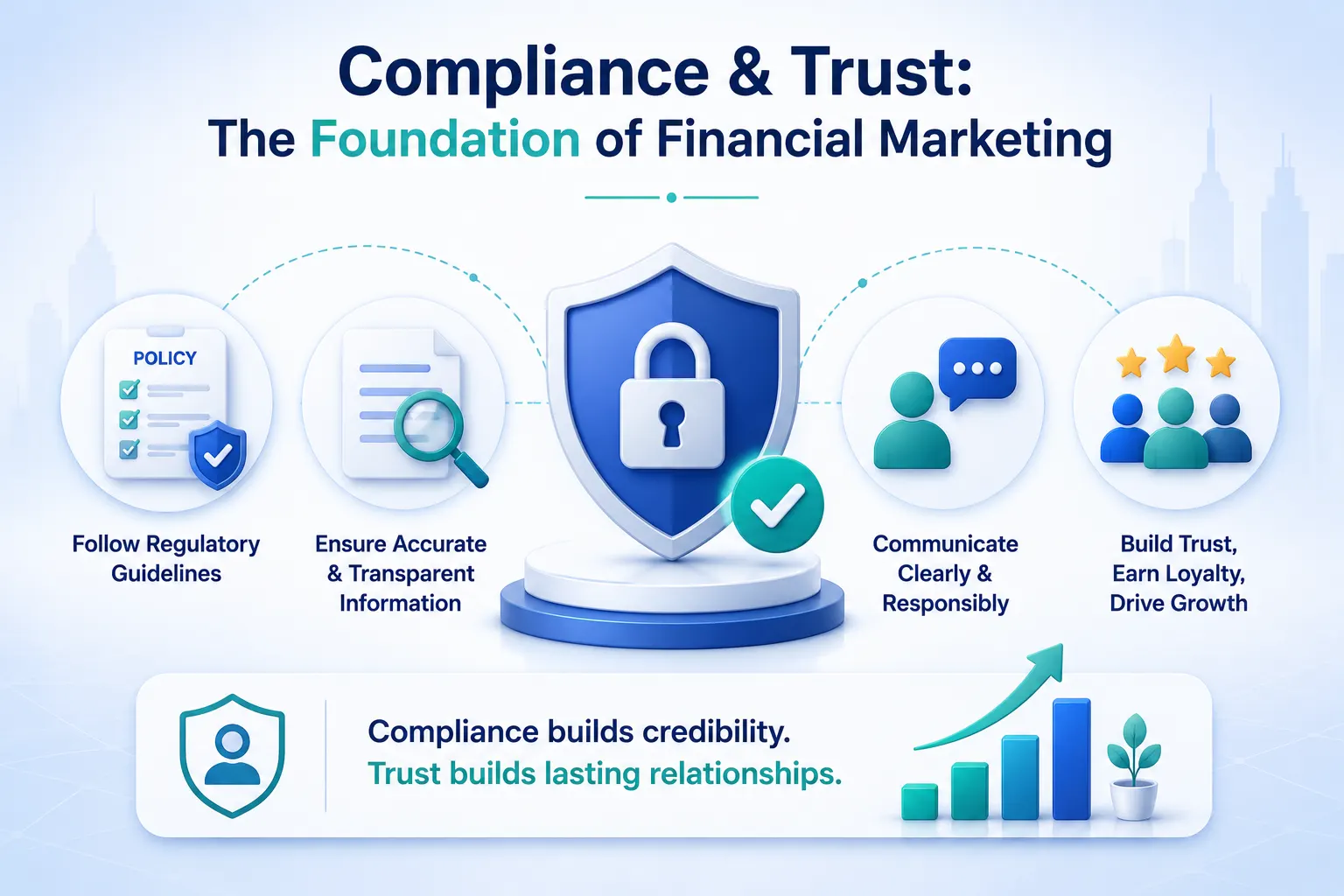
Compliance is not the enemy of good marketing — it’s the foundation of trustworthy marketing.
- Know your regulator: U.S. RIAs answer to SEC/FINRA. Insurance follows state-level rules. International firms have FCA, ASIC, frameworks.
- Never guarantee returns: Phrases like “guaranteed growth” or “risk-free” are red flags in virtually every jurisdiction.
- Maintain ad records: FINRA requires retention of all marketing materials for at least three years.
- Review AI-generated content: Every AI-assisted output must be compliance-reviewed before publication.
- Disclose conflicts: Sponsored content, affiliate relationships, and compensation structures must be clearly disclosed.
Digital Marketing KPIs for Financial Services
| Metric | Industry Benchmark | Top Quartile |
|---|---|---|
| Organic Traffic Growth (YoY) | 15–25% | 40%+ |
| Email Open Rate | 22–28% | 35%+ |
| Landing Page Conversion Rate | 2–5% | 8–12% |
| Google Ads CTR (Financial) | 2–4% | 6%+ |
| Cost Per Lead (Google Ads) | $80–$200 | Under $60 |
Conclusion
Building an effective digital marketing strategy for financial services is about constructing a system — where SEO builds visibility, content builds trust, paid advertising delivers pipeline, email nurtures relationships, and compliance protects your license and reputation.
The financial firms winning in 2026 share three traits: they produce genuinely helpful content, they optimize aggressively for both search and AI-driven answer engines, and they treat digital marketing as a long-term investment in client relationships — not a short-term lead generation exercise.
If your firm is ready to build a strategy that delivers measurable, compliant, and sustainable growth, explore PromotEdge’s digital marketing services and let’s build something that compounds.
Frequently Asked Questions
-
What is the most effective digital marketing channel for financial services?
Ans.SEO and content marketing deliver the highest long-term ROI by building sustainable organic traffic and trust simultaneously. For short-term lead generation, paid search targeting bottom-funnel keywords produces the most immediate results. A balanced strategy integrates both. -
How much should financial services firms spend on digital marketing?
Ans.Industry benchmarks suggest allocating 5–10% of revenue to marketing, with digital comprising 60–75% of that budget. Growth-stage firms often allocate 10–15%. Track cost per qualified lead and cost per acquired client from day one. -
How long does it take for digital marketing to work for financial services?
Ans.Paid advertising can generate leads within days. SEO shows meaningful organic traffic growth at 4–6 months, with significant ranking improvements at 9–12 months. A comprehensive strategy typically delivers transformational results on a 12–18 month timeline. -
Can financial advisors use influencer marketing?
Ans.Yes — with compliance oversight. Partnerships with personal finance creators can drive significant brand awareness among younger audiences. Any compensation arrangement must be disclosed, and influencer content about your services must be pre-approved.
Author Details

Latest Posts
-
 22 / Sep
Digital Marketing Digital Marketing for Ecommerce Brands: The 2027 Growth Playbook
22 / Sep
Digital Marketing Digital Marketing for Ecommerce Brands: The 2027 Growth Playbook -
 15 / Sep
-
04 / Sep
-
 29 / Jul
Search Engine Optimization 6 Enterprise SEO Mistakes That Quietly Cost You Millions
29 / Jul
Search Engine Optimization 6 Enterprise SEO Mistakes That Quietly Cost You Millions -
 24 / Jul



Blogs
Journey into Ideas Unveiling Tomorrow's Insights Today.















-
What is the most effective digital marketing channel for financial services?
Ans.SEO and content marketing deliver the highest long-term ROI by building sustainable organic traffic and trust simultaneously. For short-term lead generation, paid search targeting bottom-funnel keywords produces the most immediate results. A balanced strategy integrates both. -
How much should financial services firms spend on digital marketing?
Ans.Industry benchmarks suggest allocating 5–10% of revenue to marketing, with digital comprising 60–75% of that budget. Growth-stage firms often allocate 10–15%. Track cost per qualified lead and cost per acquired client from day one. -
How long does it take for digital marketing to work for financial services?
Ans.Paid advertising can generate leads within days. SEO shows meaningful organic traffic growth at 4–6 months, with significant ranking improvements at 9–12 months. A comprehensive strategy typically delivers transformational results on a 12–18 month timeline. -
Can financial advisors use influencer marketing?
Ans.Yes — with compliance oversight. Partnerships with personal finance creators can drive significant brand awareness among younger audiences. Any compensation arrangement must be disclosed, and influencer content about your services must be pre-approved.