


Digital Marketing for Construction Companies: Win More Bids in 2026

-
Updated Date
Aug-11-2026
-
Views
2 Min Read
-
Author: PromotEdge Digital
-
Updated Date: Aug-11-2026
-
Views: 2 Min Read
-
Author: Anindita Barik
Digital marketing for construction companies works differently depending on whether you bid public lump-sum work, chase negotiated design-build contracts, or sell residential remodels. The channel mix that fills a roofing crew’s calendar will not put a general contractor on an architect’s shortlist.
Most guides on this topic ignore that split. They list ten tactics, apply them to every firm in the sector, and leave you to work out which apply to a $40m hospital fit-out and which apply to a driveway.
Market sizing should start with primary data, not recycled percentages. The U.S. Census Bureau publishes monthly national totals through its Value of Construction Put in Place survey.
The Bureau of Labor Statistics tracks the sector’s employment and establishment counts under NAICS 23. Both update on a fixed schedule, which makes them safer to quote than a statistic taken from another blog.
This guide maps each tactic to a procurement route. It also covers what Google actually says about visibility in AI-generated answers, which is where a growing share of buyer research now starts.
Firms selling to homeowners rather than to owners and architects will find the tactics in digital marketing for contractors a closer fit.
What Digital Marketing For Construction Companies Covers
Digital marketing for construction companies is the combination of online channels that helps a firm get shortlisted. It includes search visibility through organic SEO, a website that survives a procurement team’s scrutiny, published project evidence, paid search, and direct outreach to the people responsible for selecting bidders.
The number of decision makers changes everything. A homeowner replacing a roof is usually one person comparing a few quotes. A commercial construction project, on the other hand, can involve an owner’s representative, a design team, a facilities director, and a surety, with the bid list often decided before the RFP is even released.
Why More Construction Companies Are Focusing on Digital Marketing in 2026
Construction companies are not getting work the same way they used to. A lot of clients now search online first, compare a few companies, check reviews or past projects, and then decide who to contact. In 2025, construction spending in the U.S. was estimated at around $2.2 trillion, but a lot of firms are still depending on older ways of marketing and client acquisition.
At the same time, companies putting real effort into digital channels are already getting in front of more potential clients and picking up opportunities others are missing.
A quick look at the numbers makes that pretty clear.
- 62% of customers will ignore a business without a web presence.
- 97% of consumers check reviews & a company’s online presence before deciding to engage — that includes developers, property owners, and procurement teams.
- A lot of reports now show the same thing—content marketing is bringing in more leads than traditional outbound marketing, and usually at a lower cost too. One figure often quoted is around 54% more leads.
- You can see the shift happening in construction as well. More firms are putting money into digital marketing and advertising because buyers are searching online before they decide which contractor to contact.
- Recent construction marketing benchmark reports have been pointing in the same direction too. Companies that keep investing in marketing consistently are generally seeing better-quality leads, steadier growth, and stronger profits than businesses still depending mostly on older ways of getting work.
What Most Construction Marketing Guides Miss
While going through the top-ranking articles on this topic, a few gaps kept showing up. Most of them barely touched on AI-driven search like AEO or GEO, and there wasn’t much around construction-focused CRM integration either. Video SEO was covered very lightly, seasonal demand trends were mostly ignored, and reputation management was rarely treated as an actual digital marketing channel. This guide covers all of it.
Strategy 1: Build a High-Performance Construction Website
Your website is your digital jobsite. Before anything else starts working, the website itself needs to be solid. If it’s slow, difficult on mobile, or hard to navigate, people leave.
Most customers check a company online before they ever call or visit—around 97% according to recent data—so for many construction businesses, the website ends up being the first real impression people get.
What Your Construction Website Must Have
- Clear service pages with location-specific keywords (e.g., ‘Commercial Construction in Austin, Texas’)
- A strong project portfolio helps a lot—especially before-and-after photos, along with short case studies explaining the work.
- The contact form and phone number should be easy to spot, especially on mobile. Most people shouldn’t have to scroll around just to figure out how to call you.
- Things like licenses, OSHA or LEED certifications, association memberships, client logos, and Google reviews also help build trust quickly.
- Page speed matters too. People usually won’t wait around for a slow site to load, especially on mobile. Keeping load time under three seconds is generally a better place to be.
- And by this point, SSL security and proper mobile responsiveness are basically expected. Without them, the website already feels outdated.
Strategy 2: Dominate Local SEO to Get Found by Nearby Clients
For most construction companies — especially residential contractors — the majority of projects come from within a defined geographic radius. Local SEO is basically about making sure your business shows up when people nearby search online for construction services or contractors in their area.
A few local SEO numbers make it clear why this matters.
- 97% of search engine users search online to find local businesses.
- 80% of local searches convert — these are high-intent buyers.
- 46% of all Google searches are for local businesses.
- Businesses with complete Google Business Profiles usually get far more clicks than incomplete ones—some reports put it at nearly 7x more.
Your Local SEO Checklist
- Get your Google Business Profile sorted first. Add photos, services, service areas… and reply to reviews instead of ignoring them.
- Your business details should match everywhere. Same business name, same address, same phone number—website, Google listing, directories, everything.
- It also helps to show up on platforms where people already compare contractors, whether that’s Houzz, HomeAdvisor, Angi, Yelp, or other construction-related directories.
- If you cover multiple locations, pages for each city or area tend to work better than putting everything together on one page.
- And reviews do make a difference. A lot of people check them before deciding who to contact, especially younger customers.. People look at them before they contact anyone.
- And don’t ignore “near me” searches or voice search either. A lot of searches happen that way now.

Strategy 3: Running Google Ads to Get Leads More Quickly
Organic Search takes time. Sometimes a lot of it. Google Ads is different. It can start putting your business in front of people already searching for construction services much sooner.
A lot of construction companies lean on a performance marketing agency when they want enquiries faster, mainly because paid traffic often converts better than waiting only on organic reach. Some industry reports have also shown higher conversion numbers from paid campaigns, along with a noticeable lift in visibility from Google Ads itself.
And realistically, the numbers can add up pretty quickly. A campaign pulling in around 1,000 clicks doesn’t need a massive conversion rate to generate leads. Even something around the 2% mark can still turn into 20 or more genuine enquiries if the targeting is handled properly.
Construction PPC Best Practices
- Go after more specific searches instead of broad ones. Things like “commercial roofing contractor Austin TX” or “custom home builder near me” usually bring in people who already know what they’re looking for.
- It also helps to keep ads limited to the areas you actually serve. Otherwise, you end up paying for clicks from places you don’t even work in.
- Run call-only ads on mobile — construction clients often prefer to call, not fill out forms.
- Use negative keywords aggressively — exclude ‘DIY’, ‘free’, ‘jobs’, and ‘how to’ to eliminate irrelevant clicks.
- Set up conversion tracking — measure which ads generate calls, form fills, and actual booked appointments.
- Retarget website visitors who didn’t convert — most clients research 2–3 companies before deciding.
Strategy 4: Content Marketing That Builds Authority and Generates Organic Leads
Content marketing has been reported to cost around 62% less than traditional marketing while generating roughly three times as many leads. That’s one of the main reasons more construction companies have started investing in it.
Content Types That Work Best for Construction
- Blog posts still work well, especially around informational searches like “How much does a commercial renovation cost?” or “What is design-build construction?” because those are the kinds of questions people often look up before contacting a contractor.
- Before contacting a construction company, most people want to look at past work first. Case studies help with that. Things like before-and-after photos, project timelines, details about the work, problems faced during the project, and the final outcome give people a better sense of what the company does presently.
- Video content has picked up a lot too. Construction companies are using drone shots, completed project walkthroughs, time-lapse videos, and client testimonials much more now because people spend time watching that kind of content before making contact.
- And many construction companies now use downloadable guides or capability statements as part of lead generation, usually behind a contact form so enquiries can be captured properly.
- FAQ pages targeting voice search and featured snippet queries
- Thought leadership articles and guest posts on construction trade publications
A practical content calendar for construction companies:
| Content Type | Target Intent | Publishing Frequency |
|---|---|---|
| Project Case Study | Decision stage — proves capability | 1–2 per month |
| SEO Blog Post | Awareness/Consideration — drives organic traffic | 2–4 per month |
| Short-Form Video | Awareness — Instagram Reels, YouTube Shorts | 3–5 per week |
| Google Review Request | Trust signal — boosts local SEO | After every project |
| Email Newsletter | Retention — keeps past clients engaged | Monthly |
Strategy 5: Social Media Marketing — Showcase Your Work Where Clients Are Watching
Social media marketing is still something a lot of construction companies barely use properly. Most competitors post randomly or go inactive for long stretches, while companies that stay consistent usually see more visibility, more traffic coming to the website, and more inbound enquiries over time.
Platform Strategy by Business Type
| Platform | Best For | Content That Performs |
|---|---|---|
| B2B, commercial builders, subcontractors | Case studies, project milestones, thought leadership, team spotlights | |
| Residential, design-build, renovation firms | Before/afters, behind-the-scenes, short Reels, drone footage | |
| Local residential contractors, community engagement | Project photos, client testimonials, Google review campaigns | |
| YouTube | All types — long-form SEO authority | Project walkthroughs, how-to content, time-lapse builds |
| Houzz | Residential and interior/design-build | Portfolio photos, reviews, Q&A responses |
Social media and digital ads are already being used by a large number of construction companies to reach clients and even potential hires. Some reports put that number at around 63%.
At the same time, people have started ignoring overly polished content online. Real project photos, jobsite updates, and actual team moments tend to get a better response now than generic stock images.
Strategy 6: Email Marketing — Your Highest-ROI Channel for Repeat Business
In construction, relationships are everything. Email marketing is the most cost-effective way to stay top-of-mind with past clients, warm leads, and referral partners — the people most likely to send you your next project.
Emails with personalized subject lines are 26% more likely to be opened. A well-segmented email list — split between residential clients, commercial developers, subcontractor partners, and cold prospects — allows you to send targeted content that resonates with each audience segment.
Email Campaign Ideas for Construction Companies
- Monthly project showcase newsletter with photos and brief project details
- Seasonal service reminders (‘Pre-winter commercial building inspections are now booking — contact us today.’)
- Post-project follow-up sequence requesting Google reviews and referrals
- Educational content drip campaigns for leads who haven’t yet committed (‘5 Questions to Ask Your Contractor Before Signing.’)
- Bid announcement emails for subcontractors and suppliers when new projects launch
Strategy 7: Reputation Management — Your Online Reviews Are a Marketing Asset
This is the strategy most construction marketing guides completely ignore. In 2026, your Google reviews, Houzz ratings, and BBB accreditation are as important as your portfolio. Online reputation directly influences how Google ranks your business in local searches and how potential clients make their hiring decisions.
- Construction companies with 10+ Google reviews convert at significantly higher rates than those with fewer.
- Negative reviews that go unaddressed signal poor customer service to prospects — always respond professionally.
- Actively request reviews via email, SMS, or QR codes on job site signage immediately after project completion.
- Monitor mentions of your brand across Google, Houzz, Yelp, and social platforms using tools like Google Alerts.
Build a simple post-project review request into your workflow: send a personalized text or email within 48 hours of job completion with a direct link to your Google review page. This one habit can double your review volume within 6 months.
Strategy 8: Video Marketing — The Most Powerful Proof of Your Work
For 66% of people, video is their primary source of information, and 93% of businesses gain new customers through branded video content. For construction companies, video isn’t just a nice-to-have — it’s the most compelling way to demonstrate your capabilities to clients who’ve never seen your work in person.
High-Impact Video Formats for Construction
- Time-lapse build videos — compress months of construction into 60–90 seconds of compelling content
- Drone footage — aerial shots of project sites dramatically communicate scale and complexity
- Client testimonial videos — a 60-second genuine testimonial is worth more than any written case study
- ‘Day in the Life’ crew videos — humanize your brand and help attract skilled tradespeople
- Before-and-after reveals — one of the highest-engagement formats on Instagram and Facebook
Publish video content on YouTube (for SEO), Instagram Reels (for discovery), LinkedIn (for B2B credibility), and your project portfolio pages (for conversion). Each platform serves a different stage of the buyer journey.
Strategy 9: AEO & GEO — Optimize for AI-Powered Search in 2026
This is a strategy zero competitors are currently covering — and it’s the future of search. Answer Engine Optimization (AEO) and Generative Engine Optimization (GEO) are about ensuring your content appears in AI-generated answers from tools like Google’s AI Overviews, ChatGPT, Perplexity, and Bing Copilot. In 2026, a growing portion of your potential clients are asking AI tools questions like
- ‘What should I look for in a commercial construction company?’
- ‘How much does it cost to build a warehouse in Texas?’
- ‘What digital marketing strategies work for construction companies?’
If your website contnet answers these questions clearly and authoritatively, AI search engines will cite your company as a source — a powerful new form of organic visibility.
How to Optimize for AI Search (AEO/GEO)
- Write in a clear Q&A format — structure your FAQ pages, blog posts, and service pages so they directly answer conversational questions.
- Use structured data (Schema markup) — mark up your business information, services, FAQs, and project types.
- Build topical authority — cover every subtopic within construction marketing comprehensively, not just surface-level overviews.
- Earn mentions and citations from reputable industry publications, association websites, and local news sources.
- Keep content factually accurate, current, and attributed to named experts (E-E-A-T: Experience, Expertise, Authoritativeness, Trustworthiness).
Strategy 10: Track Everything — Analytics, KPIs, and CRM Integration
Marketing without measurement is guesswork. The construction companies that consistently win more bids are those that treat their marketing like a project: scoped, tracked, and refined based on real data.
Key KPIs your construction company should track monthly:
| KPI | What It Measures | Target Benchmark |
|---|---|---|
| Website Traffic | Brand visibility & SEO performance | +15–25% month-over-month growth |
| Lead-to-Quote Conversion | Website quality & offer strength | Varies; benchmark your baseline |
| Cost Per Lead (CPL) | Ad spend efficiency | Track by channel; optimize lowest CPL |
| Google Business Profile Views | Local visibility | Track weekly; correlate with calls |
| Review Velocity | Online reputation growth | 2+ new reviews per month minimum |
| Email Open Rate | Audience engagement | 25–35% is healthy for construction |
| Organic Keyword Rankings | SEO progress | Track 10–20 target keywords monthly |
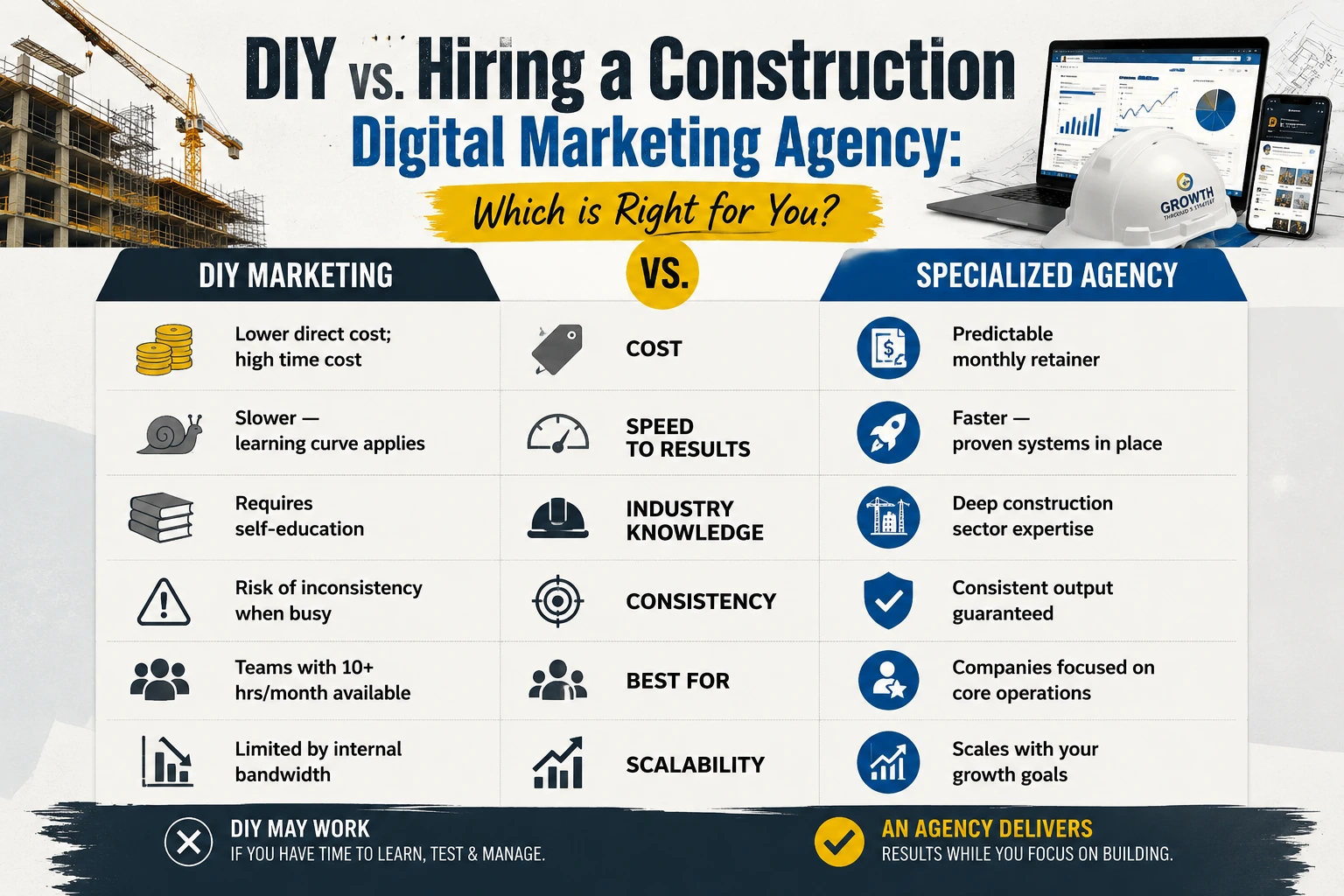
DIY vs. Hiring a Construction Digital Marketing Agency: Which is Right for You?
One of the most common questions construction business owners ask is whether to handle marketing in-house or partner with a ROI driven digital marketing agency. Here’s an honest breakdown:
| Factor | DIY Marketing | Specialized Agency |
|---|---|---|
| Cost | Lower direct cost; high time cost | Predictable monthly retainer |
| Speed to Results | Slower — learning curve applies | Faster — proven systems in place |
| Industry Knowledge | Requires self-education | Deep construction sector expertise |
| Consistency | Risk of inconsistency when busy | Consistent output guaranteed |
| Best For | Teams with 10+ hrs/month available | Companies focused on core operations |
| Scalability | Limited by internal bandwidth | Scales with your growth goals |
Key Takeaways –
- Your construction website must be fast, mobile-friendly, and built to convert — it’s the foundation of all other marketing.
- Local SEO and Google Business Profile optimization are the highest-ROI starting points for most construction companies.
- Google Ads (PPC) generates immediate, high-intent leads — use geo-targeting and call-only ads for maximum efficiency.
- Content marketing (blogs, video, case studies) builds long-term authority and drives 3x more leads than outbound tactics.
- Social media optimization works best when platform choice matches your client type: LinkedIn for B2B, Instagram for residential, YouTube for all.
- Online reputation (Google reviews) directly impacts both local SEO rankings and client trust — make review collection a workflow.
- In 2026, AEO and GEO optimization for AI search engines is an emerging first-mover opportunity virtually no competitor is leveraging.
- Track KPIs monthly. Marketing without measurement is guesswork — tie every strategy to lead generation and revenue outcomes.
Conclusion: Build Your Digital Marketing Foundation Today
The construction industry is crowded, competitive, and increasingly digital. The firms that will dominate the next decade are not necessarily the largest — they’re the most visible, most trusted, and most consistently present in the channels where their clients are searching, deciding, and recommending.
Digital marketing services for construction companies isn’t a single campaign or a one-time website refresh. It’s a systematic, ongoing investment in your brand’s visibility, credibility, and lead pipeline. Start with the foundations — a strong website, local SEO, and Google Business Profile — then layer in content, paid advertising, video, and AI-optimized search strategies as your capacity grows.
FAQs
-
What is digital marketing for construction companies?
Ans.Digital marketing for construction companies is the use of online channels — including SEO, Google Ads, social media, content marketing, email, and website optimization — to attract new clients, generate qualified project leads, and build brand authority. It replaces or supplements traditional marketing methods like print advertising and cold calling with measurable, scalable online strategies. -
How much should a construction company spend on digital marketing?
Ans.Most industry benchmarks recommend allocating 5–10% of annual revenue to marketing, with at least 60–70% of that directed toward digital channels. For mid-sized general contractors, this typically translates to $2,500–$10,000 per month for a comprehensive digital marketing program including SEO, PPC, and content creation. Companies that commit 4% or more of revenue to marketing consistently achieve 29% gross markups versus 20% for those that don't (SORCI 2026 Report). -
What is the best social media platform for construction companies?
Ans.For B2B and commercial construction, LinkedIn is the most effective platform due to its professional audience of developers, procurement teams, and project managers. For residential construction and design-build firms, Instagram is the strongest platform for showcasing portfolio work and reaching homeowners. YouTube is valuable for all construction types because project walkthrough videos rank in Google search and build long-term credibility. -
How long does it take for digital marketing to show results for a construction company?
Ans.Google Ads and paid social campaigns can begin generating leads within days to weeks of launch. SEO typically takes 3–6 months to show significant ranking improvements and 6–12 months to reach consistent first-page visibility for competitive keywords. Content marketing and social media build momentum over time and produce compounding results — most construction companies see measurable improvements in traffic, leads, and inquiries within the first 3–6 months of a consistent strategy. -
What is local SEO for construction companies and why does it matter?
Ans.Local SEO is the process of optimizing your online presence to rank prominently in geographically-targeted searches — like 'commercial contractor near me' or 'home renovation company in Dallas.' It matters because 97% of searchers look for local businesses online, and 80% of those searches convert to contact or purchase. Key local SEO activities include Google Business Profile optimization, local directory citations, location-specific landing pages, and earning Google reviews. -
Can digital marketing really help a construction company win more bids?
Ans.Yes — and the data supports it. Construction companies with strong digital presences receive more bid invitations because they appear credible and established before the first conversation. Case studies, video content, online reviews, and an optimized website collectively build the trust that accelerates bid decisions. Marketing helps you get in the room; your track record closes the deal. -
What is AEO and how does it apply to construction companies?
Ans.AEO stands for Answer Engine Optimization — the practice of structuring your content so it appears in AI-generated answers from tools like Google AI Overviews, ChatGPT, Perplexity, and Bing Copilot. As more potential clients use AI tools to research contractors and construction services, appearing as a cited source in those AI answers represents a significant new opportunity. Construction companies can pursue AEO by writing in clear Q&A formats, adding structured data markup, and building comprehensive topical authority around their services and specializations. -
How do I measure the ROI of digital marketing for my construction business?
Ans.Track these core metrics: website traffic (overall and by source), lead volume by channel, cost per lead (for paid campaigns), lead-to-quote conversion rate, quote-to-contract close rate, and average contract value from digitally-sourced leads. Using a CRM integrated with your marketing tools allows you to connect marketing spend to actual signed contracts — the truest measure of marketing ROI in construction.
Author Details

Latest Posts
-
 22 / Sep
Digital Marketing Digital Marketing for Ecommerce Brands: The 2027 Growth Playbook
22 / Sep
Digital Marketing Digital Marketing for Ecommerce Brands: The 2027 Growth Playbook -
 15 / Sep
-
04 / Sep
-
 29 / Jul
Search Engine Optimization 6 Enterprise SEO Mistakes That Quietly Cost You Millions
29 / Jul
Search Engine Optimization 6 Enterprise SEO Mistakes That Quietly Cost You Millions -
 24 / Jul


Blogs
Journey into Ideas Unveiling Tomorrow's Insights Today.














-
What is digital marketing for construction companies?
Ans.Digital marketing for construction companies is the use of online channels — including SEO, Google Ads, social media, content marketing, email, and website optimization — to attract new clients, generate qualified project leads, and build brand authority. It replaces or supplements traditional marketing methods like print advertising and cold calling with measurable, scalable online strategies. -
How much should a construction company spend on digital marketing?
Ans.Most industry benchmarks recommend allocating 5–10% of annual revenue to marketing, with at least 60–70% of that directed toward digital channels. For mid-sized general contractors, this typically translates to $2,500–$10,000 per month for a comprehensive digital marketing program including SEO, PPC, and content creation. Companies that commit 4% or more of revenue to marketing consistently achieve 29% gross markups versus 20% for those that don't (SORCI 2026 Report). -
What is the best social media platform for construction companies?
Ans.For B2B and commercial construction, LinkedIn is the most effective platform due to its professional audience of developers, procurement teams, and project managers. For residential construction and design-build firms, Instagram is the strongest platform for showcasing portfolio work and reaching homeowners. YouTube is valuable for all construction types because project walkthrough videos rank in Google search and build long-term credibility. -
How long does it take for digital marketing to show results for a construction company?
Ans.Google Ads and paid social campaigns can begin generating leads within days to weeks of launch. SEO typically takes 3–6 months to show significant ranking improvements and 6–12 months to reach consistent first-page visibility for competitive keywords. Content marketing and social media build momentum over time and produce compounding results — most construction companies see measurable improvements in traffic, leads, and inquiries within the first 3–6 months of a consistent strategy. -
What is local SEO for construction companies and why does it matter?
Ans.Local SEO is the process of optimizing your online presence to rank prominently in geographically-targeted searches — like 'commercial contractor near me' or 'home renovation company in Dallas.' It matters because 97% of searchers look for local businesses online, and 80% of those searches convert to contact or purchase. Key local SEO activities include Google Business Profile optimization, local directory citations, location-specific landing pages, and earning Google reviews. -
Can digital marketing really help a construction company win more bids?
Ans.Yes — and the data supports it. Construction companies with strong digital presences receive more bid invitations because they appear credible and established before the first conversation. Case studies, video content, online reviews, and an optimized website collectively build the trust that accelerates bid decisions. Marketing helps you get in the room; your track record closes the deal. -
What is AEO and how does it apply to construction companies?
Ans.AEO stands for Answer Engine Optimization — the practice of structuring your content so it appears in AI-generated answers from tools like Google AI Overviews, ChatGPT, Perplexity, and Bing Copilot. As more potential clients use AI tools to research contractors and construction services, appearing as a cited source in those AI answers represents a significant new opportunity. Construction companies can pursue AEO by writing in clear Q&A formats, adding structured data markup, and building comprehensive topical authority around their services and specializations. -
How do I measure the ROI of digital marketing for my construction business?
Ans.Track these core metrics: website traffic (overall and by source), lead volume by channel, cost per lead (for paid campaigns), lead-to-quote conversion rate, quote-to-contract close rate, and average contract value from digitally-sourced leads. Using a CRM integrated with your marketing tools allows you to connect marketing spend to actual signed contracts — the truest measure of marketing ROI in construction.