


Digital Marketing For HVAC Companies: How to Get More Service Calls

-
Updated Date
May-02-2026
-
Views
2 Min Read
-
Author: PromotEdge Digital
-
Updated Date: May-02-2026
-
Views: 2 Min Read
-
Author: Milan Shyamal
It’s basically a mix of a few things—showing up in local searches, running ads, putting out helpful content, and following up with people—that turns someone who just searched “AC repair near me” into a booked job. And once it’s running properly, it keeps bringing in calls even when you’re out on-site working.
Let’s be honest. You’re good at the actual HVAC work. You show up on time, you fix things properly, and your customers leave happy. So why is lead flow inconsistent?
The answer, almost every time, is this: when a homeowner’s air conditioning dies at 2 PM on a summer afternoon, they don’t think “I’ll ask around.” They grab their phone and call the first HVAC company that shows up on Google. If that’s not you, it’s your competitor — and there’s nothing you can do about it after the fact.
Here’s what the numbers say:
- 97% of consumers read online reviews before choosing a local business
- 86% of homeowners specifically use Google Maps to find HVAC contractors
- 60% of those people call directly from the search results — they never even visit a website
Digital marketing for HVAC companies is simply the work of making sure your business shows up when those searches happen — and that when someone does click on you, they call immediately.
In 2026, this matters more. Interest rates are higher, so people are thinking twice before spending. Many are repairing systems they’d normally replace. That means the customers who are ready to buy a new unit have done a lot of research first. If your online presence doesn’t look credible and professional, they’ll move on to someone who does.
What Are the Key HVAC Marketing Benchmarks in 2026? (Costs, ROI & Conversion Rates)
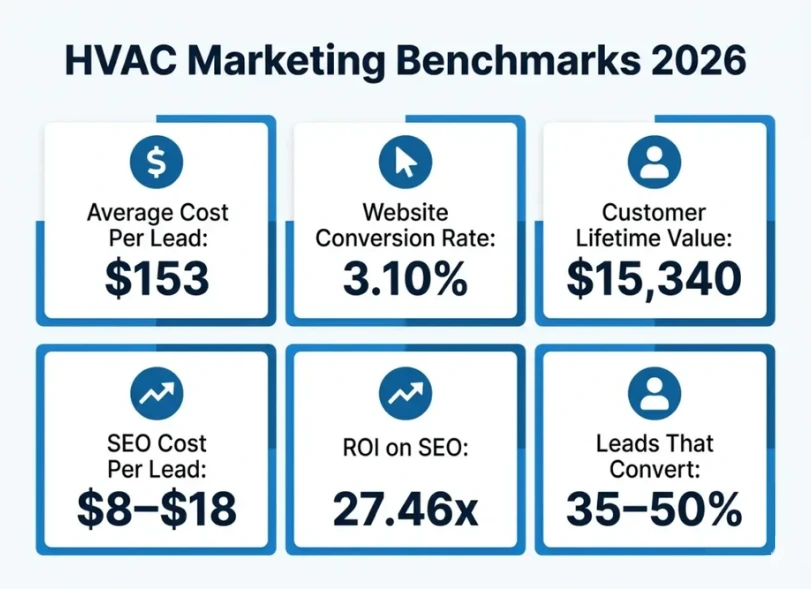
Before we get into tactics, here are the benchmarks that define what “good” looks like in HVAC marketing right now. These help you know whether what you’re spending is working — or being wasted.
| Metric | Industry Benchmark |
|---|---|
| Average cost to get one lead | $153 |
| Website conversion rate (visitors who call) | 3.10% |
| Average customer lifetime value | $15,340 |
| Leads that turn into paying customers | 35% – 50% |
| Recommended marketing spend | 7% – 12% of revenue |
| Median return on SEO investment | 27.46x |
| Cost per lead — Google LSA ads | $60 – $95 |
| Cost per lead — Google PPC ads | $120 – $300 |
| Cost per lead — organic SEO (long-term) | $8 – $18 |
The most important number there? Organic SEO generates leads for as little as $8–$18 each in the long run. That’s compared to $120–$300 for paid ads. SEO takes longer to build — but once it’s working, it keeps working without eating your ad budget every month.
What Channels Are Included in Digital Marketing for HVAC Companies?
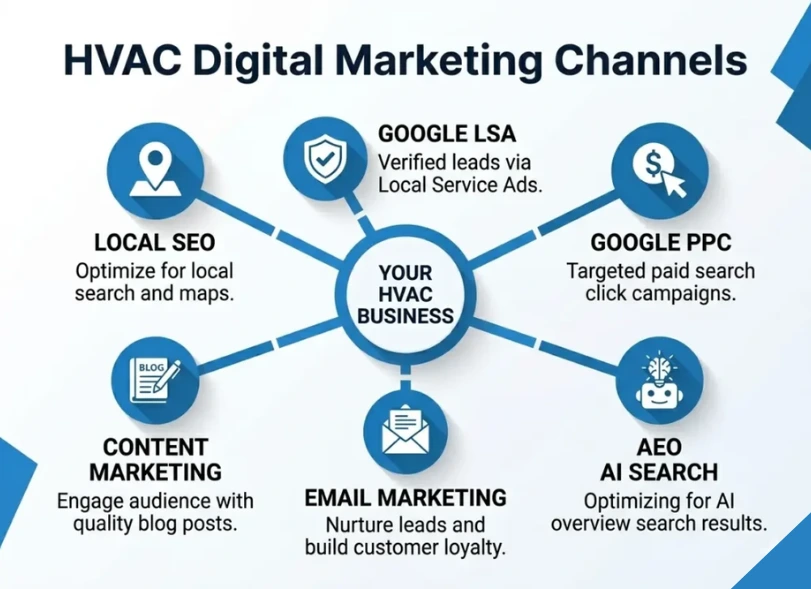
“Digital marketing” sounds like a broad term, but it’s easier to understand when you look at the actual channels that bring in work for HVAC businesses.
Local SEO — Getting Found on Google Maps
This is about showing up in those top three Google Maps results — the “Map Pack” — when someone searches “HVAC company near me” or “AC repair [your city].” It’s the highest-value real estate in local search, and it’s driven by your Google Business Profile, your reviews, and the quality of your website.
Google Local Services Ads (LSAs)
These are the listings you usually see right at the top, often with that “Google Guaranteed” tag. You don’t pay just because someone saw it—you pay when they actually call you. For most HVAC businesses, this is one of the quickest ways to start getting calls, especially when your website hasn’t started ranking yet.
Google PPC (Pay-Per-Click Ads)
With regular Google Ads, you can put your business in front of people searching for things like “emergency furnace repair” or “AC installation cost.” You reach them right when they need that service. You pay per click. It gives you more control and volume than LSAs, but it also costs more per lead.
Content Marketing & Blog SEO
You put out simple, useful pages that answer what homeowners already search—things like “why is my AC blowing warm air” or “how much does a heat pump cost.” People read these when they’re trying to figure things out on their own. By the time they decide to call, they’ve already come across your name and feel more comfortable choosing you.
Email Marketing & Maintenance Agreements
Your existing customers are your most valuable asset. A simple email saying “time for your fall furnace tune-up” sent to 500 past customers will generate calls at almost zero cost. This is how you smooth out slow seasons and build recurring revenue.
Answer Engine Optimization (AEO)
This is the new one. More and more homeowners are asking AI tools — like ChatGPT or Google’s AI Overview — questions like “why won’t my furnace turn on?” Your goal is to be the answer those tools give. We’ll cover exactly how to do this in a bit.
The best HVAC marketing programs use all of these together. They’re not competitors — they each do different jobs and compound each other’s results.
If you want a bigger picture of how all these channels fit together, our guide on digital marketing for contractors walks through the whole system — including real examples of what happens when each piece clicks into place.
How Should an HVAC Website Be Optimized to Generate More Calls in 2026?
Everything you do—ads, Google Maps, social posts—leads people back to your website. That’s where they decide whether to call or leave. If the site loads slowly, feels confusing, or looks old, most people won’t wait around. They’ll just go to the next option.
So what does a website that actually brings in calls look like in 2026?
Speed Is Non-Negotiable
Google now looks at something called “Interaction to Next Paint.” It’s just how quickly your site reacts when someone clicks or taps. If it takes more than about 300 milliseconds, it can start to hurt your rankings. Sites that fail this test have seen their traffic drop by over 30%.
Think about it this way: if a homeowner’s heat is out in January and your website takes 5 seconds to load — they’re already hitting the back button and calling your competitor.
Make It Easy to Call You — Always
Your phone number should be visible on every single page, on every device, at all times. A sticky click-to-call button on mobile alone can increase inbound calls by 20–30%. That one change, properly done, pays for itself in the first week.
Use Real Photos — Not Stock Images
This one is huge and almost every small HVAC company gets it wrong. Real photos of your team, your vans, your actual job sites build trust in a way that no stock photo can. Google also rewards this — their quality signals specifically look for evidence that a real, active business is behind the website.
Add an Online Booking Option
About 35% of people searching for HVAC help do it after business hours. If they don’t see an easy way to leave their details or book a slot, you lose them. Even something as simple as a contact form or a chat option can hold that lead till you get back to them.
| Pro Tip
If you’re not sure how your website is doing, you can check it on Google’s free PageSpeed Insights. It gives you a score in less than a minute. Anything below 70 on mobile is costing you leads. |
Our WordPress development services are built specifically around these conversion and speed standards — fast-loading, mobile-first, and structured to turn visitors into calls.
How Do HVAC Companies Rank on Google Maps in 2026? (Local SEO Guide)
The Map Pack — those three businesses that show up at the top of Google when someone searches locally — is the most valuable piece of online real estate for any HVAC company. Here’s how you earn your spot there.
Your Google Business Profile: Go Beyond the Basics
Most HVAC owners claim their Google My Business profile and then leave it as it is. That usually means missed opportunities. In 2026, regular activity on your GMB profile plays a big role in how you show up in local results.
Here’s what you should be doing:
- List every service you offer — not just “HVAC Contractor.” Add specific categories like “Furnace Repair Service,” “Air Duct Cleaning,” “Heat Pump Installation”
- Upload new photos every week — job sites, your team, your vans. Recency matters
- Share updates through Google Posts—things like seasonal offers or when you’re available
Reply to all reviews, whether good or bad, within 24 hours
Have a simple process in place to ask happy customers for a review after each job
Stop Using Copy-Paste City Pages
Here’s something that’s actively hurting a lot of HVAC websites right now: generic “service area” pages that are just the same content with a different city name swapped in. Google rolled out an update in March 2026 that goes after this, and sites doing it are starting to lose rankings.
If you cover more than one city, each page has to feel different and actually reflect that location. Mention local landmarks. Reference regional weather challenges. Feature reviews from customers in that specific area. Include locally relevant information like utility rebate programs. If you can’t do that for a city, it’s better to remove the page than to leave a thin, templated version up.
LSAs vs. Google Ads — Which One Should You Use?
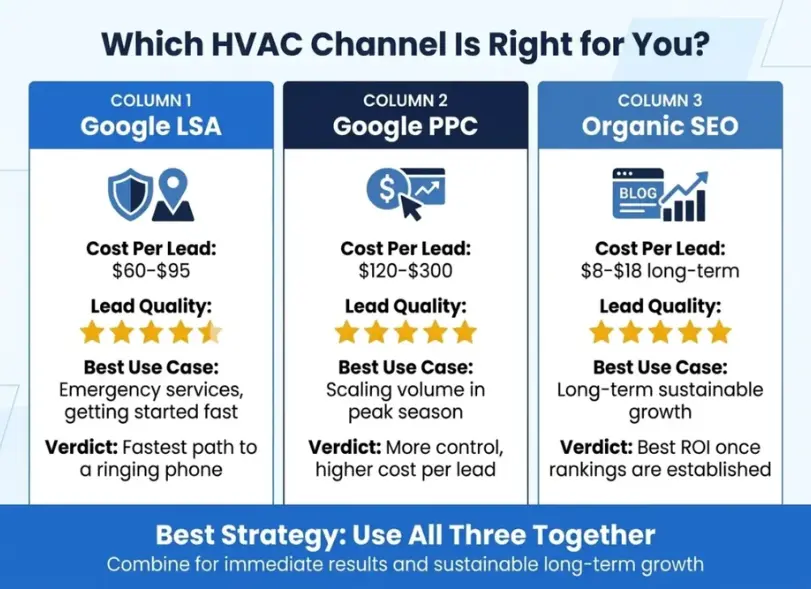
Both. But they do different jobs, and understanding that will save you a lot of wasted budget.
Local Services Ads (LSAs): Start Here
If you’re not running LSAs yet, this is your first move. LSAs show up above everything on Google — above regular ads, above organic results. They have the “Google Guaranteed” badge, which tells homeowners right away that Google has vetted your business. And you only pay when someone calls you, not just when they see your ad.
The downside: Google limits how many calls any one business gets through LSAs, spreading leads around. You’ll hit a growth ceiling quickly if you rely on LSAs alone.
Google PPC Ads: The Growth Accelerator
Once LSAs are running, Google Ads let you go further. You can bid specifically on phrases like “emergency AC repair” or “HVAC installation quotes,” control exactly when your ads show up, and run different campaigns for different parts of your service area. The cost per lead is higher — average $120–$300 — but you have much more control over volume and targeting.
| Channel | Avg. Cost Per Lead | Lead Quality | Best For |
|---|---|---|---|
| Google Local Services Ads | $60 – $95 | High — people calling to book | Getting started fast |
| Google PPC / Search Ads | $120 – $300 | High — strong intent | Scaling volume in peak season |
| Organic SEO | $8 – $18 (long-term) | Highest — warm, informed leads | Long-term sustainable growth |
The companies that get the best results use all three layers — LSAs for baseline calls, PPC for seasonal peaks, and SEO building underneath everything as a long-term asset that keeps getting cheaper to maintain over time.
For more on how budget allocation works across channels, check out our breakdown of digital marketing strategies for small businesses — the principles apply directly to HVAC contractors at every stage.
What Type of Content Works Best for HVAC Marketing?
Google doesn’t just look for keywords anymore. It tries to figure out: is this a real expert? Does this business actually know what they’re talking about? Can I trust recommending them to a homeowner?
That shift means the old approach — write a blog post stuffed with keywords and call it a day — doesn’t cut it. What works now is content that shows genuine expertise.
Write About What You Actually Know
Instead of a generic article like “How to Change Your Air Filter,” write something like “How our tech spotted a failing capacitor before it took out the whole compressor — and what signs homeowners can look for.” Include a real photo. Explain what the technician was thinking. That’s the kind of content Google rewards — and more importantly, it’s the kind that makes a homeowner think, “these people know what they’re doing.”
The 17 SEER2 Opportunity
There’s a huge content gap right now around the push toward higher-efficiency systems and heat pumps. Over 60% of HVAC buyers in 2026 say they’d pay more for an eco-friendly system — if someone explains the savings and rebates clearly. If you write content that walks homeowners through federal tax credits, state utility rebates, and the actual payback period on a high-efficiency system, you’ll capture replacement buyers before they talk to anyone else.
Build Linked Topic Pages, Not Just One-Off Posts
The most effective content strategy treats your website like a library on HVAC business topics. You have a main “pillar” page (like this guide), and then supporting pages that go deep on specific subtopics: seasonal marketing timing, SEER2 content, technician recruitment, lead generation benchmarks. Each page links to the others. This shows Google that your site covers the whole topic — not just one isolated article.
What Is AEO for HVAC Companies? and Why It Matters
AEO stands for Answer Engine Optimization. Don’t let the jargon put you off — the idea is simple.
More and more people aren’t typing keywords into Google anymore. People don’t search the way they used to. Now they type full questions into AI tools—things like, “Why is my furnace making a banging noise?” or “How much should a new AC unit cost for a 2,000 square foot house?”
Tools like Google Gemini, ChatGPT, and Perplexity AI pull answers from websites they trust. If your site answers these questions clearly and directly, there’s a good chance those tools will pick your content as a source. That’s the new “position zero.”
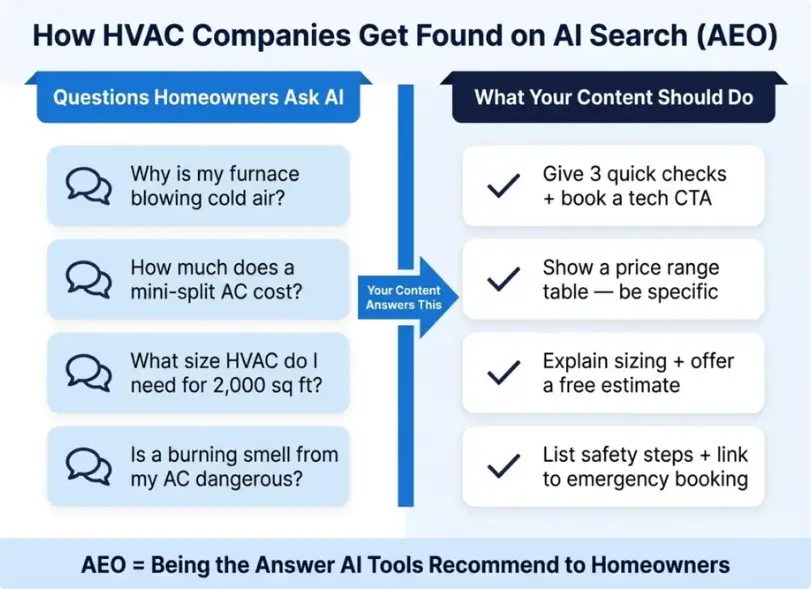
How to Do It (It’s Not That Complicated)
- Write your headings as questions — “Why is my AC blowing warm air?” not “Common AC problems”
- Answer the question immediately in the first sentence under that heading — don’t make the reader scroll
- Add an FAQ section to your key service pages and mark it up with FAQ schema (your web developer can do this in minutes)
- Use LocalBusiness and Service schema on your main pages — this tells AI tools what your business does and where
| Question Homeowners Are Asking AI | What Your Content Should Do |
|---|---|
| “Why is my furnace blowing cold air?” | Give 3 quick checks to try, then a clear call to book a tech |
| “How much does a mini-split AC cost?” | Provide a price range table — be specific, not vague |
| “What size HVAC do I need for 2,000 sq ft?” | Explain how sizing works, offer a free estimate to get the exact answer |
| “Is a burning smell from my AC dangerous?” | Give immediate safety steps, link directly to emergency booking |
AEO is now a standard part of how full-service digital marketing agencies build content strategies — and HVAC companies that invest in it early are building a lead advantage that’ll take competitors years to catch up to.
How Can HVAC Email Marketing Increase Revenue?
Here’s a stat that surprises most HVAC owners: acquiring a brand-new customer costs five times more than getting a repeat job from someone you’ve already served.
Your past customer list is genuinely one of your most valuable business assets — and most HVAC companies are sitting on it doing nothing.
The Math Behind Maintenance Agreements
The average HVAC customer is worth $15,340 over their lifetime — but only if you stay in touch. Email marketing for HVAC companies generates roughly $36–$42 in revenue for every $1 spent. That’s one of the highest returns of any marketing channel, full stop.
A simple seasonal email calendar looks like this:
- October: “Get your furnace ready before the first freeze” — tune-up promotion
- April: “AC pre-season inspection — book before the heat hits” — spring special
- January: Energy efficiency audit offer — targets homeowners thinking about upgrades
- Ongoing: System anniversary reminders — “Your system just turned 8 years old. Here’s what that means for you.”
Each of these emails goes to people who already trust you. The conversion rate is much higher than any cold ad, and the cost is almost nothing.
Connect Your Marketing to Your CRM
For any of this to work at scale, your marketing data needs to flow into a proper CRM — tools like ServiceTitan, Housecall Pro, or LeadConnector are the industry standards. When every call is tracked back to the marketing channel that generated it, you stop guessing and start knowing which budget is working.
This same data-first approach is what drives our B2B SEO services — because visibility is only valuable when it’s tied to real business outcomes, not just traffic numbers.
How to Recruit HVAC Technicians Using Marketing?
Here’s the honest reality of HVAC in 2026: for many business owners, the biggest growth constraint isn’t leads — it’s people. You can’t take more calls if you don’t have the techs to run them.
What most owners don’t realize is that their digital marketing is already their recruiting tool — whether they’ve designed it that way or not.
When a skilled HVAC technician is considering whether to join your company, the first thing they do is Google you. They look at your reviews. They check your website. They look at your social media. A company with 12 reviews, a 2019 website, and no social presence doesn’t feel like a place worth building a career.
What Winning Recruitment Marketing Looks Like
- A careers page with real technician testimonials — what they like about working there, how long they’ve been there
- LinkedIn presence for the owner or leadership — techs research who they’d be working for
- “Day in the life” video content showing the tools, the vans, the training, the team culture
- Google Ads targeting “HVAC technician jobs [your city]” — yes, you can use the same infrastructure for hiring
Companies that build their marketing to attract both customers and skilled technicians will scale without the ceiling that stops most HVAC businesses from growing past a certain point.
How Much Should You Actually Spend on HVAC Digital Marketing?
The right answer depends on where you are and where you want to go.
- Stable, established business in a competitive market: 7–10% of gross revenue. This maintains your visibility and generates steady leads.
- Growing company or entering new service areas: 12–15% temporarily. This accelerates the data, rankings, and reviews that compound into lower costs over time.
- Starting from zero: Don’t try to do everything at once. Prioritize in this order — Google Business Profile (free), LSAs, website fixes, local SEO content, then expand from there.
| Rule of Thumb
If your average replacement job generates $8,000–$12,000 in revenue, your cost per acquired customer shouldn’t be above $800–$1,200. Top-performing HVAC marketing programs bring that number below $200 within 12–18 months of consistent SEO investment. |
Your 12-Month HVAC Marketing Roadmap
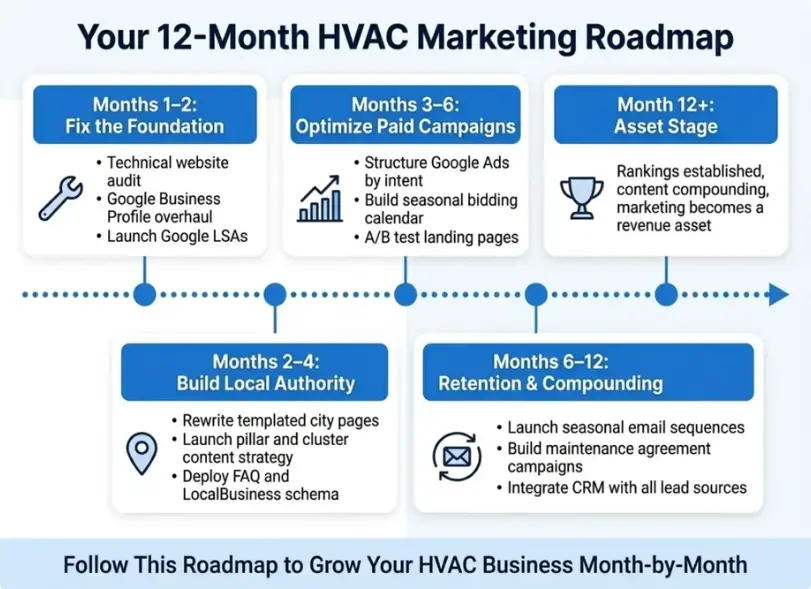
Here’s a realistic, sequenced plan to go from wherever you are now to consistent, compounding lead flow.
Months 1–2: Fix the Foundation
- Technical website audit — fix speed, mobile responsiveness, and call-to-action placement
- Complete Google Business Profile overhaul — all categories, fresh photos, review request system activated
- Launch Google Local Services Ads — fastest path from zero to ringing phone
Months 2–4: Build Local Authority
- Rewrite or remove templated city pages — replace with genuinely local content
- Launch pillar and cluster content strategy — cover the HVAC topic entity comprehensively
- Deploy FAQ schema and LocalBusiness schema across all key pages
Months 3–6: Optimize Paid Campaigns
- Structure Google Ads campaigns by intent — emergency, replacement, maintenance
- Build a seasonal bidding calendar — don’t overpay in shoulder months
- A/B test landing pages to improve conversion rate and lower effective CPL
Months 6–12: Retention & Compounding
- Launch seasonal email sequences to past customers
- Build maintenance agreement campaigns — turn one-time calls into recurring revenue
- Integrate CRM with all lead sources — start making decisions based on revenue data, not impressions
- Activate recruitment content — careers page, leadership LinkedIn, technician testimonial videos
Month 12+: The Asset Stage
At this point your rankings are established, your content is compounding, and your retention system is running. Marketing spend as a percentage of revenue starts to fall while lead volume grows. This is when digital marketing stops feeling like a cost and starts feeling like a business asset that generates returns every single day.
Ready to Fill Your Service Schedule?
There’s no single magic tactic that fills an HVAC company’s calendar. What works is a system — the right foundation, the right channels working together, and the discipline to build it consistently over time.
The good news is that most of your local competitors haven’t built that system yet. The gap between an HVAC company with a properly optimized digital presence and one that’s winging it is enormous — and it’s widening every month as search gets more competitive.
At PromotEdge Digital, we build this kind of systematic, data-driven marketing for HVAC companies, home service contractors, and trades businesses across the US. Whether you’re starting from scratch or you’ve outgrown a legacy agency, we bring the same performance-first approach we’ve applied across real estate digital marketing, e-commerce, and B2B SEO to the specific demands of HVAC business growth.
Get in touch for a no-pressure HVAC marketing audit. We’ll show you exactly where your current visibility stands and which channels represent your best growth opportunity right now.
Frequently Asked Questions
-
What's the most important digital marketing channel for HVAC companies?
Ans.For long-term results, local SEO and your Google Business Profile give the highest ROI. For immediate calls, start with Google Local Services Ads. The best results come from running both together — LSAs for speed, SEO for compounding value over time. -
How long does HVAC SEO take to work?
Ans.In most markets you'll see meaningful improvements in 3–6 months. Competitive big-city markets can take 9–12 months to hit top-3 Map Pack positions. The payoff: once it's there, organic SEO generates leads at $8–$18 each — a fraction of what you'd pay for paid ads. -
Should I use LSAs or Google Ads?
Ans.Both, not either. LSAs get you in front of emergency searchers immediately with pay-per-lead pricing. Google Ads let you scale past the cap LSAs impose and target specific high-intent keywords. Together they generate 25% higher ROI than either channel alone. -
How do small HVAC companies compete against big corporate chains?
Ans.Being genuinely local is your biggest advantage. Google specifically rewards authentic local expertise — real photos from real local jobs, reviews from real local customers, content that mentions real local landmarks and regional weather challenges. Big corporate companies can't fake that. You already have it. You just need to show it. -
What is AEO and do I actually need it?
Ans.AEO means making sure your content gets cited when homeowners ask AI tools like ChatGPT or Google Gemini questions. It's growing fast and the HVAC companies investing in it now are getting ahead of competitors who'll spend years trying to catch up. The good news: the basics — question-format headings, direct answers, FAQ schema — are things any decent web team can implement quickly. -
How do I keep leads coming in during slow seasons?
Ans.Email your past customers. A seasonal tune-up promotion sent to 500 past customers costs almost nothing and generates consistent calls. Maintenance agreement campaigns, indoor air quality content, and pre-season specials are your best slow-season tools — and they turn one-time customers into recurring revenue. -
What CRM should I use with my HVAC marketing?
Ans.ServiceTitan and Housecall Pro are the industry standards for mid-to-large operations. LeadConnector (GoHighLevel) works well for smaller companies or those who want more flexibility. The key requirement isn't which one you choose — it's that every lead from every channel flows into it with the source tracked, so you know exactly which marketing spend is generating revenue.
Author Details

Latest Posts
-
 29 / Jul
Search Engine Optimization 6 Enterprise SEO Mistakes That Quietly Cost You Millions
29 / Jul
Search Engine Optimization 6 Enterprise SEO Mistakes That Quietly Cost You Millions -
 24 / Jul
-
 23 / Jul
Search Engine Optimization How to Improve Organic SEO: A Practical 2026 Guide
23 / Jul
Search Engine Optimization How to Improve Organic SEO: A Practical 2026 Guide -
21 / Jul
Search Engine Optimization Organic SEO vs Paid SEO: Which Is Better in 2026?
-
18 / Jul
Blogs
Journey into Ideas Unveiling Tomorrow's Insights Today.











-
What's the most important digital marketing channel for HVAC companies?
Ans.For long-term results, local SEO and your Google Business Profile give the highest ROI. For immediate calls, start with Google Local Services Ads. The best results come from running both together — LSAs for speed, SEO for compounding value over time. -
How long does HVAC SEO take to work?
Ans.In most markets you'll see meaningful improvements in 3–6 months. Competitive big-city markets can take 9–12 months to hit top-3 Map Pack positions. The payoff: once it's there, organic SEO generates leads at $8–$18 each — a fraction of what you'd pay for paid ads. -
Should I use LSAs or Google Ads?
Ans.Both, not either. LSAs get you in front of emergency searchers immediately with pay-per-lead pricing. Google Ads let you scale past the cap LSAs impose and target specific high-intent keywords. Together they generate 25% higher ROI than either channel alone. -
How do small HVAC companies compete against big corporate chains?
Ans.Being genuinely local is your biggest advantage. Google specifically rewards authentic local expertise — real photos from real local jobs, reviews from real local customers, content that mentions real local landmarks and regional weather challenges. Big corporate companies can't fake that. You already have it. You just need to show it. -
What is AEO and do I actually need it?
Ans.AEO means making sure your content gets cited when homeowners ask AI tools like ChatGPT or Google Gemini questions. It's growing fast and the HVAC companies investing in it now are getting ahead of competitors who'll spend years trying to catch up. The good news: the basics — question-format headings, direct answers, FAQ schema — are things any decent web team can implement quickly. -
How do I keep leads coming in during slow seasons?
Ans.Email your past customers. A seasonal tune-up promotion sent to 500 past customers costs almost nothing and generates consistent calls. Maintenance agreement campaigns, indoor air quality content, and pre-season specials are your best slow-season tools — and they turn one-time customers into recurring revenue. -
What CRM should I use with my HVAC marketing?
Ans.ServiceTitan and Housecall Pro are the industry standards for mid-to-large operations. LeadConnector (GoHighLevel) works well for smaller companies or those who want more flexibility. The key requirement isn't which one you choose — it's that every lead from every channel flows into it with the source tracked, so you know exactly which marketing spend is generating revenue.