


How to Improve Organic SEO: A Practical 2026 Guide
-
Author
Anindita Barik
-
Updated Date
Jul-23-2026
-
Views
2 Min Read
-
Author: PromotEdge Digital
-
Updated Date: Jul-23-2026
-
Views: 2 Min Read
-
Author: Anindita Barik
Improving organic SEO in 2026 requires a fixed sequence: audit your site, match content to search intent, fix on-page and technical issues (speed, mobile, schema), strengthen E-E-A-T, refresh existing pages, build quality backlinks, then optimize for AI Overviews. Expect early movement in 3–6 months, with compounding gains after six months. Since AI Overviews now appear on over 20% of searches and cut click-through rates by nearly 60%, earning citations — not just rankings — is essential for visibility.
If you want to improve your organic SEO, the answer is simple. Start with the basics. Do the right things in the right order instead of chasing shortcuts or publishing more content than you need. The stakes are higher than ever. In early 2026, about 68% of US Google searches ended without a click, so every opportunity to earn visibility matters more than it did before.
This guide walks you through that process for 2026. It starts with your first site audit, then moves to content, technical SEO, authority building, and the growing importance of appearing in AI answers. You can start working on every step this week.
Across local service businesses, ecommerce stores, and B2B websites, the same sequence delivers the best results. The sections that follow explain that sequence in plain language, backed by publicly available data you can verify yourself.
What Improving Organic SEO Really Means
Organic SEO is the process of earning unpaid search rankings on merit. Improving it means helping Google understand your pages, trust your website, and match your content to what people actually search for. You can read more about what organic SEO services cover in practice.
The work focuses on four core areas: content, on-page structure, technical health, and authority. In 2026, a fifth area has become just as important: earning visibility in AI answers. The steps below cover all five in a logical order.
Start With a Quick SEO Audit
Before you change anything, find out where you stand. An audit shows which pages already rank, which ones are close to ranking higher, and what is holding your site back. That baseline helps you decide where your efforts will have the greatest impact first.
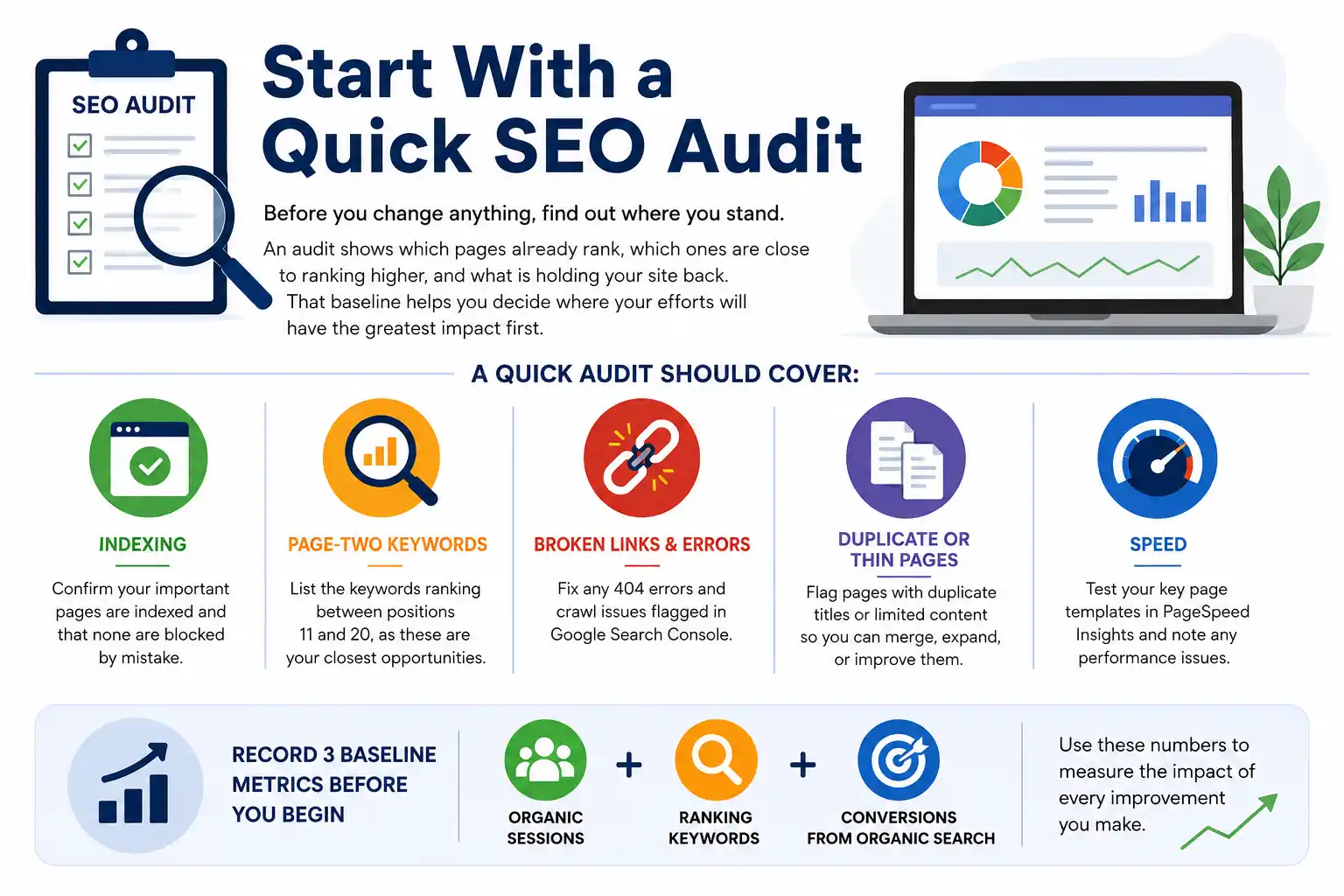
Use Google Search Console to review your current queries, impressions, and average position. Look for pages ranking on page two, as they often offer the quickest opportunities for improvement. A quick audit should cover the following:
- Indexing: Confirm your important pages are indexed and that none are blocked by mistake.
- Page-two keywords: List the keywords ranking between positions 11 and 20, as these are your closest opportunities.
- Broken links and errors: Fix any 404 errors and crawl issues flagged in Google Search Console.
- Duplicate or thin pages: Flag pages with duplicate titles or limited content so you can merge, expand, or improve them.
- Speed: Test your key page templates in PageSpeed Insights and note any performance issues.
Before you begin, record three baseline metrics: organic sessions, ranking keywords, and conversions from organic search. Use these numbers to measure the impact of every improvement you make.
Match Search Intent, Then Do Keyword Research
Every search query has an intent. Someone searching how to fix a leaky tap wants a guide, not a product page. Match your page to the intent behind the search, and you are already halfway to ranking.
Group your keywords by intent: informational, commercial, and transactional. Create guides for informational searches, comparison pages for commercial searches, and service or product pages for transactional searches. Keep one primary intent for each page.
To find the right keywords, start with the phrases your customers use. Then check Google’s People Also Ask section and related searches to discover additional opportunities. Focus on specific, lower-competition keywords first, as they are much easier to rank for than broad head terms.
Next, expand each topic with related keywords and the questions your audience actually asks. Long-tail keywords attract more qualified visitors because they reflect specific search intent. Our guide on keyword research walks through the process of building that list step by step. Local businesses have one more advantage: a well-optimised Google Business Profile, which we cover in our local SEO checklist.
Improve Your On-Page SEO
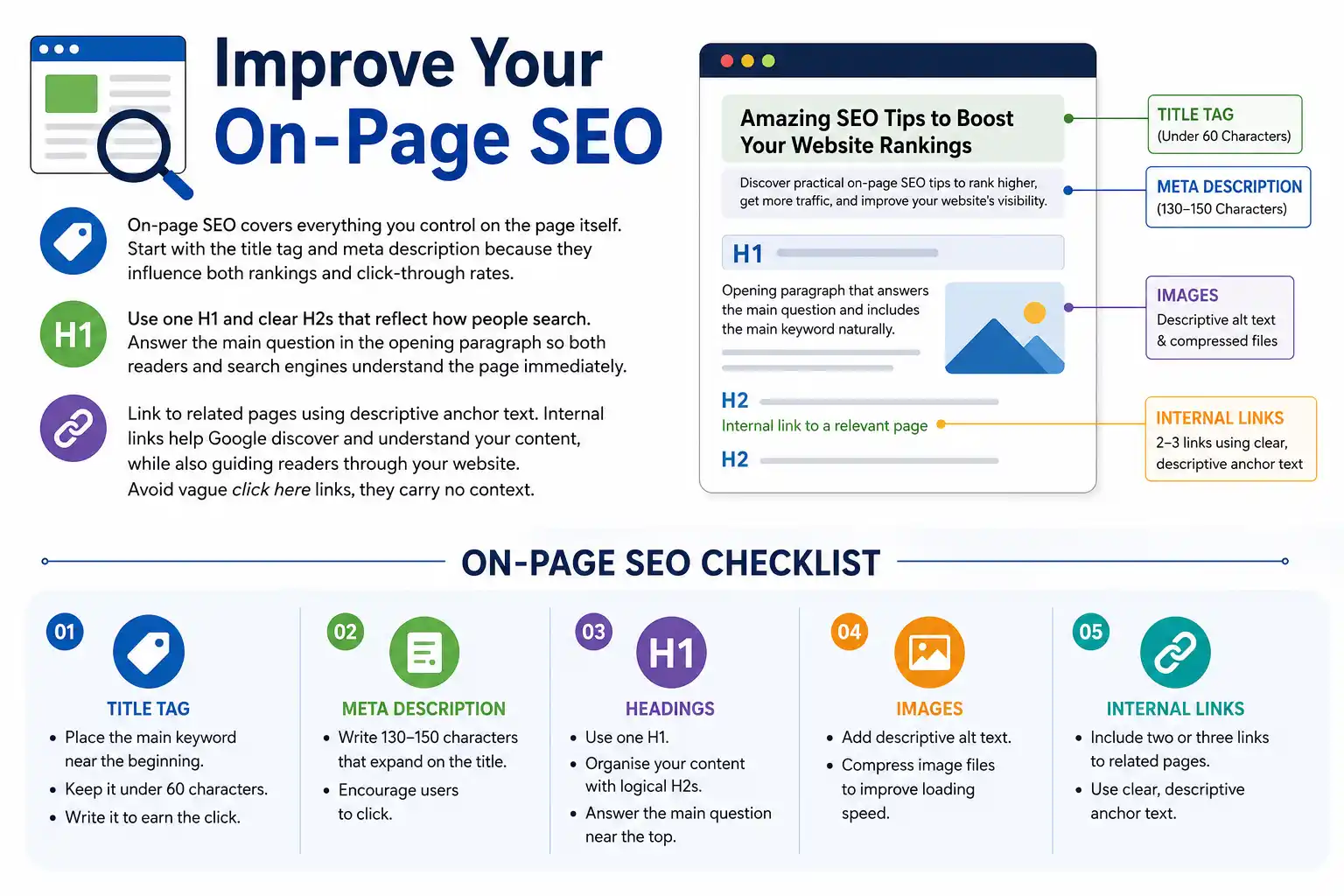
On-page SEO covers everything you control on the page itself. Start with the title tag and meta description because they influence both rankings and click-through rates. Place your main keyword near the beginning of the title and keep it under 60 characters.
Use one H1 and clear H2s that reflect how people search. Answer the main question in the opening paragraph so both readers and search engines understand the page immediately. Include your main keyword naturally, never in every line.
Link to related pages using descriptive anchor text. Internal links help Google discover and understand your content, while also guiding readers through your website. Avoid vague click here links, they carry no context.
Run every important page through this quick checklist:
- Title tag: Place the main keyword near the beginning, keep it under 60 characters, and write it to earn the click.
- Meta description: Write 130–150 characters that expand on the title and encourage users to click.
- Headings: Use one H1, organise your content with logical H2s, and answer the main question near the top.
- Images: Add descriptive alt text and compress image files to improve loading speed.
- Internal links: Include two or three links to related pages using clear, descriptive anchor text.
Fix Technical SEO and Core Web Vitals
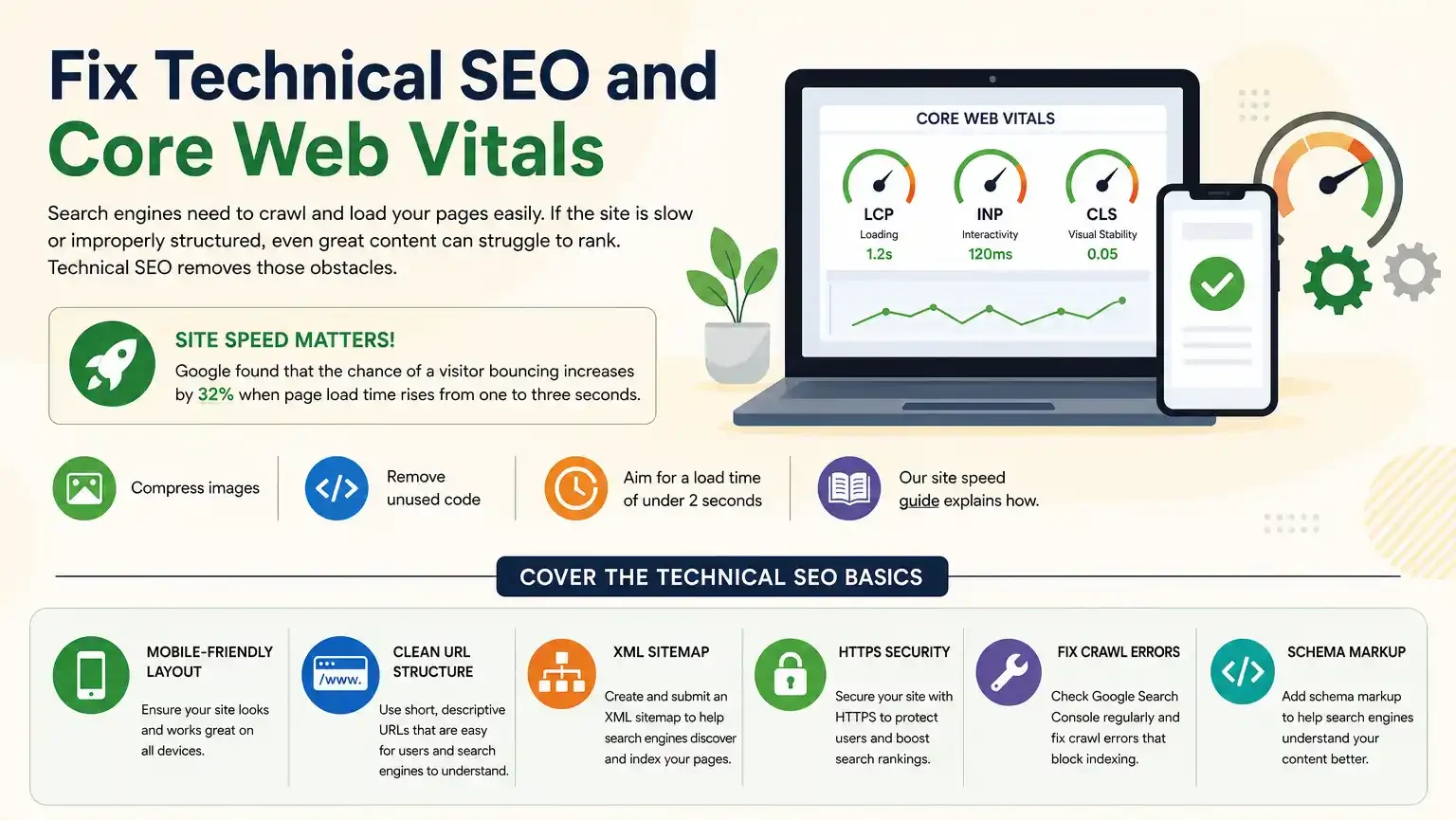
Search engines need to crawl and load your pages easily. If the site is slow or improperly structured , even great content can struggle to rank. Technical SEO removes those obstacles.
Site speed matters more than many website owners realise. Google found that the chance of a visitor bouncing increases by 32% when page load time rises from one to three seconds. Compress images, remove unused code, and aim for a load time of under two seconds. Our site speed guide explains how.
Cover the basics as well: use a mobile-friendly layout, maintain a clean URL structure, create an XML sitemap, and secure your site with HTTPS. Fix crawl errors in Google Search Console, and add schema markup to help search engines understand what each page is about.
Publish Content That Earns Trust (E-E-A-T)
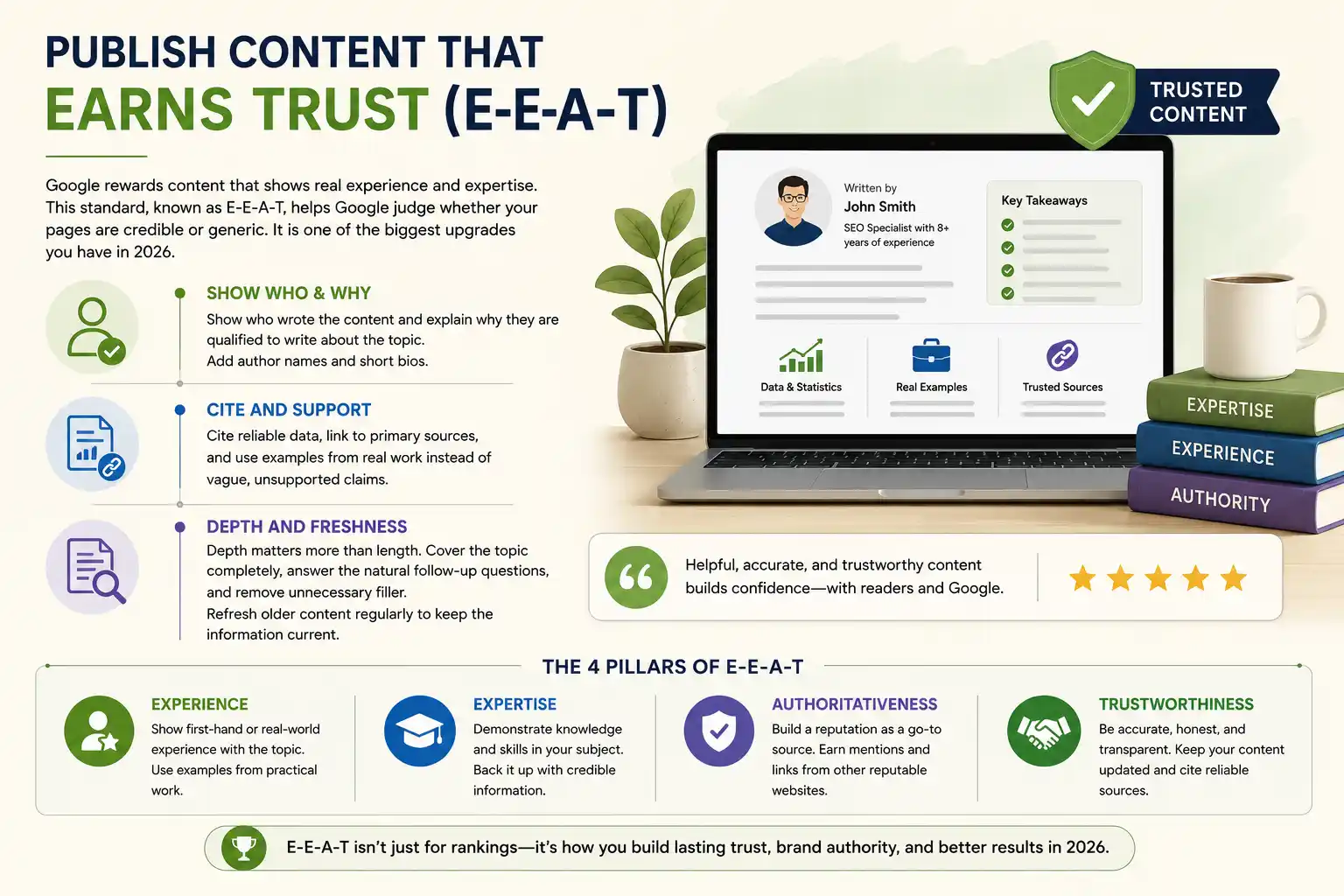
Google rewards content that shows real experience and expertise. This standard, known as E-E-A-T, helps Google judge whether your pages are credible or generic. It is one of the biggest upgrades you have in 2026.
Show who wrote the content and explain why they are qualified to write about the topic. Add author names and short bios. Cite reliable data, link to primary sources, and use examples from real work instead of vague, unsupported claims.
Depth matters more than length. Cover the topic completely, answer the natural follow-up questions, and remove unnecessary filler. Refresh older content regularly to keep the information current, giving both readers and search engines a reason to trust it.
Refresh the Content You Already Have
New pages take time to rank, but existing pages can improve much faster. Updating them often delivers the highest return on your effort, and most websites already have pages with untapped ranking potential.
Find posts that once ranked well but have slipped, or pages stuck on page two. Update the information, add sections that answer new questions, improve the title, strengthen internal links, and then resubmit the URL in Google Search Console.
A single well-planned update can lift a page several positions within weeks. Do this before writing anything new, since the groundwork is already done and the page has some history with Google.
Build Authority With Quality Backlinks
Links from trusted websites tell Google that your content deserves to rank. They remain one of the strongest ranking signals, but quality matters far more than quantity.
Earn backlinks by creating content people genuinely want to reference, such as original data, useful guides, or free tools. Guest posting on respected industry websites, running digital PR campaigns, and reclaiming unlinked brand mentions are all effective ways to build quality links.
Avoid buying links or taking part in link schemes. They violate Google’s guidelines and can damage your rankings. A few strong, relevant backlinks will always outperform hundreds of low-quality ones.
Optimize for AI Search and Zero-Click Results
Search has changed, and your SEO strategy needs to change with it. Most queries now end on the search results page instead of a website, and AI Overviews drive much of that shift. Optimizing for this is no longer optional.
AI Overviews account for much of this change. They now appear on more than a fifth of searches and can reduce click-through rates by close to 60% when they appear. Informational pages feel this impact the most.
Earn citations in AI Overviews instead of focusing only on rankings below them. According to Seer Interactive, brands cited in AI Overviews earn around 35% more organic clicks. Lead each section with a short, direct answer, then expand on it and add structured data to help AI understand your content. Our guides on optimizing for AI Overviews and zero-click SEO cover the details.
Track the Metrics That Matter
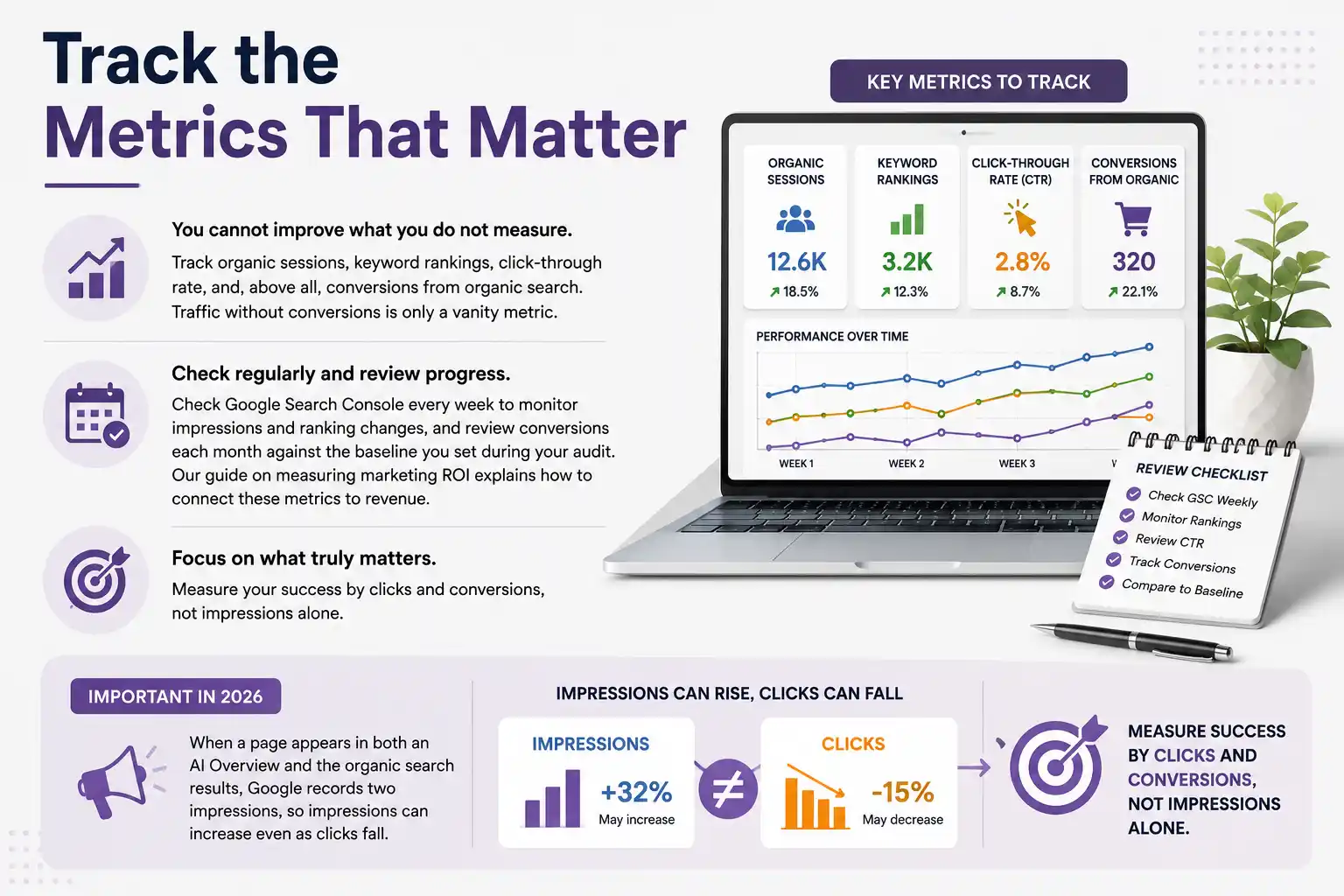
You cannot improve what you do not measure. Track organic sessions, keyword rankings, click-through rate, and, above all, conversions from organic search. Traffic without conversions is only a vanity metric.
Check Google Search Console every week to monitor impressions and ranking changes, and review conversions each month against the baseline you set during your audit. Our guide on measuring marketing ROI explains how to connect these metrics to revenue.
One change catches many people out in 2026. When a page appears in both an AI Overview and the organic search results, Google records two impressions, so impressions can increase even as clicks fall. Measure your progress by clicks and conversions, not impressions alone.
How Long Does It Take to Improve Organic SEO?
SEO rewards patience. An Ahrefs study of millions of pages found that only a small share reach the top ten within a year, and even those pages usually take two to six months to get there. Newer websites take longer because they need time to build trust.
Expect early movement within three to six months, with stronger gains after the six-month mark. You may see quicker results from page-two keywords because they already have some visibility. The compounding comes later, and that is the real strength of organic SEO.
Your First 90 Days: A Simple Priority Order
If you only do a few things, do them in this order. It prioritises the changes that have the greatest impact on rankings while keeping the work manageable.
- Weeks 1 to 2: Run the audit, fix indexing issues and broken links, and record your baseline metrics.
- Weeks 3 to 4: Improve titles, meta descriptions, and internal links on your most important pages.
- Weeks 5 to 8: Improve site speed and Core Web Vitals, then publish or refresh two strong pages.
- Weeks 9 to 12: Start earning quality backlinks, add structured data, and optimize your best pages for AI answers.
Progress comes from consistent execution, not one-off effort. Follow the sequence and review your metrics at the end of each month.
Common Mistakes That Hold Organic SEO Back
A few common habits hold organic SEO back. Chasing high-volume keywords with little chance of ranking wastes months of effort. Publishing thin content that fails to answer a question properly does the same.
Other common mistakes include ignoring mobile speed, stuffing keywords, and leaving older content untouched. Our guide to the common SEO mistakes small businesses make explains which ones cause the most damage and how to avoid them.
The Bottom Line
Improving organic SEO is not about finding a secret formula. It is about following the right sequence: audit your site, match search intent, improve your pages and technical foundation, build authority, and optimize for AI search. Follow that process religiously to get compounding results.
Start with one step this week. Focus on steady progress instead of perfection, and let every improvement build on the last.
The websites that succeed in organic search rarely chase the latest trend. They focus on the fundamentals, measure what works, and keep improving as search continues to evolve.
Frequently Asked Questions
-
How can I improve my organic SEO for free?
Ans.Most of the highest-impact work costs only time. Fix your titles and internal links, match content to search intent, improve page speed, and refresh old posts. Search Console and Google Analytics are free and show you exactly where to focus. -
What is the fastest way to improve organic rankings?
Ans.The quickest wins usually come from pages ranking on page two. Improve those pages with better titles, more complete content, and stronger internal links. Fixing slow load times and indexing issues can also bring fast, visible gains. -
How is organic SEO different from paid search?
Ans.Organic SEO earns unpaid rankings over time, while paid search buys visibility instantly. Organic continues to drive traffic after the work is done, while paid visibility stops when the budget ends. Many businesses use both. -
Does content length affect organic SEO?
Ans.Not directly. Google rewards how well you answer the query, not the word count. A focused 800-word page can outperform a padded 3,000-word one. Cover the topic fully, then stop. -
How often should I update content for SEO?
Ans.Review your key pages every three to six months. Update the facts, add new sections, and remove outdated information. Fresh, accurate content helps maintain rankings and keeps your pages eligible for AI citations.
Author Details

Latest Posts
-
 24 / Jul
-
23 / Jul
Search Engine Optimization How to Improve Organic SEO: A Practical 2026 Guide
-
 21 / Jul
Search Engine Optimization Organic SEO vs Paid SEO: Which Is Better in 2026?
21 / Jul
Search Engine Optimization Organic SEO vs Paid SEO: Which Is Better in 2026? -
 18 / Jul
-
 03 / Jul
Performance Marketing What Is a Performance Marketing Agency? A 2026 Breakdown
03 / Jul
Performance Marketing What Is a Performance Marketing Agency? A 2026 Breakdown
Blogs
Journey into Ideas Unveiling Tomorrow's Insights Today.


-
How can I improve my organic SEO for free?
Ans.Most of the highest-impact work costs only time. Fix your titles and internal links, match content to search intent, improve page speed, and refresh old posts. Search Console and Google Analytics are free and show you exactly where to focus. -
What is the fastest way to improve organic rankings?
Ans.The quickest wins usually come from pages ranking on page two. Improve those pages with better titles, more complete content, and stronger internal links. Fixing slow load times and indexing issues can also bring fast, visible gains. -
How is organic SEO different from paid search?
Ans.Organic SEO earns unpaid rankings over time, while paid search buys visibility instantly. Organic continues to drive traffic after the work is done, while paid visibility stops when the budget ends. Many businesses use both. -
Does content length affect organic SEO?
Ans.Not directly. Google rewards how well you answer the query, not the word count. A focused 800-word page can outperform a padded 3,000-word one. Cover the topic fully, then stop. -
How often should I update content for SEO?
Ans.Review your key pages every three to six months. Update the facts, add new sections, and remove outdated information. Fresh, accurate content helps maintain rankings and keeps your pages eligible for AI citations.