


Digital Marketing for Law Firms: 8 Strategies to Get More Clients in 2026

-
Updated Date
May-04-2026
-
Views
2 Min Read
-
Author: PromotEdge Digital
-
Updated Date: May-04-2026
-
Views: 2 Min Read
-
Author: Milan Shyamal
Most people searching for a lawyer today start with Google — not a referral, not a directory. They search, they scroll, they click, and they call whoever earns their trust first. SEO, PPC, social media, email, content, video — these are the channels that put your firm in that path. Done well, they bring in the right people, build enough trust to make them stay, and give them a reason to call you over the next result.
Nobody calls a friend first when they need legal help. They search online. Either way — the first move was a Google search.
That one habit explains a lot. 93% of all web traffic starts with a search engine. So if your law firm isn’t showing up on page one, someone else’s is. And they’re getting the call, not you.
Referrals still matter. But they can’t carry your entire growth strategy anymore. Whether you run a solo practice or a mid-sized firm, digital marketing is now the baseline — it’s how people find you, decide if they trust you, and make that first call.
This guide covers every major strategy for digital marketing for law firms — SEO, paid ads, social, content, AI marketing. No jargon. No vague advice. Just what’s actually working for law firms right now.
What Are the Best Digital Marketing for Law Firms Strategies in the USA for 2026?
1. SEO for Lawyers and Attorneys — Get Found on Google
Search Engine Optimisation (SEO) is the backbone of any law firm online marketing strategy. When someone types “divorce lawyer near me” or “personal injury attorney in [city]”, you want your firm to appear at the top. Organic SEO services make that happen — organically, without paying for every click.
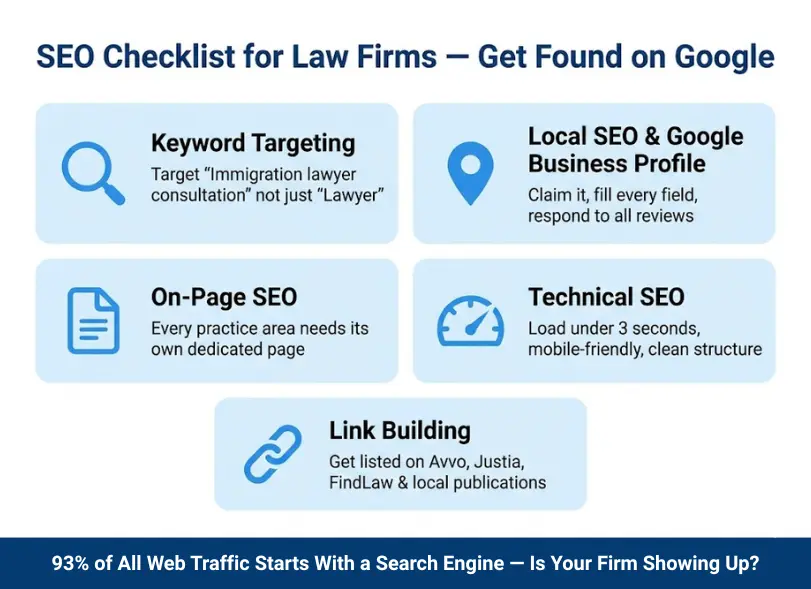
What SEO for law firms actually involves:
- Keyword targeting: Skip the broad terms. “Lawyer” gets you nowhere. “Immigration lawyer consultation” gets you a client who already knows what they need. Research what your ideal client actually types and build around that.
- Local SEO: Your Google Business Profile is often the first thing a potential client sees — before your website. Claim it, fill every field, add photos, list your practice areas, and respond to reviews. All of them.
- On-page SEO: Every practice area needs its own page. Titles, headers, meta descriptions — built around what someone actually searches when they have that specific legal problem. Nothing generic. Write the title, headers, and meta description around what someone actually searches when they have that specific legal problem — not what sounds good internally.
- Technical SEO: Pull up your own website on a phone right now. Does it load in under three seconds? Does anything break? Because that is exactly what a potential client does before deciding whether to stay. Speed, mobile layout, site structure — get these wrong and your SEO work above means nothing.
- Link building: Get listed on Avvo, Justia, and FindLaw. Reach out to local publications. Connect with your bar association. Every credible mention of your firm online tells Google you are legitimate.
If you’re weighing how to spend your marketing budget, our blog on SEO vs PPC — which channel works better breaks down exactly when each approach makes sense for a service-based business like a law firm.
2. PPC & Paid Ads — Get Leads While SEO Builds Up
SEO takes time — usually 3 to 6 months to see real results. That’s where Pay-Per-Click (PPC) advertising steps in. With Google Ads, you can appear at the very top of search results the same day you launch a campaign.
For high-value practice areas like personal injury, criminal defence, or family law, PPC delivers a strong ROI. PPC converts at an average of 3.75% to 6.98% in the legal sector — well above many other industries.
How to run smart PPC campaigns for your law firm:
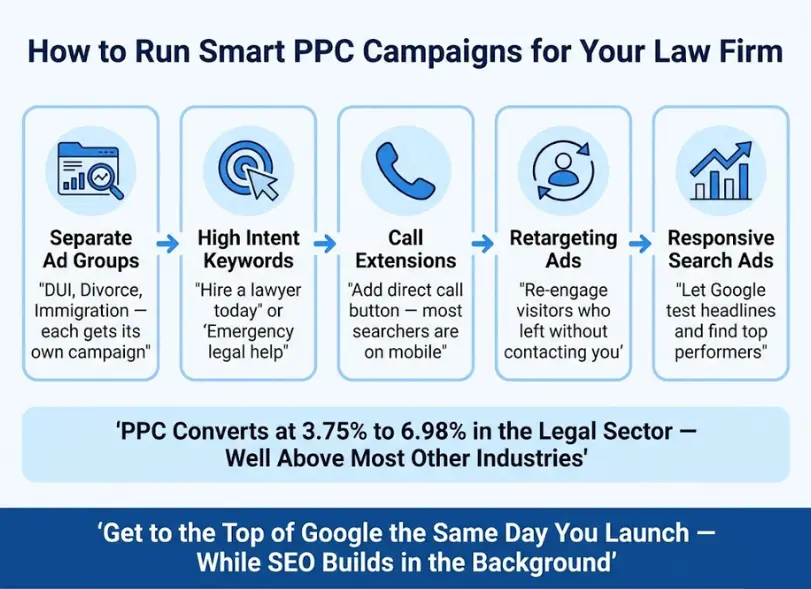
- Each practice area gets its own ad group — DUI, divorce, immigration, separate. That keeps your ads relevant to exactly what someone searched, which keeps your costs down and your click rate up.
- Target keywords that show buying intent. “Hire a lawyer today” or “emergency legal help” — someone typing that is not browsing. They need help now.
- Add call extensions. Most people searching for legal help are on their phones. A direct call button removes one more step between them and your office.
- Not everyone contacts you on the first visit. Retargeting ads follow those visitors after they leave — keeping your firm visible while they make up their mind.
- Run responsive search ads. Feed Google multiple headline and description options and let it figure out which combinations perform. It will outtest anything you pick manually.
You can also run ads on Facebook, Instagram, and LinkedIn to reach people based on demographics, location, and interests — great for family law or estate planning where audience targeting matters.
3. Content Marketing — Build Trust Before They Even Call You
Here’s the truth: most people aren’t ready to hire a lawyer the first time they find you. They’re researching. Content marketing is how you build trust during that research phase — so when they’re ready to hire, you’re the firm they already trust.
Law firms that consistently publish content pull in 67% more leads than those that don’t. Most firms still aren’t doing it — which means the ones that do have a serious head start.
Content ideas that actually work for law firms:
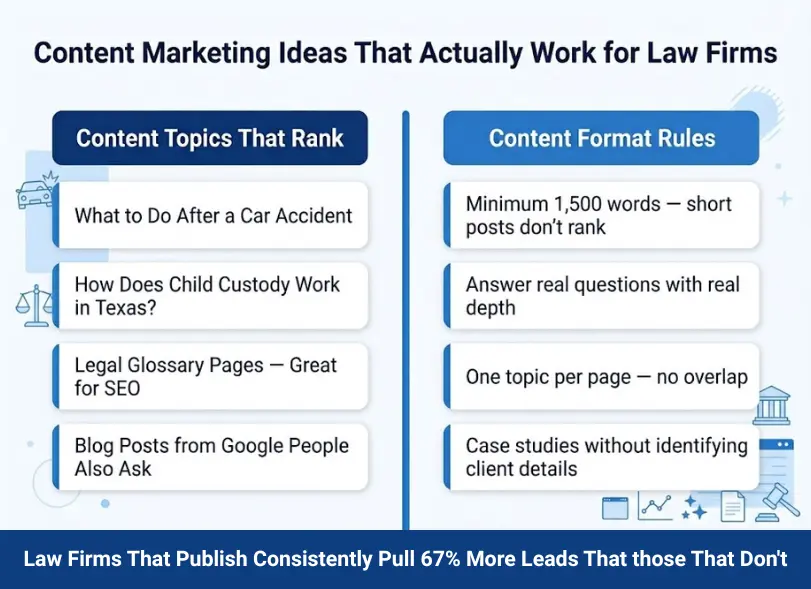
- “What to Do After a Car Accident” — that search is not academic. Someone just had one. Walk them through what happens next.
- “How Does Child Custody Work in [State]?” — custody questions come from parents who are scared, not curious. Write for that person.
- Case studies (without identifying client details) that showcase results
- Legal glossary pages — great for SEO and educating clients
- Blog posts answering questions from the Google ‘People Also Ask’ section
Short posts don’t rank. A 500-word article on DUI laws tells Google nothing it doesn’t already know. A detailed guide — 1,500 words, real questions answered, actual depth — that is what earns a page one spot and keeps someone reading long enough to trust you.
4. Social Media Marketing — Stay Visible, Stay Relevant
Nobody scrolls Instagram looking for a litigation attorney. That is not what social media does for law firms. What it does is keep your firm in front of people who already found you — so when they are ready to call, you are the name they remember. That matters more than most firms realize.
Which platforms matter for law firms?
- LinkedIn — If your work touches corporate law, employment, or IP, this is where your clients are. Post opinions on industry developments. Write about cases that shaped policy. Post things worth reading. Not updates about your firm — actual opinions, actual insight, actual commentary on things your clients care about.
- Facebook — Less about lead generation, more about being present in your community. Answer common questions. Show up at local events. People hire lawyers they feel connected to.
- Instagram — Put faces to your firm. The attorney who coaches little league. The paralegal who has been with you twelve years. That kind of content does more for trust than a polished brochure ever will.
- YouTube — Someone just got served divorce papers. They are not calling a lawyer yet — they are searching YouTube trying to understand what happens next. A plain-language explainer video that answers that question puts your firm in front of them before they even know they need you.
One 2026 trend worth noting: social platforms now return results based on profile and page relevance — not just hashtags. Treating your social profiles with SEO-friendly copy and consistent posting is becoming more important than ever.
5. Video Marketing — The Most Powerful Trust Builder Online
Text tells. Video shows. A two-minute video of an attorney explaining what happens after a DUI arrest does something a written page cannot — it puts a real person in front of a potential client. And when someone is about to hire a lawyer, that difference matters.
Video content that works well for attorneys:
- ‘FAQ Friday’ series — answer one common legal question per week
- Attorney introduction videos — sixty to ninety seconds, no script feel. Someone deciding whether to hire you wants to see who they are calling. Give them that before they even reach out.
- Legal process explainers — how does a personal injury claim actually work? What happens at an arraignment? People have these questions and most firms never answer them. The ones that do get the call.
- Client testimonial videos — nothing you produce yourself will be as persuasive as a real client saying you helped them through one of the hardest periods of their life.
- Run a live session on Facebook or Instagram. Take questions as they come. Nobody wants a rehearsed legal seminar — they want to ask the thing they have been worrying about and get a straight answer. That is what builds trust. The recording does the rest.
Host everything on YouTube. Google owns it, which means a well-optimised video there has a real shot at showing up in search results — not just on YouTube but on Google itself.
A ten-minute explainer does not have to be posted as a chunk. Clip the best moments — a thirty second Reel for Instagram, a two minute cut for LinkedIn, a snippet for Facebook. One video, multiple platforms, weeks of content from a single shoot.
6. Email Marketing — The Channel Most Law Firms Underuse
Email is not dead. It is one of the highest-ROI channels in digital marketing for law firms, it does three things well: keeps you in touch with past clients, warms up prospects who are not ready to hire yet, and quietly drives referrals in the background.
How to use email marketing as a law firm:
- Monthly newsletter — recent blog posts, legal news, firm updates. Short, useful, consistent. It keeps your name somewhere visible until the moment someone needs a lawyer or knows someone who does.
- Lead nurture sequences — someone filled out your contact form but did not call. Do not let that go cold. An automated sequence of helpful emails over seven to fourteen days keeps the conversation going without anyone on your team lifting a finger.
- Post-case follow-ups — your happiest clients are also your best source of new business. A single email asking for a review or a referral, sent at the right time, can bring in more than most firms expect from a message that takes five minutes to write.
- Legal alerts: Send updates on law changes relevant to your clients’ situations — it builds authority and keeps them engaged.
7. AI Marketing — The Game-Changer Law Firms Are Sleeping On
Artificial intelligence is reshaping how people search for legal help. Tools like ChatGPT, Google Gemini, and Perplexity are now answering legal questions directly — and they pull answers from authoritative, well-structured content online.
If your firm’s website answers common legal questions clearly and in depth, you’re more likely to be referenced by these AI tools. This is called Answer Engine Optimisation (AEO) — and it’s quickly becoming as important as traditional SEO.
How to position your firm for AI search:
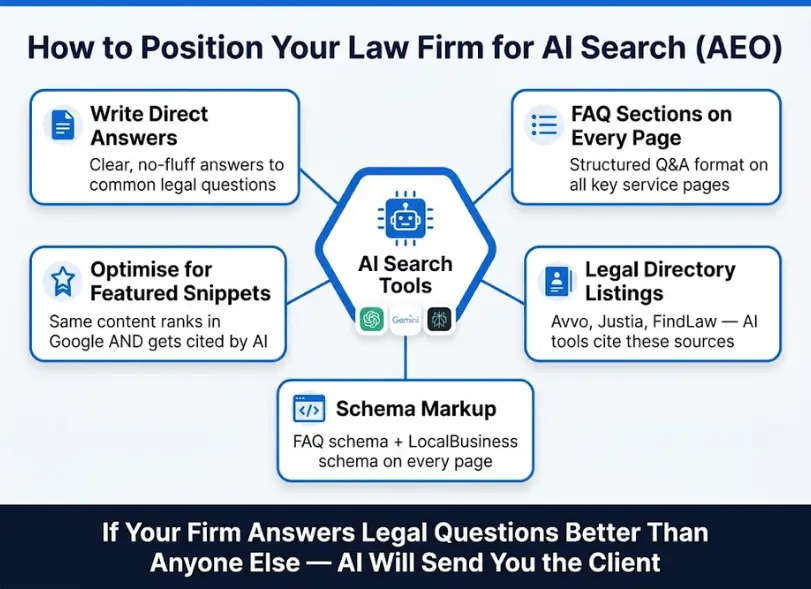
- Write clear, direct answers to common legal questions — no fluff, no padding
- Use structured FAQ sections on every key service page
- Optimise for featured snippets on Google (same content works for AI tools)
- Ensure your firm is listed on authoritative legal directories — AI tools cite these
- FAQ schema, LocalBusiness schema — set these up on your site. Search engines use them to understand exactly what your pages are about.
AI works internally too. Outlines, email drafts, ad copy — your team moves faster without the manual back and forth. But always have a qualified person review any AI-generated legal content before publishing.
8. Lead Generation Techniques for Law Firms — Turning Traffic into Clients
Getting traffic to your website is only half the battle. The real goal is converting visitors into leads — people who actually reach out and hire you.
High-impact lead generation techniques:
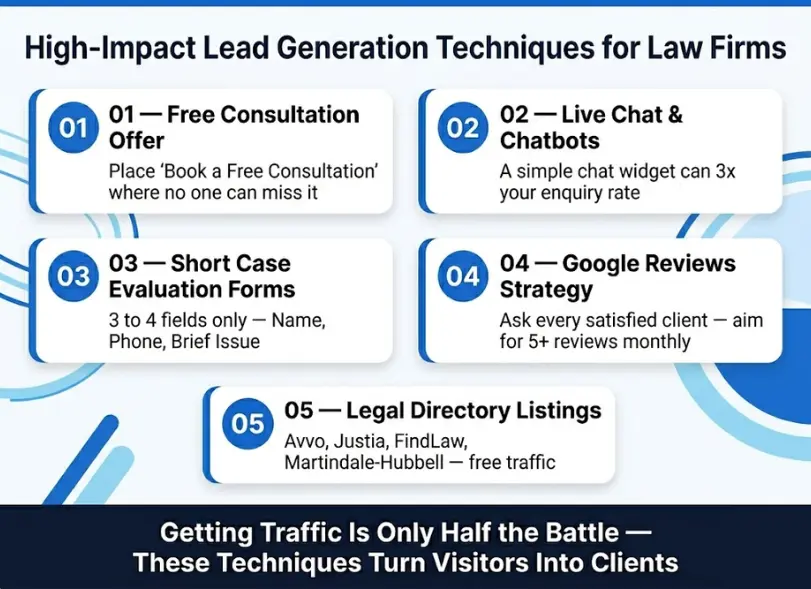
- Free consultation offers — put “Book a Free Consultation” somewhere people cannot miss it. That one line removes the biggest reason someone hesitates to reach out.
- Live chat and chatbots — A lot of people will not pick up the phone. They will type though. Give them that option and you will hear from people who would have otherwise left without contacting you. A simple chat widget can 3x your enquiry rate.
- Case evaluation forms: Short forms (3 to 4 fields) convert better than long ones. Ask for name, phone, and brief issue.
- Google Reviews strategy — Once a matter closes successfully, follow up and ask the client to leave a review. Most will if prompted. In legal services, a five-star review from a real client does more than any ad. People hiring a lawyer are making a high-stakes decision — they want proof someone else trusted you first.
- Legal directories — Avvo, Justia, FindLaw, Martindale-Hubbell. If your firm is not listed on these, you are missing referral traffic that costs nothing to earn. Fill everything out. Keep the details accurate. These profiles show up in search results on their own and send traffic your website would not have caught otherwise. These directories drive referral traffic that costs nothing in ad spend.
We have outlined how different industries apply these tactics in our guide on industries that benefit most from digital marketing — legal services consistently ranks at the top.
Digital Marketing for Small Law Firms — You Don’t Need a Big Budget
If you’re a solo attorney or running a small firm, budget is a real concern. The good news is that some of the most effective legal marketing services for small law firms are low-cost or free.
Where to start when budget is limited:
- Blogging (low cost) — two to three solid posts a month. Not more, not less. Done consistently over six months, that builds more SEO authority than a one-time content push ever will.
- Email marketing (affordable) — Mailchimp‘s free tier handles a small firm newsletter without any monthly cost. Set it up once, build the list slowly, and let it run.
- Referral strategy (free) — call past clients. Ask directly. One honest Google review from a satisfied client can bring in three more. Most firms never ask, which means the ones that do have an immediate edge.
- Social media (free) — pick one platform, maybe two. Post regularly. A firm that shows up consistently on LinkedIn every week looks more credible than one that posts on five platforms and goes quiet for a month.
Our guide on affordable digital marketing strategies for small businesses has a practical step-by-step breakdown you can follow with any budget size.
How to Get Clients for a Law Firm Online — A Practical Summary
If you’re looking for a direct answer to the question ‘how do I get more clients online?’, here it is:
- Start with Local SEO and Google Business Profile — this gets you visible for nearby searches immediately.
- Run targeted Google Ads for your top practice area — focus spend where cases have the highest value.
- Publish at least 2 blog posts per month that answer questions your ideal clients are actually asking.
- Add a live chat widget to your website to capture people who browse but won’t call.
- Collect Google reviews consistently — aim for 5+ new reviews every month.
- Nurture enquiries with email — don’t let warm leads go cold.
- Track everything using Google Analytics and Search Console so you know what’s working.
| 🚀 Ready to Grow Your Law Firm Online? At PromotEdge Digital, we help law firms build powerful online presences through SEO, PPC, content marketing, social media, and more. Whether you’re a solo attorney or a growing firm, we’ll create a custom strategy around your practice areas, location, and budget. Explore our full range of digital marketing services at PromotEdge Digital or reach out for a free consultation today. |
Frequently Asked Questions (FAQs)
-
What is the best digital marketing strategy for law firms?
Ans.A combination of Local SEO, Google Ads (PPC), and content marketing gives the best results. SEO builds long-term organic visibility, while PPC delivers immediate leads. Content marketing builds trust and supports both. -
How much should a law firm spend on digital marketing?
Ans.A general benchmark is 5% to 10% of gross revenue. A revenue-to-cost ratio of 5:1 is considered acceptable — meaning every $1 spent on marketing should return at least $5 in case of revenue. -
How long does it take SEO to work for a law firm?
Ans.Typically 3 to 6 months before you see meaningful organic traffic growth. Local SEO (Google Business Profile) can show results faster — sometimes within 4 to 8 weeks of optimization. -
Is social media important for law firms?
Ans.Yes — but not primarily for direct client acquisition. Social media builds brand awareness, humanizes your firm, and supports your SEO through engagement signals. LinkedIn is most valuable for B2B legal practices; Facebook and Instagram for consumer-facing firms. -
Can small law firms compete online against large firms?
Ans.Absolutely. Local SEO is a great equalizer — a solo attorney with a fully optimized Google Business Profile and consistent local reviews can outrank large firms in local search results. -
Do I need a digital marketing agency for my law firm?
Ans.It depends on your capacity. If you can invest several hours per week, basic SEO and social media can be done in-house. But for serious growth — especially PPC and technical SEO — a specialist agency delivers significantly better ROI.
Author Details

Latest Posts
-
 29 / Jul
Search Engine Optimization 6 Enterprise SEO Mistakes That Quietly Cost You Millions
29 / Jul
Search Engine Optimization 6 Enterprise SEO Mistakes That Quietly Cost You Millions -
 24 / Jul
-
 23 / Jul
Search Engine Optimization How to Improve Organic SEO: A Practical 2026 Guide
23 / Jul
Search Engine Optimization How to Improve Organic SEO: A Practical 2026 Guide -
21 / Jul
Search Engine Optimization Organic SEO vs Paid SEO: Which Is Better in 2026?
-
18 / Jul




Blogs
Journey into Ideas Unveiling Tomorrow's Insights Today.
















-
What is the best digital marketing strategy for law firms?
Ans.A combination of Local SEO, Google Ads (PPC), and content marketing gives the best results. SEO builds long-term organic visibility, while PPC delivers immediate leads. Content marketing builds trust and supports both. -
How much should a law firm spend on digital marketing?
Ans.A general benchmark is 5% to 10% of gross revenue. A revenue-to-cost ratio of 5:1 is considered acceptable — meaning every $1 spent on marketing should return at least $5 in case of revenue. -
How long does it take SEO to work for a law firm?
Ans.Typically 3 to 6 months before you see meaningful organic traffic growth. Local SEO (Google Business Profile) can show results faster — sometimes within 4 to 8 weeks of optimization. -
Is social media important for law firms?
Ans.Yes — but not primarily for direct client acquisition. Social media builds brand awareness, humanizes your firm, and supports your SEO through engagement signals. LinkedIn is most valuable for B2B legal practices; Facebook and Instagram for consumer-facing firms. -
Can small law firms compete online against large firms?
Ans.Absolutely. Local SEO is a great equalizer — a solo attorney with a fully optimized Google Business Profile and consistent local reviews can outrank large firms in local search results. -
Do I need a digital marketing agency for my law firm?
Ans.It depends on your capacity. If you can invest several hours per week, basic SEO and social media can be done in-house. But for serious growth — especially PPC and technical SEO — a specialist agency delivers significantly better ROI.