


B2B Content Marketing Strategy Checklist: 10 Steps to Drive Pipeline in 2026

-
Updated Date
May-06-2026
-
Views
2 Min Read
-
Author: PromotEdge Digital
-
Updated Date: May-06-2026
-
Views: 2 Min Read
-
Author: Milan Shyamal
Most B2B content gets published and forgotten. It pulls some traffic, sits on the blog, and does nothing for the pipeline. A B2B content marketing strategy checklist exists to fix that — it is a structured framework that keeps content tied to business goals from the start, not just page views.
It covers the things that actually matter: core messaging, buyer journey mapping, competitor gap analysis, keyword and semantic SEO, anchor content, AEO and AI optimisation, SME activation, intentional distribution, pipeline measurement, and quarterly audits.
The question it forces you to answer about every piece of content — did it move the needle? Or did it just exist?
Here’s the honest truth: most B2B content teams are busy — but not strategic. Done consistently, it turns scattered content activity into a repeatable pipeline engine.
Last month your B2B team published something. Maybe a blog post, a guide, a LinkedIn article. But, who will read it? Did the sales ever bring it up?
A lot of teams are putting out content week after week with no real plan behind it. The calendar stays full. The pipeline does not move.
B2B buying behaviour has shifted dramatically in 2026. Buyers wrap up around 67% of their research online before they ever speak to a salesperson. If you want to understand the full landscape driving this change, our guide on top B2B digital marketing trends in 2026 is a good starting point.
This checklist will help you turn that knowledge into an operational plan — step by step.
What Is a B2B Content Marketing Strategy Checklist?
It is a step-by-step framework built to keep content tied to business outcomes — not publishing schedules. Every stage of the content process — planning, creation, distribution, measurement — has a step in it. Nothing assumed, nothing skipped. It covers core messaging, competitor gap analysis, keyword and semantic SEO, anchor content, AEO and AI optimisation, SME activation, distribution, pipeline measurement, and quarterly audits. The goal is simple — to stop producing content that just exists and start producing content that drives revenue.
Why Most B2B Content Strategies Fall Flat
Over 90% of B2B teams are producing content. That number sounds good until you look at what most of it is doing — which is not much.
The gap is not effort. Most teams are working hard. The problem is two things that keep getting skipped: writing down the actual strategy, and connecting content to business outcomes instead of just publishing metrics.
| 3x more leads.
The research keeps pointing the same direction. Document the strategy or don’t — but the teams that do consistently pull ahead of the ones that don’t. (Source: DigitalApplied) |
There is something else worth paying attention to in 2026. Google’s AI Overviews have changed what a search results page actually looks like. A page ranking number one can still lose a significant chunk of its clicks when an AI-generated answer sits above it and gives the user what they need without them ever visiting your site.
Step 1 of 10
Document Your Core Messaging |
Before anyone writes anything, get the basics agreed on. Not roughly agreed — actually aligned. Marketing, sales, leadership — if each of them answers the same question differently, that disconnect shows up in the content. Buyers feel it even when they cannot name it.
What to define before you start creating:
- Who is your Ideal Customer Profile (ICP)? Which industry, which role, what size of company — and more importantly, what happens in their business that makes them start looking for something like what you offer.
- What pain points do your buyers have at each stage? Awareness, evaluation, decision — the concern at each stage is different. The content needs to match.
- What makes you different from your top three competitors right now? Not in theory. Right now, based on what buyers are actually choosing between.
- What exact language do your buyers use when they describe their problem? Not your internal terminology. The words they type into Google or say on a discovery call.
| Quick Tip
Pull your sales and customer success teams into a room and ask one question — what objections or questions come up most often? That conversation will do more for your content strategy than any keyword tool. |
Step 2 of 10
Map Content to the Real Buyer Journey |
The traditional marketing funnel looks clean on a slide. It rarely matches what actually happens when a B2B buyer is working through a decision.
On average, a B2B purchase involves nearly 12 different stakeholders — and buyers consume over 11 pieces of content before they ever contact a vendor. Your content needs to answer their questions at each stage.
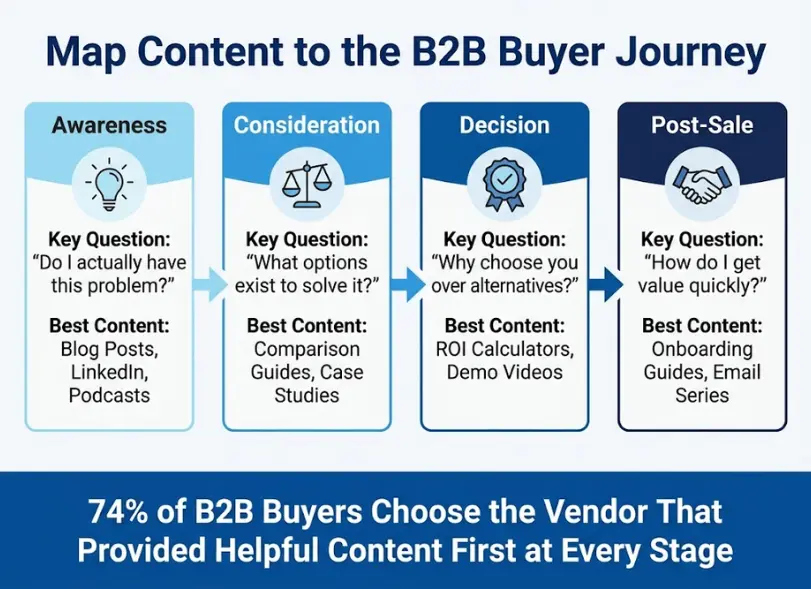
| Buyer Stage | Key Question They’re Asking | Best Content Type |
| Awareness | Do I actually have this problem? | Blog posts, LinkedIn, Podcasts |
| Consideration | What options exist to solve it? | Comparison guides, Case studies |
| Decision | Why choose you over alternatives? | ROI calculators, Demo videos |
| Post-Sale | How do I get value quickly? | Onboarding guides, Email series |
According to the Content Marketing Institute, 74% of B2B buyers end up choosing the company that was first to provide helpful content at each stage of their journey. Being present early is what wins deals later.
Step 3 of 10
Run a Competitor Content Gap Analysis |
This is the step most B2B content checklists skip — and it’s one of the most valuable things you can do before creating anything.
Your competitors’ blind spots are your opportunities. Finding what they’ve missed tells you exactly where to focus your energy.
The 3-Source Evidence Audit
Before opening a keyword tool, pull insight from three places first.
- Sales calls and deal reviews — what question comes up in every demo? What objection keeps stalling deals at the same stage? That is your content brief right there.
- Competitor content gaps — run your top three competitors through Ahrefs or Semrush. Find the topics they rank for that you don’t. Find the ones they have covered badly. Both are opportunities.
- Your own content performance — something you published is already getting traction. Find out what and why before you decide what to write next.
| 2026 Quick Win
Refreshing and republishing an outdated content can grow organic traffic by up to 106%. It’s often 3x faster than writing something entirely new — and Google rewards fresher, more complete content. |
Step 4 of 10
Build Your Keyword & Semantic SEO Map |
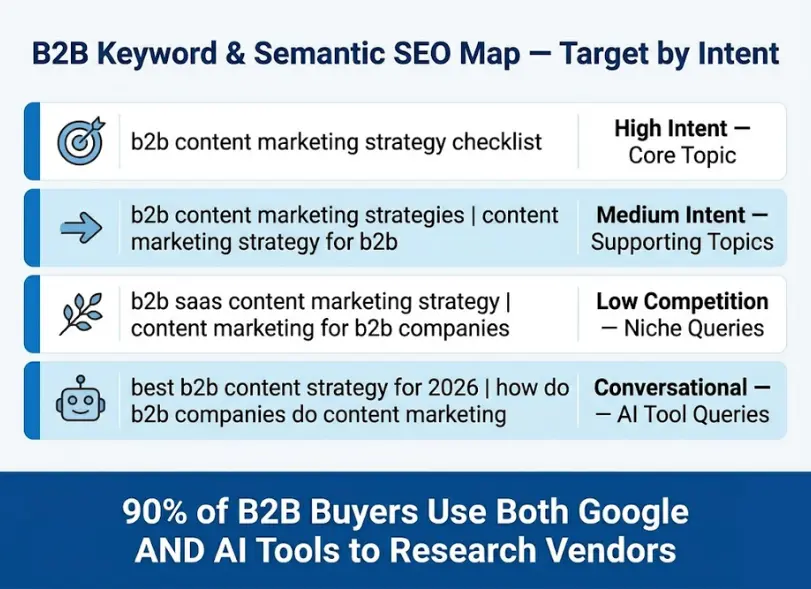
High search volume is not the goal. Relevance is. In 2026, B2B keyword research is really about one thing — figuring out what your buyers type at each stage of their journey and putting the right content in front of them at that exact moment.
Map your keywords by intent. Awareness, comparison, decision — each stage needs its own content type, not the same blog post optimised for everything.
A solid B2B SEO strategy maps keywords by intent — awareness, comparison, decision — and matches each group to a content type that fits where the buyer is in their journey.
Here is how to structure your keyword map:
- Primary keyword — b2b content marketing strategy checklist
- Secondary keywords — b2b content marketing strategies, content marketing strategy for b2b
- Long-tail — b2b saas content marketing strategy, content marketing for b2b companies
- AI queries — “best b2b content strategy for 2026”, “how do b2b companies do content marketing”
Understanding how organic SEO services work — particularly topic clustering and internal linking — is key to making this keyword map work long-term, not just for individual posts.
| 90% of B2B buyers use both Google AND AI tools to research vendors.
That means your content needs to show up in traditional search results AND in AI-generated answers. |
Step 5 of 10
Build a Content Calendar With Realistic Cadence |
Before you start creating content, get clear on a few logistics. Without this, content becomes random activity instead of strategic execution.
Answer these four questions before anything else:
- What are your top three content goals this quarter? More organic traffic, sales enablement, building authority — pick three and write them down.
- Which three channels will you focus on? SEO blog, LinkedIn, email — choose the ones your buyers actually use and ignore the rest for now.
- What are your content pillars? Three core themes your content keeps coming back to. Everything you publish should sit inside one of them.
- What cadence can you actually maintain? Two strong pieces a month beats four rushed ones every time. Pick a pace your team can hold without cutting corners.
Do not pick channels based on where your team is comfortable. Pick them based on where your ICP actually spends time when they are trying to solve a problem.
Our breakdown of which industries need digital marketing most in 2026 will help you work out the right channel mix for your B2B audience.
| Practical Tip
Ninety-day blocks. Every piece on the calendar gets an owner, a date, and a channel — sorted before the quarter starts. The “what do we publish this week” conversation stops happening because you already had it. |
Step 6 of 10
Lead With Anchor Content, Then Repurpose |
Most B2B teams treat every piece of content as its own separate project. That is where a lot of time gets lost.
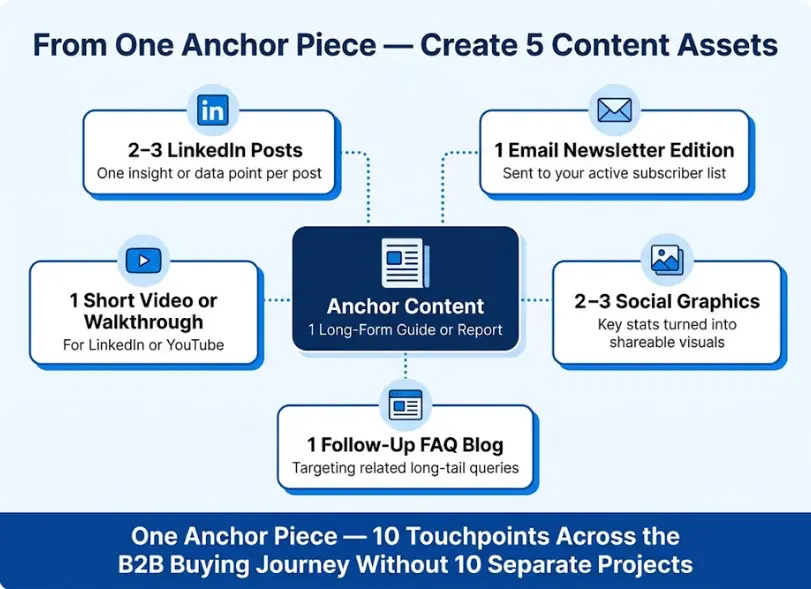
Start with one strong anchor piece — something that goes deep on a question your buyer is genuinely trying to answer. Then pull from it. A long-form guide does not have to live as just a guide. LinkedIn post. Email sequence. Short video. Sales one-pager. Four different formats, one piece of content behind all of them. The buyer sees it differently each time depending on where they are.
From one anchor piece, you can create:
- 2–3 LinkedIn posts — each one pulling out a single insight or data point
- 1 email newsletter edition sent to your active list
- 1 short video or walkthrough for LinkedIn or YouTube
- 2–3 social graphics featuring key stats from the piece
- 1 follow-up FAQ blog targeting related long-tail queries
| Ten channels. That is what a typical B2B buying journey looks like now — before a single contract gets signed.
One anchor piece reposted across those channels builds consistent brand presence without spinning up ten separate content projects. (Source: McKinsey B2B Pulse, 2024) |
Step 7 of 10
Optimise for AI Search & AEO |
This is the biggest gap in almost every competitor blog currently ranking for this keyword — and where 2026 search visibility is being decided.
ChatGPT hit 1 billion monthly searches in January 2026. Your buyers are asking AI tools for vendor recommendations before they even visit a website. If your content isn’t structured for AI, you’re invisible in half the research process.
Apply these AEO optimisations to every piece you publish:
- Write H2 headings as questions — mirroring how buyers actually ask things conversationally.
- Write a direct 2–3 sentence answer in the opening lines under each heading.
- Open every section with a direct two to three sentence answer — no build up, no context setting, just the answer.
- Close every post with a FAQ section, at least five questions, written the way a buyer would actually ask them..
- Cite credible third-party sources with outbound links — AI tools heavily favour well-referenced content.
| Why This Matters
Over 92% of marketers are already optimising for AI-powered search in 2026 — or actively planning to. The ones who are not will watch competitors show up in AI citations while their own content sits unread. (Source: Taboola) |
Step 8 of 10
Involve Your Internal Subject Matter Experts |
Generic content is losing ground fast. The content that ranks in 2026 has a name behind it — someone who has actually done the thing they are writing about, not just researched it.
Google’s E-E-A-T framework — Experience, Expertise, Authoritativeness, Trustworthiness — is built to reward exactly that kind of authorship.Content with a credible, identifiable author ranks better. And unlike most ranking factors, this one requires no technical work. Just the right people writing the right things.
How to activate your internal SMEs:
- Record 15-minute interviews with product, sales, or CS team members on topics your buyers care about — then turn those into bylined blog posts.
- Named authors with short bios visibly increase trust and E-E-A-T signals. Add an author box to every post.
- Encourage thought leaders to share their perspective on their personal LinkedIn profiles — not just the brand page.
- Build original data and research into your content wherever possible. Original data drives significantly higher conversion rates than generic commentary.
Any competitor can write about the same topic. They cannot write from the same experience your team has.
Step 9 of 10
Build an Intentional Distribution Plan |
Publishing content and hoping it gets found is not a strategy. Every piece needs a distribution plan assigned before it goes live — not as an afterthought.
Distribute every anchor piece across these channels:
- SEO — Title tag. H1. Meta description. Schema markup. Internal links. Get these done before the piece goes live.
- LinkedIn — post from personal profiles, not just the brand page. 4 in 5 LinkedIn members drive business decisions. Pairing this with a consistent social media optimisation approach compounds the reach of every piece you publish.
- Email — pull the main point out of your anchor piece and build a newsletter edition around it. Send it to the list segment it actually belongs to — not your entire database.
- Sales enablement — share relevant posts with your sales reps to use in active deal conversations.
- Dark funnel — Slack groups, Reddit threads, niche forums. Your ICP is in there having conversations that never touch your analytics. That is exactly why you need to be there too.
| 62% of B2B marketers say LinkedIn brings in leads at double the rate of every other social platform they run.
(Source: Sprout Social) |
Step 10 of 10
Measure What Actually Moves Pipeline |
Most teams report page views. Leadership always asks about pipeline. That gap costs marketing teams budget and credibility every single quarter.
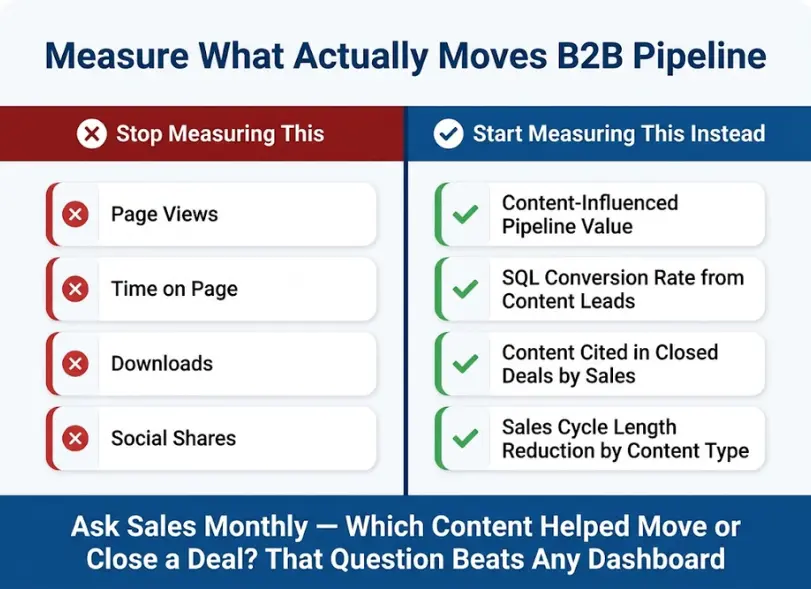
The fix is simple: stop measuring activity, start measuring influence.
| Stop Measuring This | Start Measuring This Instead |
| Page views | Content-influenced pipeline value |
| Time on page | SQL conversion rate from content-sourced leads |
| Downloads | Content cited in closed deals by sales |
| Social shares | Sales cycle length reduction by content type |
Set up UTM tracking on every distributed piece. Then ask your sales team monthly: ‘Which content helped move or close a deal?’ That one question is more valuable than any dashboard.
If you’re combining content with paid channels to accelerate pipeline, understanding how performance marketing works alongside content will help you build a measurement framework that tracks both together — not in silos.
Bonus Step: Audit and Refresh Every Quarter
Content has a shelf life — especially in fast-moving B2B categories. A quarterly audit stops decay before it compounds.
Run through these four questions every 90 days:
- Are top-performing posts still accurate — stats, links, product details all current?
- Go back 90 days. Which posts were ranking that are not anymore? Those are the ones that need attention first — not new content, not a redesign, just a piece that has gone outdated and needs optimization or upgradation.
- Are there older posts sitting without a single internal link pointing to your newer content? That is a lost authority transfer sitting right there.
- Are CTAs in older posts aligned with your current campaigns and lead magnets?
Do this every quarter without skipping it. Recovering a post that has slipped costs a fraction of the effort it takes to rank something new — and the traffic impact is often bigger.
Quick-Reference: Your B2B Content Marketing Strategy Checklist 2026
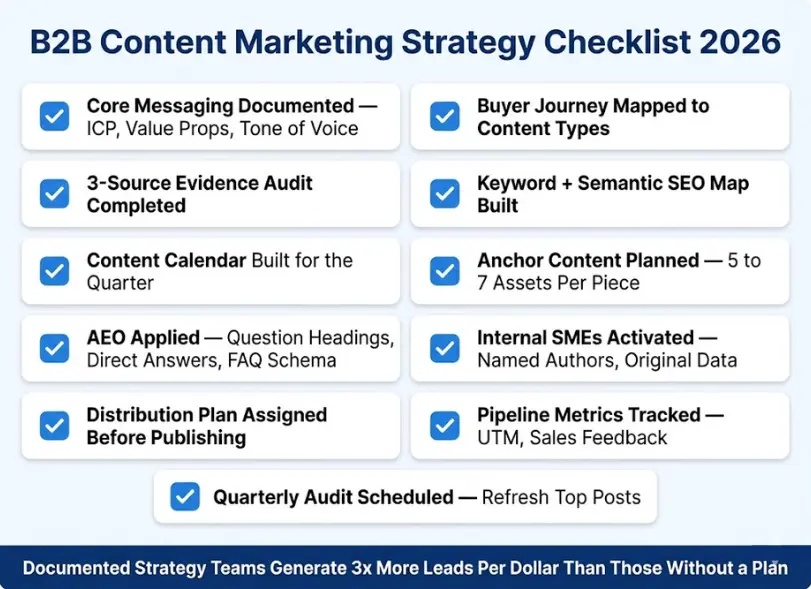
Bookmark this. Run it as a pre-quarter audit before any content goes into production.
- Core messaging documented — ICP, value props, buying committee, tone of voice
- Buyer journey mapped to content types at each decision stage
- 3-Source Evidence Audit completed — sales calls, competitor gaps, content performance
- Keyword + semantic SEO map built, including AI query variants
- Content calendar built for the quarter — goals, pillars, cadence, channel focus
- Anchor content planned with repurposing into 5–7 assets per piece
- AEO applied — question headings, direct answers, FAQ schema markup
- Internal SMEs activated — named authors, original data, first-hand experience
- Distribution plan assigned to every piece before it goes live
- Pipeline metrics tracked — UTM tagging, monthly sales feedback loop
- Quarterly audit scheduled — refresh top 10 posts by historical traffic
Conclusion
A B2B content marketing strategy checklist isn’t something you create once and revisit at the end of the year. It’s a live operational framework you run every quarter — tightening your messaging, closing competitor gaps, and connecting your content work to actual revenue.
The data is clear: documented strategy teams generate 3x more leads per dollar and see dramatically higher success rates than those working without a plan.
Start with messaging. Map the buyer journey to real questions. Run a gap analysis before you pick your next topic. Optimise for both Google and AI. Build your distribution plan before you hit publish.
If you want to go deeper on how content fits into a broader B2B digital marketing system, our overview of what a full-service digital marketing agency does explains how SEO, content, social, and performance channels all work together to drive sustainable growth.
That’s not just a content checklist. That’s a compounding growth engine — one that gets stronger every quarter you run it with clarity and consistency.
Frequently Asked Questions
-
What should a B2B content marketing strategy checklist include?
Ans.It should cover core messaging, buyer journey mapping, competitor gap analysis, keyword and semantic SEO planning, a content calendar, anchor content creation, AEO optimisation, internal SME involvement, multi-channel distribution, pipeline ROI measurement, and a quarterly audit schedule. -
How long does it take to see results from B2B content marketing?
Ans.Organic traffic typically shows improvement in 3–6 months. Pipeline impact usually follows in 4–8 months, depending on your sales cycle length. AEO-optimised content targeting mid-funnel questions can start appearing in AI-generated answers within 6–8 weeks of publishing. -
What content types work best for B2B marketing in 2026?
Ans.The strongest B2B formats right now are original research reports, detailed how-to guides structured for AEO, competitor comparison pages, customer case studies with specific metrics, and product-led walkthrough content. For distribution, LinkedIn posts and targeted email newsletters consistently produce the highest B2B engagement. -
How do I optimize B2B content for AI tools like ChatGPT or Perplexity?
Ans.Use question-format H2 headings, write a direct 2–3 sentence answer at the start of each section, add FAQ schema markup, cite credible third-party sources with links, and maintain topical authority through consistent internal linking. AI tools favour recently updated, well-structured, well-referenced content. -
Why do most B2B content strategies fail even when teams publish regularly?
Ans.Because publishing regularly without a documented plan produces activity, not results. The most common gaps are: no defined ICP, no buyer journey map, no distribution plan, and measuring page views instead of pipeline contribution. Fixing your measurement is often the fastest way to unlock more budget and strategic authority. -
What is the difference between SEO and AEO for B2B content?
Ans.SEO (Search Engine Optimisation) focuses on helping your content rank in traditional search results like Google. AEO (Answer Engine Optimisation) focuses on structuring your content so it gets cited in AI-generated answers from tools like ChatGPT, Perplexity, and Google's AI Overviews. In 2026, you need both. -
How often should I audit my B2B content?
Ans.Every quarter. A 90-day audit cycle lets you catch content that has dropped in rankings, update outdated statistics, add new internal links, and refresh CTAs before too much traffic is lost. It is one of the highest-ROI activities in content marketing — and most teams skip it entirely.
Author Details

Latest Posts
-
 29 / Jul
Search Engine Optimization 6 Enterprise SEO Mistakes That Quietly Cost You Millions
29 / Jul
Search Engine Optimization 6 Enterprise SEO Mistakes That Quietly Cost You Millions -
 24 / Jul
-
 23 / Jul
Search Engine Optimization How to Improve Organic SEO: A Practical 2026 Guide
23 / Jul
Search Engine Optimization How to Improve Organic SEO: A Practical 2026 Guide -
21 / Jul
Search Engine Optimization Organic SEO vs Paid SEO: Which Is Better in 2026?
-
18 / Jul
Blogs
Journey into Ideas Unveiling Tomorrow's Insights Today.













-
What should a B2B content marketing strategy checklist include?
Ans.It should cover core messaging, buyer journey mapping, competitor gap analysis, keyword and semantic SEO planning, a content calendar, anchor content creation, AEO optimisation, internal SME involvement, multi-channel distribution, pipeline ROI measurement, and a quarterly audit schedule. -
How long does it take to see results from B2B content marketing?
Ans.Organic traffic typically shows improvement in 3–6 months. Pipeline impact usually follows in 4–8 months, depending on your sales cycle length. AEO-optimised content targeting mid-funnel questions can start appearing in AI-generated answers within 6–8 weeks of publishing. -
What content types work best for B2B marketing in 2026?
Ans.The strongest B2B formats right now are original research reports, detailed how-to guides structured for AEO, competitor comparison pages, customer case studies with specific metrics, and product-led walkthrough content. For distribution, LinkedIn posts and targeted email newsletters consistently produce the highest B2B engagement. -
How do I optimize B2B content for AI tools like ChatGPT or Perplexity?
Ans.Use question-format H2 headings, write a direct 2–3 sentence answer at the start of each section, add FAQ schema markup, cite credible third-party sources with links, and maintain topical authority through consistent internal linking. AI tools favour recently updated, well-structured, well-referenced content. -
Why do most B2B content strategies fail even when teams publish regularly?
Ans.Because publishing regularly without a documented plan produces activity, not results. The most common gaps are: no defined ICP, no buyer journey map, no distribution plan, and measuring page views instead of pipeline contribution. Fixing your measurement is often the fastest way to unlock more budget and strategic authority. -
What is the difference between SEO and AEO for B2B content?
Ans.SEO (Search Engine Optimisation) focuses on helping your content rank in traditional search results like Google. AEO (Answer Engine Optimisation) focuses on structuring your content so it gets cited in AI-generated answers from tools like ChatGPT, Perplexity, and Google's AI Overviews. In 2026, you need both. -
How often should I audit my B2B content?
Ans.Every quarter. A 90-day audit cycle lets you catch content that has dropped in rankings, update outdated statistics, add new internal links, and refresh CTAs before too much traffic is lost. It is one of the highest-ROI activities in content marketing — and most teams skip it entirely.