


Digital Marketing for Manufacturers: The 2026 Lead-Gen Guide
-
Updated Date
Jul-18-2026
-
Views
2 Min Read
-
Author: PromotEdge Digital
-
Updated Date: Jul-18-2026
-
Views: 2 Min Read
-
Author: Milan Shyamal
Digital marketing for manufacturers covers the online channels — SEO, content marketing, paid ads, email, and social media — that industrial companies use to reach buyers before a trade show or referral ever enters the picture.
Manufacturing purchases move slowly. Buyers in sourcing and plant operations research suppliers extensively online before contacting anyone. Companies that appear during that research phase get considered. Companies that don’t are easy to overlook.
The complexity runs deeper than most B2B sales. Products are technical, cycles are long, and no single person makes the call. Procurement vets suppliers, engineering reviews specs, operations weighs practical fit — each stakeholder on their own timeline.
Why Manufacturers Can’t Ignore Digital Marketing Anymore

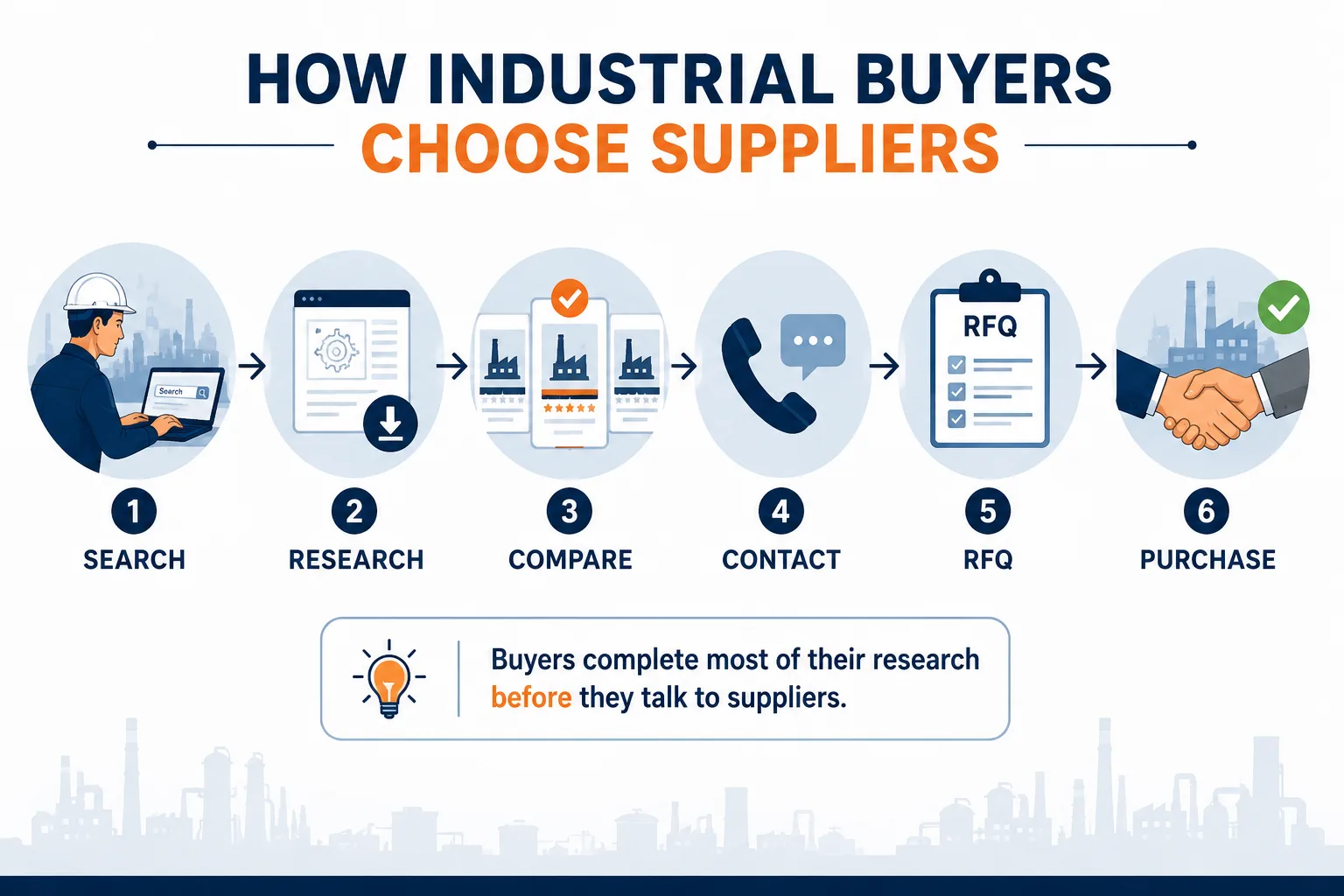
Industrial buyers don’t research suppliers the way they used to. Most of the early work happens online — comparing websites, reviewing certifications, downloading specs — before anyone makes direct contact.
Engineers pull datasheets at midnight. Plant managers study competitor case studies before setting foot at a trade show. If your company isn’t visible during that research phase, you’ve already lost the deal. Silently, and without knowing it.
The numbers confirm what experienced B2B marketers already know:
- According to 6sense’s 2024 Buyer Experience Report, B2B buyers now complete close to 70% of the purchasing process through independent research before ever speaking with a vendor. The same report also found that 81% already have a preferred supplier in mind by the time first contact happens.
- Research habits are also changing because of AI. Reports show that around 94% of B2B buyers now use AI platforms while researching products, suppliers, and solutions before talking to sales teams. If your brand isn’t discoverable on AI platforms, you’re leaving a massive opportunity untapped before prospects even reach your sales team.
- Digital leaders in manufacturing are now reallocating 25–40% of traditional event budgets toward digital campaigns and omnichannel buyer journeys, improving lead quality while shortening time to sale.
- Manufacturers who have embraced digital transformation report an average 20% increase in sales productivity and one third lower marketing costs.
The manufacturing companies winning today didn’t get lucky — they invested in building a robust digital presence that meets technical buyers where they already are: online.
At PromotEdge Digital, we specialize in digital marketing for manufacturers and have helped industrial brands generate qualified B2B leads, dominate niche search rankings, and build measurable digital pipelines. This guide lays out exactly how.
The Unique Challenges of Digital Marketing in the Manufacturing Sector
Generic digital marketing advice tends to fall apart in manufacturing. The buying process is different, the buyers are different, and the stakes are higher. Understanding those differences is what separates strategy that works from strategy that wastes budget.
Sales cycles are long — and involve multiple decision-makers. A manufacturing purchase can take weeks or months. Procurement, engineering, finance, and senior leadership often all have a role before anything moves forward. That means manufacturers need sustained visibility across the entire buying journey, not just at the point of first contact.
Technical buyers do serious research before reaching out. Engineers and procurement teams aren’t browsing casually. They’re looking for specifications, certifications, CAD files, compliance data, and performance benchmarks. If that information isn’t on your website, they move to a supplier where it is.
The audience is small — which makes every interaction count. Some manufacturing sectors have only a few hundred qualified buyers in an entire market. Targeting precision matters more here than in almost any other industry. A wasted click isn’t just inefficient — it can mean missing one of a limited number of real opportunities.
Trust carries more weight than advertising. Industrial purchases are expensive, long-term commitments. Buyers scrutinise credibility before they scrutinise price. Case studies, certifications, technical depth, and demonstrated expertise do more selling than any ad campaign.
Digital and traditional channels work together, not against each other. Trade shows, referrals, and distributor networks still drive a significant share of manufacturing business. Digital marketing works best when it supports those channels — building visibility before the trade show, reinforcing credibility after the referral.
That’s the environment manufacturers are operating in. The strategies worth using are built around it.
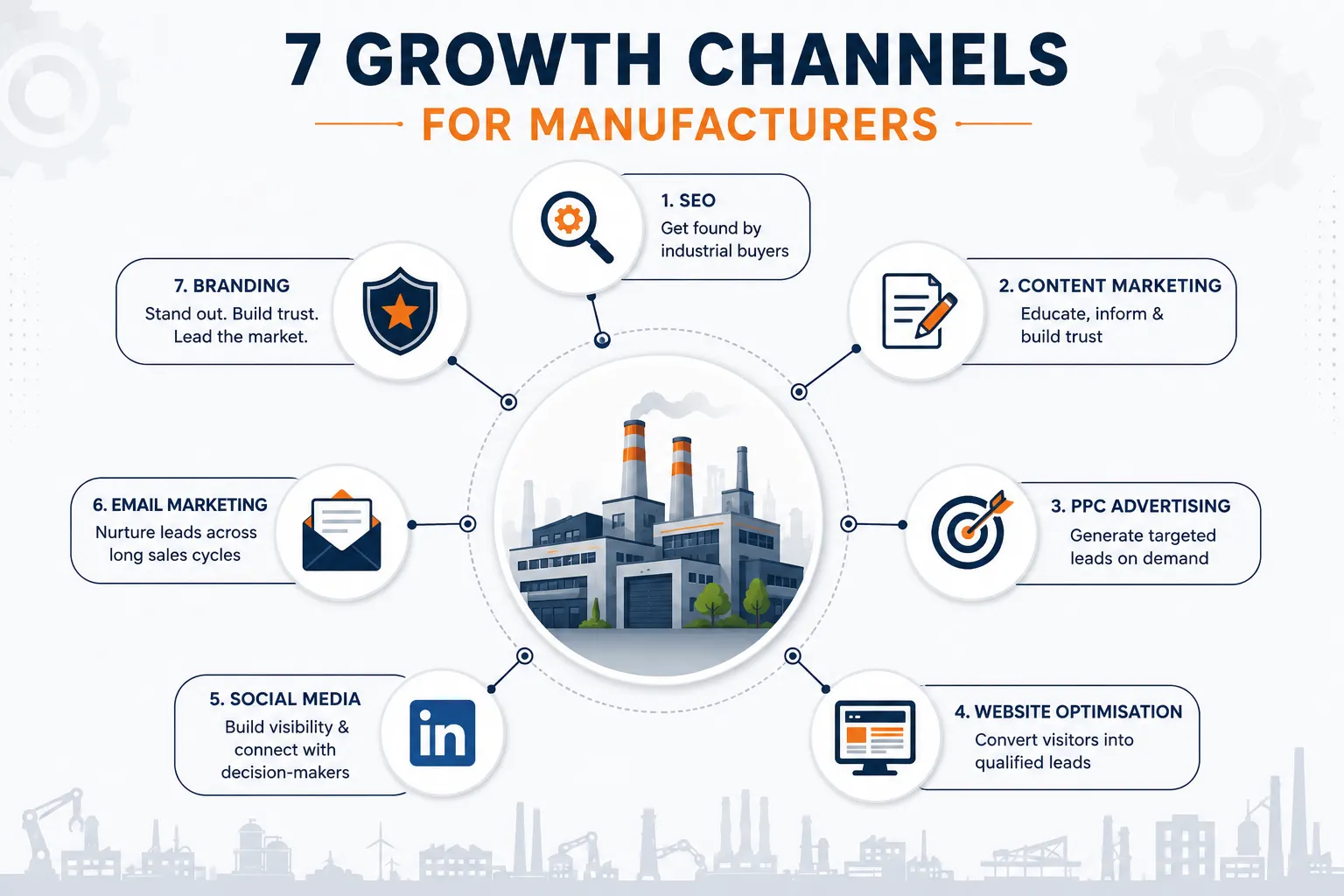
7 Core Digital Marketing Strategies for Manufacturers in 2026
1. SEO for Manufacturing Companies: Rank Where Your Buyers Search
SEO is one of the highest-ROI digital channels available to manufacturers — because it captures buyers who are already searching, already evaluating, and already close to making contact. Industry data shows that 57% of B2B marketers generate more leads through SEO than any other channel, and organic leads convert at roughly 14.6% compared to 1.7% for outbound.
For manufacturers, the goal isn’t traffic volume. It’s owning the specific, high-intent phrases buyers type when they’re actively sourcing:
- “custom aluminum extrusion manufacturer India”
- “ISO-certified contract manufacturer for automotive parts”
- “industrial heat exchanger supplier for chemical processing”
Technical foundations matter here. Fast load times, mobile rendering, and industrial-specific schema markup determine whether your pages appear in standard results — and increasingly, in AI-generated answers.
Content does the long-term work. Separate pages built around product categories, use cases, and buyer problems allow manufacturers to rank across dozens of niche keywords simultaneously. That’s how you stay visible throughout a buying cycle that might span several months.
Most SEO advice stops at “write good content” and “use keywords.” It misses the structure entirely — how to build content silos around product categories, how to implement schema for industrial applications, and how to target regional search demand around manufacturing hubs. Our SEO services for manufacturing companies are built around that deeper level of technical and strategic execution.
2. B2B Content Marketing: Using Technical Knowledge to Bring in Leads
Most manufacturing companies are sitting on a library of technical knowledge they’ve never published. That knowledge — turned into useful content — gives buyers something to research before they ever make contact.
Industrial buyers aren’t looking for marketing language. They’re trying to understand products, compare suppliers, solve engineering problems, and build enough confidence to send an RFQ. Content that answers those questions earns familiarity before the sales conversation begins.
The formats that perform best in manufacturing reflect how buyers actually research:
- Technical articles on applications, material comparisons, and process specifications get searched consistently throughout the buying cycle.
- Whitepapers and datasheets still drive lead generation, particularly when gated behind a form.
- Case studies carry significant weight — buyers want evidence that a supplier has solved similar problems before, not just claims that they can.
- Video has become harder to ignore. Factory walkthroughs, process explainers, and product demos give buyers clarity that written content alone can’t match.
- Webinars and virtual demos remain useful for product education and early-stage prospect conversations.
Content works best when it’s treated as an ongoing process rather than a publishing exercise. That means researching how buyers search, mapping content to specific stages of the buying cycle, and tracking what’s actually generating enquiries.
When that process runs alongside a structured SEO strategy, the compounding effect on visibility and inbound leads is significant.
3. Performance Marketing & PPC: Generate Manufacturing Leads on Demand
SEO usually takes time to build momentum. Paid campaigns are often used when manufacturers want enquiries sooner or need visibility for specific products, services, or markets.
For manufacturing companies, with the help of performance marketing, Google Search ads tend to work best because they appear when buyers are already searching for suppliers or industrial solutions. Searches like “CNC machining manufacturer” or “bulk industrial valve supplier” usually come from people already looking for vendors rather than casually browsing.
Google Search Ads allow manufacturers to appear at the top of results for highly specific, technical queries that may be too competitive to rank for organically in the short term. The key is granular keyword targeting and well-structured landing pages that speak to the industrial buyer — not generic product pages.
LinkedIn Ads represent an underutilised powerhouse for manufacturing B2B marketing. LinkedIn’s targeting by job title (Procurement Manager, Plant Manager, VP of Operations), industry, company size, and geography is unmatched for industrial audiences. LinkedIn’s own data shows that Lead Gen Forms convert at an average rate of 13% — more than three times the 4% average for external landing pages — making them the most efficient paid format for reaching industrial decision-makers .
Key PPC principles for manufacturers:
- In manufacturing campaigns, longer and more technical search terms usually matter more because the people searching them are often already looking for suppliers or specific solutions.
- Sending ad traffic to the homepage usually does not work well. Separate pages for different products, services, or applications tend to make more sense.
- A lot of manufacturers also run retargeting ads for people who visited the site or downloaded technical documents but left without making contact.
- And most companies track actual enquiries—phone calls, RFQ submissions, contact forms—not just clicks, because clicks alone do not say much about sales.
The average cost per lead for manufacturers across all marketing channels is $136, though this climbs sharply depending on channel — trade show leads alone average $811 per lead) — but companies using intelligent marketing automation and tight targeting often reduce CPL by up to 33% while generating significantly more qualified pipeline.
4. Website Optimisation: Your Most Important Sales Asset
Here is a hard truth: for most industrial buyers, your website is your first — and sometimes only — impression. Before they call, before they email, before they attend your booth at a trade show, they have already judged your credibility on your website.
A manufacturing website that ranks well but fails to convert is a leaking bucket. Optimising for both search visibility and conversion is non-negotiable.
What manufacturing websites usually need today:
- Fast loading speeds on both desktop and mobile. If pages take too long to load, people leave quickly, and Google also factors site performance into rankings through Core Web Vitals. Staying under roughly 2.5 seconds is generally the safer range.
- Clear messaging near the top of the page. Specific positioning like “CNC Machining for Aerospace OEMs” usually explains the offering better than broad phrases like “Industrial Manufacturing Solutions.”
- RFQ forms and quote request options that are easy to find. Buyers who are already ready to enquire generally should not have to spend time searching for contact details or forms.
- Technical product pages with downloadable datasheets, specifications, and compliance documents — this is what engineers are looking for.
- Case studies and client logos — social proof in B2B manufacturing is trust proof.
- Trust signals — ISO certifications, industry affiliations, years in operation, client base size.
Our web design and development services are purpose-built for industrial and B2B clients, combining UX best practices with SEO-ready architecture that converts technical buyers into qualified leads.
5. Social Media Marketing for Manufacturers: LinkedIn, YouTube, and Beyond
When manufacturers think of social media, many dismiss it as irrelevant for B2B. That is a costly misconception.
LinkedIn is the single most effective social platform for manufacturing B2B marketing. With over 1 billion professionals — including procurement managers, plant directors, and engineering leads — it is the digital equivalent of attending every major industry trade show simultaneously.
Effective LinkedIn strategies for manufacturers include:
- Thought leadership articles from engineering and operations leadership that showcase technical depth and industry expertise.
- Company page posts featuring new product launches, certifications, facility investments, and project milestones.
- LinkedIn Ads targeting specific job titles, industries, and company sizes — particularly powerful for reaching decision-makers in new verticals.
- Employee advocacy programmes that amplify organic reach by activating your team’s professional networks.
YouTube is the second largest search engine in the world and an increasingly important discovery channel for industrial buyers researching complex products. Product demonstration videos, process walkthroughs, and explainer content indexed on YouTube can drive organic discovery from buyers who would never find you via Google alone.
Our social media optimisation services help manufacturing brands build consistent, credible presences across the platforms where their buyers actually spend professional time.
6. Email Marketing & Marketing Automation: Nurture Long Sales Cycles
Given that manufacturing sales cycles often extend across months, email marketing and automation are not optional — they are the infrastructure that keeps your brand top-of-mind during the long periods between initial contact and final purchase decision.
Email marketing delivers $36–$40 in revenue per $1 spent in B2B contexts, making it consistently one of the highest-ROI channels available. For manufacturers, this compounds over time because the same buyers return for repeat orders, spec new projects, and refer colleagues within their networks.
High-value email sequences for manufacturers:
- Welcome & capability sequences for new subscribers — introduce your facilities, certifications, key product areas, and manufacturing specialisms.
- Technical nurture sequences — drip relevant case studies, whitepapers, and application guides based on what content a prospect originally downloaded.
- RFQ follow-up sequences — automated, personalised follow-ups that keep warm leads engaged without relying entirely on a sales rep’s memory.
- Re-engagement sequences for dormant contacts — many manufacturing relationships go quiet for a season, not forever.
Marketing automation platforms — HubSpot, Marketo, or Salesforce Marketing Cloud — allow manufacturers to segment audiences, trigger behaviour-based communications, and track which digital touchpoints contribute to eventual conversions. Companies using automation report 33% lower CPL and 451% more qualified leads (SalesHive).
7. Brand Strategy & Creative: Look Like the Market Leader You Want to Become
In a crowded manufacturing landscape, brand differentiation is a genuine competitive advantage. Yet most manufacturers invest next to nothing in brand strategy, relying on decades-old logos, generic taglines, and PDF catalogues that could belong to any competitor.
Modern industrial buyers — especially younger procurement managers and engineers who grew up digital — unconsciously calibrate trust against visual brand quality. A manufacturer with a polished, confident, technically articulate brand presence commands higher credibility and, ultimately, higher prices.
PromotEdge’s brand strategy and creative services are specifically designed to help manufacturers establish a brand that reflects the quality of their products and the depth of their technical expertise — without sacrificing the industrial authenticity that earns respect in B2B markets.
How to Build a Digital Marketing Strategy for Your Manufacturing Company: Step-by-Step
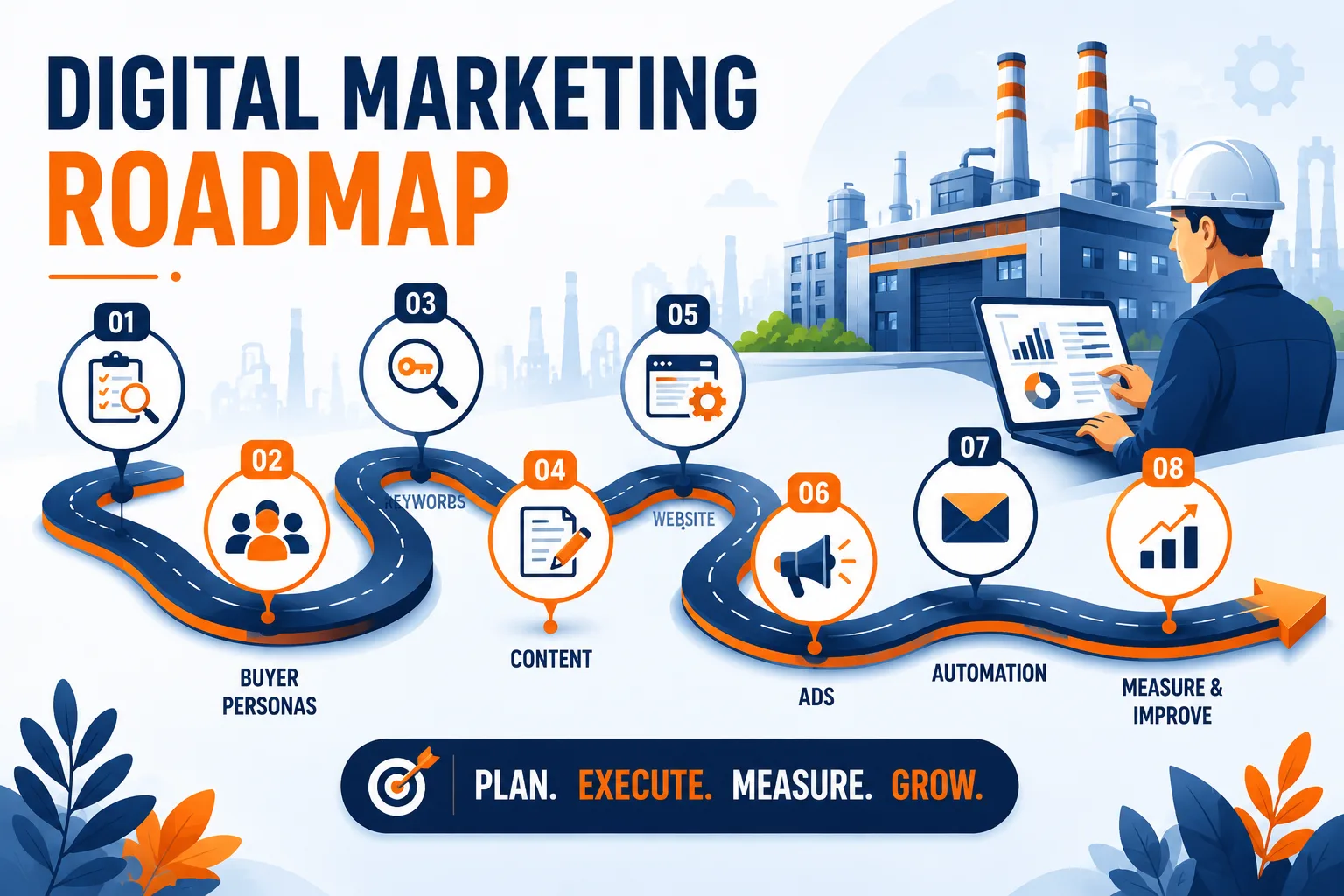
Building an effective manufacturing digital marketing strategy is not about doing everything at once. It’s about doing the right things in the right order with measurable goals at every stage.
Step 1 — Audit your current digital presence. Review your website’s technical SEO health, organic keyword rankings, traffic sources, and conversion rates. Benchmark against three to five direct competitors.
Step 2 — Define your industrial buyer personas. Who are the specific people who buy from you? Procurement managers, design engineers, plant managers, maintenance supervisors? Each persona has different questions, different content preferences, and different decision-making authority. Build at least two to three detailed buyer personas before creating any content.
Step 3 — Map your keyword landscape. Identify the specific search terms your buyers use at each stage — awareness, consideration, and decision. Prioritise niche, technical long-tail keywords where you can rank with less competition than broad industry terms.
Step 4 — Build your content architecture. Create a content plan that addresses buyer questions at every funnel stage. For each core product category, plan a pillar page plus supporting cluster content that answers related questions.
Step 5 — Fix your website’s technical and UX foundations. Address Core Web Vitals, mobile responsiveness, page structure, and RFQ/contact conversion paths before investing heavily in driving traffic.
Step 6 — Launch and optimize paid campaigns. Once organic foundations are in place, use Google Ads and LinkedIn Ads to drive immediate, targeted traffic to your best-performing landing pages.
Step 7 — Implement email automation and CRM integration. Connect your digital marketing to your sales pipeline so that every qualified lead is nurtured, tracked, and routed to the appropriate sales representative.
Step 8 — Measure, report, and iterate. Track core KPIs monthly: organic traffic, keyword rankings, cost per qualified lead, RFQ volume, lead-to-close rate. Use data to reallocate the budget toward what’s working.
Digital Marketing ROI for Manufacturers: What Results Should You Expect?
Manufacturers seldom ask: what return can we realistically expect from digital marketing? While results vary significantly based on starting point, competitive landscape, and investment level, here are realistic benchmarks drawn from current industry data:
- SEO: Organic leads convert to customers at approximately 14.6%, compared to 1.7% for outbound methods. In B2B SaaS contexts, average SEO ROI is 702% with a break-even at 7 months — and manufacturing, with its larger deal sizes, often sees similar or stronger returns. (SeoProfy, 2026)
- Content marketing: 74% of B2B marketers say content helps generate more demand and leads (CMI). For manufacturers producing technical content, qualified downloads and RFQ submissions are the primary conversion metrics.
- Email marketing: $36–$40 revenue per $1 invested, with retention and repeat-purchase rates significantly higher than any paid channel.
- PPC (Google Ads + LinkedIn): Manufacturing CPL ranges from $136 to $553 depending on channel and targeting maturity. Well-optimised campaigns in niche industrial sectors regularly achieve CPLs in the lower end of that range.
- Integrated digital marketing: Manufacturers who have fully embraced digital transformation report a 20% increase in sales productivity and 33% reduction in marketing costs on average.
The critical metric is not just lead volume — it is qualified lead quality. In manufacturing, ten highly qualified RFQs are worth more than 500 unqualified form fills. Designing your digital marketing funnel around quality over quantity is what separates manufacturers generating real revenue from those simply accumulating website traffic.
Common Digital Marketing Mistakes Manufacturers Make (And How to Avoid Them)
Treating the website as a digital brochure. Your website is an active sales tool that works 24/7. It needs technical depth, clear calls to action, fast performance, and a content strategy — not just product images and a phone number.
Ignoring SEO for technical product pages. Most manufacturers optimize their homepage, then forget about it. In reality, each product category and industrial application deserves its own optimised, content-rich page.
Running PPC without dedicated landing pages. Sending paid ad traffic to a generic homepage is one of the most common — and costly — mistakes in B2B digital marketing. Each campaign needs a matching landing page built for conversion.
Neglecting mobile optimisation. Industrial buyers increasingly research mobile devices. A website that renders poorly on smartphones signals a lack of attention to detail — not the message you want to send to a procurement officer evaluating multiple suppliers.
Measuring the wrong metrics. Vanity metrics — likes, impressions, traffic volume — mean nothing if qualified leads and RFQ submissions are not increasing. Set up conversion tracking for every meaningful action a buyer can take on your site.
Going too broad, too fast. Manufacturers with limited marketing budgets often spread investment across too many channels simultaneously. A focused, well-executed strategy on two or three channels consistently outperforms a diluted presence everywhere.
PromotEdge: Your Digital Marketing Partner for Manufacturing Growth
At PromotEdge, we are not a generic digital agency that happens to take on manufacturing clients. Industrial and B2B digital marketing is a core specialisation for us — and has been since we started helping manufacturing companies build their digital presence.
We understand that your buyers are technical. We understand that your sales cycles are long and your decisions involve multiple stakeholders. We understand that a single qualified lead can represent thousands — or hundreds of thousands — in revenue.
Our industry-specific digital marketing services are designed around those realities. We bring together:
- B2B SEO expertise built around technical, industrial keyword ecosystems — explore our B2B SEO services
- High-converting content strategies that speak the language of engineers and procurement managers
- Performance marketing campaigns on Google and LinkedIn with industrial-grade targeting
- Website design and development that converts technical buyers into qualified RFQs
- Brand strategy and creative that positions your manufacturing company as the credible, trusted market leader
- Full-funnel marketing automation to nurture long B2B sales cycles without losing leads in the gaps
Whether you are a contract manufacturer, an OEM, a capital equipment supplier, or an industrial components brand — we have the expertise and experience to build a digital marketing engine that delivers measurable business results.
Talk to our manufacturing marketing team today →
FAQs About Digital Marketing for Manufacturers
-
How is digital marketing different for manufacturers compared to other industries?
Ans.Manufacturing involves long sales cycles, technical buyers, and complex specifications. Generic strategies built for consumer journeys fail here. Industrial digital marketing is built around niche keywords, multi-stakeholder decisions, and high-value B2B conversions. -
What is the most effective digital marketing channel for manufacturing companies?
Ans.SEO delivers the strongest long-term ROI — organic leads close at 14.6% vs. 1.7% for outbound. For faster results, Google Search Ads and LinkedIn Ads targeting engineers and procurement managers generate qualified pipeline quickly. -
How long does it take to see results from digital marketing for manufacturers?
Ans.Paid ads generate leads within days. SEO takes 3–6 months to build meaningful traffic. An integrated strategy — combining paid, SEO, and content — typically produces measurable pipeline impact within 4–8 months. -
How much should a manufacturing company spend on digital marketing?
Ans.B2B benchmarks suggest 5–10% of revenue toward marketing. Manufacturers reallocating 25–40% of trade show budgets to digital consistently report better lead quality and lower cost per acquisition. -
Do manufacturers need to be on social media?
Ans.Yes — LinkedIn and YouTube specifically. LinkedIn reaches procurement managers and engineers directly. YouTube supports product demos and process explainers that technical buyers actively search during the evaluation phase. -
What is an RFQ and how does digital marketing help generate more of them?
Ans.An RFQ is a formal buyer request for pricing and specs. Digital marketing drives more RFQs by improving search visibility, building buyer confidence through technical content, and reducing friction in the quote request process. -
Should manufacturers invest in SEO or PPC first?
Ans.Both — but sequenced. Start with technical SEO foundations and two to three high-intent Google Ads keywords. This delivers early results while compounding organic authority over time. Pure SEO alone is too slow for most budgets. -
Can digital marketing work for small or mid-sized manufacturers?
Ans.Often more effectively than for large enterprises. Niche industrial SEO has low competition. A focused LinkedIn presence and technical blog can position a 50-person manufacturer as the authority in their specific niche.
Author Details

Latest Posts
-
 22 / Sep
Digital Marketing Digital Marketing for Ecommerce Brands: The 2027 Growth Playbook
22 / Sep
Digital Marketing Digital Marketing for Ecommerce Brands: The 2027 Growth Playbook -
 15 / Sep
-
04 / Sep
-
 29 / Jul
Search Engine Optimization 6 Enterprise SEO Mistakes That Quietly Cost You Millions
29 / Jul
Search Engine Optimization 6 Enterprise SEO Mistakes That Quietly Cost You Millions -
 24 / Jul

Blogs
Journey into Ideas Unveiling Tomorrow's Insights Today.











-
How is digital marketing different for manufacturers compared to other industries?
Ans.Manufacturing involves long sales cycles, technical buyers, and complex specifications. Generic strategies built for consumer journeys fail here. Industrial digital marketing is built around niche keywords, multi-stakeholder decisions, and high-value B2B conversions. -
What is the most effective digital marketing channel for manufacturing companies?
Ans.SEO delivers the strongest long-term ROI — organic leads close at 14.6% vs. 1.7% for outbound. For faster results, Google Search Ads and LinkedIn Ads targeting engineers and procurement managers generate qualified pipeline quickly. -
How long does it take to see results from digital marketing for manufacturers?
Ans.Paid ads generate leads within days. SEO takes 3–6 months to build meaningful traffic. An integrated strategy — combining paid, SEO, and content — typically produces measurable pipeline impact within 4–8 months. -
How much should a manufacturing company spend on digital marketing?
Ans.B2B benchmarks suggest 5–10% of revenue toward marketing. Manufacturers reallocating 25–40% of trade show budgets to digital consistently report better lead quality and lower cost per acquisition. -
Do manufacturers need to be on social media?
Ans.Yes — LinkedIn and YouTube specifically. LinkedIn reaches procurement managers and engineers directly. YouTube supports product demos and process explainers that technical buyers actively search during the evaluation phase. -
What is an RFQ and how does digital marketing help generate more of them?
Ans.An RFQ is a formal buyer request for pricing and specs. Digital marketing drives more RFQs by improving search visibility, building buyer confidence through technical content, and reducing friction in the quote request process. -
Should manufacturers invest in SEO or PPC first?
Ans.Both — but sequenced. Start with technical SEO foundations and two to three high-intent Google Ads keywords. This delivers early results while compounding organic authority over time. Pure SEO alone is too slow for most budgets. -
Can digital marketing work for small or mid-sized manufacturers?
Ans.Often more effectively than for large enterprises. Niche industrial SEO has low competition. A focused LinkedIn presence and technical blog can position a 50-person manufacturer as the authority in their specific niche.