


How to Optimize Content for Google AI Overviews (2026)

-
Updated Date
Jul-17-2026
-
Views
2 Min Read
-
Author: PromotEdge Digital
-
Updated Date: Jul-17-2026
-
Views: 2 Min Read
-
Author: Milan Shyamal
Google AI Overviews are no longer an experiment. They are the default search experience for a growing share of queries — and they are reshaping which pages earn visibility and which get buried below the fold.
If you are producing content without a clear AI Overviews strategy in 2026, you are optimizing for a version of Google that no longer exists.
This guide covers exactly what it takes to earn citations in AI Overviews, why some standard advice is now outdated, and how to build a content structure that Google’s AI models can extract, trust, and surface.
What Are Google AI Overviews — and Why They Change Everything
Google AI Overviews are AI-generated summaries that appear at the top of search results, synthesizing information from multiple sources to answer a query directly. First rolled out at scale in May 2024, but they appear for approximately 15–16% of all US search queries as of late 2025, per Semrush’s analysis — and over 70% of informational and how-to queries, per Semrush Sensor data.
Each AI Overview cites an average of 13.3 sources per response. Google isn’t pointing users to one answer anymore. It’s assembling one — and your content needs to be source material for that assembly.
Organic click-through rates for position-one results have declined as Overviews occupy the top of the page. The offsetting reality: visitors arriving via AI-cited results convert at higher rates because their intent is already pre-qualified.
Being cited is the new ranking. That requires a different content strategy.
Ranking in AI Overviews vs. Being Cited — Why This Distinction Matters
Most guides treat these as the same goal. They are not.
Ranking on page one is still necessary — 76% of AI Overview citations come from pages already in the top 10 organic results, per Ahrefs’ study. But ranking does not guarantee citation. Google evaluates cited pages separately, looking for content that is clearly extractable, factually complete, and semantically structured around the user’s query intent.
A page can rank at position 3 and never appear in an AI Overview. A page can rank at position 8 and be cited consistently because its content is formatted in a way that AI systems can process and trust.
Citation patterns have stabilized in 2026 after the volatile early phase. Sources that demonstrate consistent topical authority now earn more stable citation placements. This rewards sustained content investment rather than one-off optimization — which is exactly the type of content strategy that delivers long-term ROI through professional SEO services.
How Google Selects Content for AI Overviews
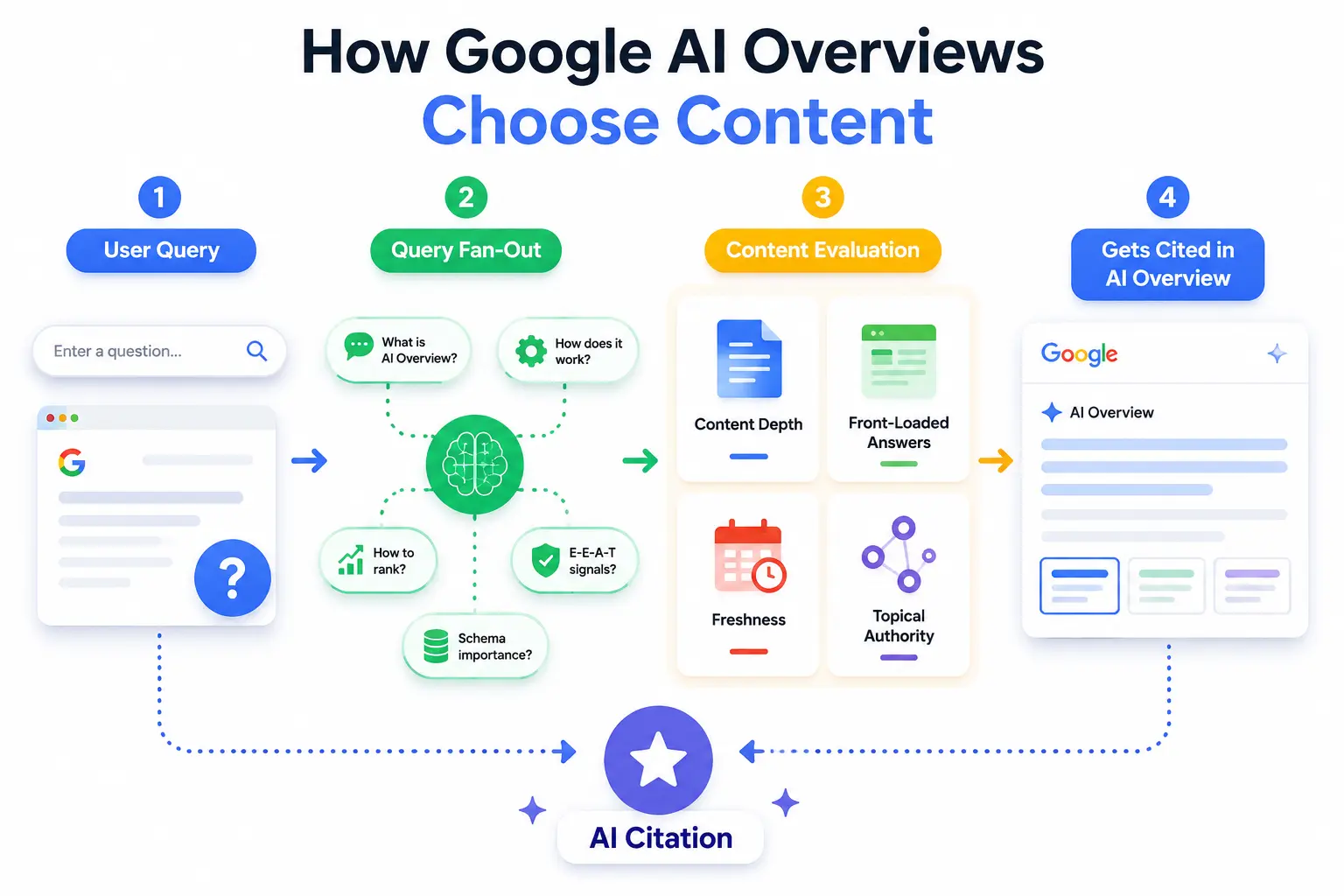
Understanding the selection mechanism is the prerequisite to optimization. Google’s AI Overview system doesn’t simply extract the highest-ranking page. It uses a process researchers call query fan-out.
When a user types a head-term query, Google generates multiple sub-queries — related, supporting, and follow-up questions — then evaluates which pages best answer the full cluster of intent, not just the surface keyword. A page ranking #1 for the head term but thin across related sub-queries will lose to a page ranking moderately across the full topic. Single-keyword pages are structurally ineligible for consistent citation.
The selection signals, based on available 2026 data, are worth understanding precisely:
- Content depth: Pages exceeding 20,000 characters average 10.18 AI citations each, versus 2.39 for pages under 500 characters, per Kevin Indig’s analysis of 21,000+ citations. More extractable information means more citation surface area.
- Front-loaded answers: 44.2% of all LLM citations come from the first 30% of a page, per Kevin Indig. Your introduction has to earn its place.
- Content freshness: Roughly 44% of AI Overview citations come from content published in 2025, and around 30% from 2024, per Search Engine Land. Recency is a meaningful signal.
The pattern across all four signals is the same: Google is rewarding content that is easy to process, not just content that exists.
10 Content Optimization Strategies to Cited in Google AI Overviews
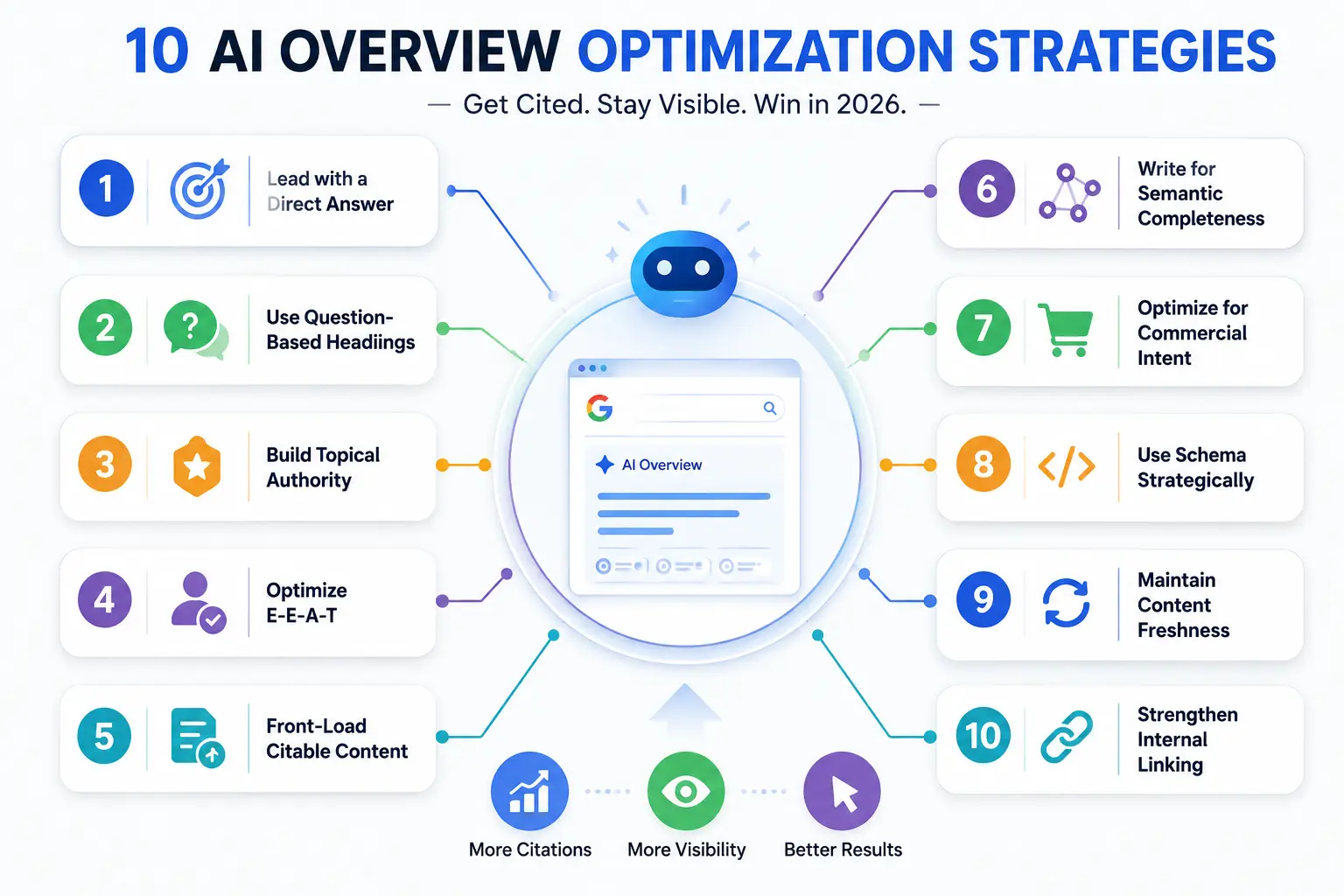
1. Lead with a Direct, Extractable Answer
The first paragraph of every page should answer the primary question completely — in 40 to 60 words. Not a teaser. Not a preamble. A clean, standalone answer that makes sense without any surrounding context.
This is the single highest-impact change most websites can make. The 44.2% front-loading citation pattern means Google is frequently pulling from introductory paragraphs. If yours starts with “In today’s digital landscape…” you are losing citations before the reader even reaches your argument.
Write the answer first. Explain it after.
2. Use Question-Based H2 and H3 Headings
Structure your content around the questions your audience is actually searching. Headings like “What is Google AI Overviews?” or “How does Google select content for AI Overviews?” match the natural language patterns that AI systems use when fan-out generates sub-queries.
This is not just an AEO tactic — it is semantic SEO in practice. Question headings signal to both users and AI that each section has a discrete, answerable purpose. They also make it easier for Google to map your page to a specific sub-query during the fan-out process.
3. Build Topical Authority Before Individual Page Optimization
This is the most common sequencing mistake in AI Overview optimization. Marketers optimize a single page for a target keyword without first establishing site-level topical authority on the subject.
Google evaluates your page in the context of your entire website. A standalone article on a site that has never covered the broader topic will be treated as an outlier — not an authority. Build a hub-and-spoke content cluster around your primary topic first, with each spoke covering a distinct sub-query at the right depth.
This is the content architecture principle that underpins every successful digital marketing strategy built for long-term organic growth — and the foundation any AI Overview optimization effort should sit on.
4. Optimize E-E-A-T Signals Explicitly
E-E-A-T — Experience, Expertise, Authoritativeness, and Trustworthiness — directly influences whether your content is selected for AI Overviews. Google’s systems are evaluating whether the person or organization behind the content has genuine knowledge of the subject.
Concrete signals to implement:
- Author bylines with credentials and verifiable professional history
- First-person examples, case studies, and direct observations
- Expert quotes from identifiable named sources
- Organization schema with consistent entity information
- Outbound citations to primary research and authoritative data sources
The goal is simple: make it unambiguous to a machine that a qualified person wrote this from direct experience.
5. Front-Load Your Most Citable Content
Given that nearly half of all AI citations come from the first 30% of a page, every critical data point, definition, and direct answer belongs early. This does not mean stuffing your introduction — it means structuring each section so the first sentence delivers the claim and the remaining sentences provide the support.
Think of it as an inverted-pyramid structure applied not just to the full article but to each individual section. Each H2 block should be independently extractable — readable in isolation and still accurate.
This structure also improves user experience for scanners, which reduces bounce rates and improves the dwell-time signals that support overall ranking strength.
6. Write for Semantic Completeness, Not Keyword Density
Keyword density is not an AI Overview signal. Semantic completeness is.
Google’s language models evaluate whether your content addresses the full conceptual territory of a topic — related entities, causal relationships, definitional clarity, and supporting context. A page that uses the target keyword twelve times but never explains the mechanism will lose citations to a page that uses it three times but covers the topic exhaustively.
Use your primary keyword naturally. Then expand outward into the entities, questions, and terminology your audience uses at different stages of understanding. This is also what drives stronger traditional rankings — and it is the foundation of any content marketing strategy built for long-term visibility.
7. Understand the Commercial AI Overviews Shift
In late 2024, approximately 89% of queries triggering AI Overviews were informational. By late 2025, that number had fallen to 57% — meaning commercial and transactional queries now regularly trigger AI Overviews. If you run an ecommerce store, a B2B service website, or a local business, this directly affects your commercial keyword performance.
For commercial pages, optimization means demonstrating clear, specific value in extractable language. Comparison pages, service explainers, and product category pages that answer “what is the best solution for X” are increasingly being pulled into AI-generated summaries.
As AI Overviews suppress some paid and organic click pathways, brand visibility across the full funnel becomes the priority. Structured performance marketing activity is how you maintain that presence where organic alone no longer reaches.
8. Implement Schema Markup Strategically
FAQ schema (Google not support faq as per new guide lines but some how it work for other platform or search engine like bing, ai tools – chatgpt, perplexcity etc), HowTo schema, Article schema, and Organization schema all remain worthwhile because they improve how Google parses your content and how it appears in rich results.
However, May 2026 data from Ahrefs shows that schema markup alone produces no major uplift in AI Overview citation rates. Schema helps Google understand your content structure, but it does not override the fundamental quality signals: depth, clarity, E-E-A-T, and topical authority.
Use schema to reinforce strong content — not as a substitute for it. The pages earning the most consistent AI citations are winning on content quality first, with schema as a supporting signal.
9. Maintain Content Freshness as a Citation Signal
Approximately 85% of all AI Overview citations come from content published within the last two years. Content published once and left static loses citation eligibility over time — regardless of how well it originally performed.
Build a content refresh schedule into your operations. Update statistics, replace outdated examples, add new data points, and revise sections where the subject has evolved. Each meaningful update signals recency to Google’s crawlers without requiring a full rewrite.
High-performing pages sitting at positions 2 through 5 are ideal refresh candidates — they already have relevance signals and authority, and a structured update can push them into more consistent AI Overview citation territory.
10. Internal Link Architecture That Supports Query Fan-Out
When Google generates sub-queries from a head term, it follows topical signals across your site to evaluate breadth of coverage. Your internal linking structure is the map that guides that evaluation.
Link from every piece of content to its closely related supporting pages using natural anchor text that reflects the conceptual relationship — not generic phrases like “click here” or “read more.” Each link should signal a topical connection, not just a navigation path.
A well-linked content cluster tells Google this site has depth on this subject. That signal contributes directly to the topical authority scores that influence which pages get selected for AI Overview citations. If your current architecture is shallow or siloed, fixing it is one of the highest-ROI technical improvements available before any other optimization work begins.
What Content Formats Does Google Prefer for AI Overviews?
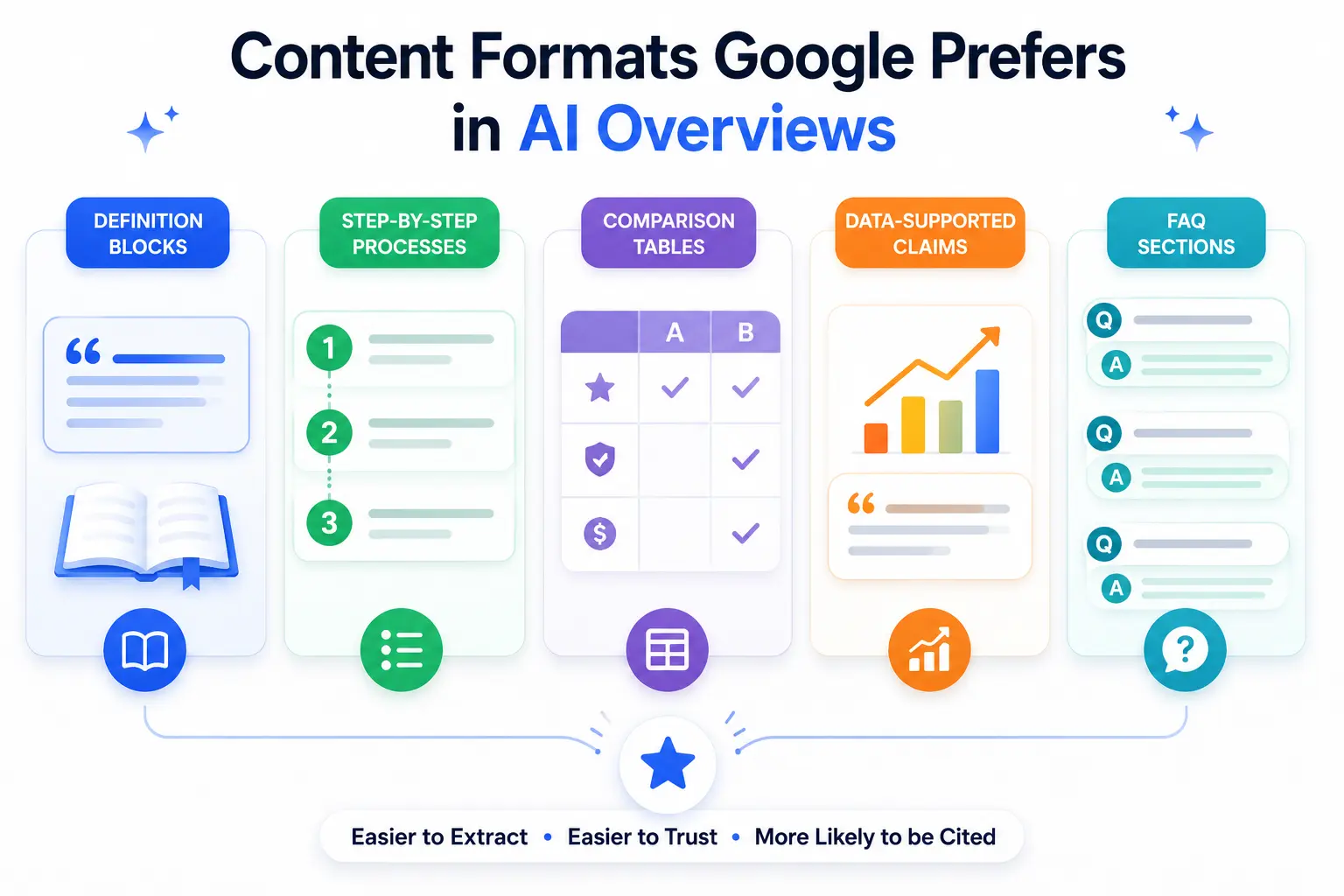
Google’s AI favors content it can extract cleanly. Based on observed citation patterns in 2026, these formats perform consistently:
- Definition blocks: Clear, standalone definitions of key terms — structured as “X is Y that does Z.”
- Step-by-step process sections: Numbered sequences where each step is a complete, actionable instruction. These map cleanly to the “HowTo schema” and are highly extractable.
- Comparison tables: Structured side-by-side comparisons of tools, options, or strategies. AI systems extract structured data efficiently from well-organized tables.
- Data-supported claims: Sentences that pair a specific claim with a verifiable source (“According to Semrush Sensor data, AI Overviews appear for 12–16% of US queries in 2026″). These carry higher citation weight because they are independently verifiable.
- FAQ sections: Discrete question-answer pairs that each stand alone as complete responses. See the FAQ section at the bottom of this article as a working example.
The underlying principle is extractability. Format your content so that any single sentence or paragraph can be lifted out of context and still communicate an accurate, complete idea.
Technical Foundations That Support AI Overview Visibility
Strong content will not earn citations if Google cannot reliably access and process your pages. These technical factors directly affect AI Overview eligibility.
- Crawlability: Ensure your pages are indexed and not inadvertently blocked by robots.txt or no-index tags. AI systems cannot cite what they cannot crawl.
- Page speed: Keep server response times below 500ms. Slow pages are deprioritized in both ranking and AI extraction processes.
- JavaScript dependency: Content loaded via JavaScript after page render is harder for AI crawlers to process. Core content should be present in the initial HTML response.
- Mobile optimization: As per WordStream, 81% of AI Overview queries occur on mobile devices. Pages that perform poorly on mobile are structurally disadvantaged in the AI citation pool.
- HTTPS and security: Trust signals at the technical layer reinforce trust signals at the content layer. A non-secure page cannot credibly claim to be authoritative.
These are table-stakes technical requirements. If your site has unresolved technical SEO issues, those need to be addressed before any content optimization work will reach its full potential.
The 2026 AI Overview Optimization Checklist
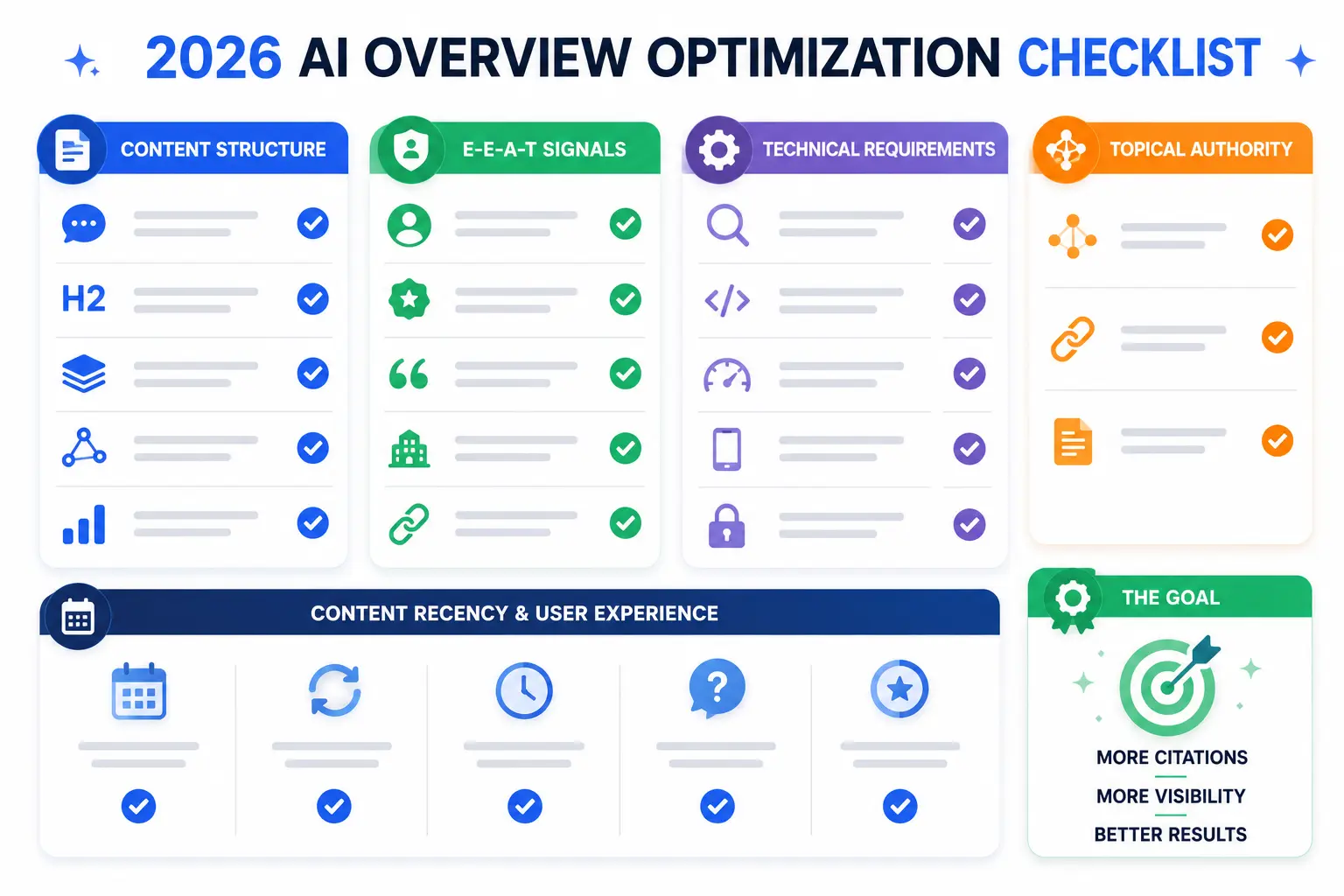
Use this before publishing any content intended to earn AI Overview citations.
Content structure:
- First paragraph delivers a complete, standalone answer to the primary query in 40–60 words
- H2 and H3 headings use natural question-based or topic-declarative language
- Each section is independently extractable — makes sense without surrounding context
- Content addresses the full conceptual territory of the topic, not just the head keyword
- Data points are sourced and cited with specific attributions
E-E-A-T signals:
- Author bio with verifiable credentials is present
- First-person examples or case study references are included
- Organization schema markup is implemented
- Outbound links point to primary research and authoritative sources
Technical requirements:
- Page is indexed and not blocked by crawlers
- Core content is present in initial HTML, not JavaScript-dependent
- Page loads under 500ms on mobile
- HTTPS is active and functional
Topical authority:
- Supporting hub pages exist for the main topic cluster
- Internal links use descriptive anchor text connecting related content
- Content was published or updated within the last 12 months
- FAQ section addresses the most common follow-up questions
Final Takeaway
Google AI Overviews have changed the mechanisms of search visibility — not the underlying standard. The sites earning consistent citations have always invested in depth, clear structure, and demonstrated expertise. The tools have evolved. The requirement has not.
The tactical adjustments matter: front-load answers, build topical clusters, refresh content regularly. But tactics only hold on a foundation that is genuinely worth citing.
The brands that win long-term are not chasing citations. They are building the kind of authoritative presence that makes citation inevitable.
If you are ready to build that kind of presence — from technical SEO foundations through to AI-ready content architecture that is exactly what we help businesses do at PromotEdge Digital. Setup a free call today!
FAQs about Google AI Overviews Optimization
-
What are Google AI Overviews?
Ans.Google AI Overviews are AI-generated summaries that appear at the top of search results, pulling from multiple sources to answer a query directly on the page — no click required. It's Google's clearest signal yet that search is shifting from navigation to direct resolution. -
How do Google AI Overviews affect organic traffic?
Ans.They reduce click-through rates, particularly on informational queries where users get a complete answer without leaving the results page. But the traffic that does arrive is more deliberate — visitors who click through have already absorbed the summary and want more, which means stronger purchase intent and better conversion potential than standard organic visits. -
How do I get my content cited in Google AI Overviews?
Ans.Start by ranking in the top 10 organic results — over 92% of citations come from pages already there. Then optimize for extractability: lead with a direct answer, use question-based headings, and demonstrate E-E-A-T through author credentials, sourced data, and organization markup. -
Does schema markup help with Google AI Overview rankings?
Ans.Schema helps Google parse your content structure, but May 2026 Ahrefs data shows it doesn't significantly lift citation rates alone. Content quality, depth, freshness, and topical authority are the real signals. Use schema to reinforce strong content — not replace it. -
Can Google AI Overviews appear for commercial and product keywords?
Ans.Yes — and this matters. In late 2024, 89% of AI Overview queries were informational. By late 2025, that dropped to 57%. Commercial, transactional, and B2B queries now regularly trigger AI Overviews. Every brand needs an AI Overview strategy, not just content publishers. -
How do I measure whether my content is appearing in Google AI Overviews?
Ans.Search Console doesn't isolate AI Overview impressions yet. Manually check target keywords, and use Semrush, SE Ranking, or Ahrefs to track appearance rates. A rising impression-to-click ratio on stable keywords often signals an AI Overview is now absorbing those clicks. -
What is the difference between Google AI Overviews and Google AI Mode?
Ans.AI Overviews are automated summaries within standard search results. AI Mode is an experimental conversational experience powered by Gemini 2.0, supporting multi-part queries, follow-ups, and multimodal inputs. Optimizing for AI Overviews improves eligibility for both — the core signals are identical. -
How do I stay eligible for AI Overview citations?
Ans.Around 85% of citations come from content published in the last two years. Review and meaningfully update content every 6 to 12 months — refresh statistics, replace outdated references, and add current data points. Freshness is a direct citation signal, not a bonus. -
What content length performs best in Google AI Overviews?
Ans.Pages above 20,000 characters average around 10 AI citations each, versus 2.4 for shorter pages. Depth signals genuine expertise. Cover the full topic — related questions, supporting context, counterpoints — but only where it adds real value. Filler doesn't earn citations.
Author Details

Latest Posts
-
 22 / Sep
Digital Marketing Digital Marketing for Ecommerce Brands: The 2027 Growth Playbook
22 / Sep
Digital Marketing Digital Marketing for Ecommerce Brands: The 2027 Growth Playbook -
 15 / Sep
-
04 / Sep
-
 29 / Jul
Search Engine Optimization 6 Enterprise SEO Mistakes That Quietly Cost You Millions
29 / Jul
Search Engine Optimization 6 Enterprise SEO Mistakes That Quietly Cost You Millions -
 24 / Jul



Blogs
Journey into Ideas Unveiling Tomorrow's Insights Today.













-
What are Google AI Overviews?
Ans.Google AI Overviews are AI-generated summaries that appear at the top of search results, pulling from multiple sources to answer a query directly on the page — no click required. It's Google's clearest signal yet that search is shifting from navigation to direct resolution. -
How do Google AI Overviews affect organic traffic?
Ans.They reduce click-through rates, particularly on informational queries where users get a complete answer without leaving the results page. But the traffic that does arrive is more deliberate — visitors who click through have already absorbed the summary and want more, which means stronger purchase intent and better conversion potential than standard organic visits. -
How do I get my content cited in Google AI Overviews?
Ans.Start by ranking in the top 10 organic results — over 92% of citations come from pages already there. Then optimize for extractability: lead with a direct answer, use question-based headings, and demonstrate E-E-A-T through author credentials, sourced data, and organization markup. -
Does schema markup help with Google AI Overview rankings?
Ans.Schema helps Google parse your content structure, but May 2026 Ahrefs data shows it doesn't significantly lift citation rates alone. Content quality, depth, freshness, and topical authority are the real signals. Use schema to reinforce strong content — not replace it. -
Can Google AI Overviews appear for commercial and product keywords?
Ans.Yes — and this matters. In late 2024, 89% of AI Overview queries were informational. By late 2025, that dropped to 57%. Commercial, transactional, and B2B queries now regularly trigger AI Overviews. Every brand needs an AI Overview strategy, not just content publishers. -
How do I measure whether my content is appearing in Google AI Overviews?
Ans.Search Console doesn't isolate AI Overview impressions yet. Manually check target keywords, and use Semrush, SE Ranking, or Ahrefs to track appearance rates. A rising impression-to-click ratio on stable keywords often signals an AI Overview is now absorbing those clicks. -
What is the difference between Google AI Overviews and Google AI Mode?
Ans.AI Overviews are automated summaries within standard search results. AI Mode is an experimental conversational experience powered by Gemini 2.0, supporting multi-part queries, follow-ups, and multimodal inputs. Optimizing for AI Overviews improves eligibility for both — the core signals are identical. -
How do I stay eligible for AI Overview citations?
Ans.Around 85% of citations come from content published in the last two years. Review and meaningfully update content every 6 to 12 months — refresh statistics, replace outdated references, and add current data points. Freshness is a direct citation signal, not a bonus. -
What content length performs best in Google AI Overviews?
Ans.Pages above 20,000 characters average around 10 AI citations each, versus 2.4 for shorter pages. Depth signals genuine expertise. Cover the full topic — related questions, supporting context, counterpoints — but only where it adds real value. Filler doesn't earn citations.