


Organic SEO vs Paid SEO: Which Is Better in 2026?
-
Author
Anindita Barik
-
Updated Date
Jul-21-2026
-
Views
2 Min Read
-
Author: PromotEdge Digital
-
Updated Date: Jul-21-2026
-
Views: 2 Min Read
-
Author: Anindita Barik
Organic SEO earns free, long-term rankings through content, technical optimization, and authority-building, while paid SEO (PPC) buys instant visibility through ad auctions, costing per click. Organic drives ~53% of trackable traffic and compounds over time; paid delivers traffic within hours but stops when spending stops. Average Google Ads CPC in 2026 is $5.42. Most businesses benefit from combining both: paid search for speed and testing, organic SEO for sustainable, lower-cost growth.
The organic SEO vs paid SEO question comes up before most businesses spend a single dollar on search. Should you earn rankings through SEO or pay for them through ads? Both channels reach people who are already searching for what you sell, and together they drive about two-thirds of all trackable website traffic (BrightEdge). They simply work in different ways.
This guide breaks down how both channels perform in 2026. You’ll learn what each one costs, how long it takes to deliver results, where each performs best, and how to use them together. No filler—just the information you need to make a confident decision.
At PromotEdge Digital, we work with both SEO and paid search every day across service businesses, ecommerce brands, and B2B companies. The insights in this guide come from that hands-on experience, backed by publicly available data you can verify yourself.
Organic SEO vs Paid SEO Explained
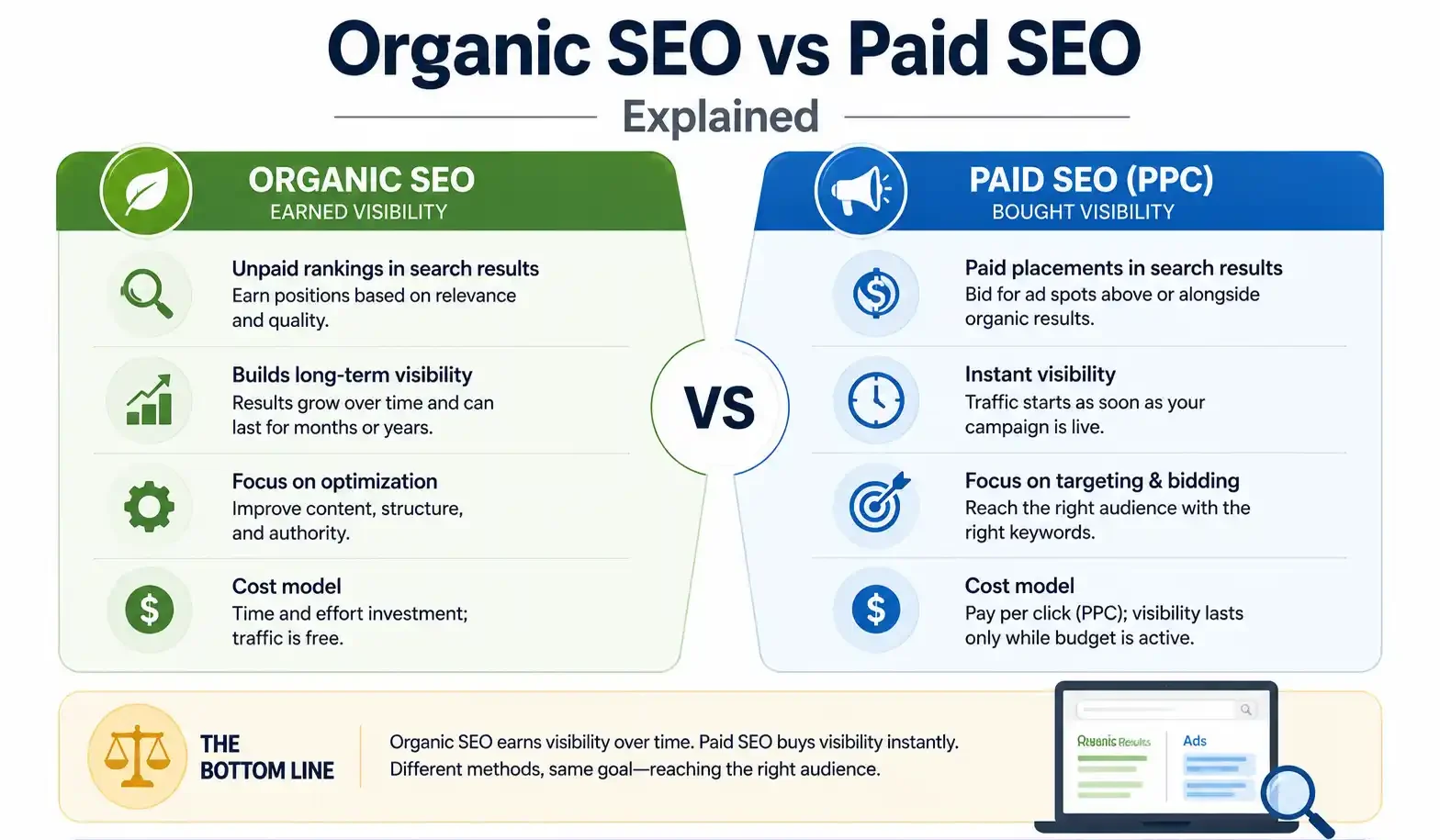
The phrase “organic SEO vs paid SEO” combines two different concepts, so it’s important to understand what each one means. Organic SEO focuses on earning unpaid rankings in search results. You improve your website’s content, structure, and authority so that Google ranks your pages based on their relevancy and quality.
Paid SEO is a broader term that most people use to describe paid search, also known as PPC (pay-per-click). Instead of earning rankings, you bid for ad placements that appear above or alongside organic search results. You’re not optimizing for free traffic—you’re paying for visibility, and that visibility lasts only while your campaign budget is active. At PromotEdge Digital, we manage these campaigns as part of our performance marketing services.
The comparison, therefore, is between earning visibility and buying visibility. Both approaches target the same search audience with the same intent, but they rely on different methods and follow very different cost models. Keep that distinction in mind, and the rest of the comparison becomes much easier to understand.
Paid Search vs Organic Search: Side by Side
Before we get into the details, here’s the short version. Use this comparison table as a quick reference when deciding where to invest your next marketing dollar.
| Factor | Organic SEO | Paid SEO (Paid Search / PPC) |
|---|---|---|
| Where you show up | Standard, unpaid search results | Sponsored slots marked “Sponsored” |
| How you pay | Invest in content, tech and authority | Pay per click or per impression |
| Speed to traffic | Weeks to months | The day the campaign goes live |
| Traffic when you stop | Keeps coming for a while | Stops almost the same hour |
| Cost over time | Drops per visit as pages mature | Holds steady or rises with competition |
| User trust | Higher, people prefer earned results | Lower, many searchers skip ads |
| Best suited for | Long-term growth and authority | Fast tests, launches and promotions |
What Organic SEO Involves
Organic SEO is not a single task. It brings together three core elements:
- Content that matches what people search for
- A technically sound website that search engines can crawl and understand
- Authority built through links and mentions from trusted sources
Get those right, and one page can rank for dozens of related searches, not just one. That compounding effect is what makes SEO worth the investment. You build the asset once, then it keeps returning visitors, and much of that success starts with solid keyword research.
The trade-off is time and consistency. New sites and new pages need time to build trust and authority before they earn stable rankings. Our guide to organic SEO services explains what happens during that process and what to expect at each stage.
What Paid SEO (Paid Search) Involves
Paid search runs on an auction. You choose keywords, set a bid, and write ads. When someone searches, Google weighs your bid and ad quality to decide which ads appear and in what order. You pay only when someone clicks your ad.
The biggest advantage is speed and control. You can launch a campaign today, target people by location, device, and time of day, and adjust or pause it whenever you want. That flexibility also makes paid search one of the fastest ways to test which keywords, ads, and landing pages generate the best results.
The catch is simple. Traffic lasts only as long as your budget does. Once you stop spending on your campaigns, your ads start to disappear from search results along with the traffic. Since visibility depends on ongoing ad spend, businesses spend on paid search for short-term campaigns rather than sustained, long-term growth.
SEO vs PPC Cost Comparison
Cost is where most comparisons become vague. Here are the latest benchmark figures you can verify.
According to the 2026 WordStream by LocaliQ benchmark, the average cost per click (CPC) on Google Ads reached $5.42, while the average cost per lead (CPL) stood at $66.69. Competitive industries can push those costs much higher, as the table below shows.
| Industry | Average Google Ads CPC (2026) |
|---|---|
| Attorneys and legal services | $8.58 |
| Dentists and dental services | $7.85 |
| Home and home improvement | $7.85 |
| Education and instruction | $6.23 |
| All industries (average) | $5.42 |
| Travel | $2.12 |
| Restaurants and food | $2.05 |
| Arts and entertainment | $1.60 |
Organic works on a different model. You pay for the work upfront, including content, technical fixes, and link building, not for each visit. As pages mature, your effective cost per visit falls because the same page keeps earning clicks that you never pay for again.
That is why the two channels feel opposite over time. Paid cost per visit tends to hold or climb as more advertisers bid for the same keywords. Organic cost per visit tends to fall because the same pages keep earning traffic without additional spend. Neither is cheaper in every case, which is why measuring marketing ROI the same way for both matters so much.
How Long Does SEO Take vs Paid Ads?
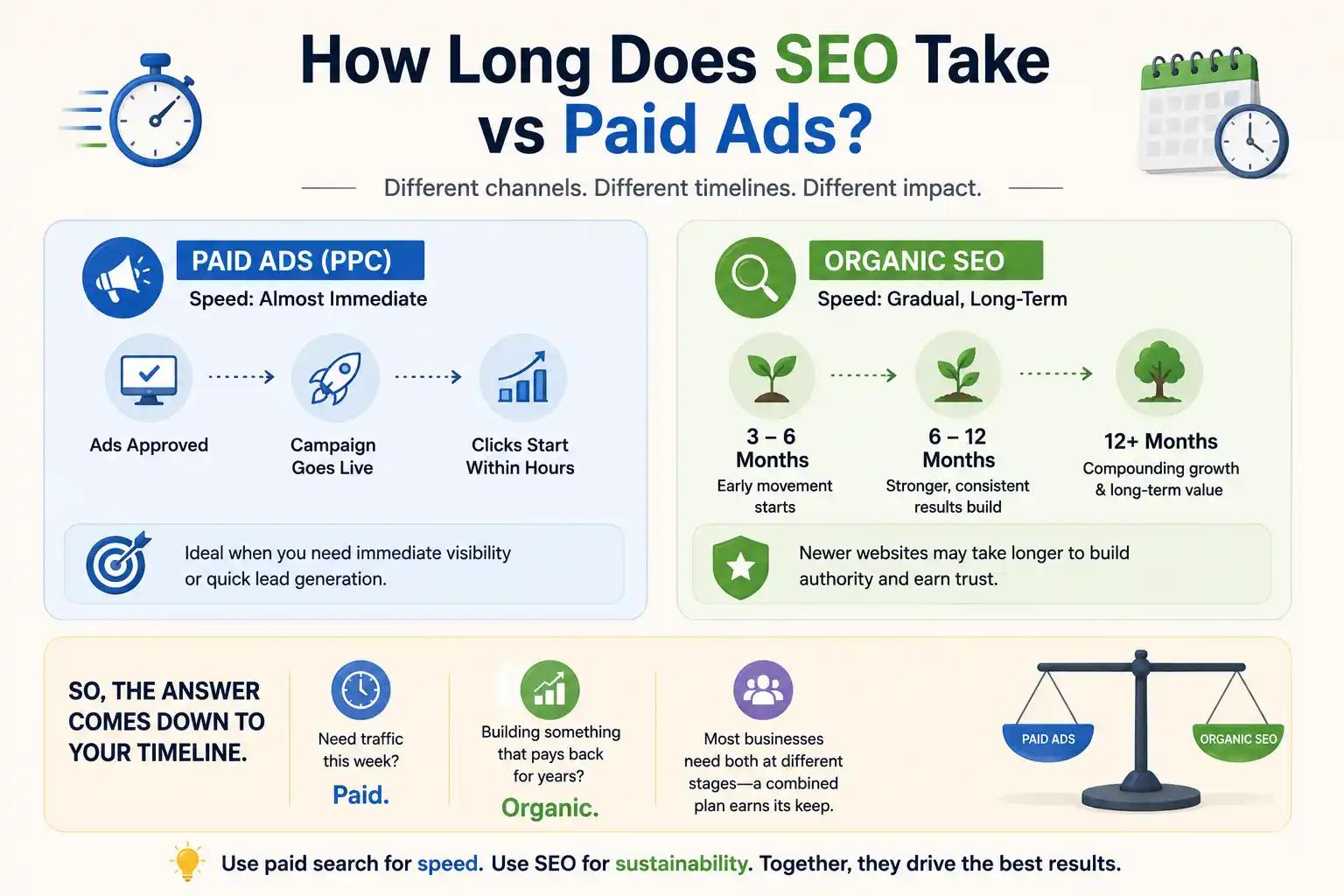
Paid search is almost immediate. Once your ads are approved and your campaign goes live, clicks can start arriving within hours. That speed is what makes paid search the preferred choice when you need immediate visibility or quick lead generation.
Organic SEO follows a different timeline. Rankings build gradually as search engines crawl, evaluate, and trust your website. Most websites see early movement within three to six months, while stronger and more consistent results usually develop between the six- and twelve-month mark. Newer websites may take longer because they first need to establish authority and credibility.
So, the answer usually comes down to your timeline.
Need traffic this week? Paid.
Building something that pays back for years? Organic.
Most businesses need both at different stages, which is exactly where a combined plan earns its keep.
Where Organic SEO Wins
Organic SEO is the stronger choice when your goal is long-term, lower-cost traffic and a brand people trust. It also drives a larger share of website traffic. Across a broad sample of websites, BrightEdge found that organic search accounts for about 53% of all trackable traffic, compared with roughly 15% from paid search.
Its value keeps compounding. A single well-optimized page can rank for multiple related searches and continue attracting visitors for years. Because those rankings are earned rather than bought, users generally place greater trust in organic listings, which can lead to higher click-through rates and stronger conversion performance over time.
Organic SEO makes the most sense if your customers research before making a purchase, if high cost-per-click rates make paid acquisition expensive, or if you’re building authority in a competitive market. Our guide on why to invest in SEO explores the long-term business case in more detail.
Where Paid SEO Wins
Paid is the stronger pick when speed and control matter more than cost per visit. It puts you at the top the moment you need to be there, which is exactly what a launch or a limited offer calls for.
It is also the best testing ground you have. Because results come back fast, you can learn which keywords and messages convert in days, then feed those winners into your organic plan. That data is worth the spend on its own.
Choose paid first if you are launching something new, running a time-boxed promotion, filling a gap while organic ramps up, or working in a market where you cannot yet rank. The keyword and conversion data you gather makes everything else sharper.
How to Use Organic and Paid Search Together
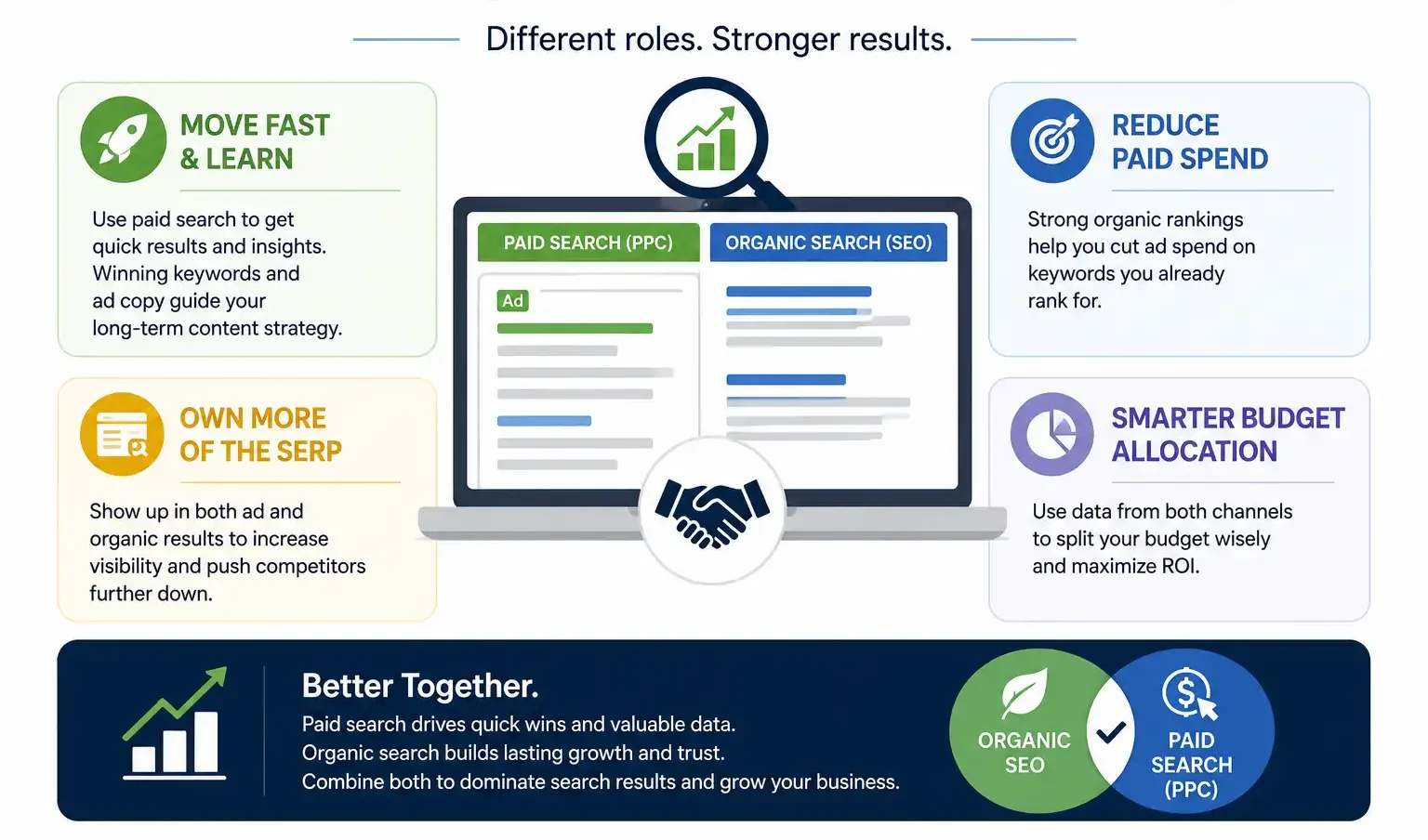
Framing this as a fight is a common mistake. Organic and paid search support different parts of the same buyer journey, and they work even better when used together.
Use paid search to move fast and learn. The keywords and ad copy that convert tell your content team exactly what to build for the long term. In turn, strong organic rankings let you reduce paid spend on the terms you already own.
Running both also helps you occupy more of the search results page for your highest-value keywords. You appear in both the ad placement and the organic listing, which pushes competitors further down the page and can increase your total clicks.
Our breakdown of SEO vs PPC explains how to split your budget between the two without wasting money.
How AI Search Is Changing SEO and Paid Ads
Search itself has shifted, and it changes how you should weigh these channels. A large share of searches now end without a click. SparkToro data puts US zero-click searches near 68%, as Google answers more queries directly on the search results page.
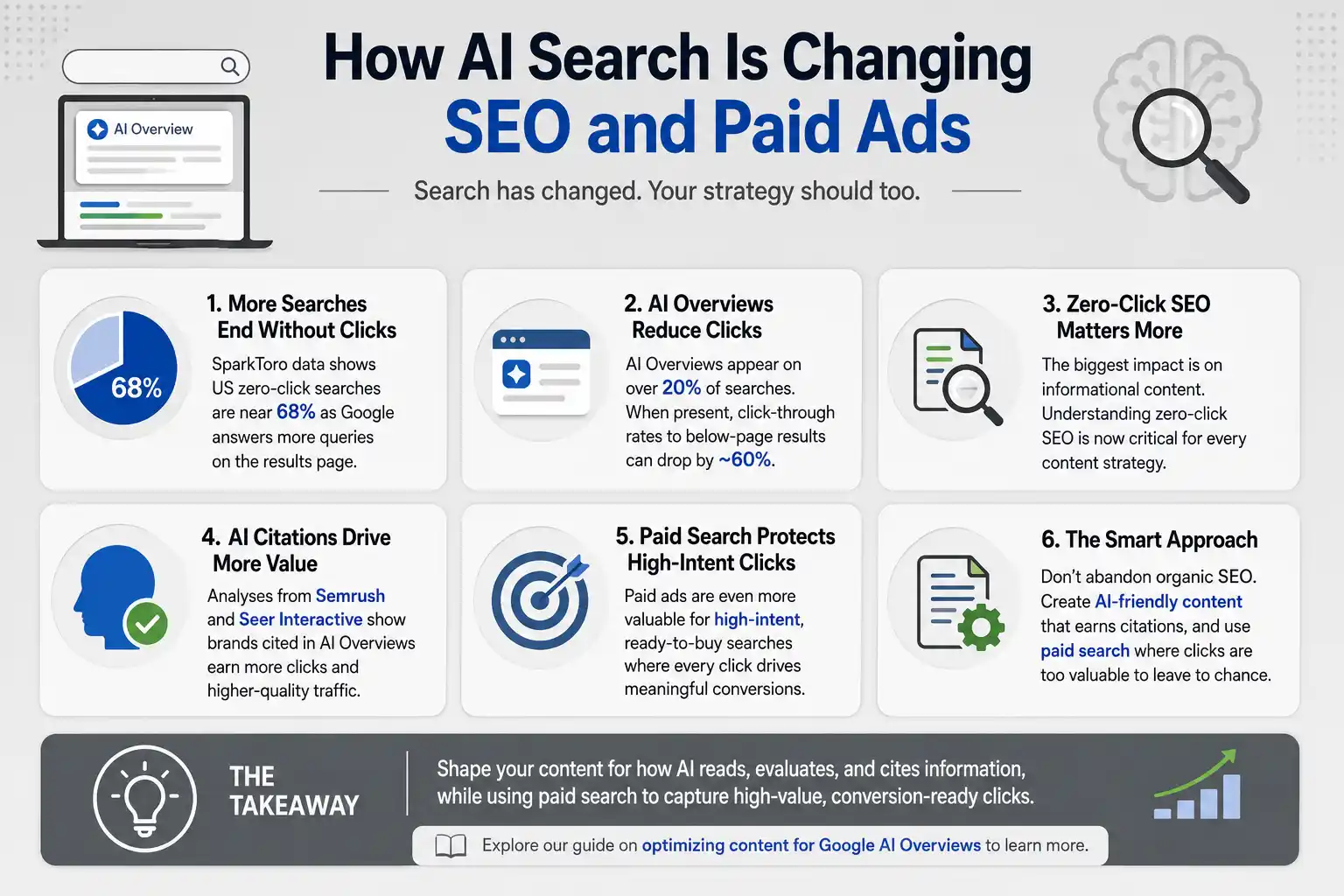
AI Overviews sit at the center of this shift. They now appear on more than a fifth of searches, and when they do, click-through rates to the pages below can fall by around 60%. That impact is greatest on informational content, which is why understanding zero-click SEO now matters for every content strategy.
Two things follow from that. First, earning a citation in AI-generated answers now matters as much as ranking below them. According to analyses from Semrush and Seer Interactive, brands cited in AI Overviews tend to earn more clicks and higher-quality visits.
Second, paid search becomes even more valuable for high-intent, ready-to-buy searches, where a guaranteed position can protect valuable conversions.
The takeaway is not to abandon organic SEO. It is to shape your content for how AI systems read, evaluate, and cite information, while using paid search where every click is too valuable to leave to chance. Our guide on optimizing content for Google AI Overviews explores that process in more detail.
How to Measure SEO and Paid Search Results
You cannot compare channels if you do not track them the same way. For organic SEO, watch rankings, organic sessions, click-through rate, and, most importantly, organic conversions and assisted conversions. Traffic alone means little if it does not lead to conversions.
For paid search, track impressions, click-through rate, cost per click, conversion rate, cost per acquisition, and return on ad spend. These metrics quickly show whether a campaign is generating value or simply consuming budget.
Then look at both together. Blended cost per acquisition across paid and organic search shows your true cost to win a customer, and it is the number that should guide where the next marketing dollar goes.
Organic SEO vs Paid SEO: Which Should You Choose?
The right answer depends on your situation, not on a rule that fits everyone. Match your goals to the channel that suits them best, then adjust your approach as your business grows.
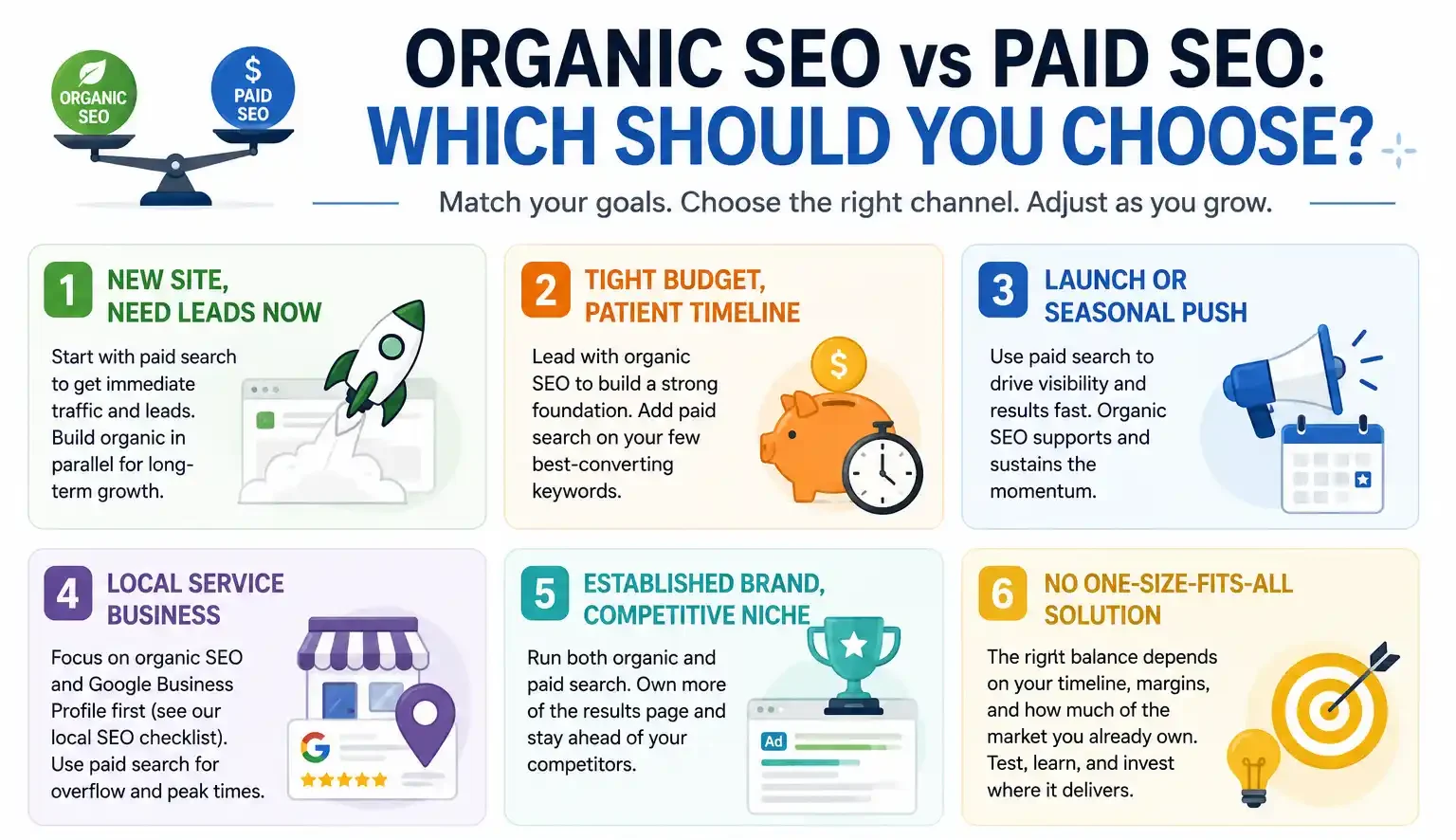
- New site, need leads now: start with paid, build organic in parallel.
- Tight budget, patient timeline: lead with organic, add paid on your few best terms.
- Launch or seasonal push: paid carries it, organic supports the aftermath.
- Local service business: organic plus Google Business Profile first (see our local SEO checklist), paid for overflow.
- Established brand, competitive niche: run both and own the full results page.
There’s no single answer that fits everyone. The right balance depends on your timeline, margins, and how much of the market you already own. When in doubt, start with a small paid campaign, learn from the data, and then invest more confidently where the results justify it.
The Bottom Line
Organic SEO and paid search are not competing strategies. They solve different parts of the same problem: helping your business reach people when they are actively searching. Paid search delivers immediate visibility, while organic SEO builds long-term visibility that continues to generate value over time.
For most businesses, the strongest approach is a combination of both. The balance depends on your goals, budget, competition, and timeline. Paid search can create early momentum, while organic SEO reduces your reliance on advertising as your rankings strengthen.
If you’re unsure where your marketing budget will have the greatest impact, our team at PromotEdge Digital can help you evaluate your options. Explore our SEO services and digital marketing services to get started.
Frequently asked questions
-
Is SEO organic or paid?
Ans.SEO refers to organic search, not paid advertising. It means earning unpaid rankings through content, technical optimization, and authority over time. Paid visibility comes from paid search or PPC. Both appear on the same results page, but SEO almost always refers to organic rankings. -
Is organic SEO cheaper than paid SEO?
Ans.Usually, yes over the long term. Organic SEO requires an upfront investment in content and optimization, but traffic can continue without paying for every click. Paid search charges for each visit, so costs continue as long as campaigns run. In the short term, paid can feel cheaper because results arrive faster. -
How long before organic SEO beats paid SEO on cost?
Ans.There is no fixed timeline, but many businesses see organic SEO become more cost-effective after six to twelve months. As pages mature and rank for more keywords, they continue attracting traffic without additional click costs. Before that point, paid search usually delivers faster results. -
Can I run organic SEO and paid SEO at the same time?
Ans.Yes, and many businesses do. Paid search delivers immediate traffic and useful conversion data, while organic SEO builds lasting visibility and lowers acquisition costs over time. Used together, each channel strengthens the other. -
Does paid SEO help organic rankings?
Ans.No. Running paid search campaigns does not improve your organic rankings. The two systems work independently. However, paid search provides keyword and conversion data that can improve your SEO strategy, and running both together can increase your overall visibility on the search results page.
Author Details

Latest Posts
-
 22 / Sep
Digital Marketing Digital Marketing for Ecommerce Brands: The 2027 Growth Playbook
22 / Sep
Digital Marketing Digital Marketing for Ecommerce Brands: The 2027 Growth Playbook -
 15 / Sep
-
 04 / Sep
-
 29 / Jul
Search Engine Optimization 6 Enterprise SEO Mistakes That Quietly Cost You Millions
29 / Jul
Search Engine Optimization 6 Enterprise SEO Mistakes That Quietly Cost You Millions -
 24 / Jul
Blogs
Journey into Ideas Unveiling Tomorrow's Insights Today.




-
Is SEO organic or paid?
Ans.SEO refers to organic search, not paid advertising. It means earning unpaid rankings through content, technical optimization, and authority over time. Paid visibility comes from paid search or PPC. Both appear on the same results page, but SEO almost always refers to organic rankings. -
Is organic SEO cheaper than paid SEO?
Ans.Usually, yes over the long term. Organic SEO requires an upfront investment in content and optimization, but traffic can continue without paying for every click. Paid search charges for each visit, so costs continue as long as campaigns run. In the short term, paid can feel cheaper because results arrive faster. -
How long before organic SEO beats paid SEO on cost?
Ans.There is no fixed timeline, but many businesses see organic SEO become more cost-effective after six to twelve months. As pages mature and rank for more keywords, they continue attracting traffic without additional click costs. Before that point, paid search usually delivers faster results. -
Can I run organic SEO and paid SEO at the same time?
Ans.Yes, and many businesses do. Paid search delivers immediate traffic and useful conversion data, while organic SEO builds lasting visibility and lowers acquisition costs over time. Used together, each channel strengthens the other. -
Does paid SEO help organic rankings?
Ans.No. Running paid search campaigns does not improve your organic rankings. The two systems work independently. However, paid search provides keyword and conversion data that can improve your SEO strategy, and running both together can increase your overall visibility on the search results page.