


Questions to Ask a Digital Marketing Agency Before You Sign
-
Author
Anindita Barik
-
Updated Date
Jul-16-2026
-
Views
2 Min Read
-
Author: PromotEdge Digital
-
Updated Date: Jul-16-2026
-
Views: 2 Min Read
-
Author: Anindita Barik
Not all digital marketing agencies deliver what they promise. This guide walks through the critical questions to ask a digital marketing agency around SEO strategy, AI Overviews readiness, pricing transparency, and communication standards. Backed by 2026 industry data—including Google’s March, May, and June core updates and agency AI-adoption trends—it helps businesses spot red flags early and choose a partner whose process, reporting, and results actually align.
Nearly half of small businesses change their marketing agency within the first two years of working together. The most common reasons include poor campaign performance, lack of communication, and rising costs that fail to deliver a matching return on investment. In many cases, the problem isn’t the decision to hire an agency—it’s choosing one without asking the right questions from the start.
Before signing a contract, it’s important to understand how an agency approaches strategy, measures success, uses AI in its services, and reports on performance. This guide covers the key questions to ask a digital marketing agency in 2026, helping businesses evaluate whether an agency is the right fit before making a long-term commitment.
Key Takeaways
- 67% of businesses are dissatisfied with their current agency’s performance (a widely cited agency-industry benchmark), and in many cases, it comes down to not asking the right questions before signing on.
- Google released three algorithm updates between March and June 2026 alone (Search Engine Journal). If an agency claims to offer SEO, ask how it tracks these updates and adapts its strategy—not just whether it “does SEO.”
- More than 99% of agencies now use AI in some capacity (Basis 2026 Advertising Agency Report). The better question isn’t whether they use AI, but how they use it to improve results without compromising quality.
- Get the pricing structure, reporting schedule, and contract exit terms in writing before the kickoff call, not after.
Why Asking the Right Questions Matters More in 2026
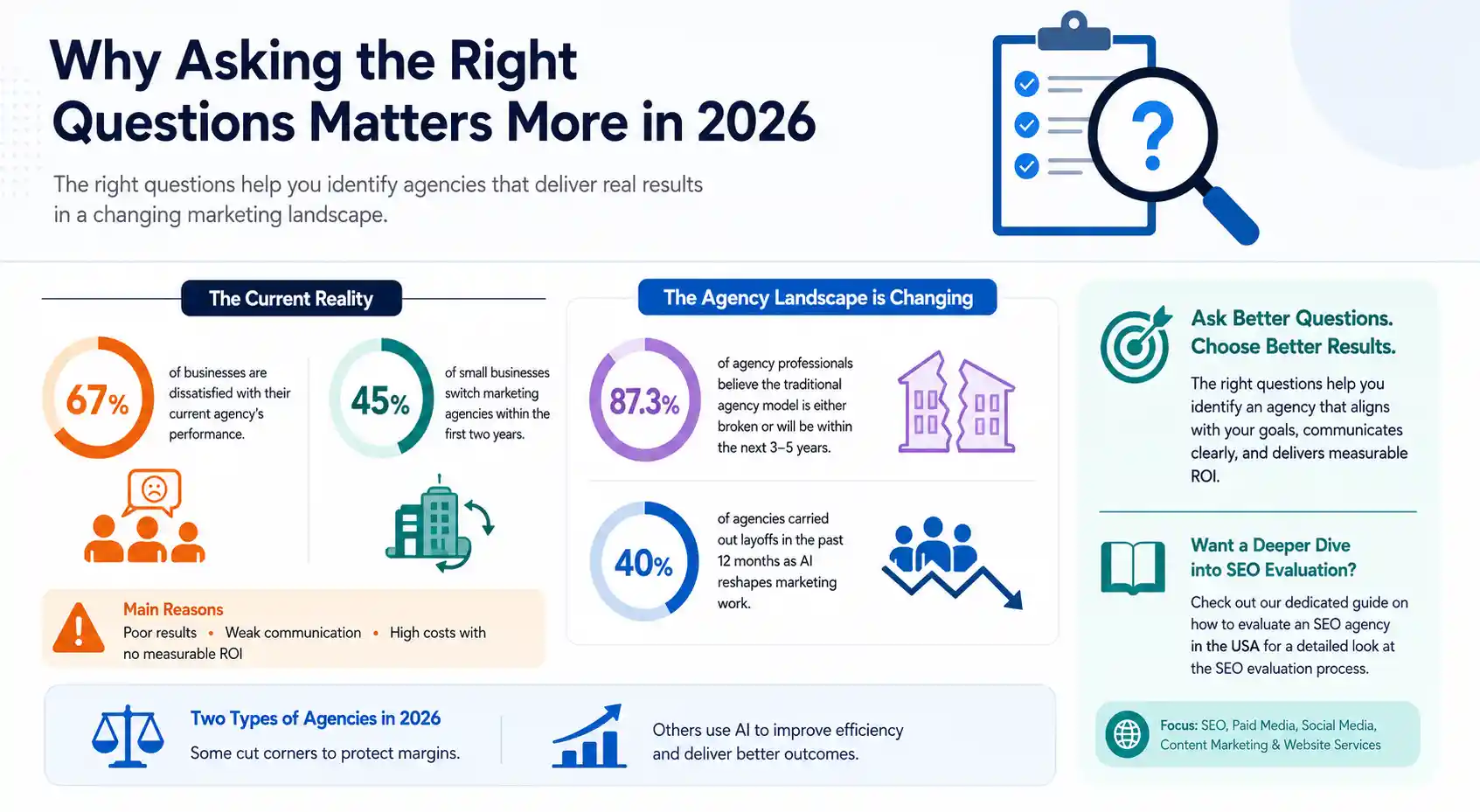
Businesses that evaluate agencies using only generic questions often end up with generic results. According to the industry benchmark report, 67% of businesses are dissatisfied with their current agency’s performance. Similarly, a small business survey found that 45% of small businesses switch marketing agencies within the first two years, mainly because of poor results, weak communication, and increasing costs that do not translate into measurable ROI.
One reason this is becoming more common is that the agency landscape itself is changing. The Basis 2026 Advertising Agency Report found that 87.3% of agency professionals believe the traditional agency model is either already broken or will be within the next three to five years. The same report also found that nearly 40% of agencies carried out layoffs in the past 12 months as AI continues to reshape how marketing work is delivered.
For clients, this shift has created two very different types of agencies. Some reduce service quality to protect their margins, while others use AI to improve efficiency and deliver better outcomes. Asking the right questions during the evaluation process helps businesses understand which type of agency they are speaking with.
If your focus is specifically on improving organic search performance rather than managing your entire digital marketing strategy, our dedicated guide on how to evaluate an SEO agency in the USA explores the SEO evaluation process in greater detail. This guide takes a broader approach, covering how to assess a digital marketing agency across SEO, paid media, social media, content marketing, and website services.
Questions About Strategy, Experience, and Fit
Before discussing pricing or packages, understand how the agency plans to approach your business. An agency’s process and industry experience determine whether the partnership has a realistic chance of succeeding.
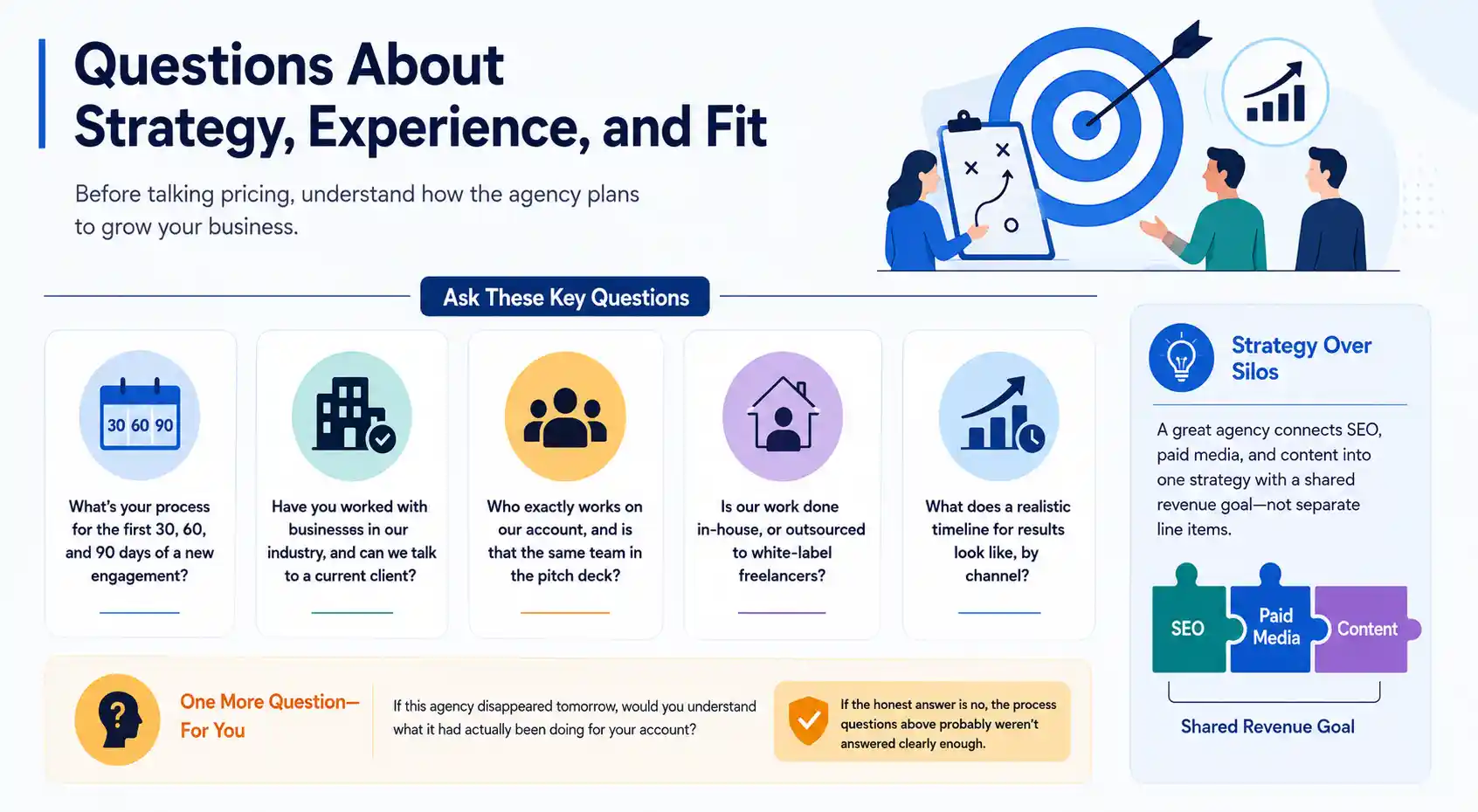
Ask:
- What’s your process for the first 30, 60, and 90 days of a new engagement?
- Have you worked with businesses in our industry, and can we talk to a current client?
- Who exactly works on our account, and is that the same team in the pitch deck?
- Is our work done in-house, or outsourced to white-label freelancers?
- What does a realistic timeline for results look like, by channel?
A versatile full-service digital marketing agency should be able to explain, in plain terms, how SEO, paid media, and content work together toward a shared revenue goal rather than operating as separate line items. If that connection isn’t clear during the first meeting, it’s likely to show up later in reporting that feels equally disconnected.
There’s one more question to ask, but this time, to yourself. If this agency disappeared tomorrow, would you understand what it had actually been doing for your account? If the honest answer is no, the process questions above probably weren’t answered clearly enough.
Which SEO and Google Update Questions Should You Ask?
Any agency claiming SEO expertise should be able to speak confidently about what’s changed in Google’s ranking systems this year, and not fall back on generic statements like “we do keyword research.”
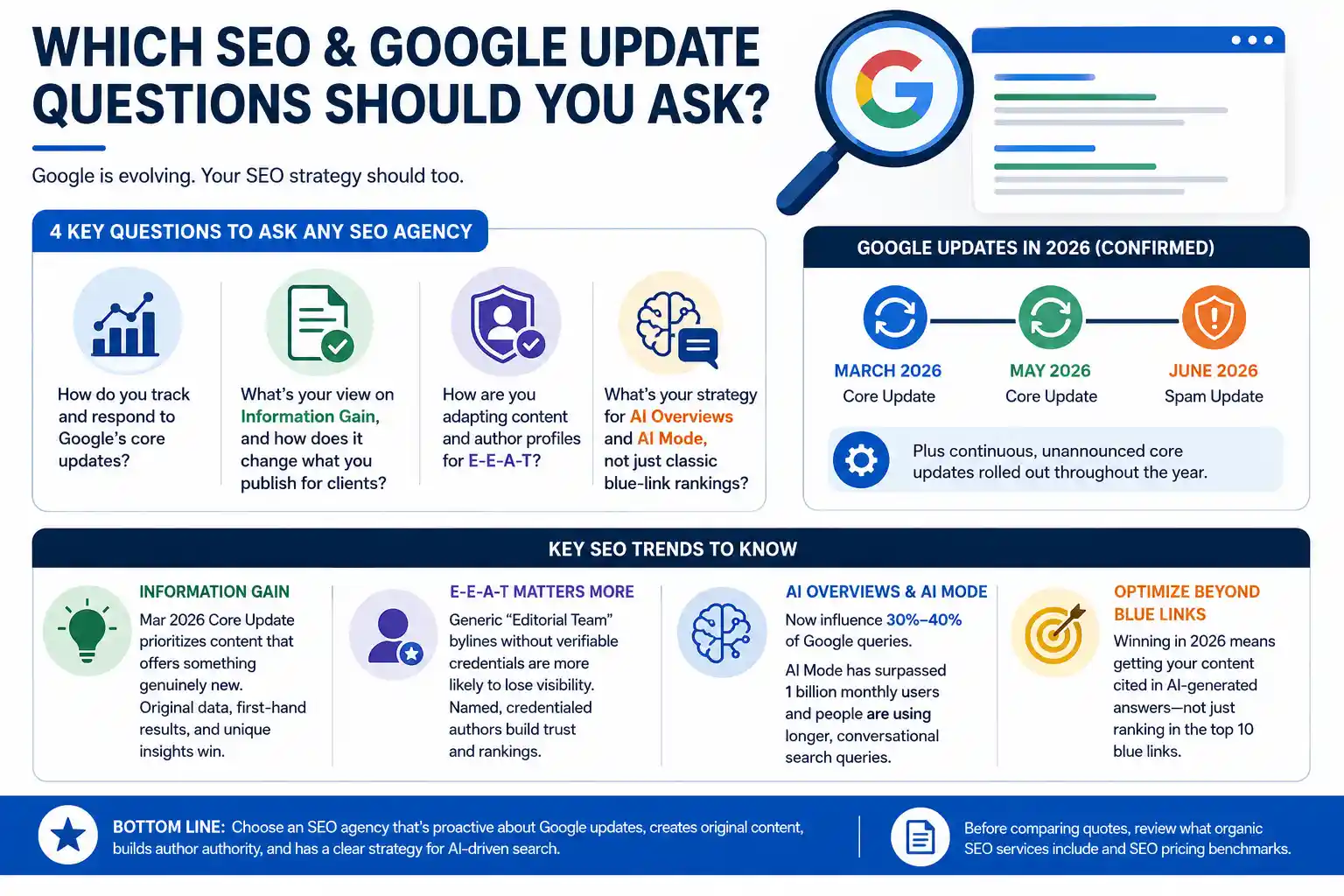
Ask:
- How do you track and respond to Google’s core updates?
- What’s your view on Information Gain, and how does it change what you publish for clients?
- How are you adapting content and author profiles for E-E-A-T?
- What’s your strategy for AI Overviews and AI Mode, not just classic blue-link rankings?
There’s a reason to ask these questions. Between late March and late June 2026, Google introduced three confirmed updates—the March 2026 core update, the May 2026 core update, and the June 2026 spam update. That’s in addition to the smaller core adjustments Google now rolls out continuously without announcing them individually (Search Engine Journal, 2026).
The March 2026 core update placed greater emphasis on Information Gain—a signal that measures whether a page offers something genuinely new rather than repackaging information that’s already ranking (Evertune, 2026). Pages built around the same handful of sources everyone else cites are steadily losing visibility, while those backed by original data, first-hand case results, and named author expertise are gaining it.
The same shift is reflected in E-E-A-T. Content published under generic “Editorial Team” bylines without verifiable credentials is now more likely to lose visibility, even when the writing itself is strong (Evertune, 2026). If your agency still depends on anonymous ghostwriting with no named, credentialed authors, ask how it plans to adapt—and pay close attention to the answer.
Search behaviour is evolving just as quickly. AI Overviews and AI Mode are now estimated to influence between 30% and 40% of Google queries, while Google’s own I/O 2026 data shows AI Mode surpassing one billion monthly users, with people using longer, more conversational search queries (reported via Search Engine Land, 2026).
An agency that’s still optimizing only for the traditional ten blue links, without a strategy for getting your content cited in AI-generated answers, is optimizing for a shrinking share of Google’s search results.
If SEO makes up most of your marketing budget, cross-reference this section with our breakdown of what organic SEO services actually include and our SEO agency pricing benchmarks before comparing quotes.
How Does the Agency Actually Use AI in Delivery?
Every agency will say it uses AI. Only a few can explain exactly how it supports their work, and some of them can even still demonstrate that it’s improving your outcomes—not just their margins.
Ask:
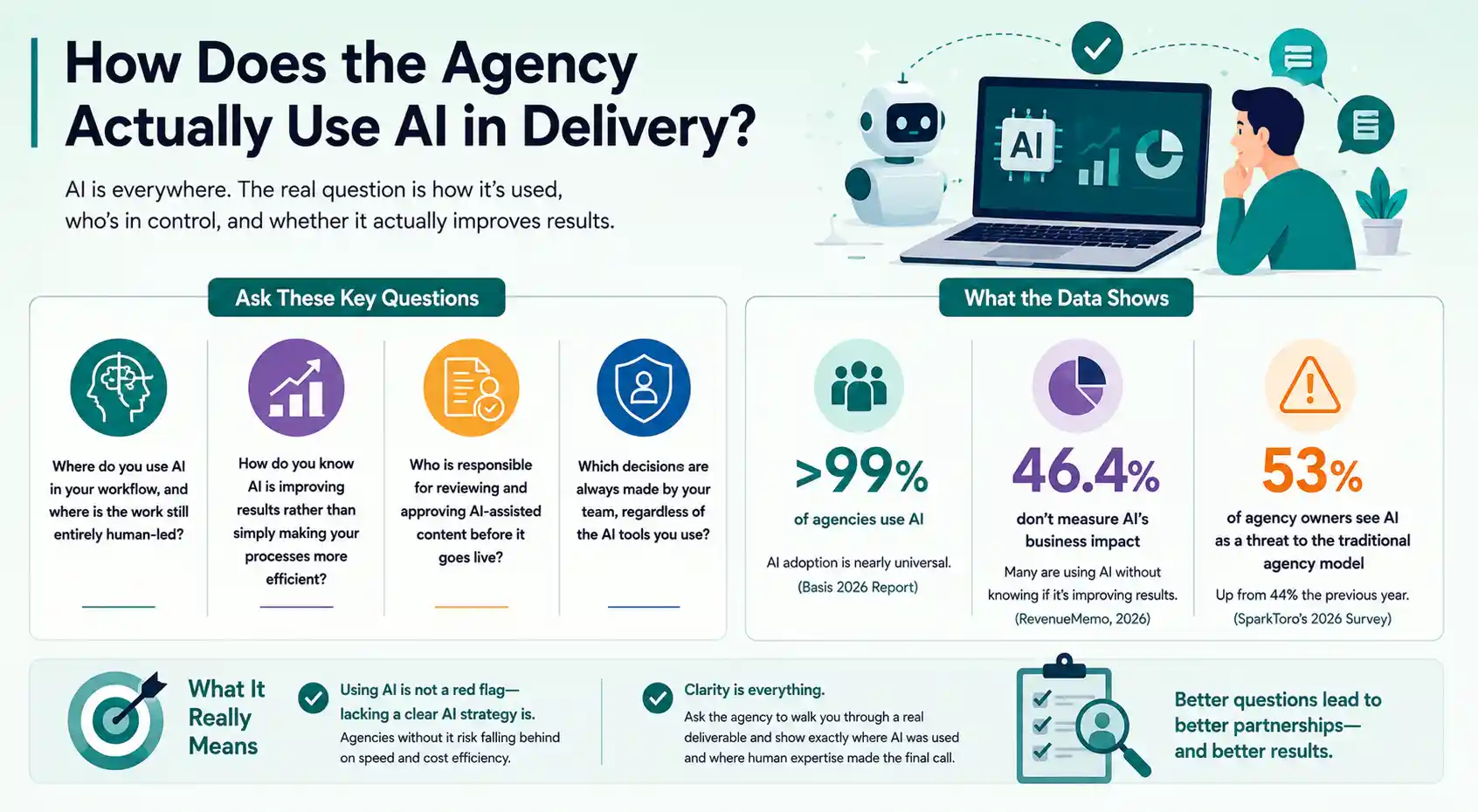
- Where do you use AI in your workflow, and where is the work still entirely human-led?
- How do you know AI is improving results rather than simply making your processes more efficient?
- Who is responsible for reviewing and approving AI-assisted content before it goes live?
- Which decisions are always made by your team, regardless of the AI tools you use?
The data tells a mixed story, which is exactly why this question deserves a clear answer instead of a marketing pitch. AI adoption is now nearly universal. Basis’s 2026 report found that more than 99% of surveyed agencies use AI, with daily usage increasing from 15.9% in 2024 to 59.2% in 2026.
At the same time, a separate 2026 industry analysis found that 46.4% of agencies don’t measure AI’s business impact at all, meaning many are using AI without knowing whether it’s actually improving results (RevenueMemo, 2026). Meanwhile, 53% of agency owners now see AI as a credible threat to the traditional agency business model, up from 44% the previous year (SparkToro’s State of Digital Agencies survey, cited 2026).
None of this suggests that using AI is a red flag. If anything, an agency without a clear AI strategy is more likely to fall behind on speed and cost efficiency. The real red flag is a lack of clarity. Ask the agency to walk you through a real deliverable and explain exactly where AI was used and where human expertise made the final decision.
Questions About Pricing, Contracts, and Reporting
Pricing conversations should happen early—and they should happen in writing, not inside a proposal PDF that no one even reads twice.
Ask:
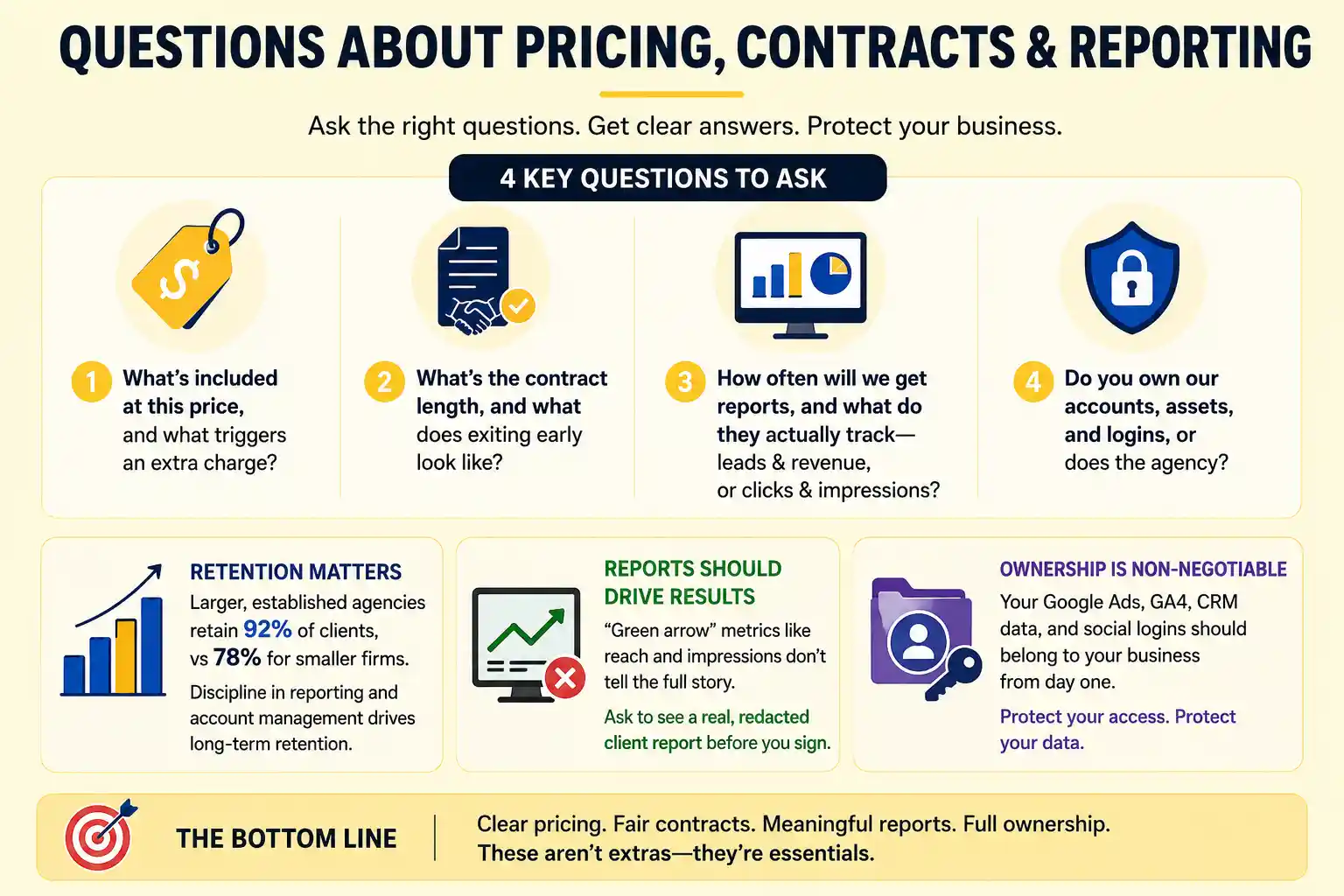
- What’s included at this price, and what triggers an extra charge?
- What’s the contract length, and what does exiting early look like?
- How often will we get reports, and what do they actually track—leads and revenue, or clicks and impressions?
- Do you own our accounts, assets, and logins, or does the agency?
The numbers tell a similar story. RevenueMemo’s 2026 agency benchmark analysis found that larger, more established agencies retain 92% of their clients, compared to 78% among smaller firms. That difference is often driven by disciplined reporting and stronger account management—not just campaign performance alone.
The reports deserve just as much attention as the proposal. A dashboard filled with “green arrow” metrics like reach, impressions, and followers may look encouraging, but if it doesn’t connect those numbers to leads or revenue, it tells you very little about business performance. Ask to see a real, redacted client report before you sign—not a polished sample created for the pitch.
Finally, confirm ownership in writing. Your Google Ads account, GA4 property, CRM data, and social logins should belong to your business from day one, not the agency. That single clause can prevent one of the biggest frustrations of switching agencies later: losing months of tracking history and having to rebuild it from scratch.
Questions About Communication and Account Management
Even the strongest strategy can feel ineffective if communication isn’t handled well. From a client’s perspective, poor communication can make even good work feel like a disappointing partnership.
Ask:
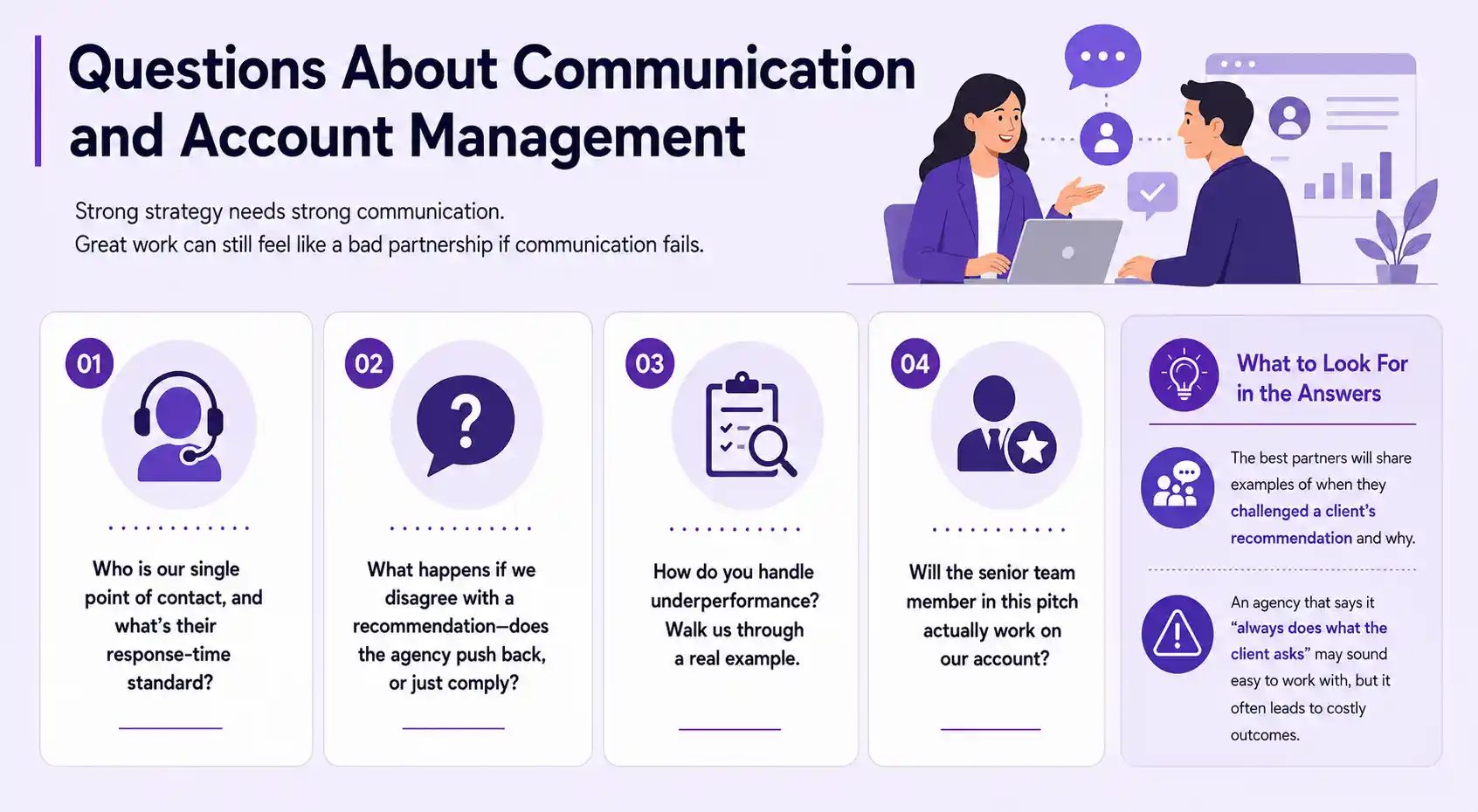
- Who is our single point of contact, and what’s their response-time standard?
- What happens if we disagree with a recommendation—does the agency push back, or just comply?
- How do you handle underperformance? Walk us through a real example.
- Will the senior team member in this pitch actually work on our account?
Pay close attention to how an agency answers the disagreement question. The best partners won’t hesitate to share an example of when they challenged a client’s recommendation and explain why. It shows they’re willing to act as strategic advisors, not simply execute instructions. An agency that says it “always does what the client asks” may sound easy to work with, but it often comes at the expense of ending up with costly outcomes.
Red-Flag Answers That Should End the Conversation
Some answers should disqualify an agency immediately, no matter how polished the rest of the pitch may be.
- “We guarantee first-page rankings.” No agency controls Google’s algorithm. That’s a sales promise, not a credible one.
- “We can’t share client references.” Reputable agencies should be able to provide at least one current client who’s willing to speak about their experience.
- “Everything is proprietary, so we can’t explain our process.” A vague explanation usually points to the absence of a clear, repeatable process.
- “AI writes everything—we just publish it.” With the March 2026 core update placing greater emphasis on named, credentialed authorship, unedited AI-generated content is more of a ranking liability than a shortcut.
- “Results in 2 weeks, guaranteed.” SEO typically takes 3–6 months to show meaningful progress. Paid media can deliver results sooner, but it still requires time for optimization.
For a broader comparison of engagement models, see our breakdown of SEO agency vs. freelance SEO consultant, which explains when a full agency team is worth the premium over a solo consultant.
How PromotEdge Digital Answers These Questions
The questions in this guide are the same ones we’d expect any agency to answer—including us. We’d rather you ask the tough questions upfront than make a decision based on a polished presentation.
As a digital marketing agency in USA working with 200+ brands since 2015, our SEO team tracks every core update as it rolls out. Our performance marketing reporting ties ad spend directly to leads and revenue, while our brand strategy and web design teams operate under one accountable structure instead of across multiple vendors..
Final Thoughts
Businesses that avoid becoming part of that 45% switching statistic usually have one thing in common: they ask the right questions before signing an agreement, not after months of disappointing results. By evaluating an agency’s strategy, SEO and AI-search readiness, approach to AI, and pricing and reporting terms upfront, you can make a more informed decision and set the foundation for a stronger working relationship.
Want to get a second opinion on a proposal you already have in hand or you’re ready to start the conversation, Get in touch with PromotEdge Digital for a free consultation.
Frequently Asked Questions
-
What's the single most important question to ask a digital marketing agency?
Ans.Ask how the agency measures success. The answer should focus on business outcomes such as leads, revenue, or bookings rather than vanity metrics. According to HubSpot's Agency Benchmark Report, much of the industry's 67% client dissatisfaction rate stems from a disconnect between the metrics agencies report and the results businesses actually expect. -
How long should a digital marketing contract run?
Ans.Most agencies work with initial contracts ranging from 6 to 12 months. SEO typically takes 3–6 months to show meaningful progress, while paid media requires a shorter period for optimization. Before signing, ask about early-exit terms and asset ownership, especially since Clutch found that 45% of businesses switch agencies within their first two years. -
Should an agency guarantee first-page Google rankings?
Ans.No. No agency has control over Google's ranking algorithm, which changed significantly through the March, May, and June 2026 updates. A credible agency will present a realistic strategy and timeline instead of guaranteeing rankings. In fact, any promise of first-page rankings should be treated as a red flag. -
How do I know if an agency's AI use is a good sign or a bad one?
Ans.Ask where AI is used and where a named human expert reviews the output. Basis's 2026 report found that AI adoption has surpassed 99% across the industry, yet 46.4% of agencies still don't measure whether AI is actually improving results. That's why AI adoption alone can never be a reliable proof of quality. -
Is it normal for a digital marketing agency to outsource work?
Ans.Yes, outsourcing is common, but it shouldn't come as a surprise. Ask whether your account will be managed in-house or passed to white-label freelancers. When work is subcontracted without your knowledge, accountability and quality control can become more difficult to maintain.
Author Details

Latest Posts
-
10 / Jul
Digital Marketing Questions to Ask a Digital Marketing Agency Before You Sign
-
 03 / Jul
Search Engine Optimization Top E-commerce SEO Agencies in the USA for Shopify & WooCommerce
03 / Jul
Search Engine Optimization Top E-commerce SEO Agencies in the USA for Shopify & WooCommerce -
 26 / Jun
Digital Marketing 6 Reasons Why You Need a Digital Marketing Agency (2026)
26 / Jun
Digital Marketing 6 Reasons Why You Need a Digital Marketing Agency (2026) -
 26 / Jun
Search Engine Optimization SEO Agency Pricing in the USA: What You Actually Get at Every Budget Level
26 / Jun
Search Engine Optimization SEO Agency Pricing in the USA: What You Actually Get at Every Budget Level -
 25 / Jun
Search Engine Optimization SEO Agency vs Freelance SEO Consultant: Which Is Right for Your Business?
25 / Jun
Search Engine Optimization SEO Agency vs Freelance SEO Consultant: Which Is Right for Your Business?
Blogs
Journey into Ideas Unveiling Tomorrow's Insights Today.











-
What's the single most important question to ask a digital marketing agency?
Ans.Ask how the agency measures success. The answer should focus on business outcomes such as leads, revenue, or bookings rather than vanity metrics. According to HubSpot's Agency Benchmark Report, much of the industry's 67% client dissatisfaction rate stems from a disconnect between the metrics agencies report and the results businesses actually expect. -
How long should a digital marketing contract run?
Ans.Most agencies work with initial contracts ranging from 6 to 12 months. SEO typically takes 3–6 months to show meaningful progress, while paid media requires a shorter period for optimization. Before signing, ask about early-exit terms and asset ownership, especially since Clutch found that 45% of businesses switch agencies within their first two years. -
Should an agency guarantee first-page Google rankings?
Ans.No. No agency has control over Google's ranking algorithm, which changed significantly through the March, May, and June 2026 updates. A credible agency will present a realistic strategy and timeline instead of guaranteeing rankings. In fact, any promise of first-page rankings should be treated as a red flag. -
How do I know if an agency's AI use is a good sign or a bad one?
Ans.Ask where AI is used and where a named human expert reviews the output. Basis's 2026 report found that AI adoption has surpassed 99% across the industry, yet 46.4% of agencies still don't measure whether AI is actually improving results. That's why AI adoption alone can never be a reliable proof of quality. -
Is it normal for a digital marketing agency to outsource work?
Ans.Yes, outsourcing is common, but it shouldn't come as a surprise. Ask whether your account will be managed in-house or passed to white-label freelancers. When work is subcontracted without your knowledge, accountability and quality control can become more difficult to maintain.