


Digital Marketing for Roofing Companies: Get More Leads

-
Updated Date
Jul-18-2026
-
Views
2 Min Read
-
Author: PromotEdge Digital
-
Updated Date: Jul-18-2026
-
Views: 2 Min Read
-
Author: Milan Shyamal
A homeowner notices a brown stain spreading across the ceiling after last night’s rain. They grab their phone and type: “emergency roof repair near me.” Within seconds, they’re looking at a map pack with three local roofers. Whichever business appears first with solid reviews and a visible phone number gets the call.
That moment — urgent, local, and intent-driven — is what digital marketing for roofing companies is designed to capture. It is not about awareness or brand building. It is about being present when a homeowner has already decided they need help.
Roofing demand is largely event-triggered. A leak, storm damage, a failed inspection, or a neighbor’s new roof can all start the search process. That makes it a high-stakes, high-frequency market — IBISWorld estimates the U.S. roofing contractors industry at $92.5 billion in 2026. The window between search and decision is short. If your company is not visible at that exact moment, the job goes to a competitor who is.
This guide breaks down which channels actually move the needle, how they work together, and how to build a strategy that turns online visibility into booked jobs.
What Is Digital Marketing for Roofing Companies?
Digital marketing for roofing companies is the use of online channels — local SEO, Google Ads, content, and reviews — to generate qualified homeowner leads without relying entirely on referrals or door-knocking.
The emphasis is on qualifications. The goal is not more traffic. It is traffic from people actively searching for the specific service your company provides, in the exact areas you serve, at the moment they are ready to hire someone.
Every digital channel is also measurable in a way traditional marketing is not. You can trace a $12,000 roof replacement back to a specific keyword, ad, or landing page. That feedback loop is what makes digital marketing improvable over time — and what justifies the investment.
Why Roofing Companies Need a Different Digital Strategy
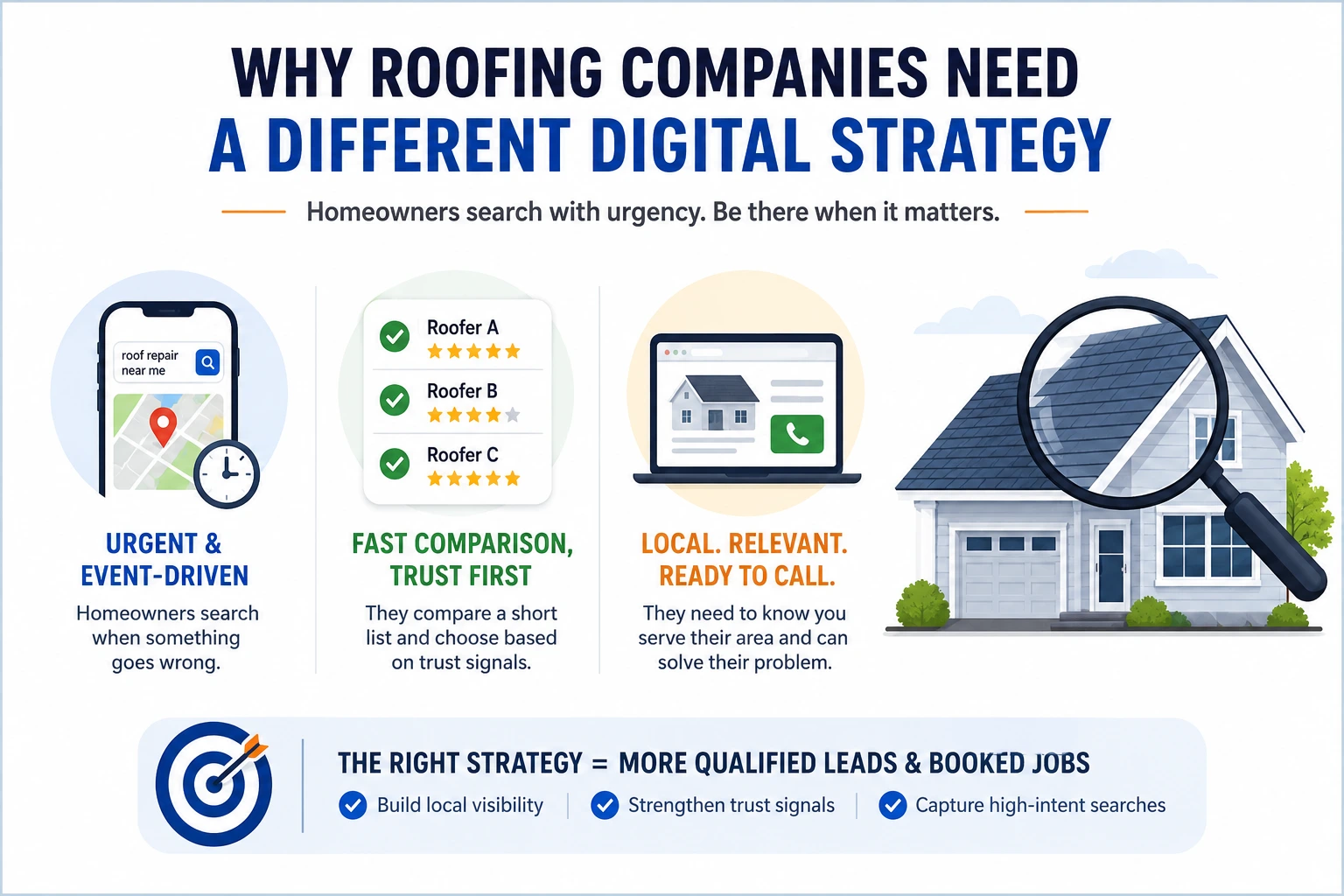
Most homeowners do not browse roofing companies the way they browse restaurants. They search when something has already gone wrong, compare a short list of options quickly, and make a decision based on trust signals rather than branding.
That means three questions need to be answered fast: Are you relevant to the exact service they need? Do you actually serve their location? Are there enough proof points to justify picking up the phone?
Generic digital marketing advice — just run SEO, social media, and PPC — does not account for this. A sharper approach is: build local visibility first, strengthen trust signals second, and use paid media to capture the urgent searches that cannot wait for organic rankings to mature.
What Channels Matter Most for Roofing Lead Generation
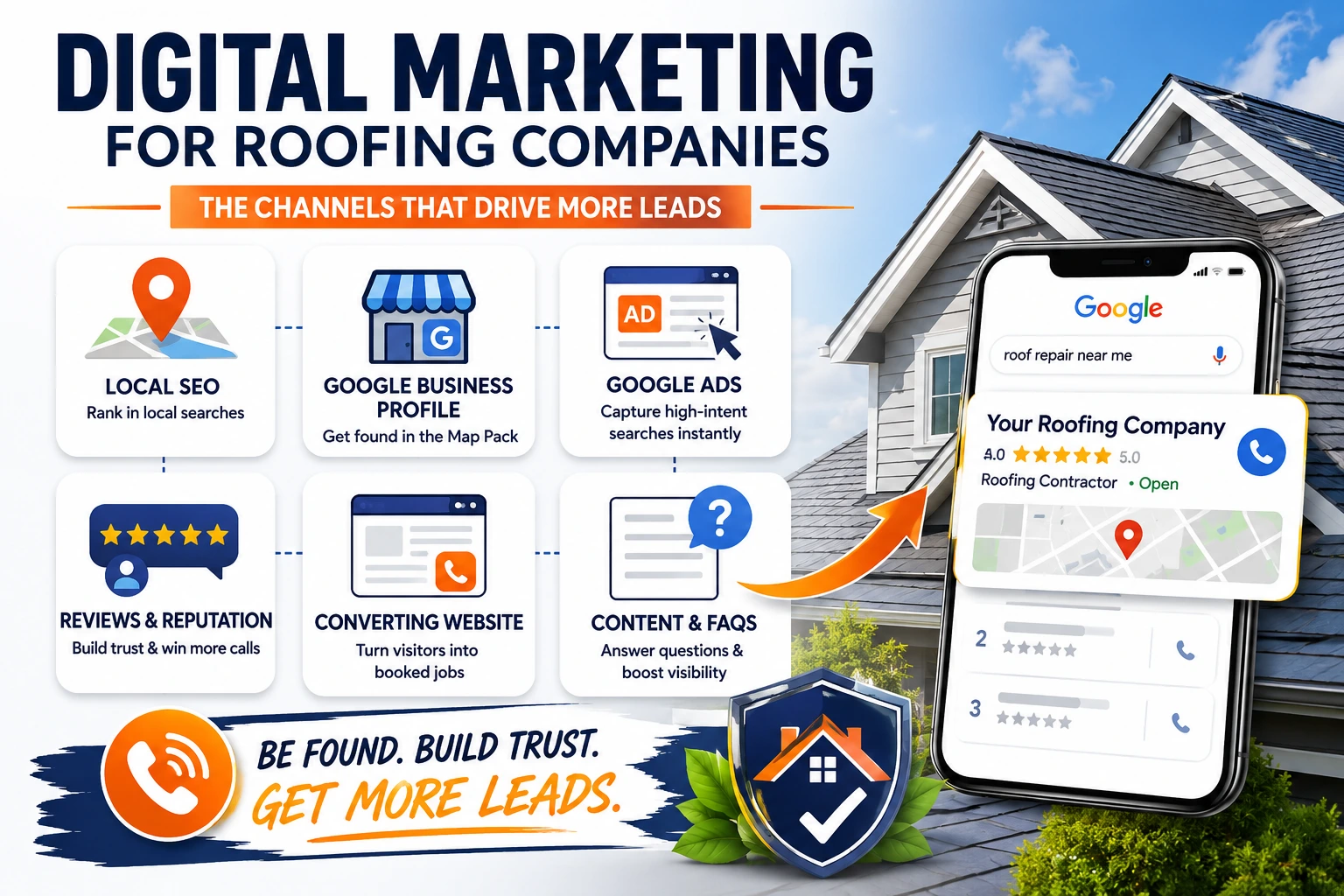
Not every channel deserves equal attention, especially when budget and time are limited. For most roofing companies, these produce the fastest and most consistent returns:
- Local SEO — to rank for searches like roof repair near me, roof replacement in [city], and emergency roofing contractor.
- Google Business Profile optimization — to improve map pack visibility and build credibility before a user even clicks your listing.
- Google Ads — for bottom-funnel, high-intent searches where appearing immediately matters more than long-term ranking.
- Website conversion optimization — so traffic turns into calls, form fills, and booked inspections.
- Review generation and reputation management — to strengthen local ranking signals and buyer confidence at the same time.
- FAQ and blog content — to support semantic SEO and improve visibility in AI-powered search experiences.
If the budget is limited, prioritize the channels closest to revenue: local SEO, Google Business Profile, landing pages, reviews, and high-intent search ads. Social media supports familiarity, but it rarely fixes weak local search visibility on its own.
Local SEO and Google Business Profile Are the Foundation
For roofing companies, local SEO is typically the highest-leverage long-term investment. It determines whether you appear when someone searches for a service-plus-location phrase, and whether Google trusts your business enough to include it in the map pack.
A well-structured site includes dedicated service pages for each offering (repair, replacement, storm damage, commercial roofing), clearly defined service area pages, strong internal linking, and content written around questions real homeowners ask before hiring.
Your Google Business Profile amplifies the rest. Complete categories, accurate contact details, updated service areas, fresh photos, and consistent review activity all signal relevance and prominence — two of the three factors Google uses to determine local ranking. The third is distance, which you cannot control but your service area pages can help address.
The stakes are high: Backlinko data shows that 44% of local searchers click a result inside the Google 3-Pack — nearly double the share that goes to paid results. If your business is not in that pack, the majority of local clicks go to competitors who are.
For a deeper look at how organic visibility is built, the local SEO checklist for small businesses.
A Roofing Website Should Be Built to Convert, Not Just Impress
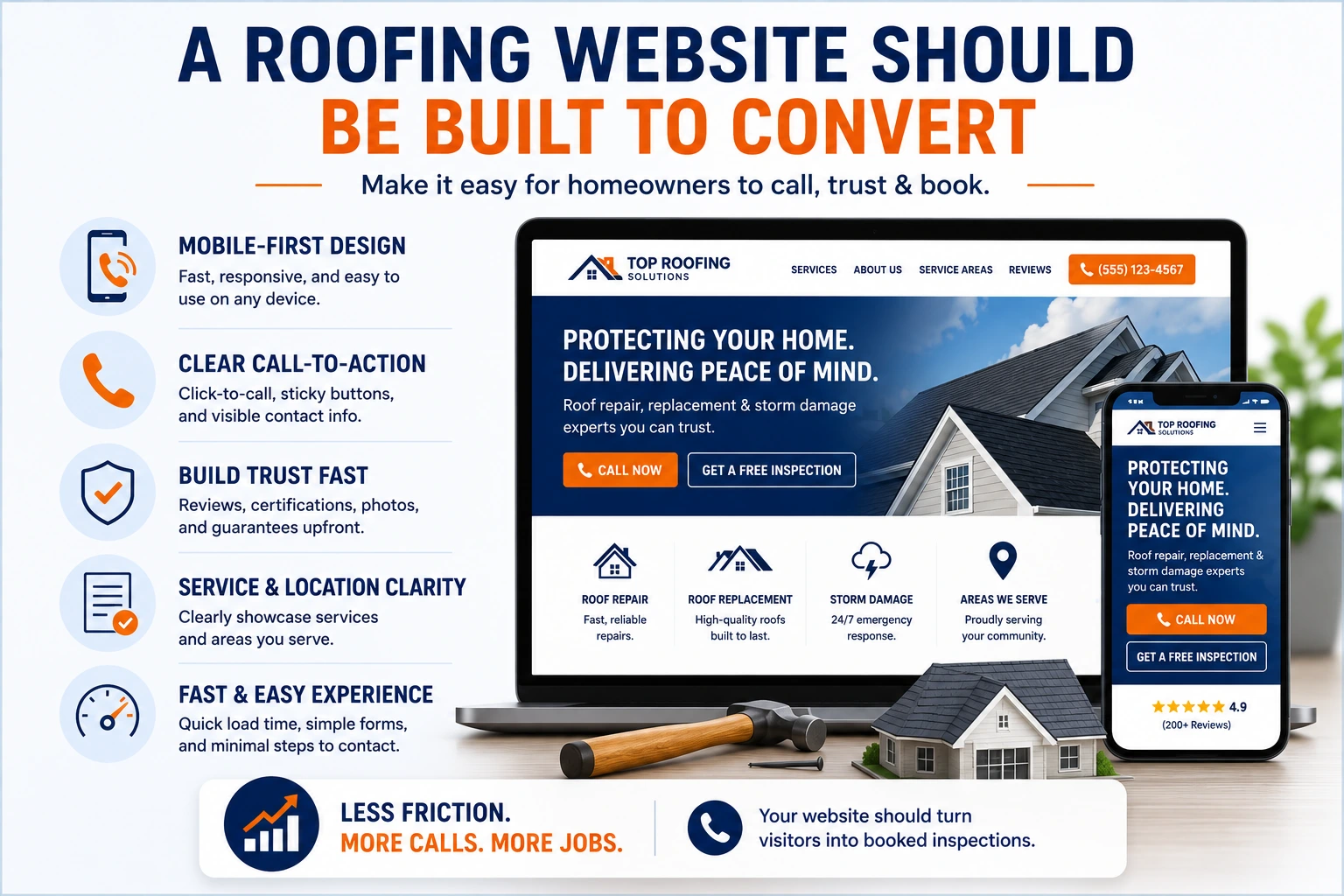
Most roofing websites lose leads not because they look bad, but because they create unnecessary friction. A homeowner dealing with an active leak is not going to hunt for your phone number or wait for a slow page to load.
A high-converting roofing website has clear calls to action on every major page, click-to-call buttons placed prominently for mobile users, short quote forms, trust badges, recent project photos with location context, and service pages that make the next step obvious from the first scroll.
Speed and usability are not separate from SEO — they are part of it. A page that loads slowly or frustrates mobile users loses both the visitor and the ranking signal. This matters more in roofing than most industries: 76% of local searches happen on mobile devices, often during emergencies when a homeowner is standing under a leak with their phone in hand. Web design and organic SEO services need to operate as one system, not two separate projects.
Google Ads Help Roofing Companies Capture Urgent Demand
Organic SEO builds visibility over time, but it does not help with leads that need to be captured today. Google Ads fill that gap — particularly for searches like emergency roof repair, roof leak inspection, storm damage roofing, and roof replacement estimate, where the searcher is often ready to call within minutes.
The most common mistake is sending paid traffic to a generic homepage. Each ad should lead to a focused landing page that matches the specific service, includes local proof points, and makes it easy to call or submit a request.
Speed of follow-up matters just as much as the page itself. Research from Harvard Business Review and MIT found that businesses responding to a new lead within five minutes are 100 times more likely to make contact than those waiting 30 minutes. Pairing a tight landing page with fast follow-up is what turns ad spend into actual revenue. Our performance marketing service is built around that kind of traceable, lead-level accountability.
Reviews and Trust Signals Influence Both Rankings and Conversion
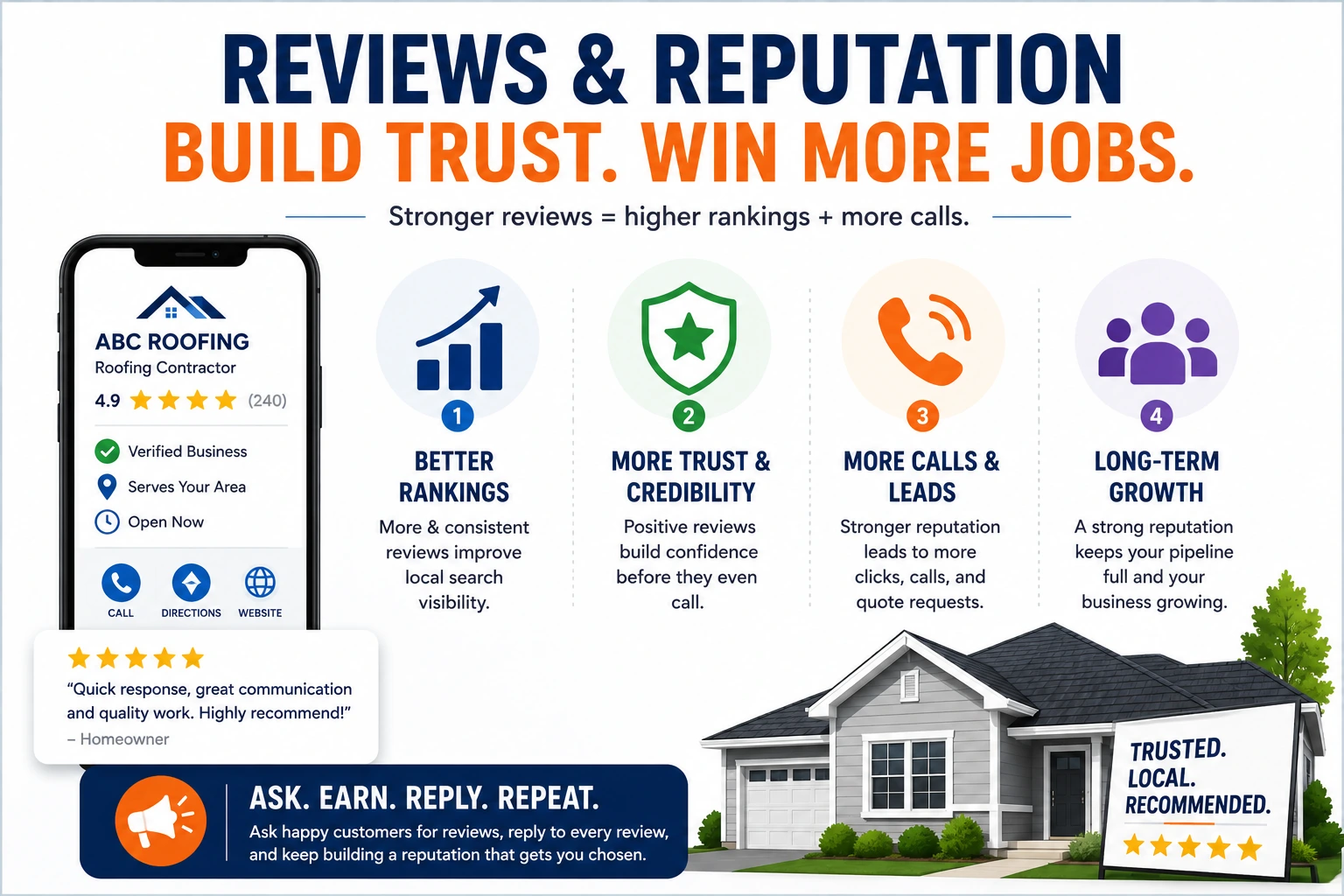
Roofing buyers compare confidence, not just prices. A company with a steady stream of recent, location-specific reviews will consistently outperform one with thin or outdated social proof — even if the latter has a better-designed website.
Reviews work as digital word-of-mouth, and in local services they often shape the shortlist before a prospect has ever visited your site. The BrightLocal Local Consumer Review Survey 2024 found that 88% of consumers are more likely to choose a business that responds to all its reviews. That is not a small edge — it determines whether you make the shortlist at all.
The process does not need to be complicated. Ask at job completion, send a direct link, follow up once, and reply to every review professionally. The impact compounds: SOCi’s analysis of 12.9 billion data points found that a one-star increase in average rating improves conversion-oriented actions on a Google Business Profile by 44%. Done consistently, this builds both ranking strength and conversion rate, because prospects can see that real homeowners in their area had a positive experience.
Content Marketing, Semantic SEO, and AEO Give You an Edge
Most competitor pages cover the same surface-level topics. What differentiates a well-built content strategy is writing for how people actually search — not just which keywords exist, but what questions are sitting behind them.
Homeowners use conversational queries like “how much does a new roof cost in [city],” “how do I know if I need repair or replacement,” or “what should I do after storm damage.” AI-powered search experiences are now pulling direct answers from content structured around those exact questions.
That is the logic behind AEO (Answer Engine Optimization): use question-based headings, short direct answers, location-aware examples, and FAQ sections that are easy for both users and search engines to parse. It strengthens semantic coverage and improves the chances your content gets cited in AI-generated summaries and rich results.
A practical roofing content plan covers topics like repair vs. replacement, signs of storm damage, roofing costs by city, insurance claims for roof damage, commercial maintenance, and material lifespan comparisons. For more on AI-oriented search visibility, the guide on how to rank a website on ChatGPT search is a useful next step.
A Simple Execution Plan for Roofing Companies
The roofing companies that get the most from digital marketing do not run every channel at once. They sequence deliberately.
Phase one: fix the foundation. Page speed, mobile usability, local service pages, and a complete Google Business Profile. Phase two: build trust. Review generation systems, service-area content, project proof, and internal linking that supports the pages you want to rank. Phase three: scale. Launch Google Ads for the highest-intent services, publish FAQ-led content around real buyer questions, and refresh underperforming pages using actual lead data.
This is the same progression we apply across contractor-focused growth work, including our approach to digital marketing for construction companies. The principle is the same regardless of trade: local intent first, trust second, scale third.
Common Mistakes Roofing Companies Should Avoid
- Targeting broad keywords without local or service-specific intent — which brings researchers, not buyers.
- Sending paid traffic to a homepage instead of a tightly matched landing page.
- Neglecting mobile experience, page speed, or click-to-call visibility — especially critical when most leads come from phones.
- Publishing thin blog content that repeats keywords without answering real buyer questions.
- Treating review generation as occasional rather than a repeatable, systematized process.
- Not tracking calls, forms, and lead quality — which makes it impossible to know what is actually working.
Final Thought
Digital marketing for roofing companies works best when it is local, measurable, and built around how a homeowner actually decides to pick up the phone. Rank where intent is high. Answer real questions clearly. Show proof that others in the area have had a good experience. Make it effortless to contact your team.
That is what turns visibility into revenue. Everything else is secondary.
If you are ready to build that kind of presence for your roofing business, PromotEdge Digital can help. From local SEO and Google Ads to conversion-focused web design, we handle the strategy and execution so you can focus on the jobs. Get in touch with our team and let’s talk about what growth looks like for your market.
FAQs About Digital Marketing for Roofing
-
What is digital marketing for roofing companies?
Ans.It is the use of SEO, Google Ads, local search, reviews, content marketing, and website optimization to generate roofing leads online and convert them into calls or estimate requests. -
Does SEO work for roofing companies?
Ans.Yes. SEO works especially well for roofing because most searches are local and high-intent. Strong service pages, city pages, internal linking, and a complete Google Business Profile can meaningfully improve visibility and lead flow over time. -
Are Google Ads worth it for roofing companies?
Ans.Yes, particularly for urgent searches like roof repair, storm damage, and roof replacement estimates. Ads work best when the keyword, landing page, and call tracking are all aligned to the same service intent. -
Why are reviews so important for roofers?
Ans.Reviews build trust fast and support local ranking. According to the 2024 Homeowner Roofing Survey by Roofing Contractor, 54% of homeowners search online to find a roofing contractor — making your digital reputation one of the first things they encounter during that process. -
What is AEO for roofing websites?
Ans.AEO stands for Answer Engine Optimization. It means structuring content with clear questions, direct answers, FAQs, and clean formatting so search engines and AI tools can surface your content more easily.
Author Details

Latest Posts
-
 22 / Sep
Digital Marketing Digital Marketing for Ecommerce Brands: The 2027 Growth Playbook
22 / Sep
Digital Marketing Digital Marketing for Ecommerce Brands: The 2027 Growth Playbook -
 15 / Sep
-
04 / Sep
-
 29 / Jul
Search Engine Optimization 6 Enterprise SEO Mistakes That Quietly Cost You Millions
29 / Jul
Search Engine Optimization 6 Enterprise SEO Mistakes That Quietly Cost You Millions -
 24 / Jul

Blogs
Journey into Ideas Unveiling Tomorrow's Insights Today.












-
What is digital marketing for roofing companies?
Ans.It is the use of SEO, Google Ads, local search, reviews, content marketing, and website optimization to generate roofing leads online and convert them into calls or estimate requests. -
Does SEO work for roofing companies?
Ans.Yes. SEO works especially well for roofing because most searches are local and high-intent. Strong service pages, city pages, internal linking, and a complete Google Business Profile can meaningfully improve visibility and lead flow over time. -
Are Google Ads worth it for roofing companies?
Ans.Yes, particularly for urgent searches like roof repair, storm damage, and roof replacement estimates. Ads work best when the keyword, landing page, and call tracking are all aligned to the same service intent. -
Why are reviews so important for roofers?
Ans.Reviews build trust fast and support local ranking. According to the 2024 Homeowner Roofing Survey by Roofing Contractor, 54% of homeowners search online to find a roofing contractor — making your digital reputation one of the first things they encounter during that process. -
What is AEO for roofing websites?
Ans.AEO stands for Answer Engine Optimization. It means structuring content with clear questions, direct answers, FAQs, and clean formatting so search engines and AI tools can surface your content more easily.