


Digital Marketing for Dentists: 9 Strategies That Fill the Schedule (2026)
-
Updated Date
Sep-21-2026
-
Views
2 Min Read
-
Author: PromotEdge Digital
-
Updated Date: Sep-21-2026
-
Views: 2 Min Read
-
Author: Milan Shyamal
Digital marketing for dentists works only when the pieces connect: a site that ranks, a profile people find, and a phone someone answers. Plenty of practices have all three and still sit with open chairs.
The ADA Health Policy Institute reported in Q2 2026 that 24% of dentists said they were “not busy enough, could have treated more patients,” while the average new-patient wait rose to 13.9 days.
So capacity and demand exist in the same market, and most of the connection runs through search. Google’s local ranking documentation says local results are ranked on relevance, distance and prominence.
Nine strategies cover the path from search to retention, with organic and technical SEO underneath all of it. Let’s start with the foundation first: a local SEO checklist covers the groundwork before anything else earns budget.
What Is Digital Marketing for Dentists?
Digital marketing for dentists is the coordinated use of search, local listings, paid ads, website design, reviews, content, video and patient communication to bring people in and keep them.
These are not ten separate projects. SEO produces traffic the website has to convert. Ads send clicks a landing page has to catch. Reviews decide whether a searcher who sees you in the map pack actually calls.
ADA HPI research puts average gross billings for general practitioners at $965,660, with 72.5% of U.S. dentists working as practice owners in 2023 and 16% affiliated with a DSO in 2024. Independent owners compete against groups with in-house marketing teams.
How Digital Marketing Turns Searches Into Dental Appointments
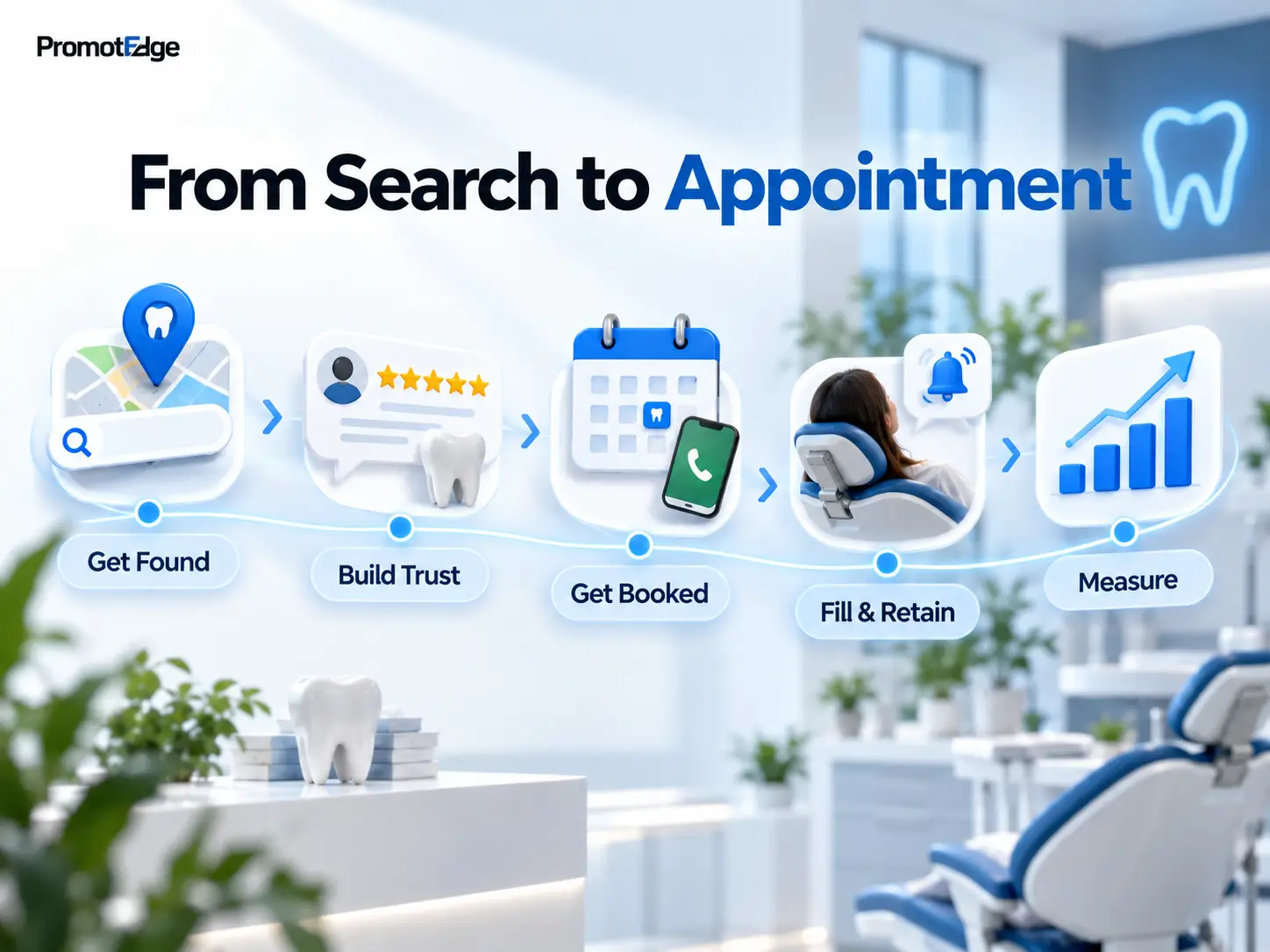
Every booked patient passes through five stages.
Get Found. Someone searches for “dentist near me,” “emergency dentist,” or “Invisalign cost.” SEO, Google Business Profile and Ads decide whether you appear.
Build Trust. The searcher shortlists two or three practices. Star ratings, review recency, website clarity and dentist credentials decide who survives.
Get Booked. Trust converts through mechanics: a tappable phone number, a short form, booking that syncs to the schedule. Most high-value inquiries still arrive by phone.
Fill & Retain. Overdue hygiene patients, unscheduled treatment plans and same-week cancellations are demands you already own.
Measure. Traffic describes activity. Booked appointments, show rate, cost per booked patient and treatment acceptance describe the business.
9 Digital Marketing Strategies for Dentists
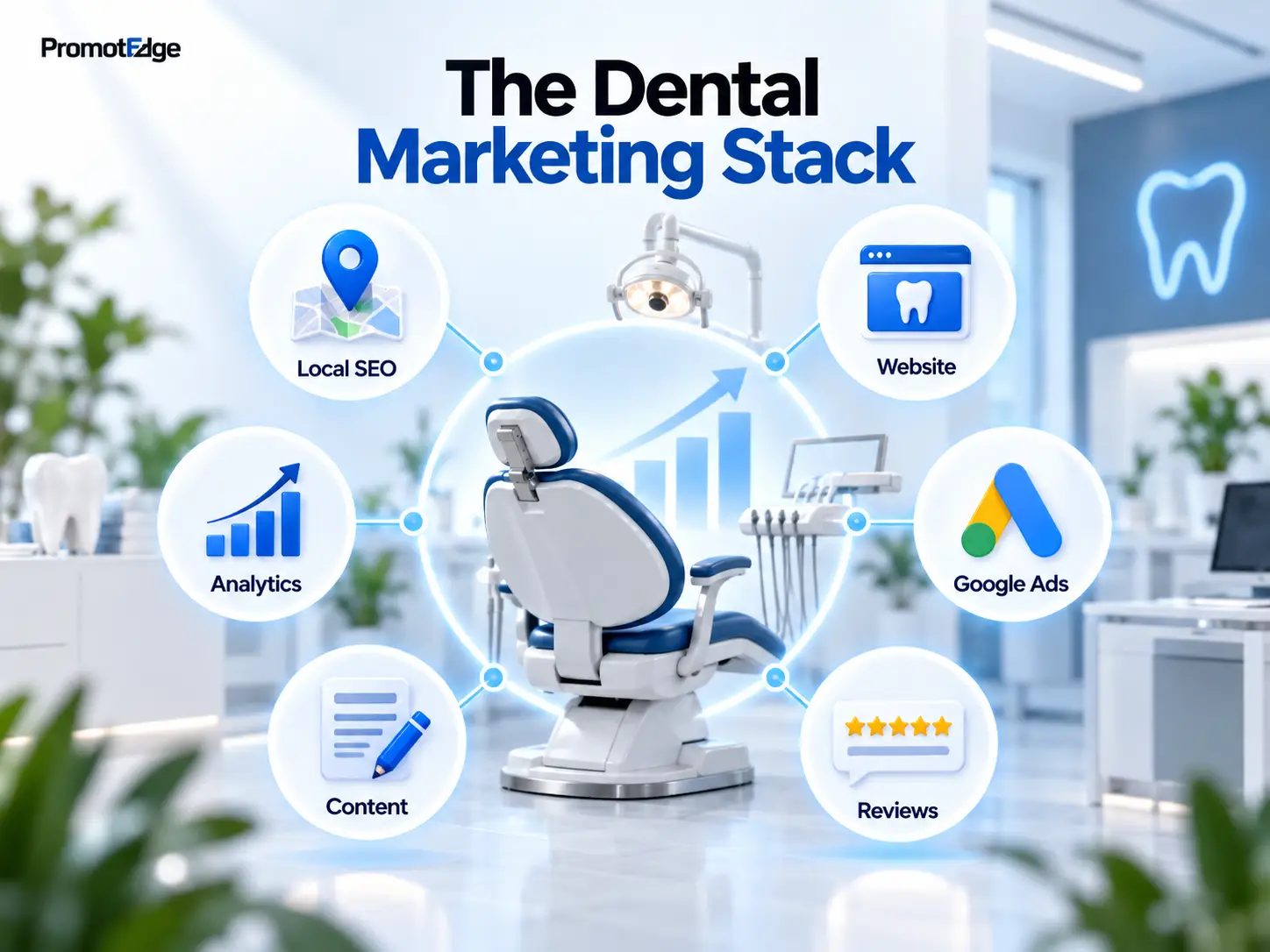
1. Optimize Your Google Business Profile and Local SEO
Google Business Profile is the highest-return asset in dental marketing: the map pack exists above organic results for “dentist near me” and “emergency dentist [city].” Google’s documentation also states that “more reviews and positive ratings can help your business’s local ranking.”
Distance is fixed by your address. Relevance and prominence are what you control.
Relevance comes from categories and services. Set the primary category to the practice’s main identity, Dentist or Cosmetic Dentist or Oral Surgeon, and add secondary ones only for services delivered in-house.
Then populate the services list item by item: implants, Invisalign, root canals, whitening, emergency care, dentures, veneers.
Prominence comes from reviews, citations and consistency. Name, address and phone (NAP) details must match exactly across the website, insurance directories, Healthgrades, Yelp, Apple Maps and Bing Places.
GBP checklist:
- Primary category set precisely; secondary ones only for in-house services
- Full service list, each treatment with a short description
- Exact NAP, matching the website footer character for character
- Accurate hours, holiday hours and after-hours emergency instructions
- Appointment URL pointing to booking, not the homepage
- Real photos: exterior, signage, reception, operatories, team
- Posts for seasonal availability, new services or new associates
- Q&A seeded with real patient questions
- Responses on positive and negative reviews
Multi-location groups need a profile per location. Running two through one splits relevance and wastes both.
2. Build Dental SEO Around Services, Locations and Search Intent
Dental SEO works when each page targets one intent. Three dominate:
- Local intent: “dentist near me,” “dentist in Frisco TX.” Homepage and location pages.
- Treatment intent: “dental implants in Dallas,” “Invisalign cost Austin.” Service pages.
- Informational intent: “how long do dental implants last,” “is a root canal painful.” Blog and FAQ content.
Structure follows: homepage, location pages, service pages, supporting content. Each location page carries that office’s address, hours, team, insurance and map.
Each service page targets one treatment. “Dental implants” and “All-on-4 implants” are separate pages. “Dental implants” and “tooth implants” are one page.
Write the keyword map down first: one primary keyword per page, and no two pages on the same primary term. Cannibalization, three pages competing for “dental implants Dallas,” is the most common self-inflicted problem here, and disciplined keyword research prevents it.
Choose keywords by treatment value, not volume. A practice selling $6,000 implant cases should take 90 monthly searches for “dental implants [city]” over 2,400 for “teeth cleaning.” One converted case outweighs a month of hygiene clicks.
A hygiene-driven family practice inverts that and chases “dentist near me” and insurance queries, because volume and recall revenue are the model.
Internal linking ties it together. Posts link up to the service page, service pages link to their location, and the location page links to every service offered there.
Google’s Core Web Vitals documentation measures real-world loading, interactivity and visual stability and “aligns with what our core ranking systems seek to reward.”
3. Turn Your Dental Website Into a Patient-Conversion Machine
A dental website converts when a first-time visitor can answer four questions in ten seconds: what you do, where you are, whether you are trustworthy, how to book.
Above the fold: the value proposition, a tappable phone number, the city, one call to action, and trust signals like star rating and insurances accepted.
Pew Research Center reported in June 2025 that 91% of U.S. adults own a smartphone. The mobile layout is the real layout.
Service pages need more than a treatment description. Each should carry what the treatment is, who is a candidate, what a visit involves, the dentist’s credentials, financing, testimonials and FAQs.
Patients ask three things before treatment: what will it cost, will it hurt, how long will it take. Pages answering all three convert better than pages describing clinical technique.
Offer three paths, Call | Book Online | Request Appointment, and keep the form to name, phone, preferred time and reason for visit. Every extra field costs completions.
Page speed is conversion infrastructure, not a vanity metric. Uncompressed operatory photos and bloated theme builders are the usual culprits, and site speed optimization usually pays back faster than a redesign.
When a rebuild is genuinely warranted, treat website design and development as a conversion project.
4. Use Google Ads to Capture High-Intent Dental Searches
Google Ads buys immediate placement for the queries closest to an appointment: emergency dentist, dental implants, Invisalign, root canal, wisdom tooth extraction.
Structure campaigns by service. Keep recall demand (“dentist near me”) separate from high-ticket considered treatment (“dental implants”). They have different costs per click, conversion windows and acceptable acquisition costs. Blending them hides both.
Set targeting to a realistic drive radius, typically 5 to 15 miles in a metro, with presence targeting so you pay for people in the area.
Negative keywords every dental account needs on day one: jobs, careers, salary, hiring, school, assistant program, hygienist course, free, cheap, DIY, at home, insurance only, Medicaid unless accepted.
Every campaign needs a landing page matching the ad’s promise, and scheduling limited to staffed hours. Sending implant traffic to the homepage wastes the click, and an unanswered ad call is pure waste.
Google Ads Help describes Quality Score as a 1–10 diagnostic built from expected click-through rate, ad relevance and landing page experience, noting it is “not used at auction time to determine Ad Rank.” Treat it as a read on message match, not a lever.
Rankings built in month four still deliver in month twenty at no extra click cost. Paid search stops when the budget stops, so the SEO versus PPC trade-off is a question of timeline.
Running paid search as performance marketing, measured to booked patients rather than clicks, separates a profitable account from an expensive one. No platform can guarantee a position or a patient volume.
5. Build a Review and Online Reputation Engine
Reviews influence local visibility and the shortlist decision, and Google states that more reviews and positive ratings can help local ranking. They do not guarantee it.
A review engine is a cadence, not a campaign. Ask at the moment of relief: a completed crown, a finished ortho case, a resolved emergency. Send by SMS or email within 24 hours with a direct link. One reminder, then stop.
Google’s contributed-content policy prohibits reviews “not based on a real experience,” reviews “paid for, directly or in kind,” and incentives offered in exchange for reviews.
It also says merchants may not “discourage or prohibit negative reviews, or selectively solicit positive reviews from customers.” Review gating, surveying first and routing only happy patients to Google, violates this.
The FTC’s 2024 final rule banning fake reviews and testimonials goes further, banning AI-generated reviews, reviews from nonexistent reviewers, compensation conditioned on sentiment, undisclosed insider reviews, and suppression of reviews through “unfounded or groundless legal threats.”
Responding to a negative review carries a HIPAA risk unique to healthcare. You cannot confirm the reviewer is a patient, reference their treatment, dispute their account or mention visit dates.
A compliant response acknowledges the concern generally, states the service standard, and gives an offline contact. Three complaints about wait times in a quarter is an operations finding, not a marketing one.
6. Create Content Around Real Patient Questions
Publishing frequency is not a strategy. Content works when it answers what a patient types before booking, then links that answer to the page selling the treatment.
Build clusters around one high-value treatment. An implants cluster covers candidacy, cost, pain, longevity, implants versus bridges, bone grafting and financing.
Each post answers one question and links up to the service page. That is the mechanism: the posts capture searchers months early and pass relevance to the page that needs to rank.
Google’s helpful content guidance states that among experience, expertise, authoritativeness and trust, “trust is most important. The others contribute to trust, but content doesn’t necessarily have to demonstrate all of them.”
For dental content, which is YMYL health information, that means named authorship by the treating dentist, stated credentials, review dates and honest cost ranges. A page saying when a bridge beats an implant earns more consultations than one listing benefits.
7. Use Social Media and Video to Build Trust
Social media for a dental practice is not a follower-count exercise. It is pre-visit reassurance for people who already found you and are deciding whether to call.
Five content types cover it:
- People: team introductions, the hygienist a patient will actually meet
- Education: 60-second treatment explanations, such as what a root canal involves
- Proof: review highlights and patient stories, with written consent on file
- Experience: office tours, sedation and anxiety-management explainers
- Community: school visits, sponsorships, local events
Repurpose rather than produce more. One three-minute explainer becomes a Reel, a YouTube Short, video on the service page and a written FAQ. Four assets, one session.
Coordinated social media optimisation keeps profile information consistent with the GBP and website, which matters for local relevance and for AI systems reading the practice.
Patient photos, before-and-afters and testimonials require signed HIPAA authorization naming the platforms and duration of use. Verbal permission in the chair is not authorization.
8. Reactivate Existing Patients and Fill Schedule Gaps
Not every empty appointment needs a new lead. Most practices sit on more recoverable revenue in their practice-management system than the ad budget will produce this quarter.
Five lists, in order of value:
- Unscheduled treatment plans: diagnosed, quoted, never booked. The highest-value list, because clinical need is documented and trust exists.
- Overdue hygiene: patients past their recall interval by 3, 6 or 12 months.
- Broken and no-show appointments: never rescheduled, often forgotten rather than refused.
- Dormant patients: no visit in 18 to 36 months, still in the area.
- Same-week openings: a short-notice list texted when cancellations open a chair.
If paid search runs $150 to $400 per booked patient in a competitive metro, a recall text costs cents and converts far higher, because that patient already has a chart and a diagnosed need.
Against average gross billings near $965,660, recovering a fraction of unscheduled treatment moves the number more than a new campaign does.
HHS guidance on HIPAA and marketing defines marketing as “a communication about a product or service that encourages recipients of the communication to purchase or use the product or service.”
That carries exceptions, including communications made for treatment of the individual and for case management or care coordination. A recall reminder sits differently from a whitening blast to the full list.
Keep consent documented, honor opt-outs immediately, and confirm your approach with healthcare counsel, not a vendor.
9. Measure Marketing by Booked Patients, Not Clicks
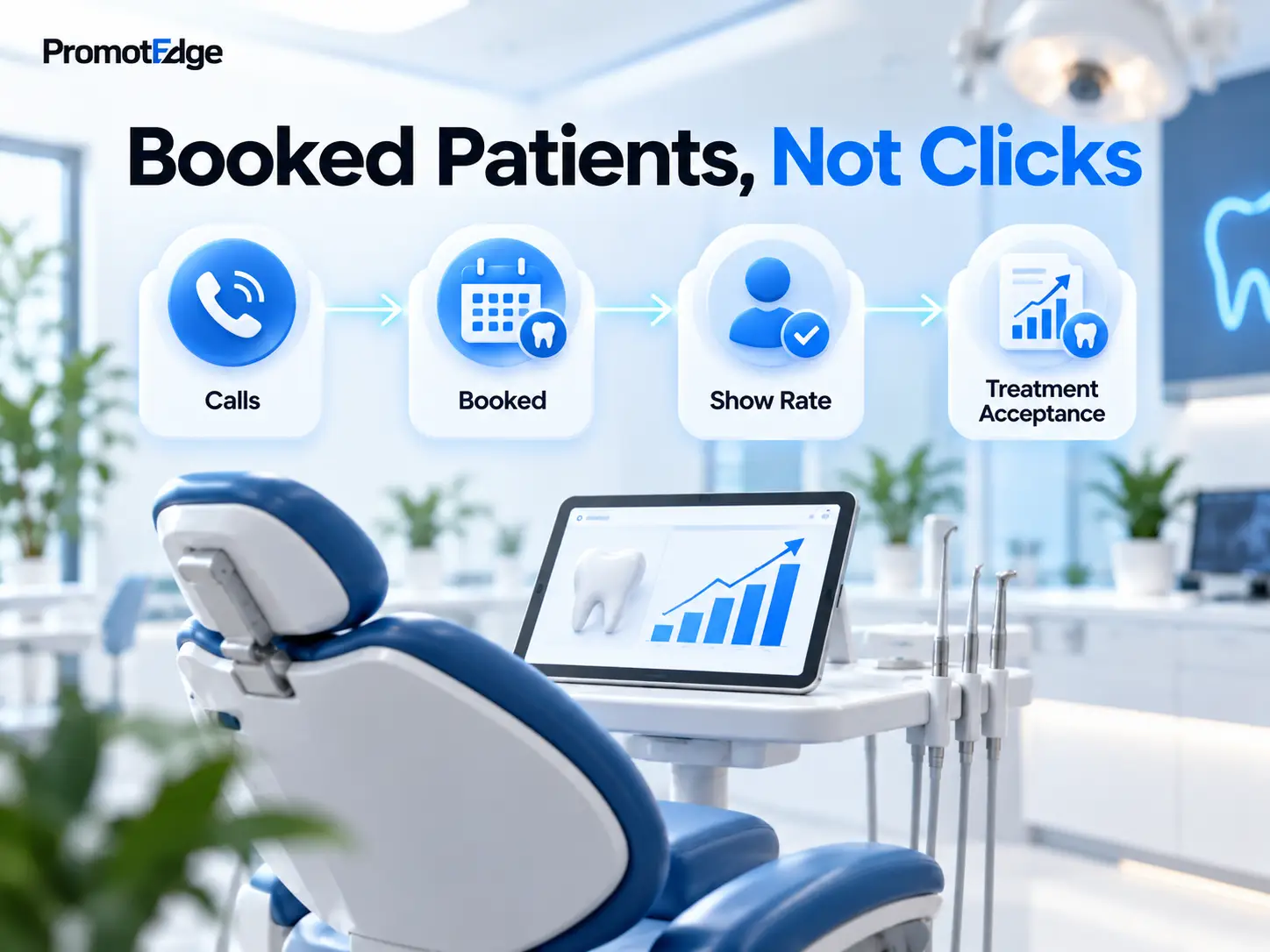
Most dental reporting stops at traffic and cost per lead. Two steps short of what matters.
| Metric | What It Tells You |
|---|---|
| Website traffic | Visibility |
| Leads | Demand |
| Calls | High-intent interest |
| Appointment requests | Conversion |
| Booked appointments | Acquisition |
| Show rate | Lead and operational quality |
| New patients | Growth |
| Cost per booked patient | Efficiency |
| Treatment acceptance | Business impact |
Two chains carry almost all dental revenue: SEO to website to call to appointment, and Ads to landing page to lead to appointment. Instrument both end to end, or you optimize toward cheaper clicks, not better patients.
Call tracking is non-negotiable here, because the highest-value inquiries, implants, emergencies and full-arch cases, arrive by phone.
Dynamic number insertion swaps the displayed number by traffic source, so an implant call is attributed to the campaign, page or GBP listing that produced it. Keep the NAP number fixed on the listing, and apply DNI to website sessions.
Then import booked appointments from the practice-management system into Google Ads, so bidding optimizes toward patients, not form fills.
Three outcomes differ. Booked means an appointment exists, Kept means the patient showed, Accepted means treatment was agreed.
A campaign with a low cost per booked patient and a 55% show rate is worse than one costing more that holds 85%.
The stack is GA4, Search Console, Google Ads, a call tracking platform, and the practice-management system for the booked and kept truth. No tool attributes perfectly, and any honest approach to measuring marketing ROI treats it as directional.
How AI Is Changing Digital Marketing for Dentists in 2026
AI Overviews, Google’s AI Mode, and assistants like ChatGPT and Perplexity answer many dental questions directly. That cuts clicks on informational queries and raises the value of being the source they cite.
Google Search Central states plainly that “there are no additional requirements to appear in AI Overviews or AI Mode, nor other special optimizations necessary,” and that no AI text files or special markup are needed.
What helps: identical business information on the website, GBP, directories and social profiles, so AI systems resolve the practice as one entity. Service pages stating what a treatment is, who it suits and what it costs.
Google’s LocalBusiness structured data documentation covers business hours, departments and reviews, and the Dentist type sits within that schema family.
No sequence of steps causes ChatGPT to recommend a practice. The defensible position is content that would earn a citation on merit, the approach behind optimising content for AI Overviews and ranking in ChatGPT search.
Which Digital Marketing Strategy Should a Dental Practice Prioritize?
| Practice Goal | Relevant Strategies |
|---|---|
| Improve local visibility | Google Business Profile + local SEO |
| Generate high-intent inquiries | Google Ads + SEO |
| Promote dental implants | Service-page SEO + PPC |
| Increase website bookings | Website CRO + landing pages |
| Build trust | Reviews + website + video |
| Fill schedule gaps | Patient reactivation |
| Increase retention | Email/SMS + follow-up |
| Understand ROI | Conversion and call tracking |
| Improve AI visibility | Clear, structured, consistent content |
There is no universal best strategy. Priorities depend on location, competition, chair capacity, treatment mix and existing visibility.
A practice with two open hygiene days and 4,000 inactive charts should start with reactivation, not ads. A new practice with no reviews needs paid search and GBP while SEO builds. One ranking well but converting poorly should fix the website first.
Diagnose the weakest stage, then fund it.
90-Day Digital Marketing Plan for Dentists
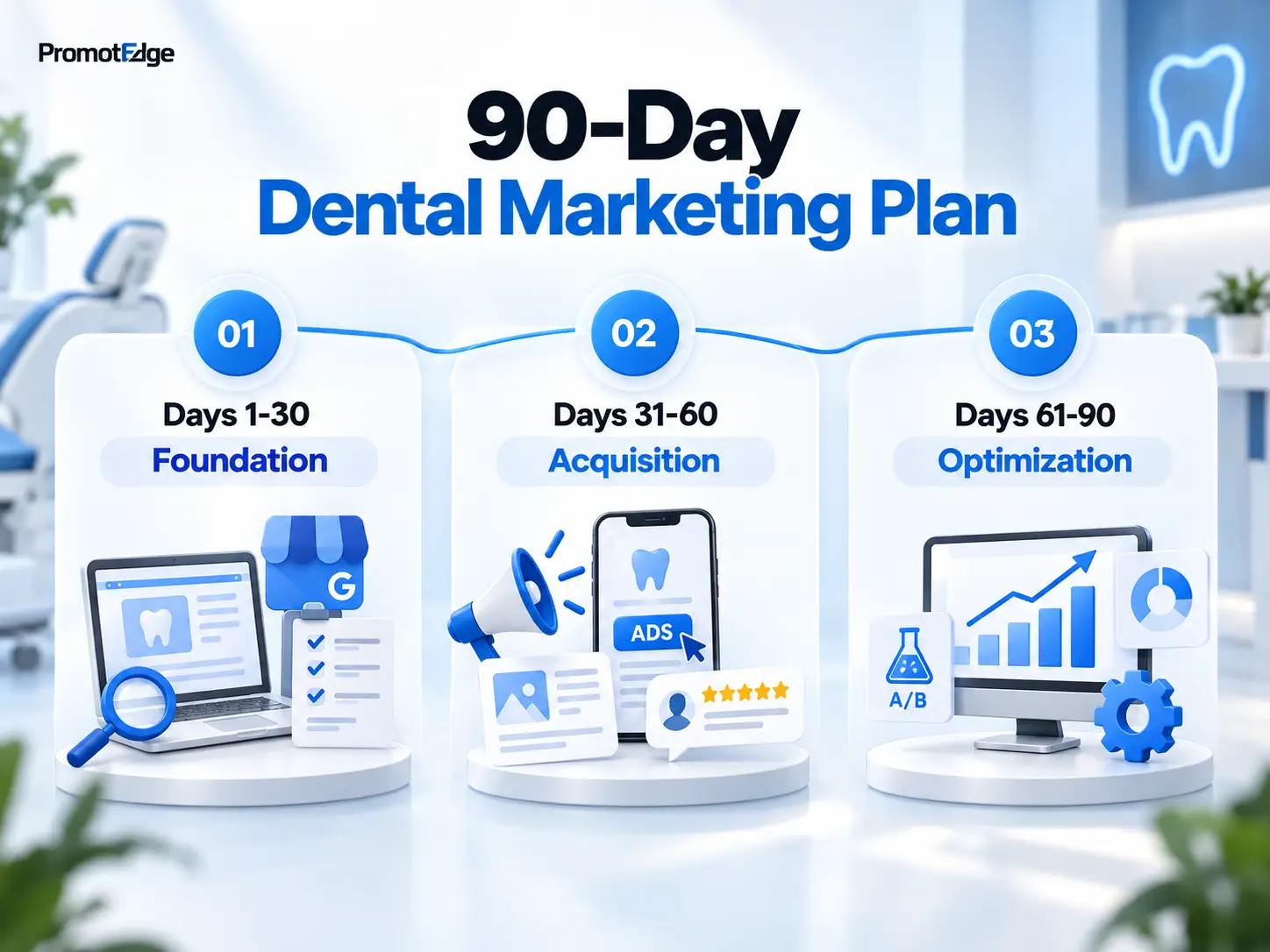
Days 1–30: Foundation. Audit the website for mobile usability, page speed, broken forms and missing service pages. Fully optimize the Google Business Profile: categories, services, hours, photos, appointment URL.
Fix indexing errors, duplicate title tags and cannibalization. Set up GA4 events, Ads conversions, call tracking and a review response protocol.
Days 31–60: Acquisition. Rewrite the three service pages tied to your highest-value treatments, adding cost ranges, candidacy criteria, FAQs, credentials and financing.
Launch or restructure Google Ads with service-specific campaigns, a negative keyword list, dedicated landing pages and staffed-hours scheduling.
Publish the first four posts in your priority cluster and improve CTAs sitewide. Start the review workflow: one message within 24 hours, one reminder, no gating.
Days 61–90: Optimization. Pull booked-patient data by source, not lead data, and move the budget towards expected bookings. Test landing page headlines, form length and CTA placement.
Expand what produced appointments, then run reactivation in sequence: unscheduled treatment plans, overdue hygiene, broken appointments.
Final Takeaway
Digital marketing for dental practices works as a sequence. Get Found through Google Business Profile, local SEO and paid search. Build Trust through reviews, a clear website and honest content.
Get Booked through answered calls, short forms and matched landing pages. Fill & Retain through reactivation. Measure by booked, kept and accepted appointments rather than clicks.
Find the weakest stage, fund that one first, and re-measure.
PromotEdge Digital works with practice owners on exactly this sequence, from local visibility through appointment-level measurement.
Request a Digital Marketing Consultation
FAQs About Digital Marketing for Dentists
-
What is digital marketing for dentists?
Ans.Digital marketing for dentists is the use of search engines, local listings, paid ads, websites, reviews, content and patient communication to attract and retain patients, run as one system rather than ten projects. -
How can digital marketing help dentists get more patients?
Ans.It makes you visible when someone searches for care and removes friction from booking. The ADA Health Policy Institute reported in Q2 2026 that 24% of dentists were not busy enough and could have treated more patients. -
How much does dental digital marketing cost?
Ans.Costs vary by competition, treatment mix and whether the work is in-house or agency-run, so any figure quoted without knowing your market is guesswork. Judge it on cost per booked patient. -
How long does dental SEO take to work?
Ans.Dental SEO typically shows early movement in three to six months and competitive rankings over six to twelve, depending on domain age, content and technical condition. Profile changes show faster. -
Is Google Ads worth it for dentists?
Ans.Google Ads is worth it when searches like emergency dentist and dental implants are out of organic reach short term, and when calls get answered during ad hours. -
How can a dentist get more patients from Google?
Ans.Optimize the Profile with accurate categories, a complete service list, consistent NAP and steady reviews, then add service and location pages matching search intent. -
How important are reviews for dental practices?
Ans.Reviews matter as a ranking input and as the deciding factor when a patient compares two nearby options. But they cannot be bought, incentivized or gated: Google's policies and the FTC's 2024 fake review rule prohibit all three. -
Should dentists invest in SEO or Google Ads?
Ans.Ads when you need patients this month, SEO when you need sustainable acquisition cost over years. A new practice usually needs paid search for two quarters. An established one gets more from conversion and reactivation. -
How can dentists improve their visibility in AI search?
Ans.Keep business information identical across the website, Profile and directories, and publish accurate credentials. Google Search Central states there are no additional requirements or special optimizations necessary to appear in AI Overviews or AI Mode. -
How do you measure dental marketing ROI?
Ans.Track the chain from click to booked, kept and treatment-accepted appointment, not traffic or leads. That needs call tracking with dynamic number insertion, conversion tracking in GA4 and Ads, and reconciliation against practice-management data.
Author Details

Latest Posts
-
04 / Sep
-
 29 / Jul
Search Engine Optimization 6 Enterprise SEO Mistakes That Quietly Cost You Millions
29 / Jul
Search Engine Optimization 6 Enterprise SEO Mistakes That Quietly Cost You Millions -
 24 / Jul
-
 23 / Jul
Search Engine Optimization How to Improve Organic SEO: A Practical 2026 Guide
23 / Jul
Search Engine Optimization How to Improve Organic SEO: A Practical 2026 Guide -
21 / Jul
Search Engine Optimization Organic SEO vs Paid SEO: Which Is Better in 2026?
Blogs
Journey into Ideas Unveiling Tomorrow's Insights Today.













-
What is digital marketing for dentists?
Ans.Digital marketing for dentists is the use of search engines, local listings, paid ads, websites, reviews, content and patient communication to attract and retain patients, run as one system rather than ten projects. -
How can digital marketing help dentists get more patients?
Ans.It makes you visible when someone searches for care and removes friction from booking. The ADA Health Policy Institute reported in Q2 2026 that 24% of dentists were not busy enough and could have treated more patients. -
How much does dental digital marketing cost?
Ans.Costs vary by competition, treatment mix and whether the work is in-house or agency-run, so any figure quoted without knowing your market is guesswork. Judge it on cost per booked patient. -
How long does dental SEO take to work?
Ans.Dental SEO typically shows early movement in three to six months and competitive rankings over six to twelve, depending on domain age, content and technical condition. Profile changes show faster. -
Is Google Ads worth it for dentists?
Ans.Google Ads is worth it when searches like emergency dentist and dental implants are out of organic reach short term, and when calls get answered during ad hours. -
How can a dentist get more patients from Google?
Ans.Optimize the Profile with accurate categories, a complete service list, consistent NAP and steady reviews, then add service and location pages matching search intent. -
How important are reviews for dental practices?
Ans.Reviews matter as a ranking input and as the deciding factor when a patient compares two nearby options. But they cannot be bought, incentivized or gated: Google's policies and the FTC's 2024 fake review rule prohibit all three. -
Should dentists invest in SEO or Google Ads?
Ans.Ads when you need patients this month, SEO when you need sustainable acquisition cost over years. A new practice usually needs paid search for two quarters. An established one gets more from conversion and reactivation. -
How can dentists improve their visibility in AI search?
Ans.Keep business information identical across the website, Profile and directories, and publish accurate credentials. Google Search Central states there are no additional requirements or special optimizations necessary to appear in AI Overviews or AI Mode. -
How do you measure dental marketing ROI?
Ans.Track the chain from click to booked, kept and treatment-accepted appointment, not traffic or leads. That needs call tracking with dynamic number insertion, conversion tracking in GA4 and Ads, and reconciliation against practice-management data.