


How to Measure Digital Marketing ROI Beyond Vanity Metrics

-
Updated Date
Jul-17-2026
-
Views
2 Min Read
-
Author: PromotEdge Digital
-
Updated Date: Jul-17-2026
-
Views: 2 Min Read
-
Author: Milan Shyamal
Most marketers track clicks, impressions, and follower counts — but leadership always asks a different question: Is our marketing actually making money? That is what digital marketing ROI answers.
That’s exactly how to measure digital marketing ROI — by understanding the profit your marketing generates, not just the activity it produces.
This guide covers everything involved in measuring digital marketing ROI — the formula, full cost accounting, attribution models, channel-level frameworks, and the tools that keep tracking ongoing. B2B SEO campaigns, paid media, email, content — whichever channel you are running, there is a framework here you can put to work straight away.
What Is Digital Marketing ROI?
Digital marketing ROI is simply the profit your marketing generates measured against what it cost to run — written out as a percentage.. It tells you whether your campaigns are generating more value than they consume.
It’s easy to mix this up with ROAS, which only looks at how much revenue your ads bring in compared to what you spend on them. ROI is broader. It includes all the real costs—your team, tools, creative, agency fees—so you get a more honest sense of what your marketing is actually doing for you.
Understanding ROI is the foundation of any sound full-service digital marketing strategy. Without it, budget decisions are based on activity rather than results.
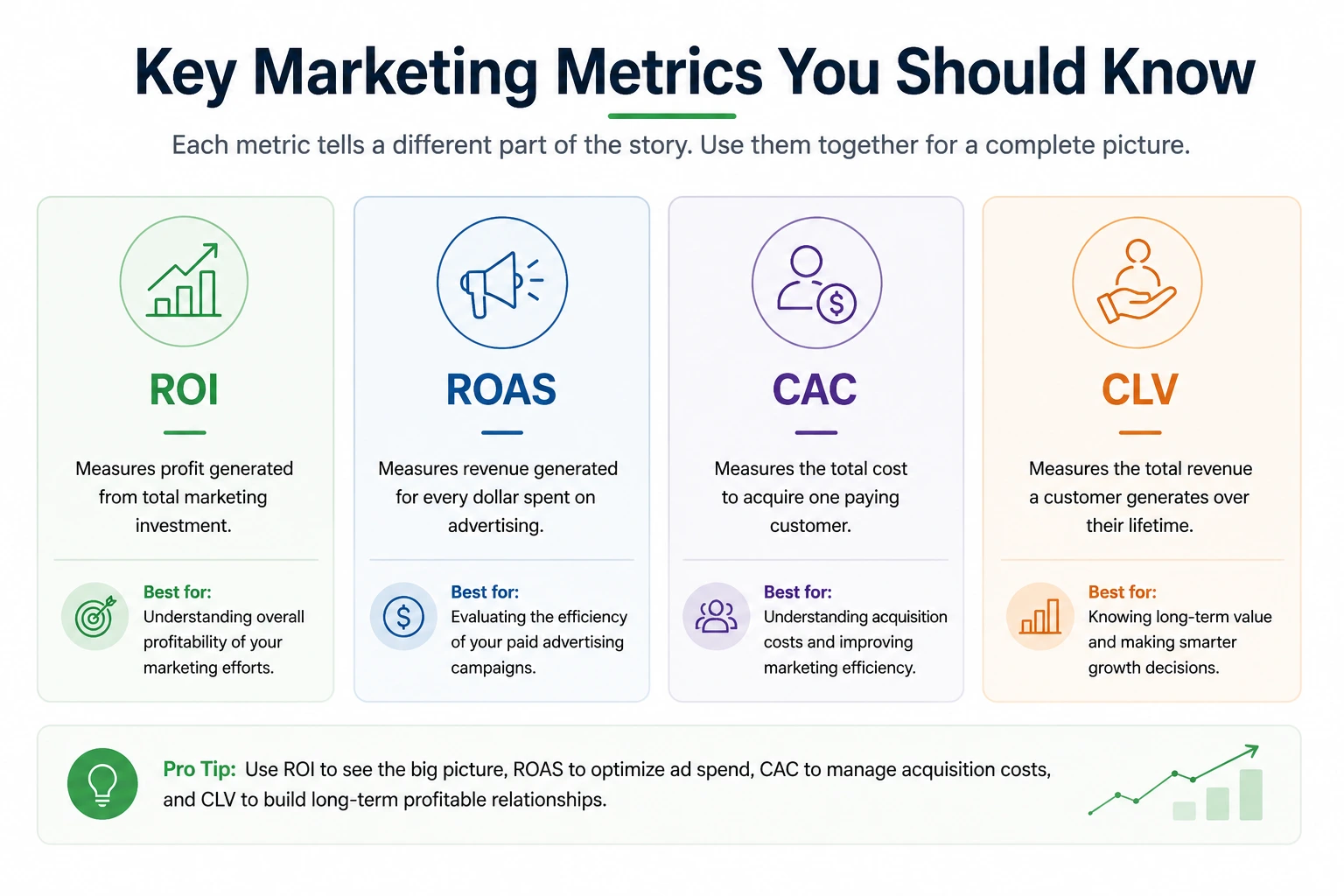
| Metric | What It Measures |
| ROI | Profit vs. total marketing investment |
| ROAS | Revenue vs. ad spend only |
| CAC (Customer Acquisition Cost) | How much you spent to get one customer. Total spend, divided by how many people actually signed up or bought. |
| CLV (Customer Lifetime Value) | What one customer is worth over time. Not just the first payment—everything they spend with you. |
| Payback Period | How long it takes to recover what you spent. When the money starts coming back. |
What Is the Formula for Marketing ROI?
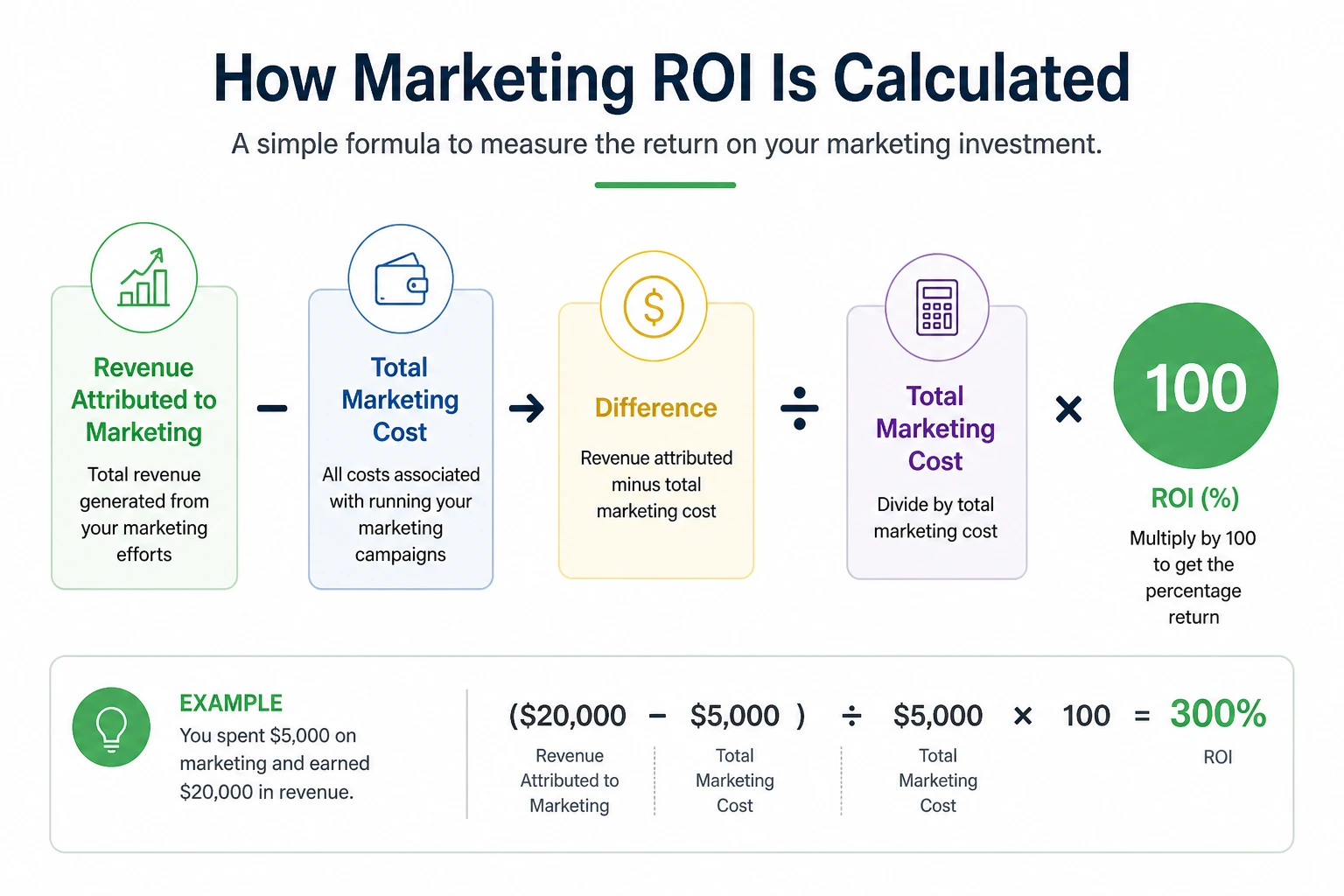
| The Standard Marketing ROI Formula |
| ROI (%) = ((Revenue Attributed to Marketing − Total Marketing Cost) ÷ Total Marketing Cost) × 100 |
| Adjusted for Organic Growth (recommended for SEO & content): |
| ROI (%) = ((Revenue − Organic Baseline − Marketing Cost) ÷ Marketing Cost) × 100 |
| Use the adjusted formula when some revenue would have occurred without any campaign effort. |
Not all revenue in a campaign window came from that campaign. Some of it was coming regardless — organic search, repeat visitors, referrals. The adjusted ROI formula removes that baseline so what you are left with is only what the campaign actually moved. For content and SEO especially, skipping this step overstates results significantly. (Source: Investopedia).
How to Measure Marketing ROI (Step by Step)
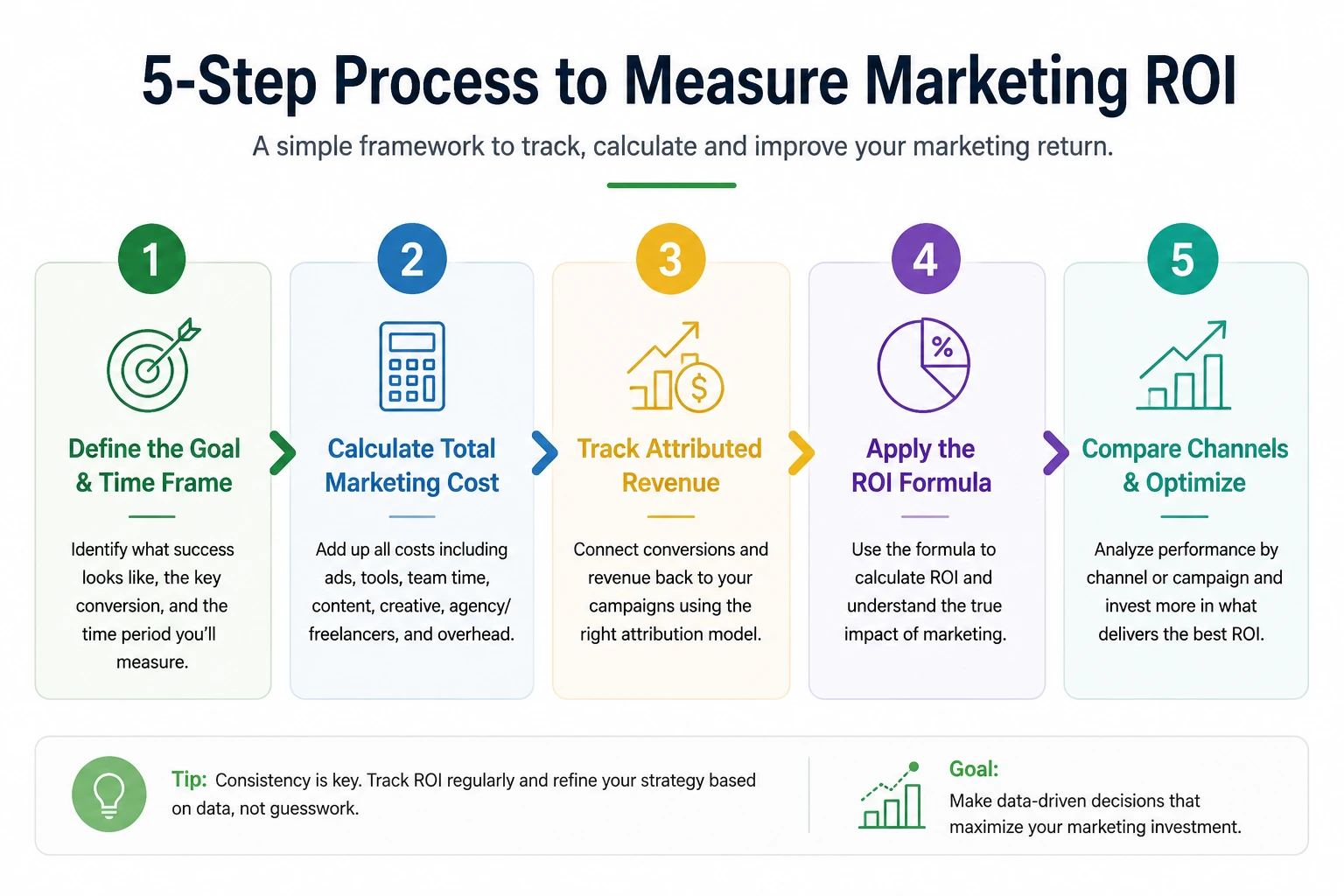
Don’t start with the numbers right away. Get the basics clear first, then get going from there.
Step 1 — Define the goal and the time frame
Start with one simple thing—what are you even measuring? Leads? Revenue? Traffic? Pick one. Otherwise, you’ll end up looking at numbers that don’t really answer anything. If you don’t lock this in, the numbers won’t really mean much.
Also decide the time frame-30, 60, 90 days… whatever matches your sales cycle.
Then pick one main conversion to track. That could be a purchase, a form fill, a demo request, or even a closed deal.
And make sure you’re clear on what you’re including. Which channels? Which campaigns? Don’t mix everything together.
This matters even more if you’re working with organic B2B SEO or anything that takes time to show results. You won’t see the full picture overnight.
Step 2 — Calculate Total Marketing Cost (Don’t Skip This)
This is where most guides fall short. A complete cost calculation includes more than ad spend. Leaving out any category produces a falsely optimistic ROI figure.
- Ad spend – Google Ads, Meta, LinkedIn… programmatic too
- Agency / freelancer – retainers, project work
- Tools – CRM, automation, analytics, attribution
- Team time: strategy, creative, reporting
- Creative: copy, video, design, landing pages
- Overhead: operational costs directly tied to the campaign
For businesses investing in digital marketing strategies for small businesses, full cost accounting makes the difference between knowing which channels are profitable and which are draining the budget undetected.
Step 3 — Track Attributed Revenue
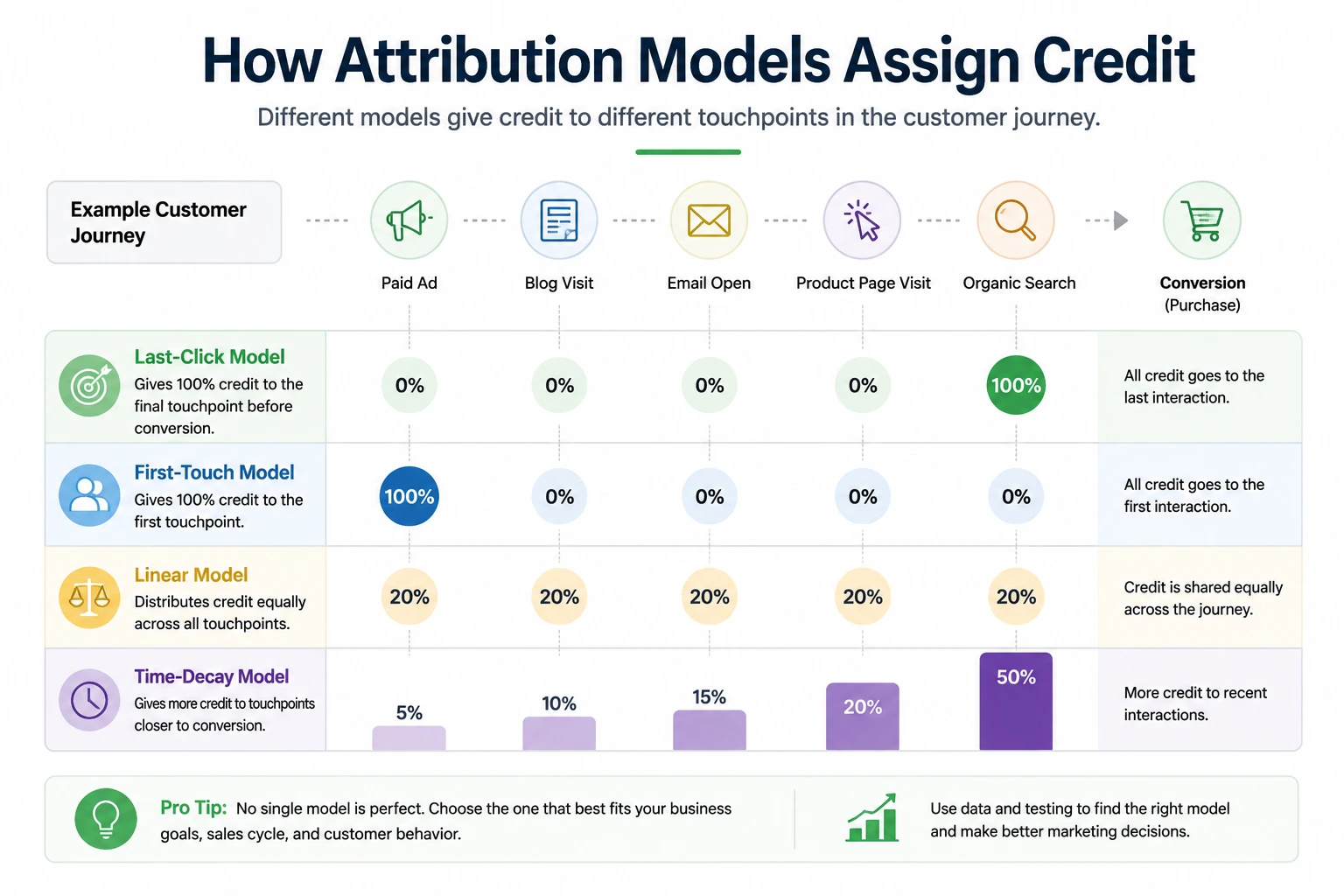
Now you need to connect revenue back to what actually brought it in.
The tricky part is attribution. The model you use can change your ROI quite a bit, so this isn’t something to gloss over.
Last-click is the simplest—gives all the credit to the final touchpoint before someone converts.
Easy to track, but it misses everything that happened before.
- First-touch flips that. It gives credit to the first channel that brought the person in. Useful if you’re trying to understand what’s driving initial interest.
- Linear spreads things out. Every touchpoint in the journey gets a share, so you’re not over-crediting just one.
- Time-decay leans towards what happened closer to conversion. The later interactions carry more weight.
- Position-based (U-shaped): credits first and last touches heavily, with the remainder distributed across the middle.
For most businesses, linear or position-based attribution gives the most balanced view of actual marketing contribution across multiple sessions and channels.
Step 4 — Apply the ROI Formula
With total cost and attributed revenue confirmed, apply the formula directly:
| 🔢 Worked Example |
| Total Marketing Cost: $8,000 |
| Revenue Attributed to Marketing: $32,000 |
| ROI = ((32,000 − 8,000) ÷ 8,000) × 100 = 300% |
| Every $1 spent returned $4 in revenue — $3 net profit per dollar invested. |
Step 5 — Break Down ROI by Channel
Blended ROI tells you whether marketing is working overall. Channel-level ROI tells you specifically where to invest more and where to pull back. Always run both calculations — they answer different questions.
This five-step approach applies whether you are running paid media,content, email or opt for organic SEO services, — and forms the backbone of how performance-led agencies track return on marketing investment.
How to Track ROI by Marketing Channel
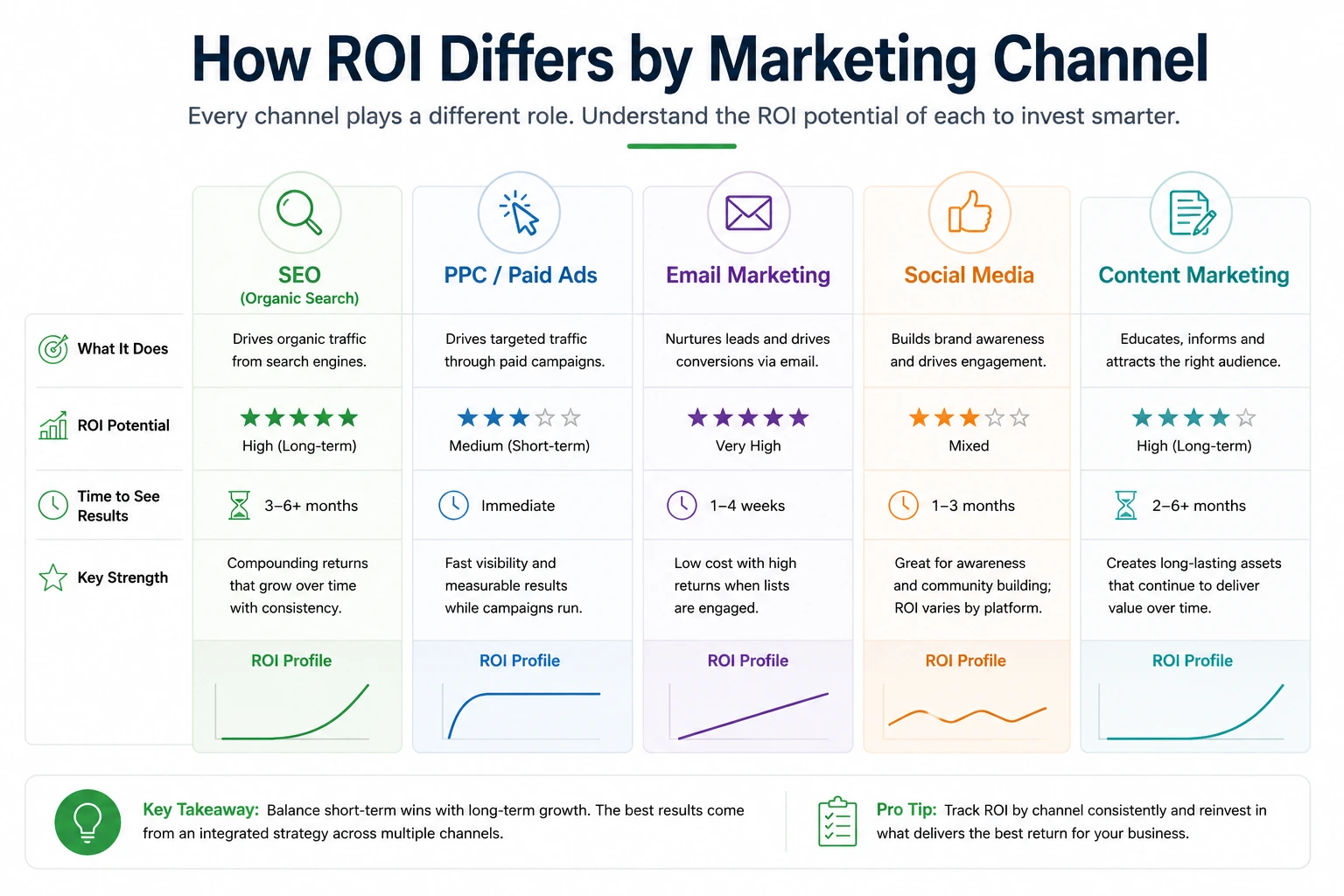
Different channels have different measurement requirements, attribution windows, and cost structures. Let’s break this down channel by channel so you can actually see what’s working and what’s not.
SEO ROI
SEO takes time. Months, not days. A lot of what shows up now is from work done earlier. And just looking at traffic won’t tell you much.Organic traffic builds slowly, and what you see today often comes from work done months back.
So when you’re tracking it, don’t just look at traffic. Pay attention to keyword conversions, assisted revenue, and what you’re spending to create and maintain content.
Costs aren’t just writing either. There’s publishing, technical fixes, link-building, and all the ongoing optimisation that keeps things moving.
To see what SEO is really bringing in, you have to connect a few things—Search Console, GA4, your CRM. That’s when it starts to click.
And if you’re in B2B, a short window won’t cut it. Thirty days is almost never enough to understand what’s happening with organic.
PPC (Pay-Per-Click) ROI
PPC offers the most direct attribution of any digital channel — but only when conversion tracking is properly configured before campaigns launch.
- Keep an eye on cost per click, conversion rate, cost per acquisition—plus the revenue per conversion.
- Include: ad spend plus management or agency fees in total cost
- Watch ROAS alongside ROI — high ROAS with thin margins can still produce a negative ROI
PPC is often one of the first channels industries that benefit most from digital marketing priorities because the attribution is clean and the feedback loop is short.
Email Marketing ROI
Email usually ends up giving solid returns. Costs per send are low compared to most other channels, so even small wins add up.
What to look at—open rates, clicks, conversions… and what each email actually brings in.
Costs aren’t just the tool. You’ve got the platform (Mailchimp, Klaviyo, whatever you’re using), plus copy, design, and list management.
Also—use UTM links in your emails. Otherwise, it’s hard to tell what revenue is actually coming from them in GA4.
Social Media ROI
Organic social is tough to tie straight to revenue. It plays a role, but it’s not always direct. Paid social is easier to measure—but only if your tracking is set up properly.
For paid campaigns, you’ll need the platform pixel or CAPI with server-side tracking in place. That’s what lets you see conversions clearly.
With organic, it’s different. Use UTM links and look at assisted conversions in GA4 to understand how it’s contributing.
On the cost side, don’t just think about ads. Content creation, time spent managing accounts, and any influencer or creator fees all count.
And one thing that’s easy to overlook—UTM tracking at the campaign level. Without that, it’s hard to connect social activity back to revenue across sessions and devices. (Source: UTM.io).
Content Marketing ROI
Content doesn’t pay off straight away. It takes time—sometimes six months, sometimes closer to a year, especially with evergreen content. And when you look at performance, traffic alone won’t tell you much.Look at which pieces are bringing in leads and where they’re helping in the journey, even if they’re not the final touchpoint.
And on the cost side, it’s more than just writing. There’s design, promotion, distribution, and the ongoing updates that keep content relevant.
Include: writing, design, promotion, distribution, and update cycles in cost
Use multi-session attribution to capture readers who convert weeks after first reading
For e-commerce brands, content that supports product discovery directly influences revenue — making e-commerce website development with strong on-site content a significant ROI lever.
Web Design and Landing Page ROI
Every campaign that drives traffic to a landing page is partially dependent on that page’s conversion rate.
If a page isn’t converting, everything feeding into it suffers.
Look at conversion rate, bounce rate, time on page, scroll depth—see where people drop off.
Then try a few changes. Headline, CTA, form, layout. See what actually moves.
Whether you use WordPress website development or a custom build, page performance is a direct input into campaign ROI and should be reviewed alongside spend data.
How to Measure ROI in B2B Digital Marketing Campaigns
Measuring ROI in B2B digital marketing campaigns works differently from B2C. Sales cycles usually run anywhere from 30 to 180+ days, there are multiple stakeholders involved at different stages, and most deals don’t close after the first interaction.
Standard revenue ROI is often premature in B2B contexts. Pipeline ROI gives leadership a meaningful interim view while deals are still in progress.
B2B Pipeline ROI
| 📊 Key B2B ROI Metrics |
| MQL (Marketing Qualified Lead): a lead that fits your scoring criteria |
| SQL (Sales Qualified Lead): a lead the sales team has picked up and is working on |
| Opportunity Influenced: deals in the pipeline where marketing had some touchpoint |
| Closed-Won Revenue: revenue from deals linked (fully or partly) to marketing |
| Pipeline ROI = (Pipeline Value × Win Rate × Avg Deal Size − Marketing Cost) ÷ Marketing Cost × 100 |
For businesses with long sales cycles — such as those investing in manufacturing digital marketing or real estate digital marketing — measuring pipeline influence at each funnel stage gives a usable ROI picture long before deals close.
Attribution in B2B: Which Model to Use
| Attribution Model | Best Used For |
| First-touch | Top-of-funnel campaigns (brand awareness, content, SEO) |
| Last-touch | Direct-response campaigns (PPC, retargeting) |
| Linear | Long-cycle accounts with multiple campaign touchpoints |
| Time-decay | Nurture campaigns where recent touches are what close deals |
| Position-based | Balanced view of acquisition and conversion touchpoints |
For B2B demand generation teams, position-based attribution tends to reflect actual buying behaviour more accurately than single-touch models (Source: Adobe Business).
What Is a Good Digital Marketing ROI?
There is no universal benchmark. Good ROI depends on your margins, sales cycle length, customer lifetime value, and the cost of capital your business carries. That said, these are commonly referenced reference points:
- A 5:1 ratio (500%) is widely referenced as a benchmark for healthy marketing performance
- A ratio below 2:1 (200%) often indicates that costs are too high or conversion rates are too low to justify the channel at current investment levels
- A ratio above 10:1 (1000%) typically signals exceptional efficiency — or an attribution gap worth investigating
The more useful question is whether ROI is improving over time and whether higher-ROI channels are receiving proportionally more budget each cycle.
Which Tools Help You Track Return on Marketing Investment?
Web Analytics
- Google Analytics 4 (GA4): conversion tracking, assisted revenue, multi-channel funnel reporting
- Google Search Console: organic keyword performance and click-to-conversion data
- Adobe Analytics: enterprise attribution and advanced segmentation
CRM and Marketing Automation
- Salesforce: closed-loop revenue attribution from lead through to deal close
- HubSpot: campaign ROI dashboards and pipeline revenue tracking
- Marketo: B2B lead scoring and multi-touch revenue attribution for long-cycle campaigns
CRM-based attribution closes the loop between marketing activity and actual revenue — a step that platform-level reporting alone cannot complete.
Campaign Tracking Tools
- UTM parameters: mandatory for accurate source, medium, and campaign attribution in GA4
- Call tracking (e.g., CallRail): attributes inbound phone calls to specific campaigns
- Multi-touch attribution platforms (e.g., Rockerbox, Triple Whale): model-level revenue attribution across channels
Reporting and Dashboards
Reliable ROI reporting connects three data streams: ad spend from channel platforms (Google Ads, Meta, LinkedIn), lead and pipeline data from your CRM, and revenue from your billing system or e-commerce platform.
Tools like Looker Studio, Super metrics, and HubSpot Dashboards can unify these sources into a single ROI view without requiring manual reconciliation each reporting cycle.
For e-commerce brands, connecting e-commerce website development data directly to analytics and CRM systems eliminates reporting gaps that distort ROI calculations.
Common Mistakes When Measuring Marketing ROI
1. Ignoring hidden costs
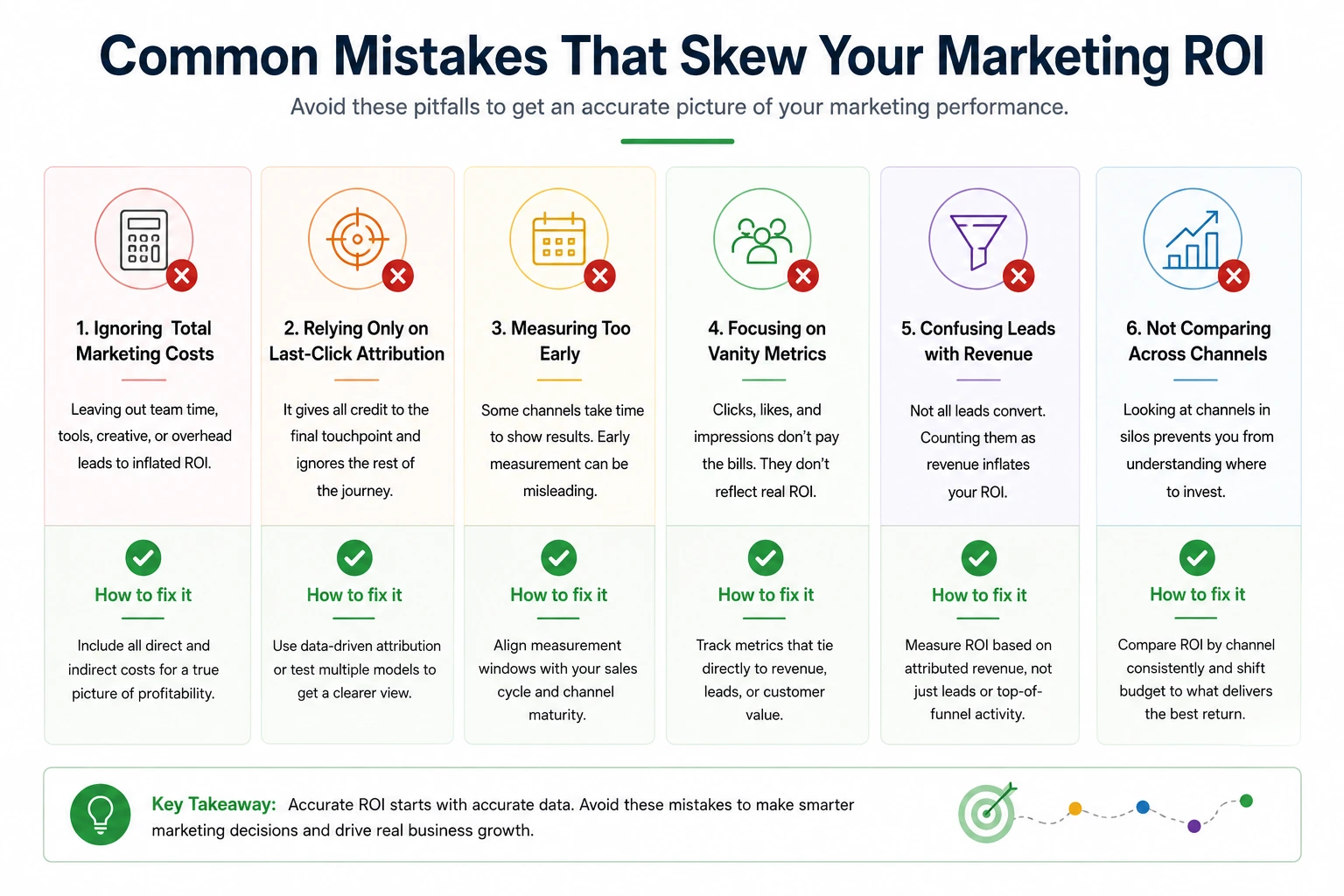
Easy one to miss. People look at ad spend and assume that’s the full picture. It’s not. There’s team time, tools, content, design—none of that is free. Leave those out and ROI looks better than it actually is.
2. Relying on last-click too much
Last-click attribution systematically undervalues top-of-funnel channels like organic SEO services and content. It makes upper-funnel campaigns look unprofitable even when they are driving the majority of qualified demand.
3. Checking results too early
This happens a lot. Campaign runs for a few weeks and expectations kick in. Realistically, that’s too soon. You’re not seeing a pattern yet. Especially in B2B, it can take a couple of months before the data starts making sense.
4. Treating leads like revenue
Leads are useful, but they’re not the end goal. Some convert, some don’t. If you’re only counting leads and not what turns into actual revenue, you’re only seeing part of what’s going on.
5. Mixing Channel ROI with Blended ROI
Blended ROI hides channel-level problems. A high-performing email programme can mask a loss-making paid social campaign within the same blended number. Always calculate at both levels.
6. Relying on Vanity Metrics
Impressions, follower counts, and click-through rates are directional signals — not financial outcomes. Reporting them in place of revenue-linked metrics gives leadership an incomplete and potentially misleading view of performance.
How to Improve Digital Marketing ROI
Reallocate Budget to High-Efficiency Channels
Use channel-level ROI data to shift budget toward your best-performing channels each quarter. Even a 10–15% reallocation compounded over four quarters can materially improve blended ROI.
If your digital marketing strategies for small businesses are spreading budget too thinly across channels, consolidating into two or three high-ROI channels is often more effective than maintaining broad but shallow coverage.
Improve Landing Page Conversion Rates
Higher conversion rates lower your effective cost per acquisition and increase ROI without requiring any change to spend levels. Test headlines, CTAs, and form length continuously.
Whether built on WordPress website development or a custom platform, your landing pages are a direct multiplier on campaign ROI — a 2× improvement in conversion rate effectively doubles the return from the same ad spend.
Tighten Audience Targeting and Segmentation
Narrower, better-matched audiences typically convert at lower cost. Lookalike audiences, intent-based targeting, and account-based marketing all improve signal quality and reduce wasted spend.
For niche verticals — such as construction digital marketing or real estate digital marketing — precise audience targeting is often the single most impactful lever for improving campaign ROI.
Increase Customer Lifetime Value
ROI improves when customers spend more over their lifetime. Onboarding improvements, upsell sequences, and retention program increase CLV without raising acquisition cost — effectively making every past acquisition more valuable retroactively.
Run A/B Tests and Regular Attribution Reviews
Test one variable at a time across campaigns and review attribution models quarterly. Stale attribution assumptions are one of the most common causes of budget misallocation in growing marketing teams.
Actionable Checklist for Measuring Digital Marketing ROI
Use this checklist to standardize how your team sets up, tracks, and reviews ROI across every campaign.
Pre-Campaign Checklist
- Define the campaign goal and primary KPI (revenue, pipeline, leads, traffic)
- Set the attribution window based on your actual sales cycle length
- Tag all campaign URLs with UTM parameters (source / medium / campaign)
- Configure conversion tracking in GA4 and your CRM before launch
- Confirm the single source of truth for revenue reporting and establish the baseline
In-Campaign Checklist
- Monitor spend pacing and cost-per-conversion on a weekly cadence
- Validate lead quality with the sales team — not just volume
- Review assisted conversions across all active touchpoints
- Compare channel performance against targets and adjust bids or budgets accordingly
Post-Campaign Checklist
- Calculate total cost including all categories: spend, labor, software, creative
- Pull attributed revenue from CRM against the campaign period
- Apply the ROI formula and compare against baseline and previous campaigns
- Document learnings and tag decisions in your campaign log for future reference
- Decide: scale the channel, optimize targeting, or reallocate budget
Conclusion
Knowing how to measure digital marketing ROI correctly is not just a reporting task — it is the operational foundation of every smart budget decision. When you know which channels generate real profit, you can grow what works and eliminate what does not.
The framework in this guide covers the formula, full cost accounting, attribution models, channel-level measurement, B2B pipeline ROI, the tools that support it, and the mistakes that consistently distort results.
If your business is investing in B2B SEO, paid media, content, or any other digital channel, the measurement approach you put in place today will determine whether your budget decisions next quarter are guided by data or by guesswork.
For a broader look at how measurement fits into a full digital marketing strategy, explore our guide on full-service digital marketing and what to expect from a performance-led agency partnership.
Frequently Asked Questions
-
How do you measure digital marketing ROI?
Ans.Measure digital marketing ROI by subtracting total marketing cost from attributed revenue, dividing by total cost, and multiplying by 100. Reliable measurement also requires defined attribution windows, complete cost accounting across all cost categories, and a confirmed source of revenue data. -
What is the formula for marketing ROI?
Ans.The formula is: ((Revenue attributed to marketing − Marketing cost) ÷ Marketing cost) × 100. When evaluating SEO or content campaigns, subtract the organic baseline from revenue before applying the formula to isolate the true incremental impact of your marketing effort. -
What is a good digital marketing ROI?
Ans.A 5:1 ratio — five dollars in revenue for every dollar spent — is a commonly referenced benchmark for healthy marketing performance. Below 2:1 generally signals that the channel needs optimization or is not viable at current costs. What counts as 'good' ultimately depends on your margins, customer lifetime value, and sales cycle length. -
How do you measure ROI in B2B digital marketing campaigns?
Ans.Use pipeline ROI rather than immediate revenue ROI for B2B campaigns. Track MQLs, SQLs, pipeline influenced, and closed-won revenue. For long sales cycles, measure cost per qualified opportunity and pipeline-to-spend ratio as interim indicators before final revenue closes. -
What tools help track return on marketing investment?
Ans.Most teams use GA4 for web attribution, a CRM (Salesforce or HubSpot) for pipeline and revenue data, UTM parameters for campaign-level tracking, and a dashboard to unify all data sources. Multi-touch attribution platforms add model-level revenue attribution for more complex, multi-channel buying journeys. -
What is the difference between ROI and ROAS?
Ans.ROI measures profit after all marketing costs, expressed as a percentage. ROAS measures revenue generated per dollar of ad spend only, expressed as a ratio. ROI gives a complete financial view; ROAS is useful for optimising individual ad campaigns within a single channel. -
Can you measure ROI for SEO and content marketing?
Ans.Yes — but you need longer attribution windows (typically 6–12 months) and should include assisted conversions alongside direct revenue. Include content production cost, internal labour, and link-building in your total cost calculation. Organic ROI compounds over time and typically increases as content matures and earns authority.
Author Details

Latest Posts
-
 29 / Jul
Search Engine Optimization 6 Enterprise SEO Mistakes That Quietly Cost You Millions
29 / Jul
Search Engine Optimization 6 Enterprise SEO Mistakes That Quietly Cost You Millions -
 24 / Jul
-
 23 / Jul
Search Engine Optimization How to Improve Organic SEO: A Practical 2026 Guide
23 / Jul
Search Engine Optimization How to Improve Organic SEO: A Practical 2026 Guide -
21 / Jul
Search Engine Optimization Organic SEO vs Paid SEO: Which Is Better in 2026?
-
18 / Jul


Blogs
Journey into Ideas Unveiling Tomorrow's Insights Today.














-
How do you measure digital marketing ROI?
Ans.Measure digital marketing ROI by subtracting total marketing cost from attributed revenue, dividing by total cost, and multiplying by 100. Reliable measurement also requires defined attribution windows, complete cost accounting across all cost categories, and a confirmed source of revenue data. -
What is the formula for marketing ROI?
Ans.The formula is: ((Revenue attributed to marketing − Marketing cost) ÷ Marketing cost) × 100. When evaluating SEO or content campaigns, subtract the organic baseline from revenue before applying the formula to isolate the true incremental impact of your marketing effort. -
What is a good digital marketing ROI?
Ans.A 5:1 ratio — five dollars in revenue for every dollar spent — is a commonly referenced benchmark for healthy marketing performance. Below 2:1 generally signals that the channel needs optimization or is not viable at current costs. What counts as 'good' ultimately depends on your margins, customer lifetime value, and sales cycle length. -
How do you measure ROI in B2B digital marketing campaigns?
Ans.Use pipeline ROI rather than immediate revenue ROI for B2B campaigns. Track MQLs, SQLs, pipeline influenced, and closed-won revenue. For long sales cycles, measure cost per qualified opportunity and pipeline-to-spend ratio as interim indicators before final revenue closes. -
What tools help track return on marketing investment?
Ans.Most teams use GA4 for web attribution, a CRM (Salesforce or HubSpot) for pipeline and revenue data, UTM parameters for campaign-level tracking, and a dashboard to unify all data sources. Multi-touch attribution platforms add model-level revenue attribution for more complex, multi-channel buying journeys. -
What is the difference between ROI and ROAS?
Ans.ROI measures profit after all marketing costs, expressed as a percentage. ROAS measures revenue generated per dollar of ad spend only, expressed as a ratio. ROI gives a complete financial view; ROAS is useful for optimising individual ad campaigns within a single channel. -
Can you measure ROI for SEO and content marketing?
Ans.Yes — but you need longer attribution windows (typically 6–12 months) and should include assisted conversions alongside direct revenue. Include content production cost, internal labour, and link-building in your total cost calculation. Organic ROI compounds over time and typically increases as content matures and earns authority.