


Digital Marketing for Ecommerce Brands: The 2027 Growth Playbook

-
Author
Anindita Barik
-
Updated Date
Oct-09-2026
-
Views
2 Min Read
-
Author: PromotEdge Digital
-
Updated Date: Oct-09-2026
-
Views: 2 Min Read
-
Author: Anindita Barik
Digital marketing for ecommerce brands in 2027 requires a stronger focus on profitability, AI-driven discovery, and customer retention. This growth playbook explains how ecommerce businesses can improve contribution margins, prepare product catalogs for agentic commerce, optimize product pages for generative AI search, and scale native social commerce. It also covers first-party tracking, retail media, predictive replenishment, and customer lifetime value. Use the practical ecommerce growth scorecard to assess your marketing readiness, identify performance gaps, and prioritize strategies that support sustainable revenue growth.
Digital marketing for ecommerce brands in 2027 starts with one simple problem: margins are getting tighter, and shoppers are changing how they find products.
Level CFO’s ecommerce benchmarks put a realistic DTC contribution margin at 15% to 20%. Paid customer acquisition can take 20% to 40% of first-order revenue. That means ecommerce brands cannot rely on paid traffic alone. They need better ways to attract, convert, and retain customers.
There is another change you need to watch. Google search is adopting new ways. People do not always need to click a website to find products and answers. The AI overview and the Google Shopping (GMC) feature does it for them.
A Similarweb study cited by Search Engine Roundtable found that Google’s zero-click news searches grew from 56% to 69% during the year following the launch of AI Overviews. This indicates that more users now get their answer on Google, instead of visiting another website.
So, if your ecommerce SEO still revolves around getting a blue-link ranking, it’s worth looking beyond that. Start by learning how zero-click SEO works and also focus on organic shopping.
In this guide, we will go step by step through what ecommerce brands need to prepare for in 2027. We will look at AI-ready product catalogs, AI search, social commerce, customer retention, and a simple scorecard you can use to check how ready your brand is.
Why Digital Marketing for Ecommerce Brands Is Breaking in 2027
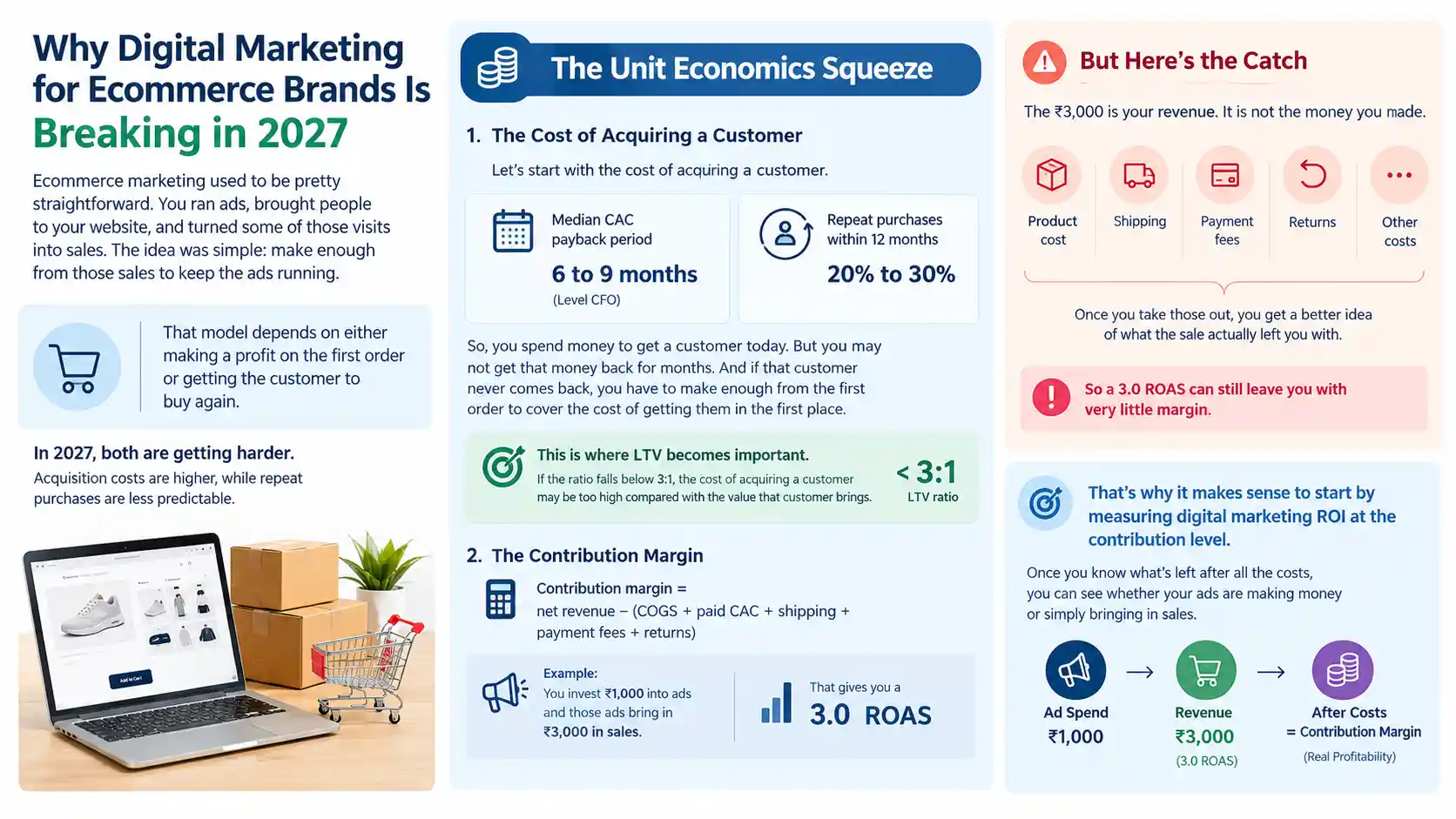
Ecommerce marketing used to be pretty straightforward. You ran ads, brought people to your website, and turned some of those visits into sales. The idea was simple: make enough from those sales to keep the ads running.
That model depends on either making a profit on the first order or getting the customer to buy again.
In 2027, both are getting harder. Acquisition costs are higher, while repeat purchases are less predictable.
The Unit Economics Squeeze
Let’s start with the cost of acquiring a customer.
Level CFO says the median CAC payback is 6 to 9 months. Repeat purchases sit at 20% to 30% within 12 months.
So, you spend money to get a customer today. But you may not get that money back for months. And if that customer never comes back, you have to make enough from the first order to cover the cost of getting them in the first place.
This is where LTV becomes important. If the ratio falls below 3:1, the cost of acquiring a customer may be too high compared with the value that customer brings.
Now look at the contribution margin.
Contribution margin = net revenue − (COGS + paid CAC + shipping + payment fees + returns)
For instance, you invest ₹1,000 into ads and those ads bring in ₹3,000 in sales. That gives you a 3.0 ROAS.
Now, here’s where you need to be careful. The ₹3,000 is your revenue. It is not the money you made.
You still have the product cost, shipping, payment fees, returns, and other costs tied to that order. Once you take those out, you get a better idea of what the sale actually left you with.
So a 3.0 ROAS can still leave you with very little margin.
That’s why it makes sense to start by measuring digital marketing ROI at the contribution level.
Once you know what’s left after all the costs, you can see whether your ads are making money or simply bringing in sales.
Decoupled discovery
Here’s what’s different now. Say you’re looking for a new product. You don’t have to open ten different websites to compare your options. You can ask ChatGPT, Gemini, or Perplexity, and get a few products based on their price, specs, and availability.
Engineering your catalog for agentic commerce
Agentic commerce is when software helps someone find and buy a product. So your product data needs to be clear enough for these systems to understand and use. Two protocols help decide whether your products can show up.
UCP vs ACP
Shopify and Google developed the Universal Commerce Protocol (UCP) with support from Etsy, Target, Walmart, and Wayfair. According to Shopify Engineering, the protocol lets merchants publish a profile at /.well-known/ucp so systems can see what their store supports.
ACP, or the Agentic Commerce Protocol, comes from Stripe and OpenAI. According to Stripe’s announcement, it uses Shared Payment Tokens. These tokens can be limited by time or amount and can also be revoked, so the agent does not need to see the shopper’s card details.
| UCP | ACP | |
|---|---|---|
| Backers | Google, Shopify | OpenAI, Stripe |
| Model | Open, merchant-hosted profile |
Platform-mediated checkout |
| Where it surfaces | Google AI Mode, Gemini | ChatGPT Instant Checkout |
| Merchant task | Publish /.well-known/ucp | Accept Shared Payment Tokens through the checkout API |
Google’s UCP documentation also explains how UCP works with AP2, A2A, and the Model Context Protocol (MCP).
If your store runs on Shopify, the platform takes care of much of this setup. Keep that in mind when you’re deciding between Shopify development and building your ecommerce stack from scratch.
Product data hygiene
This is where you need to get specific. An agent cannot do much with a line like “exceptionally durable winter boot.” Give it facts it can use. Say the boot works down to −20°F, the midsole lasts 500 miles, and each boot weighs 1.4 lb.
Here’s what your product pages should have:
- Schema.org Product, Offer, AggregateRating, and MerchantReturnPolicy on every PDP
- GTINs that match the products in your Merchant Center feed
- Inventory updates through webhooks instead of one update each night
- Product specs listed as attributes instead of sitting inside long paragraphs
A clean ecommerce website design also makes this information easier to manage as your catalog gets bigger.
Generative engine optimization for product discovery
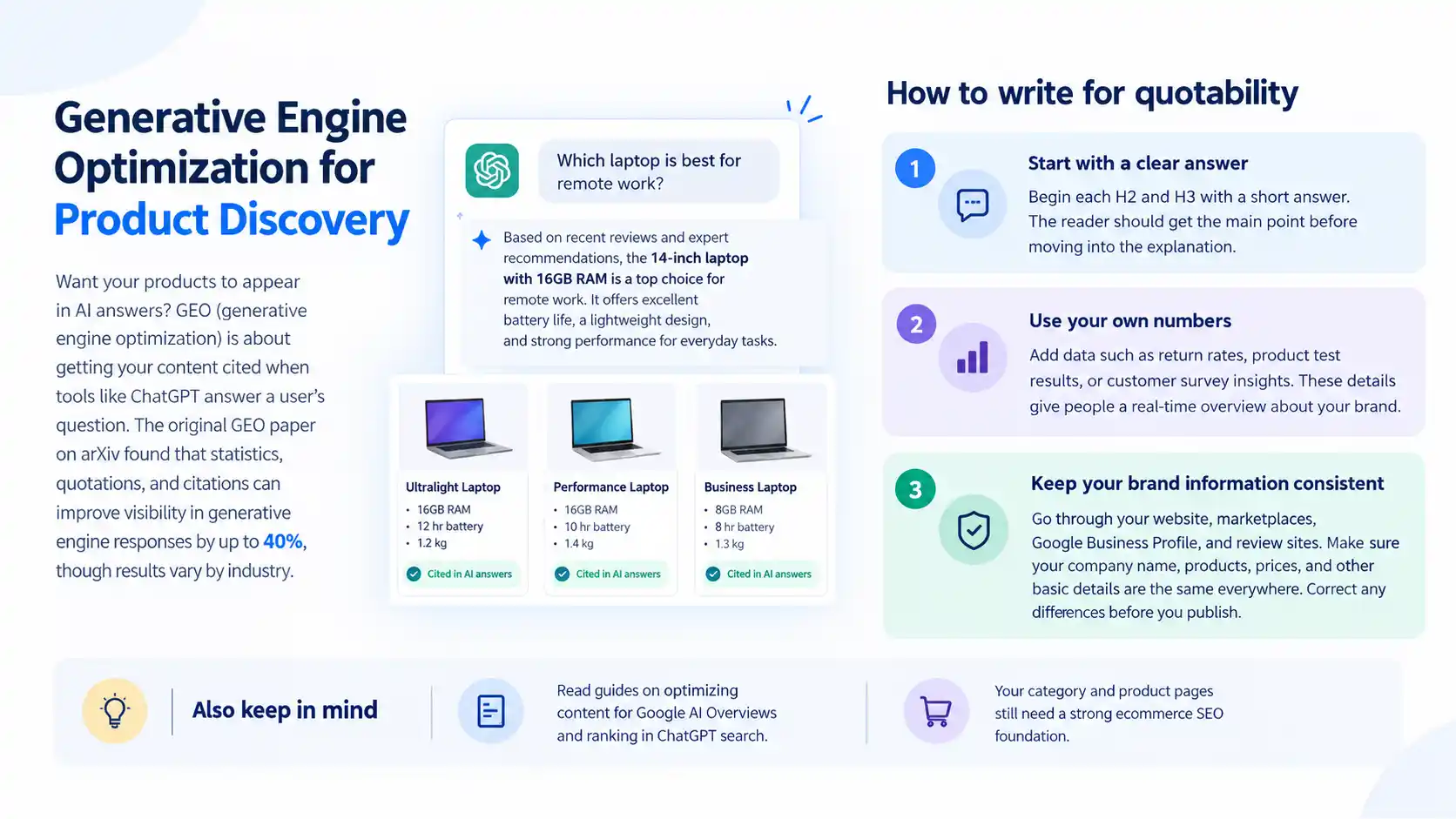
So, what should you do if you want your products to appear in AI answers? GEO, or generative engine optimization, is about getting your content cited when tools such as ChatGPT answer a user’s question. The original GEO paper on arXiv found that statistics, quotations, and citations can improve visibility in generative engine responses by up to 40%, although results vary by industry.
Here comes the part to focus on. AI systems break pages into smaller sections when they retrieve information. Each section should make sense on its own, clearly name the product or topic, and include a useful fact or number.
How to write for quotability
Start each H2 and H3 with a short answer. The reader should get the main point before moving into the explanation.
Next, add some numbers from your own business. If you know your return rate by size, have product test results, or have customer survey data, use it. These details give people a real-time overview about your brand.
Then check your brand information. Go through your website, marketplaces, Google Business Profile, and review sites. See if your company name, products, prices, and other basic details are the same on every platform. If you spot a difference, correct it before you publish anything else.
You can also read these guides on optimizing content for Google AI Overviews and ranking in ChatGPT search. Your category and product pages still need a strong ecommerce SEO foundation.
Scaling native social commerce
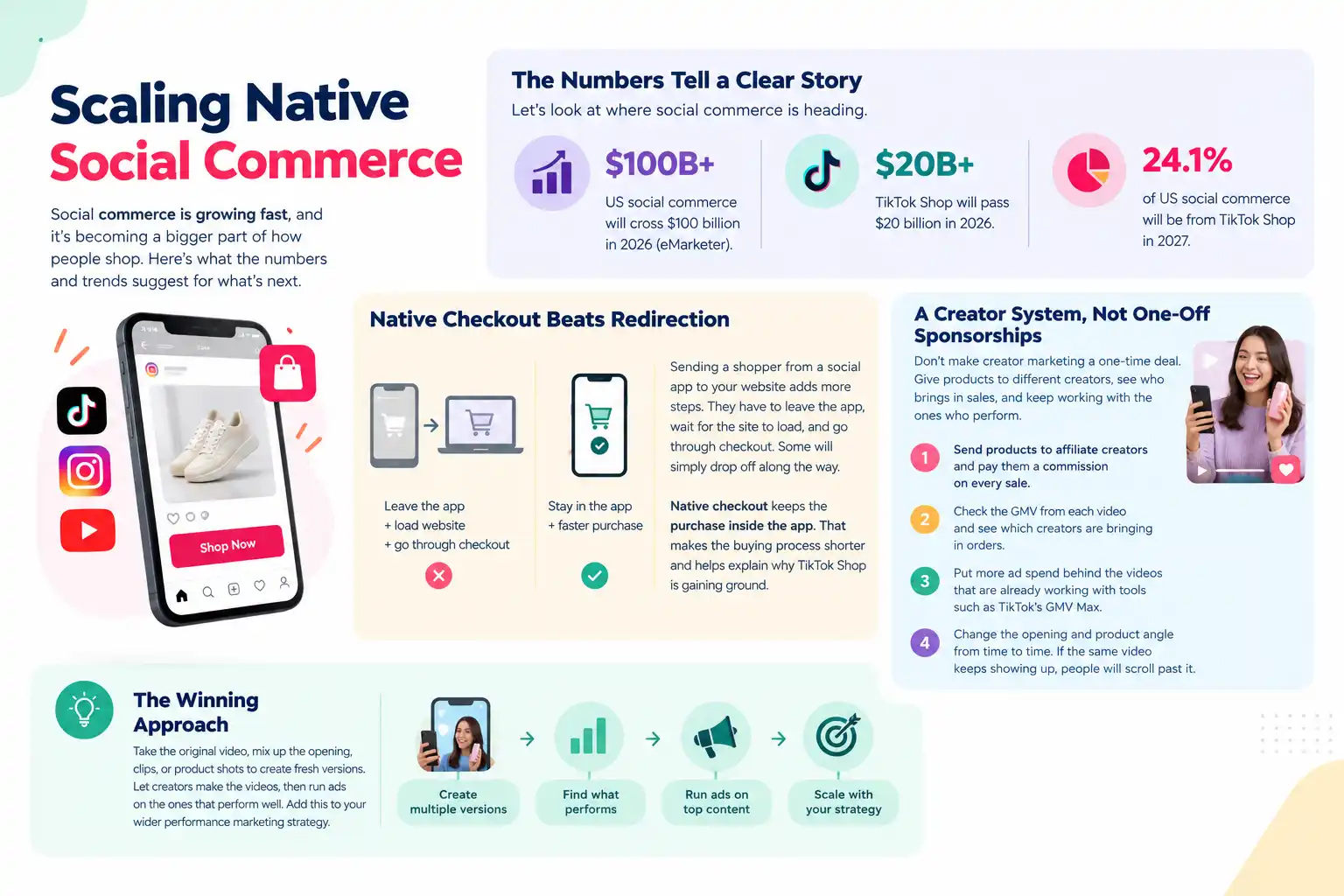
Let’s look at where social commerce is heading. eMarketer projects US social commerce will cross $100 billion in 2026, with TikTok Shop passing $20 billion and reaching 24.1% of US social commerce in 2027.
Native checkout beats redirection
Sending a shopper from a social app to your website adds more steps. They have to leave the app, wait for the site to load, and go through checkout. Some will simply drop off along the way.
Native checkout keeps the purchase inside the app. That makes the buying process shorter and helps explain why TikTok Shop is gaining ground.
A creator system, not one-off sponsorships
Don’t make creator marketing a one-time deal. Give products to different creators, see who brings in sales, and keep working with the ones who perform.
- Send products to affiliate creators and pay them a commission on every sale.
- Check the GMV from each video and see which creators are bringing in orders.
- Put more ad spend behind the videos that are already working with tools such as TikTok’s GMV Max.
- Change the opening and product angle from time to time. If the same video keeps showing up, people will eventually scroll past it.
Take the original video and change the opening, clips, or product shots to make a few new versions. Let creators make the videos, then run ads on the ones that perform well. Add this to your wider performance marketing strategy.
First-Party Retention Systems That Protect Margin
If the first order barely covers what you spent to get the customer, the next orders become more important. That is where you can make back more of the acquisition cost and improve your margin.
The first step is to get your customer data in order. Then use that data to bring customers back instead of relying on bigger discounts.
Server-Side Tracking and Identity
Browser tracking does not always capture every conversion. Ad blockers can stop tracking pixels, while Safari’s privacy settings can limit what the browser sends.
Server-side tracking sends conversion data from your server to Meta, Google, and TikTok. It gives these platforms another way to record conversions that browser tracking may miss.
This helps ad platforms receive conversion data that the browser may have missed.
The next step is to match that data to the right customer.
You can use hashed email addresses, phone numbers, or login details to identify the same customer across different interactions. This process is called deterministic identity resolution. It helps bring separate customer actions into one profile.
You can also collect information that customers share through quizzes, surveys, signup forms, and onboarding questions. This is known as zero-party data.
Once you have this data, group customers by their lifetime value (LTV). You can then send these customer value groups back to your advertising platforms.
This gives your campaigns more information about the customers who generate the most value. It can also help platforms find new audiences with similar characteristics.
The key is data quality. If conversion events or customer profiles contain errors, the results will not give you a reliable view of campaign performance.
That is why measuring marketing results with reliable data starts with getting your tracking and customer data right.
Retail Media and Clean Rooms
eMarketer estimates that US retail media ad spending will be close to $70 billion in 2026. Amazon Ads, Walmart Connect, and Target Roundel let advertisers use purchase data from their retail platforms.
A data clean room gives you a way to compare your customer list with retailer data without seeing the customer’s personal information. You can use this to find customers who have already purchased.
Say someone bought your product last week. Add that customer to your exclusion list before you run the next campaign. Your ads will then go to people who have not purchased instead of spending money on another ad for an existing customer.
Retention Without Heavy Discounting
If you keep running sitewide discounts, customers can learn to wait for the next offer. Two options can bring customers back without cutting the price each time.
Predictive replenishment uses the customer’s buying pattern to decide when to send a reminder. Tools such as Klaviyo and Attentive can help with this. If someone buys a 60-day supply of supplements, you can send a reminder around day 52 and keep the product at its regular price.
Recommerce trade-ins work well for products that last longer. A customer returns an old product and gets store credit. You can then refurbish the returned item and sell it to someone else at a lower price.
| Model | Margin effect | Repeat driver |
|---|---|---|
| Sitewide discount cycles | Lower margin on every order | Price |
| Predictive replenishment | Full-price repeat orders | Timing |
| Recommerce trade-in | Store credit and resale margin | Store credit |
The 2027 Ecommerce Growth Scorecard
Now, check where your ecommerce business stands. Give each area a score from 0 to 3. A score of 0 means it is not in place. A score of 3 means it is running and you are tracking the results.
Anything below 2 should become a priority for the next quarter.
| Capability | What “3” looks like |
|---|---|
| Agentic readiness | Valid UCP profile, ACP-ready checkout, clean GTINs |
| Generative search visibility | Clear entities, complete schema, original data cited by AI tools |
| Native social commerce | Affiliate creator roster, GMV-based paid scaling |
| First-party tracking | Server-side CAPI live, deterministic identity graph |
| Unit economics | Contribution margin tracked monthly, LTV at 3:1 or better |
| Retention infrastructure | Replenishment flows, trade-in program, discount frequency capped |
If you need help with the search side of this audit, this guide to ecommerce SEO agencies in the USA compares how different specialists approach ecommerce SEO.
Conclusion
You do not have to do everything at once. Start with your margins and tracking. Make sure you know what each sale costs you and where your conversions are coming from.
Next, check your product listings. Make sure Google, ChatGPT, and marketplaces have the right product details. Once that is done, look at social selling and ways to bring customers back.
FAQs
-
What is the biggest change in ecommerce digital marketing for 2027?
Ans.AI tools are starting to help people shop. UCP and ACP let tools such as Gemini and ChatGPT read product information and support checkout. This makes clean product data more important for ecommerce brands. -
What is a healthy LTV ratio for a DTC ecommerce brand?
Ans.A 3:1 ratio is a good target. Level CFO puts the healthy range around 2.5:1 to 3.5:1. A ratio above 5:1 can also mean the brand could spend more to bring in new customers. -
Do ecommerce brands need to set up UCP?
Ans.It is worth considering if you want your products to appear in Google’s AI shopping results. Shopify handles much of the setup. Custom ecommerce sites need to publish a UCP profile and provide the required checkout information. -
How is GEO different from traditional SEO?
Ans.SEO is about getting your page to show up in search and getting people to click it. GEO is about getting your content mentioned or cited in an AI answer. Clear writing, useful facts, and good sources can help with this. -
Is TikTok Shop worth it for ecommerce brands in 2027?
Ans.It can be a good option if your products are easy to sell through video. eMarketer expects TikTok Shop to pass $20 billion in US sales in 2026 and reach 24.1% of US social commerce in 2027. -
How can ecommerce brands improve retention without discounts?
Ans.Send customers a reminder when they are likely to need the product again. You can also offer trade-ins on products that last longer. Customers return an old product, get store credit, and use it on their next purchase.
Author Details

Latest Posts
-
22 / Sep
Digital Marketing Digital Marketing for Ecommerce Brands: The 2027 Growth Playbook
-
 15 / Sep
-
 04 / Sep
-
 29 / Jul
Search Engine Optimization 6 Enterprise SEO Mistakes That Quietly Cost You Millions
29 / Jul
Search Engine Optimization 6 Enterprise SEO Mistakes That Quietly Cost You Millions -
 24 / Jul
Blogs
Journey into Ideas Unveiling Tomorrow's Insights Today.
















-
What is the biggest change in ecommerce digital marketing for 2027?
Ans.AI tools are starting to help people shop. UCP and ACP let tools such as Gemini and ChatGPT read product information and support checkout. This makes clean product data more important for ecommerce brands. -
What is a healthy LTV ratio for a DTC ecommerce brand?
Ans.A 3:1 ratio is a good target. Level CFO puts the healthy range around 2.5:1 to 3.5:1. A ratio above 5:1 can also mean the brand could spend more to bring in new customers. -
Do ecommerce brands need to set up UCP?
Ans.It is worth considering if you want your products to appear in Google’s AI shopping results. Shopify handles much of the setup. Custom ecommerce sites need to publish a UCP profile and provide the required checkout information. -
How is GEO different from traditional SEO?
Ans.SEO is about getting your page to show up in search and getting people to click it. GEO is about getting your content mentioned or cited in an AI answer. Clear writing, useful facts, and good sources can help with this. -
Is TikTok Shop worth it for ecommerce brands in 2027?
Ans.It can be a good option if your products are easy to sell through video. eMarketer expects TikTok Shop to pass $20 billion in US sales in 2026 and reach 24.1% of US social commerce in 2027. -
How can ecommerce brands improve retention without discounts?
Ans.Send customers a reminder when they are likely to need the product again. You can also offer trade-ins on products that last longer. Customers return an old product, get store credit, and use it on their next purchase.